Explore 12 questions to determine whether your child may be Autistic

A young boy is in the foreground and has turned his head away from the woman sitting next to him.
May your child be autistic?

As professionals, when diagnosing young children with an Autistic Spectrum Condition, it is vital we work as a multi-disciplinary team, so you will likely see many professionals. This may include Educational Psychologist, Dietician, General Practitioner, Occupational Therapist, Paediatrician, Special Educational Needs Coordinator, Speech and Language Therapist and Social worker. Once the evidence is collated, then a diagnosis may be made.

You may be wondering what are some of the early signs of social communication difficulties? Whilst no autistic child is the same and we know Autism is very much a very wide spectrum of abilities and needs there are some autistic spectrum characteristics we do typically see in the early years of childhood. You may wish to think about these areas or presentations to help you prepare for the Speech and Language Therapy appointment.

Twelve questions

  1. Does your child respond to their name?
  2. Are they fixated with watching their hands?
  3. Do they have sensory processing difficulties such as bright lights, food textures, or loud noises?
  4. Are they meeting their milestones or are they delayed?
  5. Do they flap their arms or legs when excited?
  6. Have you noticed any rocking back and forth?
  7. Do they blink excessively or display any facial tics?
  8. Do they play with a particular sort of toy e.g. spinning toys?
  9. Have you noticed that they lack interest in toys?
  10. Have they regressed in their language? Perhaps you’ve noticed they are not using words that they have previously learnt.
  11. Do they use gestures to communicate their needs? How do they communicate their wants and needs?
  12. Do they appear to be in their own world?

You are not alone

These questions are by no means exhaustive and there are many more factors to consider. But it is important to trust your instincts as you are the expert on your child and know your child the best. Regardless of whether you see all of the above points or none, do not hesitate to have an assessment if you are concerned as, even if it turns out to be nothing to worry about, there is always at least one or two great pieces of advice I can offer you on the way and you will leave feeling hopeful and empowered. It’s always best to seek early intervention with communication difficulties. This allows strategies and support to be put in place. Never feel alone, always speak out.

Find communication support here from me, Sonja, (Specialist Speech and Language Therapist)


Find a speech and language therapist for your child in London. Are you concerned about your child’s speech, feeding or communication skills and don’t know where to turn? Please contact me and we can discuss how I can help you or visit my services page.

Similar Posts

  • · ·

    How do we know our Gestalt Learner is moving to Stage 2?

    Image by Freepik

    Is our student ready to move to NLA 2 (Natural Language Acquisition stage 2)?

    We know that the GLP (Gestalt Language Processor) will move into the next stage when they are ready. But are they now ready you might think? When are they ready? How do I know? If you are not sure whether your child is ready to move forward then go and see your GLP trained Speech Therapist. Together you can work out what the next steps are and how to help your child settle into NLA 2. It’s very exciting!!

    Tip

    The first useful tip: keep a language sample of phrases your child says. This is very helpful!

    You might want to check with your Speech Therapist and offer some language sampling you have taken so they can help you figure out where your child is currently. Always keep an Utterance Journal that you can share with your Speech Therapist and with others who look after your child.

    Basically, we want to listen out for phrases our child says that you or nursery don’t say routinely; that way you can presume that this is not an echo but a mixing together of two chunks of gestalts. Watch out for those coco melon phrases though: double check it really isn’t an NLA 1 gestalt that is copied verbatim from a favourite you tube video.

    You can best support your child best by listening, and thus figuring out what your child is TRYING TO SAY. Often your child might skip over the parts of gestalts they don’t want to say. This is common in older kids who have long gestalts, sometimes even whole episodes or whole stories!

    Try and tease out their shorter mitigations and then focus on practicing and modelling those as they are so much more useful!

    So back to our question: are they ready?

    Are their gestalts covering a variety of situations and contexts?

    Make a note in your journal to see what the backgrounds are to each phrase you ear, so for example:

    • Transitioning: ‘it’s time for the park’ ‘what’s next’ ‘shoes on’
    • Bed Time: ‘we need to wash’ ‘let’s get in (bath/bed)’ ‘ready for our book’
    • Toilet/nappy: ‘we need the potty’ ‘where’s the potty’ ‘let’s wash hands’
    • Mealtime: ‘time to eat’ ‘go get a spoon’ ‘yummy num num’
    • Park/going out: ‘look at the squirrel’ ‘funny doggy’ ‘I wanna swing’
    • At the shops: ‘let’s get the trolley’ ‘lots of veggies’ ‘no tomatoes’ ‘ooh long queue’ ‘back to the car’

    And… does the child use the phrases for a variety of functions?

    • labelling
    • providing information
    • calling out
    • affirming
    • requesting
    • protesting
    • directing

    We need to offer lots of similar language models so that in their own time our children can extract/mitigate useful phrases for what they want to express. The more similar utterances a child hears around him the more he/she can discover the communalities. Once the child has a small range of phrases, he/she can mix them up and create semi-original own phrases.

    If the answer is YES!! our child has perhaps not all but a range of functions and a range of situations where they use a variety of easily mitigable gestalts then yes they are ready for moving to stage 2 of NLA!

    Hurrah!

    Keeping a journal of what your child is saying and in what circumstance is crucial to help with our ongoing detective work!

    Next time I will be looking at how we can help our NLA 2 GLP produce even more of their own mix and match phrases.

    If you need help with your child, please do not hesitate to contact me.


    Find a speech and language therapist for your child in London. Are you concerned about your child’s speech, feeding or communication skills and don’t know where to turn? Please contact me and we can discuss how I can help you or visit my services page.

    1
  • ·

    How to use Attention Autism to develop language and communication

    Now you’ve read Attention Autism (part one), you are familiar with the concept of ‘bucket time’ and the benefits it has to offer your child. It’s time to explore all the different stages. In sessions, it can be noisy and with so much to take in, you may want something to refer to. If you’re in need of a helping hand or memory jogger for stage two, read on…

    Knowing what stage your child is working at is vital. Every stage has different aims to develop and enhance functional communication. So being familiar with your child’s goals ensures you can continue to practise at home. If you’re unsure of their goals, please ask your Speech and Language Therapist.

    With all speech, language and communication goals, the aim is always to generalise skills from therapy settings to home and nursery or school life. This generalisation period will take time. Please try to stick with the plan. You will experience the benefits for your child, and it’ll make family life a little easier.

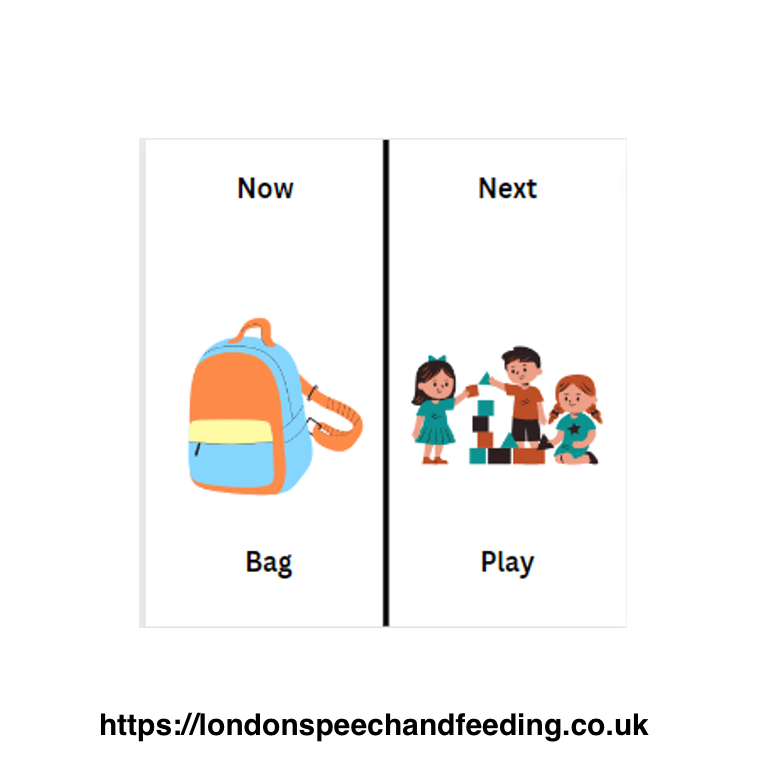
    You may remember that Autistic children thrive on visuals. Let’s use their strengths to support their communication needs. It is a good idea at the start of the activity to have a visual for what’s happening now and what will happen next. If you’re anything like me, you’ll grab a pen and paper or a whiteboard and whiteboard pen, and will doodle away! You don’t need fancy photos.

    On the left is a bag with Now written above it and Bag below. On the right are three children playing with Net written above and Play written below.

    The attention builder

    Stage two of the Attention Autism approach is called “the attention builder”. The clue is in the name, your child’s goal is to keep focused on the activity for a longer period. The duration will be different for every child, but it’s useful to time their attention, so you can report progress back to your therapist.

    Parents are often worried about doing something wrong. If it all goes a bit pear-shaped or not as you expected, don’t panic! This is the time to ask yourself, did my child have fun? Did they engage in the activity? It’s very helpful to reflect on the experience. What could you do that would make the activity easier for your child to access? (For example, did you set up the activity before your child entered the room? This would allow for a smoother session, so that waiting time was minimal.)

    Three ideas for stage two activities

    There are so many ideas out there, which at times can feel overwhelming. I’m always looking for the easiest options to present to you to reduce overwhelm and allow it to feel manageable.

    Remember this is about having fun. Your child’s communication will benefit from you relaxing and having this structured approach.

    Here are our three top ideas for stage two attention Autism activities:

    1. Flour castles

    You’ll need:

    • Container, cup or glass
    • Flour
    • Sheet (for the table/floor) (optional)

    This is a fun-filled activity to try. But it can get a little messy!

    Fill a small glass, cup or container with flour and flip the cup over to build flour castles. It’s great to engage your child especially with the “Splat” at the end.

    2. Paint balls

    Another activity which is a little bit cleaner is ‘Paint balls’.

    You’ll need:

    • Tray, container
    • Paint
    • Rubber balls or marbles
    • Paper (optional)

    First dip the marbles into the paint, then drop into the container and roll it around to make a pattern. You could always make a pattern on some paper.

    I love to use everyday objects in therapy, so when I came across this next idea, it was added to the list. It’s simple, effective, not to mention clean!

    3. Skittles

    You’ll need:

    • A packet of skittles
    • Warm water
    • Plate

    You’ll need to create a circle of skittles around the edge of the plate. Then add small amounts of warm water to the plate and watch the rainbow of colours appear.

    These activities offer a sequence to build and sustain your child’s attention. Remember the key is to have fun. Create meaningful interactions that your child cannot miss! If they can learn to hold their attention, they can learn to use functional skills.

    Now you’ve got ideas for stage two activities. Go ahead and carry them out.

    Have fun!

    If you need speech, language or communication support or advice, I am always here to help.


    Find a speech and language therapist for your child in London. Are you concerned about your child’s speech, feeding or communication skills and don’t know where to turn? Please contact me and we can discuss how I can help you or visit my services page.

    0
  • ·

    Discover more about Verbal Dyspraxia

    What is Verbal Dyspraxia?

    Apraxia or dyspraxia is a difficulty in motor planning, which sometimes can be seen in both gross and fine motor skills, as well as speech. Gross motor refers to difficulties in coordinating the whole body (e.g., bumping into things frequently, often falling over hurting themselves or others through being “clumsy” or unsteady). Fine motor movements refer to smaller, more precise movements (e.g., difficulties doing anything with their hands such as holding a spoon or pen).

    Verbal dyspraxia

    In Dyspraxia of Speech, instead of seeing a coordinated smooth way of talking, we see the articulators (tongue, lips, cheeks) and voice coordinating very smoothly. The voice can be very quiet or very loud. Muscle tone can be weaker at times. Speech sounds are very unintelligible, with a flat voice that can sound forced. It may be that the timings of verbalisation appear random and that children can say a certain word once and never again. This is often what we hear from parents.

    It is interesting to note that many of our autistic clients are either non-speaking or are reluctant speakers. Sometimes they say a word once and then never again. Others say lots of words but the words are very hard to make out. Did you know that about 40% of autistic people have verbal dyspraxia? (Richard, 1997). Because the problem is one of motor planning, not of automatic motor execution, once a plan has become automatic, it is easier to get back to it and this is why we often see repetitive patterns that can be called ‘stims’ (Marge Blanc, 2004).

    How can Speech and Language Therapy help?

    Children with verbal dyspraxia can make great progress!

    We provide frequent and appropriate speech movement opportunities and with time and the right support, children will move forward and begin to speak more fluently and with greater intelligibility. It is important to know this can take time.

    We provide Oral Motor Therapy using a variety of approaches to practise breathing, vocalising on the outbreath, and sequencing our speech movements.

    We design carefully tailored programmes focusing on words that have a lot of power (e.g., NO, GO, UP, IN, OUT, LET’S GO, STOP).

    We offer shared enjoyment, and laughter. This helps a child find their voice. Other ways of finding our voices include singing or humming, or even yelling/shouting!

    The most difficult phase of verbal dyspraxia is initiation, that is to start talking, to start producing a word. Frequent “automatic” repetition supports children with initiation because it removes the element of “thinking to start”. I often ask a child to repeat a word 5-10 times (with rewards at the end. A little game works well). You can see that with repetition the act of initiating is taken out of the equation as you are “on a roll “as it were.

    Once a child starts to find their voice, we will be able to hear them talk lot… And if we give them credit and presume that what they are saying has meaning, we will find in time that their words become clearer and more intelligible. If we listen carefully, we can detect real words and phrases.

    For more tips and support, please get in touch!


    Find a speech and language therapist for your child in London. Are you concerned about your child’s speech, feeding or communication skills and don’t know where to turn? Please contact me and we can discuss how I can help you or visit my services page.
    0
  • ·

    Explore activities for Gestalt Language Processors to aid communication

    Speech Therpaist in London

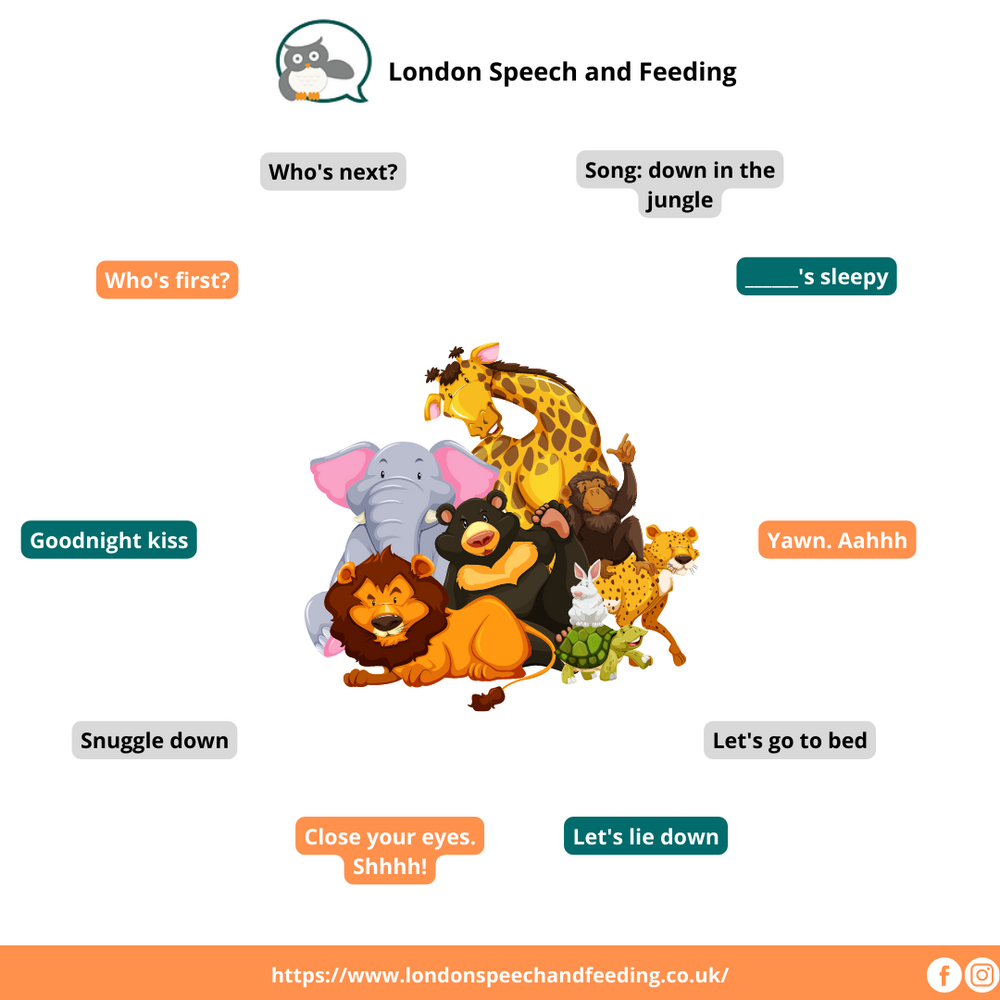
    When you have a child who uses Gestalts it is often difficult to think and adapt clinic activities into those to use at home. More importantly, you find that individualising your activities for your child who uses Gestalt are time-consuming. But you value its importance for their communication development.

    You feel so busy, you are taking them to other appointments, or trying to get through your daily activities, all whilst still ensuring your child’s emotional needs are met. You know life should not get in the way of your child’s therapy activities at home, but it does. We know your spare time is precious and limited, so let us achieve your child’s or young person’s goals in the allotted time you have which meets their way of learning (using Gestalts).

    We wanted to support you by exploring items which you may have at home, and we will give you some key phrases which you can start to model with your child. Whereas our last blog introduced the idea of gestalt language processors, we are now developing ideas to give you the tools to implement activities at home. We recognise how overwhelming it may feel, and this is one of the reasons to make activities as straight forward as possible. Therapy does not need to be complicated; it just needs to be carried out on a regular basis.

    Explore the samples I’ve created to give you an idea of how this might look but please consult with a Speech and Language Therapist who knows about Gestalt Language Processing so that you can work together to develop great home activities for your child.

    Want to learn more about gestalt language processing?

    Please contact me for help.


    Find a speech and language therapist for your child in London. Are you concerned about your child’s speech, feeding or communication skills and don’t know where to turn? Please contact me and we can discuss how I can help you or visit my services page.

    1
  • · · ·

    How do we play with our Gestalt Language Processors?

    Image by Freepik

    Child-led therapy

    When working with Gestalt Language Processors, it is always advisable to use child-led therapy. What does that mean? Child led therapy involves following a child’s interests and allowing her/him to lead the play activity throughout the speech and language therapy session. In other words, instead of having my own ideas of what we might want to play with or what activities I might try and use, I provide a range of toys I know the child likes or has played well with before; then I wait for the child to pick what she/he enjoys doing.

    Play can be very repetitive and we can often see our child cycling back to the same one or two toys throughout the session. But this is what she/he needs to do at that time and it means that we have focused attention and engagement. This in turn is very helpful for the therapeutic process, which is to offer great scripts and phrases/words alongside what she/he is playing with.

    Monotropic minds

    Often the mind of autistic children is more strongly pulled towards a smaller number of interests or hobbies as I like to call them. Dr Dinah Murray, Dr Winn Lawson and Mike Lesser have found in 2005 that autistic people have ‘monotropic’ minds. They explain that autistic children focus their energy on a narrow range of activities as the energy required to switch between several toys is much higher than we would see in the neuro-typical population.

    Gestalt Language Processors are often also Gestalt Cognitive Processors. This is when experiences are retained as episodic events and memories. An event is remembered by specific parts of the same event. And, therefore, these specific parts should always be part of that event, when the event is repeated.

    Should any of the specifics be changed or are missing, then this can cause great upset to Gestalt Cognitive Processors. So, for example, if the last two times in speech therapy we had the train set out and this was played with happily, then this becomes a specific part of the whole session. If, I then don’t offer the train set the third time a child comes to see me, this could be very upsetting.

    This is why I tend to try this out and see what happens. Usually in the 3rd or 4th session: I might not bring out the car run that has hitherto been super successful to see if we are able to transition well to other toys. If yes, then we can have new experiences but if not then I will re-offer the car run/or whatever toy pretty quickly so as not to cause complete dysregulation.

    A few pointers below which help with child-led play:

    Introduce a few new toys and see what happens

    Parents are encouraged to bring some familiar toys their child likes to the session. We can then introduce a couple of different toys to see how we go. Try offering a new toy alongside the familiar one; try offering new toys without the familiar one present, but be prepared to re-offer the “old” toy should our child get upset.

    Rotate toys and don’t offer out too many toys

    I find that children can get overwhelmed and overstimulated by too many items out all at once. I always talk to parents about toy rotation at home and I encourage storage and ‘tidy up’ of toys so that we can increase attention focus, and also maintain freshness and new interest in older toys.

    Some children are not yet ready to play with toys

    Here I suggest people games: these are games where the adult becomes part of a more motor-based activity. Some call it ‘rough and tumble play’ but it can be nursery rhymes such as sleeping bunnies/row row the boat or peek-a-boo for the younger ones.

    Copy/Imitation is so important – try getting two identical or similar play items

    When we are copying our child, it is often not desirable to ‘take turns’ with their toys/blogs/cars etc as our child may not be ready to let us take a turn. Instead, if we have the exact same toy that our child is having then we can play alongside our child and copy them perfectly without interrupting their play.

    References:

    Murray, D., Lesser, M., & Lawson, W. (2005). Attention, monotropism and the diagnostic criteria for autism. Autism9(2), 139-156.

    If you need help with your child, please do not hesitate to contact me.


    Find a speech and language therapist for your child in London. Are you concerned about your child’s speech, feeding or communication skills and don’t know where to turn? Please contact me and we can discuss how I can help you or visit my services page.

    0
  • ·

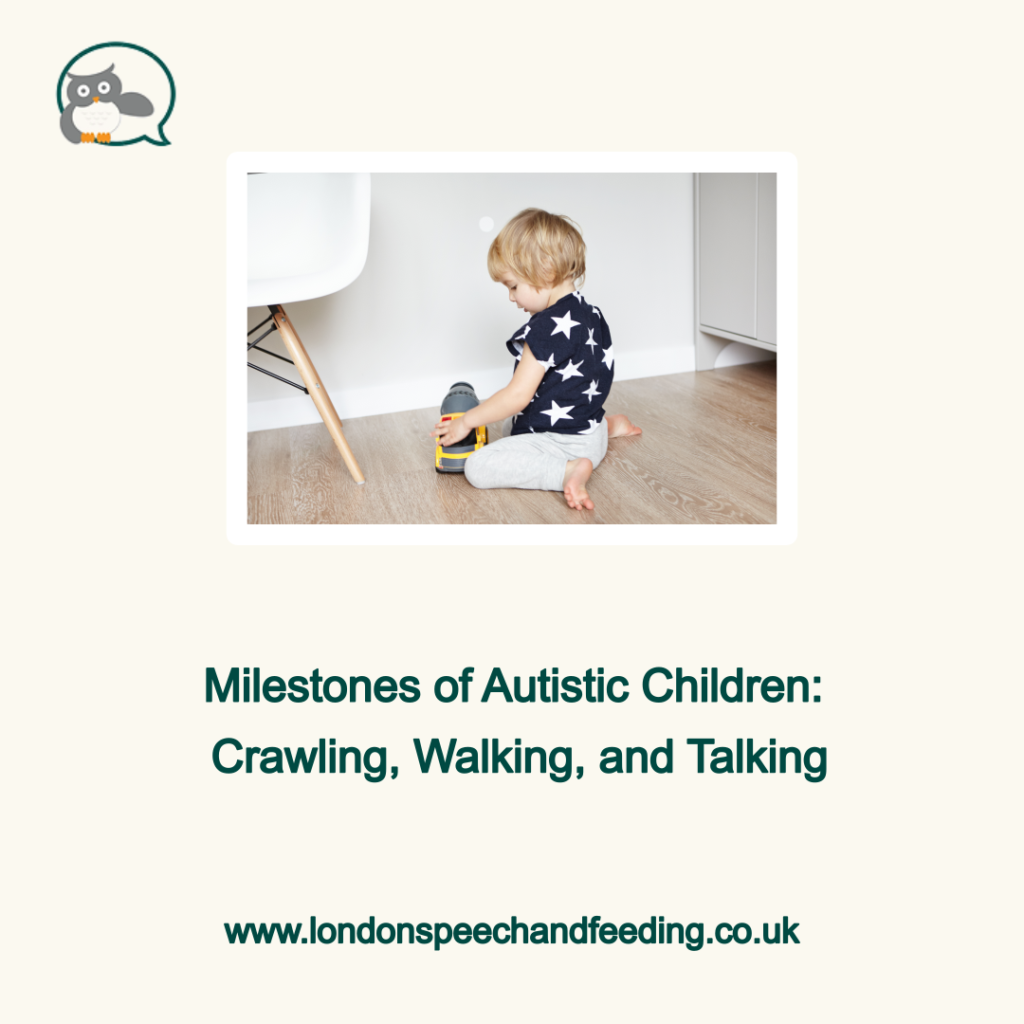
    Milestones of autistic children: Crawling, walking, and talking

    For all children every milestone achieved is a testament to the unique and intricate process unfolding within each young mind. For autistic children, this journey may present a distinct pattern, with some reaching developmental milestones like crawling, walking, and talking later than their neurotypical peers. Let’s have a look into the fascinating realm of Autism and explore why some autistic children might crawl, walk, and talk later, shedding light on the underlying factors contributing to this unique way of developing.

    1. Individual Pacing:

    Child development is not a one-size-fits-all journey. Each child, whether neurotypical or autistic, has a unique timeline for achieving milestones. Autistic children, like any other children, follow their own pacing. This individual rhythm might lead them to focus on one set of skills before they progress to others. Like some neurotypical children might focus on talking earlier than walking, autistic children might prioritise other areas before crawling or talking.

    2. Neurodevelopmental Complexity:

    The human brain is a remarkable entity, with a bewildering array of interconnected processes that lead to us achieving our developmental milestones. Autistic children often have variations in “neural wiring”, which can impact the balance between gross motor skills (crawling, walking) and fine motor skills. Speech and language acquisition falls under fine motor skills and may be momentarily disrupted due to the divergent neurological pathways at play in autism.

    2. Sensory Processing Differences:

    One of the hallmarks of autism is altered sensory processing. Autistic children often experience sensory stimuli differently than their neurotypical peers. This heightened or diminished sensitivity can influence a child’s desire or ability to engage in activities like crawling and walking. The sensation of movement while crawling or walking, for instance, might be overwhelming for some autistic children, causing them to either avoid or delay these activities.

    3. Visual-Spatial Abilities:

    Autistic children and adults frequently display excellent visual-spatial abilities. This strength might lead some children to focus more on activities that engage these skills, potentially delaying their engagement with activities like walking or talking. As they navigate their environment and process information visually, they might naturally invest more time in activities that stimulate this particular cognitive ability and strength.

    4. Communication Challenges:

    For many autistic children, speaking can be a really complex and difficult endeavour. Communication delays are a common feature of autism. This can affect both receptive and expressive language development. While some children might be physically capable of crawling or walking, they may not yet have the tools to communicate their desires and intentions. This leads to a temporary focus on non-speaking forms of expression. This does not mean that they do not communicate at all. But autistic individuals often start out using jargoning or echolalia as a form of communication as well as behaviours and physical forms of communication.

    5. Executive Functioning and Motor Skills:

    Executive functioning, or abilities for planning, organising, and carrying out tasks, can vary in autistic children. These skills are crucial for activities like crawling, walking, and talking, which need coordination and planning. About 40% of autistic persons have a motor planning difficulty.

    6. Intense Interests and Routines:

    Autistic children often develop intense interests in specific subjects, sometimes to the exclusion of other activities. These interests might become their primary mode of engagement. They might side-line milestones like crawling, walking, or talking. The mostly rigid adherence to routines and preferences might cause them to allocate more time to their preferred activities. This delays their engagement with other developmental tasks.

    How can Speech and Language Therapy help:

    Support and Intervention:

    Early intervention and regular Speech and Language Therapy play a pivotal role in the developmental journey of autistic children. Therapies tailored to individual needs can aid in bridging the gaps between milestones. Occupational therapy, for example, can help address sensory sensitivities and motor skill challenges that might impact crawling and walking. Speech therapy can help communication development, gradually bridging the gap between non-verbal expressions and spoken language.

    For example, we now know that echolalia or jargoning of longer phrases with intonation, repeating scripts from favourite tv shows or songs have many meanings and communicative functions. For example, a child who utters long strings of echolalic utterances, often difficult to understand, might want to do any one of the following:

    • Comment
    • greet
    • ask a question
    • make a request
    • express surprise
    • negate something.

    We now understand that the way to support a child with echolalia is to acknowledge all utterances and try and find out what the meaning is behind these scripts. This is very supportive. Over time it will lead a child to move on to understanding and saying more clear and self-generated language. For more information about this Natural Language Acquisition here are some other great websites for you to look at:

    Conclusion

    In conclusion, the journey of an autistic child’s development is a testament to the uniqueness and complexity of the human mind. The delays or differences in achieving milestones like crawling, walking, and talking can be attributed to a range of factors, including

    • neurodevelopmental intricacies,
    • sensory processing variations,
    • and communication challenges.

    It’s crucial to recognise that these delays are not indicative of a lack of potential, but rather a manifestation of the intricate interplay between an autistic child’s strengths and challenges. By embracing these differences and providing tailored support, we can help each autistic child unfold their potential at their own pace.

    Do get in touch if you would like to book an appointment where we can explore how to help your child develop and thrive

    Do get in touch if you would like to book an appointment where we can explore how to help your child develop and thrive


    Find a speech and language therapist for your child in London. Are you concerned about your child’s speech, feeding or communication skills and don’t know where to turn? Please contact me and we can discuss how I can help you or visit my services page.
    0