Speech Therapy At Home

  • Tele-Speechtherapy: Online, connected, and highly effective

    A different kind of therapy. Online, connected, and highly effective

    When parents first enquire about speech and language therapy, many assume it will happen face-to-face, in a clinic room, with a therapist sitting across from their child.

    So when therapy is offered online, it’s natural for questions to arise:

    Can this really work? Will my child engage? Will progress be slower?

    This short video offers a glimpse into what online therapy can look like: calm, interactive, relationship-based, and surprisingly effective.

    Online therapy is not ‘less than’ in the right circumstances

    Teletherapy is not suitable for every child in every situation. However, for many school-aged children, particularly those who enjoy conversation, technology, and shared activities, online therapy can be an excellent fit.

    The child you see in this video is around eight years old and was supported for a persistent lisp. Sessions were primarily online, with the occasional in-person appointment when helpful.

    What made the difference was not the screen. It was the combination of engagement, support, and consistency.

    Parent involvement changes everything

    One of the greatest strengths of online therapy is the way it naturally invites parents in.

    In this case, parents regularly joined the video sessions:

    • Listening in
    • Taking part when appropriate
    • Learning how to support practice gently between sessions

    This meant that therapy didn’t stay ‘on the screen’. Strategies carried over into everyday conversation, making progress faster and more meaningful.

    Speech sound therapy, including support for lisps, relies heavily on awareness, feedback, and confidence, all of which can be supported very effectively at home with the right guidance.

    Therapy through a screen can still be deeply relational

    A common concern is whether connection can truly be built online.

    In reality, many children feel more relaxed in their own home environment. They are often more willing to talk, experiment with sounds, and reflect on their speech when they feel comfortable and supported.

    Online sessions allow:

    • Shared focus and conversation
    • Clear visual feedback
    • Real-life practice in a familiar setting
    • Immediate parent support

    For some children, this actually enhances engagement rather than limits it.

    Real progress, real outcomes

    Over the course of approximately 12 online sessions, alongside a small number of in-person appointments, this child achieved resolution of their lisp.

    Progress was steady, positive, and confidence-building. Importantly, the child remained motivated and proud of their achievements throughout the process.

    While every child’s journey is different, this example highlights what is possible when:

    • The child is ready
    • Parents are involved
    • Therapy is tailored and collaborative

    If you’re considering online therapy

    If you’re unsure whether teletherapy could work for your child, it’s worth remembering that effective speech and language therapy is less about the room you’re in, and more about:

    • Relationship
    • Understanding
    • Consistency
    • Carryover into daily life

    For many families, online therapy offers flexibility, accessibility, and excellent outcomes especially when parents are active partners in the process.

    If you’re at the start of your child’s speech journey and wondering whether online therapy could be the right fit, I’m always happy to talk it through. Sometimes clarity begins with simply understanding what therapy can look like

    Teletherapy: Frequently Asked Questions

    Is online speech and language therapy really effective?

    Yes. For many children, particularly school-aged children, online therapy can be highly effective. Progress depends far more on engagement, consistency, and support than on physical location.

    What age does online therapy work best for?

    Teletherapy often works well for children from around six years and up, especially those who can attend to a screen, enjoy conversation, and follow simple instructions. That said, suitability is always considered individually and often a supportive adult is needed to help guide the child through the activities.

    Can speech sound work (such as a lisp) really be done online?

    Absolutely. Speech sound therapy relies on clear visual feedback, listening skills, and practice all of which can be supported very effectively online. Many children respond particularly well when practising in their own home environment.

    Do parents need to be involved in sessions?

    Parental involvement is strongly encouraged. Parents may sit in, join parts of the session, or support practice between appointments. This involvement often leads to quicker progress and better carryover into everyday speech.

    Will my child still build a relationship with the therapist?

    Yes. Strong therapeutic relationships can and do develop online. Many children feel more relaxed and confident communicating from home, which can actually enhance connection and learning.

    Is online therapy suitable for every child?

    Not in my experience. Some children benefit more from in-person support, or a combination of online and face-to-face sessions. A discussion and initial assessment help determine the best approach for each child.

    Sonja McGeachie

    Highly Specialist Speech and Language Therapist

    Owner of The London Speech and Feeding Practice.


    Health Professions Council registered
    Royal College of Speech & Language Therapists Member
    Member of ASLTIP

    Find a speech and language therapist for your child in London. Are you concerned about your child’s speech, feeding or communication skills and don’t know where to turn? Please contact me and we can discuss how I can help you or visit my services page.

    3
  • · · · ·

    What to do when words don’t come fast enough

    What to do when words don’t come fast enough

    When children find talking hard, parents often face a difficult question: ‘Should we wait and keep encouraging speech? Or introduce something like AAC?’

    AAC (Augmentative and Alternative Communication) can sound intimidating, but it simply means any way we support or replace spoken words, from simple gestures and picture boards to high-tech speech-generating devices. Far from ‘giving up on speech,’ AAC often becomes the bridge that helps children find their voice, in whatever form that takes.

    💡 What is AAC, really?

    AAC is a spectrum of tools and strategies that help people express themselves when speaking is difficult. It might include:

    • Low-tech supports: Gestures, key word signs (like Makaton), picture symbols, or printed boards
    • High-tech systems: Apps on tablets that speak aloud when pictures or words are tapped

    AAC is not just for children who will never talk. It’s for anyone whose speech isn’t meeting their communication needs right now.

    🤔 When to introduce AAC

    There’s a common myth that you should only try AAC after ‘exhausting’ other speech therapy options. In fact, AAC can be introduced at any stage, even alongside speech development.

    Here are some helpful signs that AAC might support your child:

    • Your child understands much more than they can say.
    • They rely on gestures, sounds, or behaviour to communicate.
    • They become frustrated trying to express themselves.
    • You find yourself ‘reading their mind’ to interpret needs.
    • Speech progress feels slow or inconsistent.

    If you recognise these patterns, AAC isn’t a ‘last resort’. It’s a communication support, not a replacement for speech.

    Recent research consistently shows that AAC does not stop children from talking. In fact, it can encourage speech to develop. A 2024 systematic review and meta-analysis published in the Journal of Autism and Developmental Disorders found that children who received interventions combining naturalistic developmental behavioural approaches with aided AAC showed improved language outcomes, and that AAC ‘does not negatively impact speech development and may even facilitate spoken language growth’ (Smith et al., 2024).

    🌉 How AAC supports speech development

    Speech and AAC aren’t competing paths: they’re parallel tracks that often feed each other.

    Here’s how AAC helps speech grow:

    1. Reduces frustration: When a child can express their needs, they’re more relaxed and ready to learn.
    2. Provides a visual model: Seeing symbols or words while hearing spoken language strengthens understanding and word recall.
    3. Builds consistent language structure: AAC systems follow the same grammar and word order as speech, helping children internalise how sentences work.
    4. Encourages turn-taking and social connection: AAC lets children join conversations even before speech is fluent, giving them more practice in real communication.

    AAC is not ‘giving up on speech’. It’s giving a child more ways to succeed while speech continues to develop.

    🧩 How to introduce AAC gently and effectively

    1. Start small and meaningful: Begin with a few key messages your child wants to say, not just what adults want to hear. Think ‘I want’, ‘stop’, ‘help’, ‘more’, ‘all done’, ‘no’, ‘again’. These are powerful words for real interaction and autonomy.
    2. Model, model, model: The most important part of AAC success is modelling—using the system yourself as you talk. For example: ‘You want banana 🍌’ and you tap the ‘want’ and ‘banana’ symbols. Children need to see and hear AAC used naturally before they try it themselves.
    3. Use it throughout the day: AAC isn’t a therapy tool to take out once a week. It’s a living part of communication. Model a few words during mealtimes, play, and routines. The more consistently it’s embedded, the more fluent both you and your child will become.
    4. Keep it accessible: If using a device or picture board, make sure it’s always nearby. If it’s in a bag or drawer, it can’t be used in real moments.
    5. Celebrate all communication: If your child points, signs, uses a sound, or taps a symbol, it all counts. Respond warmly and naturally to reinforce communication in any form.

    🧠 What parents often worry about

    • ‘Won’t AAC stop them from talking?’: No. Research shows AAC use either has no negative effect on speech or leads to increased spoken output (Smith et al., 2024). When children feel understood, their motivation to communicate grows.
    • ‘What if I model it wrong?’: There’s no perfect way to start. Your effort and consistency matter far more than accuracy.
    • ‘Will they get ‘stuck’ using pictures?’:  Some children do continue using AAC long-term; others move naturally toward more spoken language. The goal is always functional communication, not replacing one form with another.

    🪞 Bringing AAC into daily life

    Here are a few simple, parent-friendly ideas:

    • Create visual spaces: Post symbols or core words on the fridge, mirror, or play area.
    • Narrate routines: Use AAC during toothbrushing, dressing, or mealtimes; consistent contexts build understanding.
    • Pair speech and touch: Always say the word aloud when you point to or tap a symbol.
    • Involve siblings and friends: Model how they can respond to AAC too. ‘Oh, you said go! Let’s go fast!’
    • Use shared books and songs: Pause and model key words in stories or songs.

    🌱 The takeaway

    AAC doesn’t mean giving up on speech; it means opening more doors to communication. When words don’t come easily, AAC gives children a way to connect, share, and be heard.

    It helps parents move from guessing to understanding, and gives children the power to express themselves on their own terms.

    If you’re unsure where to start, reach out to a speech and language therapist experienced in AAC. Together, you can find a system that fits your child’s strengths, build confidence in modelling, and help every word (spoken or tapped) feel like a step forward.

    And download and print my one page summary.

    Because when communication is possible, everything else begins to grow.

    Sonja McGeachie

    Highly Specialist Speech and Language Therapist

    Owner of The London Speech and Feeding Practice.
    📚 Reference

    Smith, K., et al. (2024). The Effect of Naturalistic Developmental Behavioral Interventions and Aided AAC on the Language Development of Children on the Autism Spectrum with Minimal Speech: A Systematic Review and Meta‑Analysis. Journal of Autism and Developmental Disorders, 55, 3078–3099. https://doi.org/10.1007/s10803-024-06382-7


    Health Professions Council registered
    Royal College of Speech & Language Therapists Member
    Member of ASLTIP

    Find a speech and language therapist for your child in London. Are you concerned about your child’s speech, feeding or communication skills and don’t know where to turn? Please contact me and we can discuss how I can help you or visit my services page.

    2
  • · ·

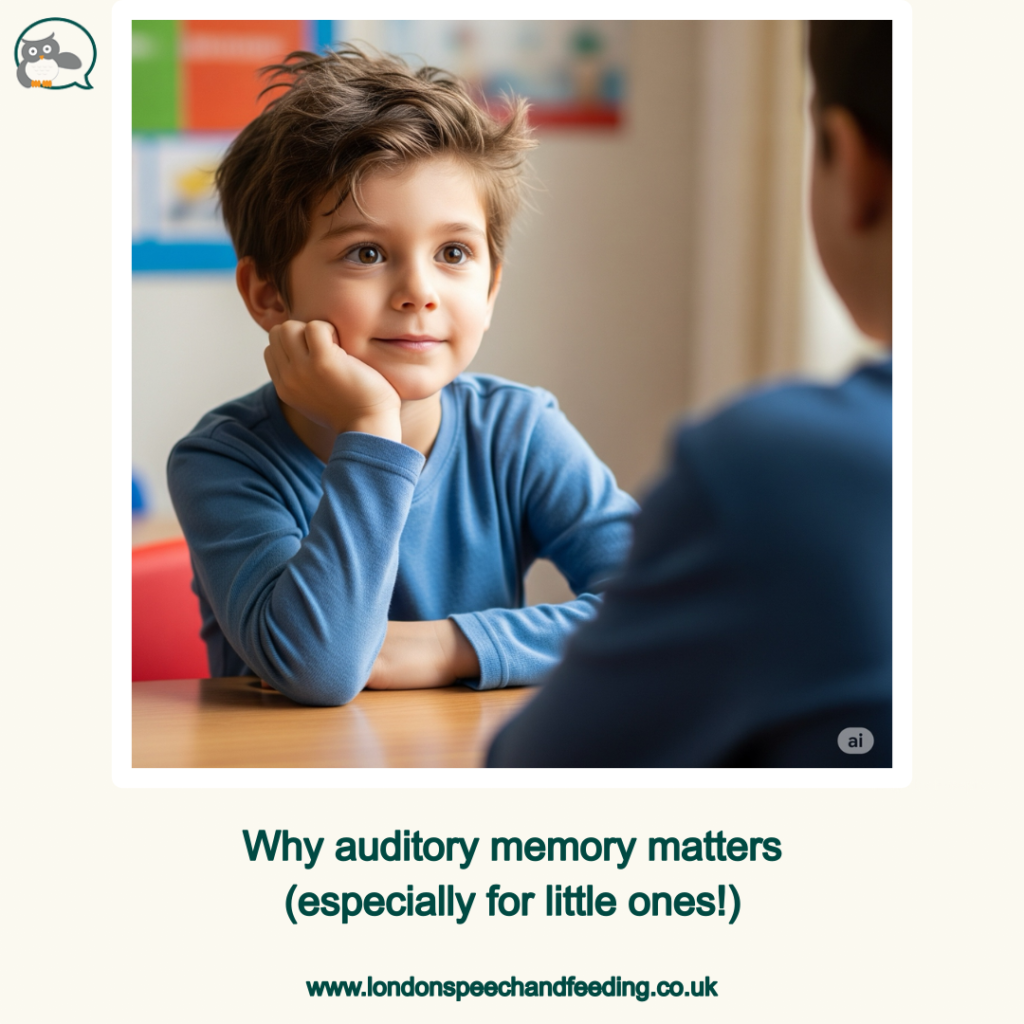
    Why auditory memory matters (especially for little ones!)

    Why auditory memory matters (especially for little ones!)

    Have you ever stopped to think about how we learn to speak, understand, and communicate effectively? It’s a complex dance of various cognitive skills, and one often overlooked but absolutely crucial player in this orchestra is auditory memory. It’s not just about remembering sounds. It’s about remembering sequences of sounds, which is fundamental to language development.

    What exactly is auditory memory?

    At its core, auditory memory is our ability to take in, process, store, and recall information that we hear. Think of it as your brain’s internal recording studio. When someone speaks to you, your auditory memory is busy at work, capturing the individual sounds, the order in which they appear, and the rhythm and intonation of the words. This isn’t just for long-term recall; it’s also vital for working auditory memory, which allows us to hold onto a small amount of auditory information for a short period, just long enough to make sense of it.

    For speech and language, auditory memory is essential for:

    • Understanding spoken language: To comprehend a sentence, we need to remember the beginning of the sentence by the time we hear the end.
    • Following instructions: Remembering a sequence of commands relies heavily on auditory memory.
    • Learning new words: We hear a word, remember its sound, and connect it to its meaning.
    • Developing phonological awareness: This is the ability to recognise and manipulate the sounds in spoken language, a critical precursor to reading. Auditory memory helps children distinguish between similar-sounding words (e.g., ‘cat’ vs. ‘bat’) and segment words into individual sounds.
    • Producing clear speech: To articulate words correctly, we need to recall the precise sequence of sounds that make up that word.
    • Developing conversational skills: Remembering what was just said helps us formulate appropriate responses.

    When auditory memory falls short: The impact on speech

    When auditory memory is poor, particularly in young children, the ripple effects on speech and language development can be significant. Children might struggle with:

    • Following multi-step directions: ‘Put on your shoes, get your coat, and meet me at the door’ can become an overwhelming jumble of sounds.
    • Learning new vocabulary: They might hear a new word repeatedly but struggle to retain its sound pattern, making it difficult to recognise or use later.
    • Understanding stories or conversations: Missing key details or losing the thread of a narrative because they can’t hold enough information in their working memory.
    • Developing phonological skills: Difficulty with rhyming, identifying initial sounds in words, or blending sounds together to form words, which can impact early literacy.
    • Speech production: They might mispronounce words, omit sounds, or struggle with the correct sequencing of sounds within words.
    • Social communication: Difficulty participating in group discussions, remembering names, or recalling what their peers have said.
    • Academic performance: Auditory memory challenges can impact a child’s ability to learn in a classroom setting, where much of the instruction is delivered verbally.

    It’s important to note that poor auditory memory isn’t a sign of low intelligence, but rather a specific processing challenge that can be addressed with targeted support.

    Nurturing auditory memory in under 5s: Preparing for schooling

    The good news is that auditory memory is a skill that can be strengthened and developed, especially during the crucial early years. For children under five, laying a strong foundation in auditory memory is an invaluable gift as they prepare for the demands of formal schooling. Here’s what we can do to help:

    1. Read aloud regularly: This is perhaps one of the most powerful tools. As you read, encourage your child to listen for specific words, predict what happens next, and retell parts of the story. Vary your voice, use different intonations, and pause to emphasise key words.
    2. Play auditory memory games:
      • ‘Simon says’: This classic game is fantastic for following multi-step instructions. Start with one command and gradually increase the number.
      • ‘I Spy’ with sounds: Instead of colours, describe sounds. ‘I spy with my little ear something that goes “moo”.’
      • Rhyming games: Sing rhyming songs, read rhyming books, and encourage your child to come up with words that rhyme.
      • Sound matching: Use everyday objects to make sounds (e.g., shaking keys, tapping a spoon) and have your child identify or match them.
      • ‘Memory chain’: Start a sentence and have your child add to it, remembering everything that came before: ‘I went to the market and bought an apple.’ ‘I went to the market and bought an apple and a banana.’
    3. Sing songs and nursery rhymes: Repetitive songs and nursery rhymes are excellent for developing auditory memory, rhythm, and phonological awareness. The predictable patterns help children anticipate and remember sequences of sounds and words.
    4. Give multi-step instructions (and praise!): Start with two-step instructions and gradually increase the complexity as your child’s skills improve. Always give positive reinforcement when they succeed. ‘Please pick up the red block and put it in the box.’
    5. Engage in active listening: Model good listening skills yourself. When your child is speaking, give them your full attention. Ask clarifying questions to encourage them to elaborate and organise their thoughts.
    6. Reduce background noise: A quiet environment makes it easier for young children to focus on auditory information. Minimise distractions like TV or loud music during activities that require listening.
    7. Use visual cues: While we’re focusing on auditory memory, sometimes pairing auditory information with visual cues can be helpful, especially initially. For example, when giving instructions, demonstrate the action as you say it.
    8. Be patient and consistent: Developing auditory memory takes time and consistent practice. Celebrate small victories and create a playful, supportive environment for learning.

    By actively engaging in these strategies, we can empower our youngest learners to build robust auditory memory skills, setting them up for success not only in speech and language development but also in their overall academic journey. It’s an investment that truly pays dividends in their future communication and learning abilities.

    Any comments or if you need help and support with your child’s speech please do not hesitate to get in touch with me: simply fill out the contact form here on the website. I endeavour to reply within 48 hours.

    Sonja McGeachie

    Highly Specialist Speech and Language Therapist

    Owner of The London Speech and Feeding Practice.


    Health Professions Council registered
    Royal College of Speech & Language Therapists Member
    Member of ASLTIP

    Find a speech and language therapist for your child in London. Are you concerned about your child’s speech, feeding or communication skills and don’t know where to turn? Please contact me and we can discuss how I can help you or visit my services page.

    1
  • · ·

    From ‘Nailed it!’ in therapy to ‘Whoops!’ at home: Why generalising speech sounds is tricky

    As a parent, you’ve likely experienced the triumphant feeling when your child, who’s been working so hard on his or her /S/ sound, produces it perfectly in a therapy session. He or she is rocking those ‘sun’ and ‘socks’ words, his or her lisp seemingly a distant memory. You leave feeling elated, confident that all that hard work is finally paying off.

    Then you get home. And within minutes, you hear it: ‘Thooper!’ instead of ‘Super!’ Or maybe the clear /R/ in ‘rabbit’ from therapy reverts to a ‘wabbit’ when his or she is playing with his or her toys. It’s frustrating, confusing, and can feel like you’re back to square one.

    So, what’s going on? Why is it so difficult for children to take those amazing skills learned in a focused therapy session and seamlessly apply them to their everyday conversations? You’re not alone in wondering this. It’s a common challenge in speech therapy and understanding the ‘why’ can help both parents and children navigate this crucial stage.

    The brain’s habits: Old pathways are strong pathways

    Think of your child’s brain as having established ‘pathways’ for how he or she produces certain sounds. If he or she has been lisping his or her /S/ sound for years, that neural pathway is deeply ingrained. It’s like a well-worn path through a field: easy to follow because it’s always been there.

    In therapy, we’re essentially trying to forge a new path. We’re teaching him or her a new, more accurate way to make the sound. This new path is initially faint, like a barely visible trail. It takes conscious effort and repeated practice to strengthen it. Outside of the structured therapy environment, his or her brain often defaults to the old, comfortable, and well-established pathway, even if it’s not the most accurate.

    The demands of daily conversation: A multitasking challenge

    Therapy sessions are designed to be focused and controlled. We isolate sounds, practice them in specific words, and provide immediate feedback. There are minimal distractions, and your child’s full attention is on his or her speech production.

    Now, consider daily conversation:

    • Speed: We speak much faster in natural conversation than we do during structured practice. There is less time to think about individual sounds.
    • Cognitive load: Children are simultaneously thinking about what they want to say, understanding what others are saying, processing social cues, and managing their emotions. Adding the conscious effort of producing a new speech sound correctly on top of all that is a huge cognitive demand.
    • Variety of contexts: In therapy, we might practise ‘sun’ and ‘socks’. In real life, the /S/ sound appears in countless words, in different positions within words, and alongside a vast array of other sounds. Each new word and phonetic context present a fresh challenge.
    • Lack of immediate feedback: In therapy, the speech therapist is right there to provide instant correction and reinforcement. In a playground, during a family dinner, or while playing with friends, that immediate, consistent feedback isn’t present.

    The role of automaticity: Making it second nature

    The ultimate goal of speech therapy isn’t just correct sound production; it’s automaticity. This means producing the sound correctly without having to consciously think about it. It’s like learning to ride a bike. Initially, every pedal stroke and steering adjustment is deliberate. Eventually, it becomes second nature.

    Generalisation is the process of moving from conscious, controlled production to unconscious, automatic production. This takes time, consistent practice, and exposure to a wide variety of real-life speaking situations.

    How can we help? Bridging the gap

    So, what can parents do to help their children bridge this gap between therapy success and everyday speech?

    1. Be patient and positive: This is a marathon, not a sprint. Celebrate the small victories and avoid getting discouraged by setbacks. Your positive reinforcement is crucial.
    2. Practise little and often: Instead of long, infrequent practice sessions, aim for short, consistent bursts throughout the day. ‘Sprinkle’ in opportunities to practise their target sounds in natural conversations.
    3. Create ‘sound awareness’ moments: Gently draw your child’s attention to his or her target sounds in everyday words. For example, if he or she is working on /R/, you might say, ‘Oh, you said ‘wabbit.’ Can you try to make your /RRR/ sound for ‘rabbit’?’
    4. Model correct production: Continue to model the correct production of their target sounds in your own speech.
    5. Collaborate with your speech therapist: Your therapist is your best resource! Ask them for specific strategies and activities you can do at home to support generalisation. They can also provide guidance on when and how to gently correct your child.

    Tips and tricks

    Below I have listed a few good tips and tricks that can help the transition from therapy room to daily life:

    Empowering your child as the ‘sound detective’:

    • ‘Secret sound listener’: Instead of you doing the correcting, make your child the detective. When you’re having a conversation, say ‘your /S/ sounds are sometimes a bit “slippery”’ (or whatever fun, non-judgmental term you like). Ask your child to quietly listen for your /S/ sounds. You can even purposely make a few ‘slippery’ ones (or correct yourself immediately after) and see if they notice. This shifts the focus from being corrected to actively listening and identifying the sound in a non-threatening way.
    • ‘Sound scorecard’: For a short period (maybe 10–15 minutes during a specific activity, like dinner or a game), provide a small notepad and pencil. Explain that your child is going to listen for his or her /S/ sounds and gently mark a tally every time he or she uses it correctly. The goal isn’t perfection, but awareness. This gives your child agency and a visual representation of progress. You can even make it a game: ‘Let’s see how many /S/ sounds we can catch in five minutes!’
    • /S/ sound song/rhyme creation: Work together to create silly songs or rhymes that are packed with /S/ sounds. The sillier, the better! You can sing them in the car, while doing chores, etc.
    • /S/ sound superpower: Frame the new sound skill as a ‘superpower’. ‘You’re getting so good at using your /S/ superpower! It’s going to help you speak so clearly and confidently.’
    • Highlighting successes: Always go out of your way to acknowledge and praise successful /S/ productions in natural conversation. ‘I really understood you clearly when you said ”s_top”.’ or ‘That /S/ sound was perfect when you told me about the “s_tory”!’

    Important considerations:

    • Keep it low-pressure: The goal is generalisation, not perfection. If your child is feeling pressured, he or she will likely revert to old patterns.
    • Focus on awareness, not just correction: Help your child become aware of his or her own speech rather than relying on you for corrections.
    • Short, frequent bursts: A few minutes of subtle focus multiple times a day is more effective than one long, forced session.
    • Acknowledge feelings: If your child expresses frustration about ‘being corrected’, validate these feelings. ‘I understand it can feel like a lot of listening, but we’re just trying to help you use that super /S/ sound all the time!’

    By incorporating these strategies, you can help your child naturally integrate the new /S/ sound into daily speech, fostering independence and confidence without it feeling like constant ‘testing’ or ‘correction’. Generalising new speech sounds is arguably the hardest part of speech therapy, but it’s also the most rewarding. With patience, consistent effort, and a collaborative approach between parents and therapists, children can successfully integrate their new, clearer speech sounds into every aspect of their daily lives.

    Any comments or if you need help and support with your child’s speech please do not hesitate to get in touch with me: simply fill out the contact form here on the website. I endeavour to reply within 48 hours.

    Sonja McGeachie

    Highly Specialist Speech and Language Therapist

    Owner of The London Speech and Feeding Practice.


    Health Professions Council registered
    Royal College of Speech & Language Therapists Member
    Member of ASLTIP

    Find a speech and language therapist for your child in London. Are you concerned about your child’s speech, feeding or communication skills and don’t know where to turn? Please contact me and we can discuss how I can help you or visit my services page.
    1
  • ·

    Unlocking language and thinking skills: The power of sequencing

    Sonja demonstrates the power of sequencing

    As speech and language therapists, we often use a variety of techniques to help children develop their communication and cognitive skills. One incredibly valuable tool in our toolkit is the use of sequencing activities. But what exactly is sequencing, and why is it so beneficial?

    What is sequencing?

    Sequencing, at its core, involves arranging items, events, or actions in a specific order. This could involve putting pictures in the correct order to tell a story, following the steps in a recipe, or understanding the order of daily routines like brushing teeth or getting dressed.

    The link between sequencing and language

    Sequencing is fundamental to language development and is quintessential to executive functioning skills in several ways:

    • Narrative skills: Storytelling, whether oral or written, relies heavily on sequencing. A child needs to understand the order of events (beginning, middle, end) to construct a coherent narrative.
    • Explanations and instructions: Providing clear explanations or instructions requires the ability to sequence information logically. For example, explaining how to play a game or how to get from one place to another. In the video clip below we are working on ‘how do make a sandwich’.
    • Vocabulary development: Sequencing helps children understand temporal words and phrases like ‘first,’ ‘then,’ ‘next,’ ‘before,’ and ‘after’.
    • Sentence structure: Constructing grammatically correct sentences often involves sequencing words in a specific order (e.g., subject-verb-object).

    Beyond language, sequencing plays a crucial role in developing executive functioning skills. These are higher-level cognitive skills that help us plan, organise, and manage our time and actions.

    Sequencing activities can help children improve in the following areas:

    • Planning and organisation: Sequencing tasks require children to think ahead, plan the steps involved, and organise them in a logical order.
    • Problem-solving: When they are faced with a problem, sequencing helps children break it down into smaller, more manageable steps.
    • Working memory: Holding information in mind and manipulating it, such as remembering the steps in a multi-step direction, is supported by sequencing skills.
    • Cognitive flexibility: Being able to adjust to changes in a sequence or think of alternative sequences promotes cognitive flexibility.

    Examples of sequencing activities

    Here are some practical examples of sequencing activities you can do with your child:

    • Picture sequencing: Use a set of picture cards to tell a short story or illustrate a process (e.g., making a sandwich, going to the park). Ask your child to arrange the cards in the correct order.
    • Story retelling: After reading a story, have your child retell it, focusing on the order of events.
    • Following instructions: Give your child multi-step instructions to follow (e.g., ‘First, get your shoes. Then, put on your coat. Next, go to the door.’).
    • Sequencing during play: Integrate sequencing into everyday play. For example, while building with blocks, talk about the steps: ‘First, we put this block here. Next, we add this one…’
    • Daily routines: Create visual schedules for daily routines, like getting ready for school or bedtime, to help children understand the sequence of events.
    • In the video clip below I am using an on-line language activity which is often fun for children as they can use their finger to swipe the pictures effortlessly into the right place and, if we realise at the end of the story that we have made a little error, we can then easily re-jig the pictures into their correct place.

    In conclusion

    Sequencing activities offer a powerful way to support children’s language development and enhance their executive functioning skills. By helping children understand and create order, we equip them with essential tools for communicating, learning, and navigating the world around them.

    Do get in touch via my contact form if you are concerned about your child’s development.

    Sonja McGeachie

    Highly Specialist Speech and Language Therapist

    Owner of The London Speech and Feeding Practice.


    Health Professions Council registered
    Royal College of Speech & Language Therapists Member
    Member of ASLTIP

    Find a speech and language therapist for your child in London. Are you concerned about your child’s speech, feeding or communication skills and don’t know where to turn? Please contact me and we can discuss how I can help you or visit my services page.

    1
  • · ·

    Speech Sound Challenges: A focus on /L/ and /Y/

    Have you ever thought about how difficult it can be to produce certain speech sounds? Some sounds are definitely trickier than others. This is especially true for children with speech sound disorders like Childhood Apraxia of Speech (CAS).

    My student with CAS has been working hard on producing the /L/ sound especially when it was followed by an /O/ or /OO/ like, ‘log’ or ‘look’. We’ve practised lots and now that he’s got a good handle on /L/, he’s started replacing another difficult sound, /Y/, with it. So, ‘yes’ becomes ‘less’ and ‘yuck’ becomes ‘luck.’

    This is a common pattern in speech development. Once a child masters a new sound, they may start using it in place of other sounds they find even more challenging.

    Minimal Pair therapy

    I use different evidence-based methods to help my students. And I often like to start out with phonemic awareness and then I move to contrasting the error sound with another sound to make completely different words. This approach is called ‘minimal pair’ therapy: both words are the same except for the initial/final sound which has the error sound, and this is contrasted with the correct sound.

    Below is an example of this:

    After we have worked on sound awareness, listening and becoming aware of small units of sound matter, then we can move to working on tongue placement and movement.

    Tongue placement and movement to produce correct /L/ and /Y/ sounds

    To produce these sounds correctly, the tongue needs to be in specific positions and make specific movements.

    • /L/ sound:
      • Tip of the tongue touches the alveolar ridge (the bony ridge behind your upper teeth)
      • Sides of the tongue are raised to the sides of the upper teeth
      • Airflow escapes through the sides of the tongue
    • /Y/ sound:
      • Tip of the tongue touches the roof of the mouth behind the alveolar ridge
      • Sides of the tongue are raised to the sides of the upper teeth
      • Airflow escapes through the centre of the mouth

    I also use:

    • Auditory bombardment: Auditory bombardment is a technique that involves repeatedly listening to a target sound. This can help children to develop a better understanding of the sound and how to produce it.
    • Visual cues: Visual cues can be helpful for children who are having difficulty producing a particular sound. Here I use the image of a ‘standing tongue’ versus a ‘sitting tongue’.
    • Physical cues: I use my hands to show a ‘standing tongue’ for the /L/ versus a ‘sitting tongue’ for the /Y/. But what worked even better and sadly I don’t have the video clip for it:
    • Semantic cues: For example a picture of an ‘EAR’ to make the sound /Y/ so we shape the sound /EA/ to /Y/.
    • Parent involvement: Parents play an important role in their child’s speech sound development by providing opportunities for them to practise their speech sounds at home. This can be done through activities such as reading books, singing songs, and playing games.
    • Reinforcement: It is important to praise children for their efforts, even if they are not perfect. This will help them to feel motivated to keep practising. Important here for speech correction is concrete reinforcement: I feed back to my student what exactly they were doing correctly with their tongue or lips. Rather than saying ‘well done’, I mention what my student has just done with the tongue to change the sound: ‘I saw you lowered your tongue! That made a good /Y/’.

    Another great way of reinforcing positively is to ask the student how they feel they have done? For the older ones I often ask them to self-rate their sound production out of 10. Then we can work towards the next incremental number upwards. This is very effective and gives the student control over their own work.

    Please contact me if your child has speech sound difficulties.

    Sonja McGeachie

    Early Intervention Speech and Language Therapist

    Feeding and Dysphagia (Swallowing) Specialist The London Speech and Feeding Practice

    The London Speech and Feeding Practice


    Find a speech and language therapist for your child in London. Are you concerned about your child’s speech, feeding or communication skills and don’t know where to turn? Please contact me and we can discuss how I can help you or visit my services page.

    1
  • · ·

    Speech sounds practice at home

    Speech therapists use a variety of tools to help children master specific sounds, and then the students are sent home with some practice sheets to use daily. Parents are able to observe what we do in the session, but I know that back at home three days later they can’t quite remember what it was all about and how to do the practice.

    Here I explain the importance of visual cues, finger shapes, pictures, and semantic prompts (fancy speech therapy term for word clues!). By understanding these tools, you can turn practice time into a fun and engaging experience for both of you.

    Why Visual Cues matter?

    Imagine learning a new language just by listening. It’s tough, right? Young children learning new speech sounds face a similar challenge. Visual cues act like flashcards for their minds, giving them a clear picture of how to position their mouth and tongue.

    • Mirrors: Encourage your child to watch your face (and theirs) in the mirror as you make the sound together. This helps them see the tongue placement and lip movements required.
    • Mouth pictures: Speech therapy sheets often have pictures of mouths making specific sounds. Point to the picture and explain how the tongue and lips look, then have your child try to imitate it.
    • Your face is the best cue! Don’t underestimate the power of your own face. Over-enunciate the sound and let your child observe your mouth movements. Watch this little video clip where I am teaching the /SH/ sound to my little student. You cannot see him but we are both sitting on the floor opposite one another so that he can see me easily.

    Finger fun: making sounds with our hands

    Finger shapes are another powerful tool in my speech therapy arsenal. Think of them as fun reminders of how to position the tongue.

    • ‘Open Wide’ fingers: For sounds like /AH/ and /OH/, hold your fingers wide apart, mimicking an open mouth.
    • ‘Tongue Up’ fingers: For sounds like /T/ and /D/, touch the tip of your thumb to your other fingers, creating a little ‘wall’ like the tongue tip touches the teeth ridge.
    • ‘Snake Tongue’ fingers: For the /S/ sound, wiggle your pinky finger to represent the snake-like tongue tip.
    • In this little video clip I am demonstrating the C-shape moving forward which I had taught my child, showing how the windy sound (/SH/) travels forward with lips open and slightly pursed.

    Bringing sounds to life with pictures

    Pictures serve as visual prompts to connect the sound with a familiar word.

    • Video clip: I am using the WINDY SOUND picture and the FLAT TYRE sound picture to represent /SH/ and /S/ respectively
    • Point and Say: Point to each picture and say the word clearly, emphasising the target sound. Encourage your child to repeat.

    Unlocking sounds with semantic prompts

    Semantic prompts are fancy words for clues that help your child guess the target sound. They can be simple questions or descriptive words.

    • ‘Can you feel the wind whooshing?’ (/SH/)
    • Think of tyre going flat, or a balloon losing air, or a train coming to a slow halt (/S/)

    Practice makes progress, but fun makes it funnier!

    Remember, the key is to keep practice sessions light and engaging. Here are some extra tips:

    • Short and sweet: Stick to short practice times (5-10 minutes) to avoid frustration.
    • Make it a routine: Integrate practice time into your daily routine, like after breakfast or before bedtime.
    • Positive reinforcement: Celebrate your child’s efforts with praise and high fives!
    • Make it multisensory: Incorporate sensory activities like blowing bubbles for /F/ or feeling the wind for /SH/.

    Parents you’re a vital part of your child’s speech development, and together we can make huge progress quickly.

    Please contact me if your child has speech sound difficulties.

    Sonja McGeachie

    Early Intervention Speech and Language Therapist

    Feeding and Dysphagia (Swallowing) Specialist The London Speech and Feeding Practice

    The London Speech and Feeding Practice


    Find a speech and language therapist for your child in London. Are you concerned about your child’s speech, feeding or communication skills and don’t know where to turn? Please contact me and we can discuss how I can help you or visit my services page.
    1