What to do when words don’t come fast enough

| | | |
What to do when words don’t come fast enough

When children find talking hard, parents often face a difficult question: ‘Should we wait and keep encouraging speech? Or introduce something like AAC?’

AAC (Augmentative and Alternative Communication) can sound intimidating, but it simply means any way we support or replace spoken words, from simple gestures and picture boards to high-tech speech-generating devices. Far from ‘giving up on speech,’ AAC often becomes the bridge that helps children find their voice, in whatever form that takes.

💡 What is AAC, really?

AAC is a spectrum of tools and strategies that help people express themselves when speaking is difficult. It might include:

  • Low-tech supports: Gestures, key word signs (like Makaton), picture symbols, or printed boards
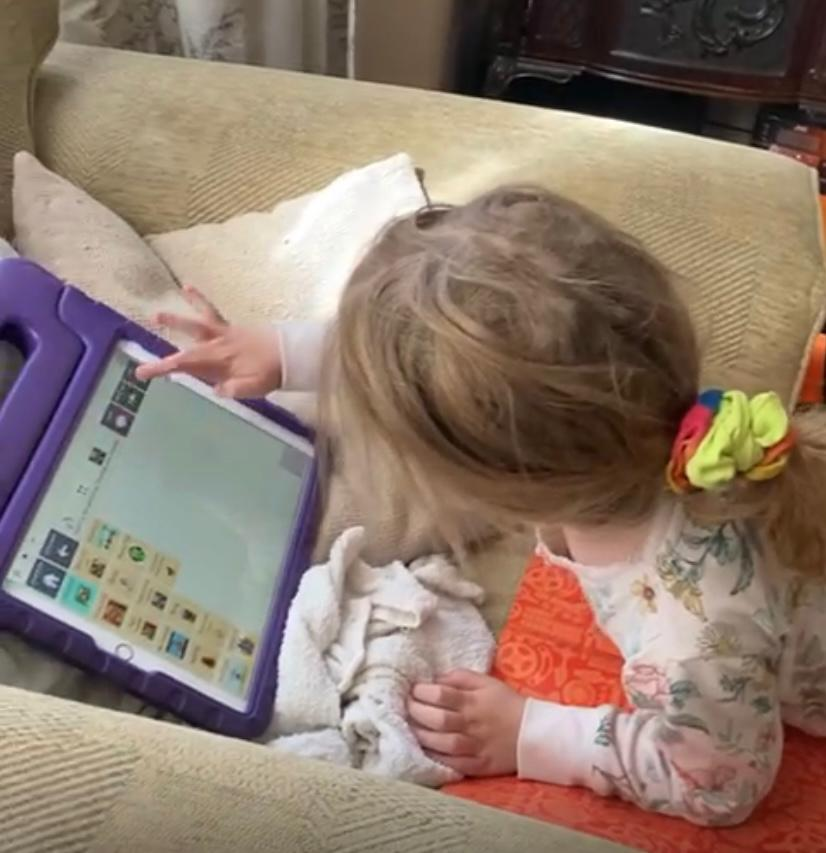
  • High-tech systems: Apps on tablets that speak aloud when pictures or words are tapped

AAC is not just for children who will never talk. It’s for anyone whose speech isn’t meeting their communication needs right now.

🤔 When to introduce AAC

There’s a common myth that you should only try AAC after ‘exhausting’ other speech therapy options. In fact, AAC can be introduced at any stage, even alongside speech development.

Here are some helpful signs that AAC might support your child:

  • Your child understands much more than they can say.
  • They rely on gestures, sounds, or behaviour to communicate.
  • They become frustrated trying to express themselves.
  • You find yourself ‘reading their mind’ to interpret needs.
  • Speech progress feels slow or inconsistent.

If you recognise these patterns, AAC isn’t a ‘last resort’. It’s a communication support, not a replacement for speech.

Recent research consistently shows that AAC does not stop children from talking. In fact, it can encourage speech to develop. A 2024 systematic review and meta-analysis published in the Journal of Autism and Developmental Disorders found that children who received interventions combining naturalistic developmental behavioural approaches with aided AAC showed improved language outcomes, and that AAC ‘does not negatively impact speech development and may even facilitate spoken language growth’ (Smith et al., 2024).

🌉 How AAC supports speech development

Speech and AAC aren’t competing paths: they’re parallel tracks that often feed each other.

Here’s how AAC helps speech grow:

  1. Reduces frustration: When a child can express their needs, they’re more relaxed and ready to learn.
  2. Provides a visual model: Seeing symbols or words while hearing spoken language strengthens understanding and word recall.
  3. Builds consistent language structure: AAC systems follow the same grammar and word order as speech, helping children internalise how sentences work.
  4. Encourages turn-taking and social connection: AAC lets children join conversations even before speech is fluent, giving them more practice in real communication.

AAC is not ‘giving up on speech’. It’s giving a child more ways to succeed while speech continues to develop.

🧩 How to introduce AAC gently and effectively

  1. Start small and meaningful: Begin with a few key messages your child wants to say, not just what adults want to hear. Think ‘I want’, ‘stop’, ‘help’, ‘more’, ‘all done’, ‘no’, ‘again’. These are powerful words for real interaction and autonomy.
  2. Model, model, model: The most important part of AAC success is modelling—using the system yourself as you talk. For example: ‘You want banana 🍌’ and you tap the ‘want’ and ‘banana’ symbols. Children need to see and hear AAC used naturally before they try it themselves.
  3. Use it throughout the day: AAC isn’t a therapy tool to take out once a week. It’s a living part of communication. Model a few words during mealtimes, play, and routines. The more consistently it’s embedded, the more fluent both you and your child will become.
  4. Keep it accessible: If using a device or picture board, make sure it’s always nearby. If it’s in a bag or drawer, it can’t be used in real moments.
  5. Celebrate all communication: If your child points, signs, uses a sound, or taps a symbol, it all counts. Respond warmly and naturally to reinforce communication in any form.

🧠 What parents often worry about

  • ‘Won’t AAC stop them from talking?’: No. Research shows AAC use either has no negative effect on speech or leads to increased spoken output (Smith et al., 2024). When children feel understood, their motivation to communicate grows.
  • ‘What if I model it wrong?’: There’s no perfect way to start. Your effort and consistency matter far more than accuracy.
  • ‘Will they get ‘stuck’ using pictures?’:  Some children do continue using AAC long-term; others move naturally toward more spoken language. The goal is always functional communication, not replacing one form with another.

🪞 Bringing AAC into daily life

Here are a few simple, parent-friendly ideas:

  • Create visual spaces: Post symbols or core words on the fridge, mirror, or play area.
  • Narrate routines: Use AAC during toothbrushing, dressing, or mealtimes; consistent contexts build understanding.
  • Pair speech and touch: Always say the word aloud when you point to or tap a symbol.
  • Involve siblings and friends: Model how they can respond to AAC too. ‘Oh, you said go! Let’s go fast!’
  • Use shared books and songs: Pause and model key words in stories or songs.

🌱 The takeaway

AAC doesn’t mean giving up on speech; it means opening more doors to communication. When words don’t come easily, AAC gives children a way to connect, share, and be heard.

It helps parents move from guessing to understanding, and gives children the power to express themselves on their own terms.

If you’re unsure where to start, reach out to a speech and language therapist experienced in AAC. Together, you can find a system that fits your child’s strengths, build confidence in modelling, and help every word (spoken or tapped) feel like a step forward.

And download and print my one page summary.

Because when communication is possible, everything else begins to grow.

Sonja McGeachie

Highly Specialist Speech and Language Therapist

Owner of The London Speech and Feeding Practice.

📚 Reference

Smith, K., et al. (2024). The Effect of Naturalistic Developmental Behavioral Interventions and Aided AAC on the Language Development of Children on the Autism Spectrum with Minimal Speech: A Systematic Review and Meta‑Analysis. Journal of Autism and Developmental Disorders, 55, 3078–3099. https://doi.org/10.1007/s10803-024-06382-7

Health Professions Council registered
Royal College of Speech & Language Therapists Member
Member of ASLTIP

Find a speech and language therapist for your child in London. Are you concerned about your child’s speech, feeding or communication skills and don’t know where to turn? Please contact me and we can discuss how I can help you or visit my services page.

2

Similar Posts

  • ·

    Answers to very common questions I get as a Feeding Therapist

    What are hunger cues in newborn babies? How do we recognise when our baby is hungry? How often should we feed our baby?

    These are very common questions I get as a Feeding Therapist. And so I thought I would write a blog on it.

    A mother holding her baby on one arm in her lap while holding a cup
    Image by Freepik

    First-time parents’ journey

    First-time parents often imagine that feeding, particularly breastfeeding, will be an easy and natural process without too many problems. It can be a rude awakening to find that feeding our newborn is not at all easy and can be fraught with complications. It is fair to say that in most cases by the time our baby is about eight weeks old most mums have got the hang of feeding, either by breast and/or bottle, and things are falling into place.

    But until that time it can be a difficult journey:

    • getting to know one’s baby,
    • getting to know their feeding rhythm,
    • falling in with it,
    • TRUSTING that baby knows what they need and knows when they have had enough,
    • TRUSTING and not going crazy with going down an on-line rabbit hole of information and guidance mostly unnecessary and often quite simply FALSE!

    Many mums I have met set out with the best intentions to breastfeed for as long as possible. However, they arrive in my clinic anxious and often have given up with the breast; now we are on bottle feeds and things are still very tricky for several reasons. There are too many reasons for this blog to cover but I thought I would start with the basics and ‘reading hunger cues’ is one of those early basics.

    Reading hunger cues

    So let’s dive in:

    Newborns communicate hunger through a variety of cues. Here are some early signs to look for:

    • Early hunger cues: These are the best times to respond to baby’s hunger for a more peaceful feeding. Look for things like:
      • Becoming more alert and active
      • Turning head from side to side in the cot
      • Rooting (turning their head towards your breast or a bottle, especially when stroked on the cheek)
      • Putting hands/fists to mouth
      • Sucking on fists or lips
      • Opening and closing mouth, smacking sounds
    TOP TIP: THIS IS WHERE YOU SHOULD GET READY TO FEED. Breast or bottle. Either way get ready. We do not want our baby to get into later hunger cues, which are below:
    • Later hunger cues: If we miss the early cues, babies will progress to more insistent hunger cues. These include:
      • Fussiness or whimpering
      • Rapid sucking motions
      • Increased squirming
      • Head bobbing

    Generally, remember that we do not want our baby to cry for their food. Because once they are riled and cry they are not relaxed enough to latch, especially when latching is hard!

    Feeding on demand vs. scheduled feeds

    We now know and have researched how babies are fed best and safest, how weight gain is ensured best, both for breastfed and bottle-fed babies.

    It’s generally recommended to feed on demand—unless your baby is tube-fed or has some other pressing health concerns or is failing to thrive.

    What are the benefits of on demand feeding?

    • We need to respond to baby’s individual needs and hunger cues because every person is unique!
    • Babies need to learn and regulate their own hunger and satiation cycles
    • Promotes better weight gain and growth
    • Leads to more peaceful feeding experiences

    Scheduling can come later

    A loose schedule might emerge naturally when your baby is around 2–3 months old, but it’s best to follow your baby’s lead.

    Tips:

    • Some newborns may feed every 2–3 hours, while others go longer stretches. Pay attention to your baby’s cues and feeding habits.
    • Crying is a late hunger cue, and frequent crying can make feeding more difficult. Responding to earlier cues is best.
    • If you have concerns about your baby’s feeding patterns or weight gain, consult with a Speech and Language Therapist/Dysphagia Therapist and/or Lactation Consultant.

    Check out these useful resources on  the topic of Demand Feeding:

    Do get in touch if you would like some in-person or on-line 1:1 support with this. It can be overwhelming to figure it all out alone.


    Find a speech and language therapist for your child in London. Are you concerned about your child’s speech, feeding or communication skills and don’t know where to turn? Please contact me and we can discuss how I can help you or visit my services page.

    1
  • ·

    Four Ways to Progress your Child’s Language and Build Confidence

    A child is using a tablet

    Watching your child’s confidence grow as their language develops is something you dream of. You feel helpless, you watch your child repeat language over and over and this concerns you. You know you should be supporting their communication development, but you feel stuck. You’ve reached the point where you don’t know where to turn to for support. Accessing the knowledge of a Speech and Language Therapist is a great place to start.

    Here are four ways to support your child’s language:

    1. Provide great communication models that include scripts or “gestalts”

    Instead of commenting with single words like “apple” or two word phrases e.g., “want apple”, it is more beneficial to comment with small sentences or scripts such as “let’s eat an apple”, “I want an apple mummy”, “I want more apple please” or “I’m hungry daddy.”

    These are phrases that include more intonation and rhythm (top tip: ensure you do use appropriate intonation and rhythm), and your child is likely to pick up those phrases and copy them much more easily than single words or two-word phrases.

    2. Offer a robust Alternative and Augmentative Communication (AAC) device

    There are many examples of AAC devices such as ‘Lamp for Life’ or ‘Grid Smartbox’. It’s vital that you consult a Speech and Language Therapist with a specialism within this area of communication. You want your child to be able to communicate their wants and needs. Furthermore, their communication buttons need to be tailored to your child’s interests so they are motivated to use them (e.g. if your child likes Thomas the Tank Engine, you may wish to program in specific phrases such as “I want to watch Thomas the Tank Engine”. It is also important that the devices are suitable for your child’s physical and emotional stage of development.

    3. Learn to be a word detective

    Listen to your child’s echolalia (or repetitions) and try to understand what they mean. Their communication is often meaningful around a previous experience. For example, one of my students says, “bang my head” and that actually means “I want to play that tickling game again” (where I banged my head the other day).

    4. Take turns with your child and copy their scripts

    This shows you are listening actively and value their attempts at language. We all love it when someone is actively listening and trying to decode what we are saying.

    Take heart and try not to worry. You’re doing the best you can. Your child is more than likely a Gestalt Processing Learner and so they are moving through very defined stages. Echolalia (repetition) is the first of many, so you have an exciting journey ahead watching your little one’s language grow and develop.

    Reduce your child’s frustration and build their confidence today.

    Contact me here for speech and language advice and AAC support


    Find a speech and language therapist for your child in London. Are you concerned about your child’s speech, feeding or communication skills and don’t know where to turn? Please contact me and we can discuss how I can help you or visit my services page.
  • · ·

    Explaining pronoun reversal: A window into gestalt language processing

    Explaining pronoun reversal: A window into gestalt language processing

    Have you noticed your child referring to themselves as ‘you’, or calling you ‘me’? This seemingly confusing mix-up of pronouns, known as pronoun reversal, often raises concerns for parents. Below I outline why your child does this and want to reassure you that it is to do with his or her unique language learning style.

    Gestalt language processing: Learning in chunks

    Many children, particularly those on the autism spectrum, use a gestalt language processing approach. Unlike analytic language processors who learn individual words and build sentences, gestalt language processors learn language in whole ‘chunks’ or ‘gestalts’. Think of these gestalts as pre-packaged scripts they pick up from their environment — phrases, sentences, even snippets of songs or movie lines.

    As Marge Blanc, author of Natural language acquisition on the autism spectrum, explains, ‘When a child picks up an entire gestalt (script), he’s got the pronoun of the original speaker. So ‘pronoun reversal’ is nothing more than that.’

    So your child is simply repeating what they’ve heard, without yet understanding the individual word meanings or grammatical functions.

    Imagine your child hearing ‘You want a rice cake?’ repeated frequently. They might then use this phrase to express their own desire for a rice cake, even though it doesn’t grammatically fit. So they are thinking and saying ‘You want a rice cake?’ and the meaning of this phrase is: ‘I want a rice cake’. This isn’t a sign of confusion, but a natural step in their language development. They’re working with the tools they have: the scripts they’ve acquired.

    How can we support their natural language journey

    Instead of trying to ‘correct’ pronoun usage, our role as caregivers and speech therapists is to support the child’s natural language progression. Here’s how we can do this:

    1. Learn about their gestalt stage and run with it: In the early stages (1–3) of gestalt language development, correcting pronouns can be counterproductive. These children are still processing language as whole units, not individual words. Direct corrections can lead to frustration and hinder their natural language exploration.
    2. Patience and trust: Gestalt language processing follows a predictable, albeit sometimes non-linear, path. By understanding their current stage, we can provide targeted support. Language sampling and scoring, guided by the Natural Language Acquisition framework, help us pinpoint their stage and tailor our approach.
    3. Model language strategically: In the early stages, avoid using pronouns like ‘you’ and ‘you’re’. Instead, model language from the child’s perspective or use joint perspectives. For example, instead of ‘Are you thirsty?’, try ‘I’m thirsty!’ or ‘Let’s get some water’,

    The big picture: Language unfolds naturally

    Pronoun reversal is a stepping stone, not a stumbling block. As gestalt language processors progress, they begin to break down these gestalts into smaller units and develop their own self-generated language. This is when their understanding and use of pronouns naturally emerge.

    By shifting our perspective from ‘error correction’ to ‘developmental support’, we create a nurturing environment for these children to thrive. We empower them to navigate their unique language journey, ultimately leading to more meaningful and independent communication.

    So, to summarise:

    • Pronoun reversal is a typical characteristic of early-stage gestalt language processing.
    • Focus on modelling language from the child’s perspective or a joint perspective.
    • Avoid correcting pronouns in the early stages.
    • Trust the process and support the child’s natural language development.

    Let’s celebrate the diverse ways our children learn to communicate and empower them to find their unique voice!

    If you have any questions or would like some help with understanding your little gestalt language learner, please get in touch with me via my contact form.

    Sonja McGeachie

    Highly Specialist Speech and Language Therapist

    Owner of The London Speech and Feeding Practice.


    Health Professions Council registered
    Royal College of Speech & Language Therapists Member
    Member of ASLTIP

    Find a speech and language therapist for your child in London. Are you concerned about your child’s speech, feeding or communication skills and don’t know where to turn? Please contact me and we can discuss how I can help you or visit my services page.

    1
  • · ·

    Speech Sounds Practice at home

    Speech therapists use a variety of tools to help children master specific sounds, and then the students are sent home with some practice sheets to use daily. Parents are able to observe what we do in the session, but I know that back at home three days later they can’t quite remember what it was all about and how to do the practice.

    Here I explain the importance of visual cues, finger shapes, pictures, and semantic prompts (fancy speech therapy term for word clues!). By understanding these tools, you can turn practice time into a fun and engaging experience for both of you.

    Why Visual Cues matter?

    Imagine learning a new language just by listening. It’s tough, right? Young children learning new speech sounds face a similar challenge. Visual cues act like flashcards for their minds, giving them a clear picture of how to position their mouth and tongue.

    • Mirrors: Encourage your child to watch your face (and theirs) in the mirror as you make the sound together. This helps them see the tongue placement and lip movements required.
    • Mouth pictures: Speech therapy sheets often have pictures of mouths making specific sounds. Point to the picture and explain how the tongue and lips look, then have your child try to imitate it.
    • Your face is the best cue! Don’t underestimate the power of your own face. Over-enunciate the sound and let your child observe your mouth movements. Watch this little video clip where I am teaching the /SH/ sound to my little student. You cannot see him but we are both sitting on the floor opposite one another so that he can see me easily.

    Finger fun: making sounds with our hands

    Finger shapes are another powerful tool in my speech therapy arsenal. Think of them as fun reminders of how to position the tongue.

    • ‘Open Wide’ fingers: For sounds like /AH/ and /OH/, hold your fingers wide apart, mimicking an open mouth.
    • ‘Tongue Up’ fingers: For sounds like /T/ and /D/, touch the tip of your thumb to your other fingers, creating a little ‘wall’ like the tongue tip touches the teeth ridge.
    • ‘Snake Tongue’ fingers: For the /S/ sound, wiggle your pinky finger to represent the snake-like tongue tip.
    • In this little video clip I am demonstrating the C-shape moving forward which I had taught my child, showing how the windy sound (/SH/) travels forward with lips open and slightly pursed.

    Bringing sounds to life with pictures

    Pictures serve as visual prompts to connect the sound with a familiar word.

    • Video clip: I am using the WINDY SOUND picture and the FLAT TYRE sound picture to represent /SH/ and /S/ respectively
    • Point and Say: Point to each picture and say the word clearly, emphasising the target sound. Encourage your child to repeat.

    Unlocking sounds with semantic prompts

    Semantic prompts are fancy words for clues that help your child guess the target sound. They can be simple questions or descriptive words.

    • ‘Can you feel the wind whooshing?’ (/SH/)
    • Think of tyre going flat, or a balloon losing air, or a train coming to a slow halt (/S/)

    Practice makes progress, but fun makes it funnier!

    Remember, the key is to keep practice sessions light and engaging. Here are some extra tips:

    • Short and sweet: Stick to short practice times (5-10 minutes) to avoid frustration.
    • Make it a routine: Integrate practice time into your daily routine, like after breakfast or before bedtime.
    • Positive reinforcement: Celebrate your child’s efforts with praise and high fives!
    • Make it multisensory: Incorporate sensory activities like blowing bubbles for /F/ or feeling the wind for /SH/.

    Parents you’re a vital part of your child’s speech development, and together we can make huge progress quickly.

    Please contact me if your child has speech sound difficulties.

    Sonja McGeachie

    Early Intervention Speech and Language Therapist

    Feeding and Dysphagia (Swallowing) Specialist The London Speech and Feeding Practice

    The London Speech and Feeding Practice


    Find a speech and language therapist for your child in London. Are you concerned about your child’s speech, feeding or communication skills and don’t know where to turn? Please contact me and we can discuss how I can help you or visit my services page.

    1
  • · · ·

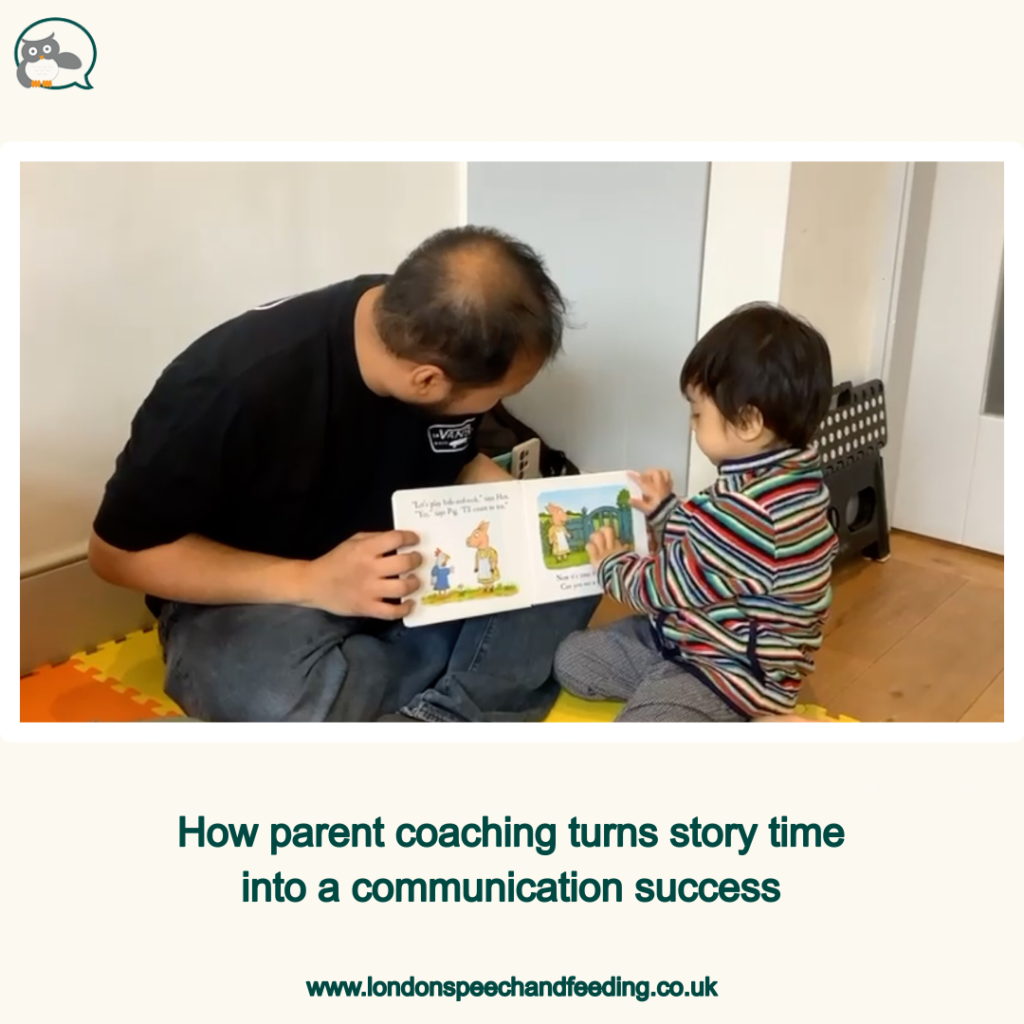
    How parent coaching turns story time into a communication success

    We often hear from parents who are trying their best to connect with their child, especially when reading books, but are met with frustration. They’ll say, ‘I read the book exactly as it’s written, but my child can’t focus for very long and just runs off!’ or ‘my child just flicks through the pages then turns it upside down and runs off with it’ or similar.

    It’s a common story. Traditional reading—going through the text from cover-to-cover—has its place of course, but for little ones with a language delay or autism it can move too quickly and place all the focus on the book’s words, not on the interaction.

    But what if I told you that story time could become one of the most fun and productive times for your child’s communication development?

    Watch the fantastic little video clip above! You can see the pure joy and connection between this dad and his son. This is the same family who, just a few weeks ago, felt defeated when trying to read a book, with their child quickly losing interest and leaving the reading/book corner.

    What changed?

    The power of parent coaching and Hanen principles

    The difference you see in the video is the direct result of parent interaction therapy, or parent coaching, based on the internationally recognised Hanen principles.

    I didn’t ‘fix’ the child. Instead, I coached the parents in a few simple, powerful strategies that completely changed the dynamic of their interaction. Instead of being a time for teaching and instruction, story time became a back-and-forth conversation.

    Here are the four major transformations that coaching helped this family achieve:

    1. From reader to play partner

    Before coaching, the parents felt their job was to read the text and to teach the words in it to their child. Now, their job is to follow their child’s lead. They learned to Observe, Wait, and Listen (OWL). If the child points to the tree or the badger on the page, the parent talks about the tree or the badger.

    The result

    The child is now initiating and leading the conversation! He is sharing what he finds interesting, which makes him feel powerful and keeps him deeply engaged.

    2. Building connection and attention

    When parents focus solely on reading, they often forget to make frequent eye contact and use animated facial expressions. The principles taught them to put the text aside and prioritise connection.

    The result

    Our little boy is looking at his dad more frequently, making great eye contact, and clearly having fun! When the interaction is fun, the child’s attention span naturally lengthens, allowing him to attend to the book and the interaction for a much longer time.

    3. Creating opportunities for communication

    The parents learned simple ways to prompt communication without pressure. They stopped asking knowledge-based questions (‘What colour is that? Or point to the pig!’), which can feel like a test.

    Instead, they learned to use techniques like ‘Saying less and pausing’ or ‘copying their little one’s echolalia ‘, signalling that they are very interested in what he is saying and that his communication matters!

    The result

    The child is now spontaneously using strings of sounds and gestures to communicate his needs and interests, knowing and enjoying his parents’ enthusiastic responses.

    This video is a testament to the fact that you are your child’s best therapist. With the right tools and coaching, you can transform everyday routines, like reading a book, into the most joyful and effective communication sessions.

    4. Acknowledging and interpreting echolalia

    In the video, you may hear the little boy repeat a phrase from the book or from what his dad just said. This is called echolalia, and for a long time, it was often dismissed or discouraged.

    However, a core principle of our parent coaching is that echolalia is communication. For children who are ‘Gestalt Language Processors,’ these memorised phrases (or ‘gestalts’) are their building blocks of language.

    The key is not to stop the repetition, but to become a ‘language detective’ and ‘interpreter’!

    By modelling the correct, first-person phrase right after the echo, parents/caregivers are teaching a child how to break down the ‘chunk’ and use the individual words functionally. They are showing their child: ‘I heard you. Your communication makes sense to me.’

    This strategy is a game-changer because it:

    1. Validates the child’s communication: It honours the child’s natural way of learning language, which boosts their confidence and willingness to communicate.
    2. Facilitates language development: It provides the child with the next step—a meaningful, functional phrase—to move them from repeating language to generating their own spontaneous sentences.

    Look at the child’s face again in the video. When his dad acknowledges and interprets his communication, you see that spark of joy and connection—that’s the moment when true, functional language learning happens!

    Ready to unlock the potential in your family’s story time? Contact me to learn more about our parent coaching programs.

    Sonja McGeachie

    Highly Specialist Speech and Language Therapist

    Owner of The London Speech and Feeding Practice.


    Health Professions Council registered
    Royal College of Speech & Language Therapists Member
    Member of ASLTIP

    Find a speech and language therapist for your child in London. Are you concerned about your child’s speech, feeding or communication skills and don’t know where to turn? Please contact me and we can discuss how I can help you or visit my services page.

    2
  • · ·

    The power of babble: Why your baby’s ‘talk’ matters

    That adorable string of ‘ba-ba-ga-ga-ma-ma’ might sound like baby gibberish, but it’s actually a crucial milestone in your little one’s language development. Babbling or babble, as we call it, is far more than just cute baby noises. It’s a sequence of sounds that lays the foundation for future communication.

    Image by freepik

    What is babbling?

    Babbling typically begins around six months of age, though the timing can vary slightly from baby to baby. It involves your baby experimenting with different sounds, stringing together consonants and vowels. You might hear them repeating sounds like:

    • ‘Ba-ba’
    • ‘Da-da’
    • ‘Ma-ma’
    • ‘Ga-ga’

    As they progress, the babbling becomes more complex, with variations in pitch, rhythm, and intonation. It might even sound like they’re having a conversation with you!

    Why is babbling so important?

    1. Laying the groundwork for speech: Babbling is like a vocal workout for your baby. By practising these sounds, they’re strengthening the muscles in their mouth, tongue, and vocal cords that are essential for speech.
    2. Developing phonological skills: Through babbling, babies begin to understand the sound patterns of their native language. They’re learning which sounds go together and how they’re used.
    3. Enhancing social interaction: Babbling is a social activity. Babies often babble back and forth with their caregivers, which helps them learn about the give-and-take of communication.
    4. Cognitive development: The act of babbling requires babies to use their brains in new ways. They’re learning to control their vocalisations, pay attention to the sounds they’re making, and connect those sounds to the responses they receive from others.

    How can you encourage babbling?

    • Talk to your baby: Even though they can’t understand your words yet, talking to your baby exposes them to language and encourages them to respond with their own vocalisations.
    • Imitate their sounds: When your baby babbles, imitate them! This shows them that you’re paying attention and encourages them to keep ‘talking.’
    • Respond to their babbling: Treat your baby’s babbling as if it’s a real conversation. Respond with words, smiles, and gestures.
    • Play sound games: Make different sounds for your baby and encourage them to imitate you. This could include animal sounds, silly noises, or simple words.
    • Read to your baby: Even before they can understand the words, reading to your baby exposes them to the rhythm and sounds of language.
    • Sing songs: Singing is a fun and engaging way to introduce your baby to new sounds and words.
    • Use mirrors: Babies often enjoy watching themselves make sounds in a mirror.
    • Tactile stimulation: Gentle massage around the mouth and face can increase oral awareness and encourage vocalisations.
    • Vary textures: Offer different textured teethers.
    • Read books with sound effects: Choose books with animal sounds or other engaging noises.
    • Blow bubbles: The act of blowing and popping bubbles can encourage vocalisations.
    • Use visual aids: Show pictures of objects and say their names, emphasising the consonant sounds.
    • Use exaggerated facial expressions: When you make sounds, exaggerate your mouth movements to help your baby see how sounds are made.
    • Increase joint attention: Follow the child’s gaze and point to objects that they are looking at and say the name of the object.

    When to seek help

    If you notice that your baby is not babbling by eight months, it’s a good idea to talk to your speech and language therapist. You might also notice a lack of variation in tone when your child is making sounds, is your baby sounding a little ‘flat’ or monotonous? While every child develops at their own pace, a lack of babbling can sometimes indicate a developmental delay or hearing issue.

    Remember, babbling is a gift. So, enjoy those precious moments of ‘baby talk’ and take comfort in knowing that your little one is on the path to becoming a chatterbox!

    Do get in touch via my contact form if you are concerned about your child’s development or if you simply want some reassurance that your baby is developing well. We will be delighted to arrange a screening appointment for you and give you support and reassurance.

    Sonja McGeachie

    Highly Specialist Speech and Language Therapist

    Owner of The London Speech and Feeding Practice.


    Health Professions Council registered
    Royal College of Speech & Language Therapists Member
    Member of ASLTIP

    Find a speech and language therapist for your child in London. Are you concerned about your child’s speech, feeding or communication skills and don’t know where to turn? Please contact me and we can discuss how I can help you or visit my services page.

    1