Using AAC during play with your child

| |

Playtime! It’s a magic time for exploration, learning, and connection.

If your child is struggling to use words with his/her mouth, we can always use a robust Augmentative and Alternative Communication (AAC) device to help find their words. We know that using such a device does never stop or delay children to speak with their mouths. On the contrary it helps, enormously!

Can playtime still be a blast? Absolutely! In fact, incorporating AAC into play can be a powerful way to boost communication skills, build confidence, and create a truly inclusive play experience. Here’s how to make it happen, with a focus on core words and core scripts for our GLP’s (the building blocks of communication used by everyone). In this video I am using the core word ‘IN’ and ‘MORE’.

The Magic of Core Words

Core words are the most frequently used words in everyday communication. They might be verbs like ‘want’, ‘more’, ‘go’, or ‘stop’, or adjectives like ‘happy’, ‘sad’, and ‘hot’. These words are the foundation for building sentences and expressing needs and desires. They’re perfect for children using AAC because they’re simple to understand and use.

Let’s Play! Here’s How

1. Choose Your AAC System

Many options exist! It could be a low-tech picture board with core words, such as the one you see pasted on my cabinet door in the background, or it can be a dedicated AAC app on your tablet. Here I am using the GRID app but I also love using others, such as LAMP Words for Life.

2. Make it Fun and Functional

No pressure! Integrate your AAC system seamlessly into your play routine. Here are some ideas:

  • Car/trains: Use core words to describe what the cars are doing: (‘down’, ‘go’, ‘stop’, ‘again’ ‘fast’ ‘slow’).
  • Dress-up: Use core words to choose clothes (‘want’, ‘hat’, ‘shoes’).
  • Tea Party: Use core words to ask for and share (‘more’, ‘juice’, ‘give’).
  • Building Blocks: Use core words to describe what you’re building (‘tall’, ‘big’, ‘house’).
  • Dolls/Stuffed Animals: Use core words to act out scenarios (‘sleep’, ‘eat’, ‘cry’).
  • Arts and Crafts: Use core words to describe colours (‘red’, ‘blue’), actions (‘draw’, ‘paint’), and feelings (‘happy’, ‘sad’).

If your child is a Gestalt Language Processor you will want to model meaningful, fun scripts instead of single words! As above, but use phrases:

  • Car/trains: Use scripts to describe what the cars are doing: (‘it’s going down’, ‘let’s go’, ‘make it stop’, ‘want it again’, ‘that was fast’, ‘it’s so slow’).
  • Dress-up: Use scripts to choose clothes (‘I’m gonna wear this’ ‘that’s a lovely hat’, ‘let’s choose shoes’).
  • Tea Party: Use scripts to ask for and share (‘I want more’, ‘more juice’, ‘give me this’).
  • Building Blocks: Use scripts to describe what you’re building (‘a tall one’, ‘that’s so big’, ‘it’s a house’).
  • Dolls/Stuffed Animals: Use scripts to act out scenarios (‘it’s time to sleep’, ‘let’s eat’, ‘he’s crying’).
  • Arts and Crafts: Use scripts to describe colours (‘a red crayon’), actions (‘let’s draw’, ‘I’m gonna paint’), and feelings (‘I’m happy’, ‘that’s so sad’).

3. Model, Model, Model

This is key! As you play, constantly model using your child’s AAC system.

  • Point to the picture or word or script you’re using.
  • Speak clearly and slowly while pointing.
  • When using core words for either Analytical or Gestalt Language Processors, try using good phrases. For example, instead of just saying ‘juice’, say, ‘you want more juice?’

4. Make it a Team Effort

Get everyone involved! Encourage siblings, grandparents, and caregivers to use the AAC system with your child during playtime. The more consistent the approach, the faster your child will learn and feel confident using their voice.

5. Celebrate Progress, Big and Small!

Every step counts! Acknowledge and celebrate your child’s efforts, whether it’s reaching for their AAC system or successfully using a core word. This positive reinforcement will keep them motivated.

Remember

  • Playtime should be fun, not stressful. Don’t force your child to use their AAC system. Let them lead the way and follow their interests.
  • Every child develops at their own pace. Celebrate your child’s unique communication journey.
  • Seek professional help when needed. Your SLT can provide tailored strategies and resources to support your child’s development.

By incorporating AAC and core words into playtime, you’re not just fostering communication; you’re creating a space for your child to thrive, explore, and build strong connections.

So, grab those toys, power up your AAC system, and get ready for a playtime adventure filled with fun, connection and, therefore, communication!

Don’t hesitate to contact me!

Sonja McGeachie

Early Intervention Speech and Language Therapist

Feeding and Dysphagia (Swallowing) Specialist The London Speech and Feeding Practice

The London Speech and Feeding Practice


Find a speech and language therapist for your child in London. Are you concerned about your child’s speech, feeding or communication skills and don’t know where to turn? Please contact me and we can discuss how I can help you or visit my services page.


1

Similar Posts

  • The art of selective care: My journey as a semi-retired private therapist

    Welcome!

    Hello, and welcome. I’m writing this today to share a bit about my professional journey, a journey that has evolved over many years from a bustling, full-schedule practice to a more intentional, deeply fulfilling semi-retired life. This shift wasn’t born out of a desire to slow down, but rather an understanding of what truly matters: my time, your time, and the quality of the work we do together.

    For decades, I poured my energy into a full calendar, helping as many families as I possibly could. It was a wonderful, demanding, and rewarding time. I learned so much, grew immensely as a professional, and had the privilege of witnessing countless moments of breakthrough and success. But over recent months, I began to realise that the most impactful work wasn’t about quantity; it was about quality. It was about giving my whole, undivided attention to a select few, creating an environment where true progress could flourish.

    Change

    This realisation led to a significant change in my practice. I am now at a point in my career where my time is both valuable and precious. It is no longer a commodity to be filled, but a resource to be invested wisely. This doesn’t just apply to my personal life, but to my professional life as well. I’ve chosen to be more selective about the clients I see, and this selectivity is rooted in a single, powerful question: ‘Who can I truly, profoundly help?’

    I believe that successful therapy is a partnership. It requires commitment, trust, and a genuine connection between therapist and client. When I take on a new family, I am not just filling a slot in my schedule; I am making a deep commitment to them. I am dedicating a part of my precious time and decades of expertise to their child’s success. This is why I am now focusing on who I can really work with: families who are equally invested in the process, who understand that progress is a team effort, and who are ready to engage fully in the journey.

    My fees reflect this deep investment. You will find that my rates are higher than those of many other therapists, and I want to be transparent about why. It’s a reflection of the extensive experience I bring to the table. I have spent years honing my skills, navigating complex cases, and developing a unique, effective approach to speech, language and feeding challenges. This is not just a job for me. It is my life’s work, and I honour the value of that expertise and the time I dedicate to each family.

    I want to ensure that every minute you spend with me is productive, focused, and truly transformative. Therefore, I provide a ‘boutique style’ of care. Think of it as an exclusive, personalised experience where every detail is considered and your needs are at the forefront. You won’t feel like you’re just another appointment on a long list. You will feel that you have my full, undivided attention, as if you were my only client.

    This means less time spent on administrative tasks and more time dedicated to preparing for your sessions, reflecting on our progress, and providing you with the most thoughtful, tailored support possible. It means an environment of calm and focused expertise, where we can truly dive deep into the specific challenges and build a clear, effective path forward.

    New perspective

    For parents reading this, I hope this provides a new perspective. Choosing a therapist for your child is one of the most important decisions you can make. It’s about finding not just a professional, but a partner. I want you to feel that, if we choose to work together, you are entering into a unique partnership where your child’s growth is my singular focus.

    In this next chapter of my career, I am prioritising passion over pace, depth over breadth, and meaningful connections over a packed schedule. I am here to work with families who are ready for a truly collaborative and transformative experience. If you are seeking a level of care that goes beyond the standard, an approach that is both highly experienced and deeply personal, I would be honoured to speak with you.

    Sonja McGeachie

    Highly Specialist Speech and Language Therapist

    Owner of The London Speech and Feeding Practice.


    Health Professions Council registered
    Royal College of Speech & Language Therapists Member
    Member of ASLTIP

    Find a speech and language therapist for your child in London. Are you concerned about your child’s speech, feeding or communication skills and don’t know where to turn? Please contact me and we can discuss how I can help you or visit my services page.

    1
  • · · ·

    Autism – Benefits of Early Assessment and Intervention

    I think my child might be autistic – how can we help?
    Image by macrovector on Freepik

    Consulting a Specialist Speech and Language Therapist can help you in several ways: assessment, informal and formal observation, discussion and advice, onward referrals, direct intervention, parent coaching, educational support and much more, all geared towards supporting you the parents, and helping your child to flourish and thrive.

    First up, we can help you with assessment and advice: with a wealth of expertise in observing childrens’ play and communication, as well as knowledge of the latest research we can see a child’s strengths and areas of struggle very quickly indeed.

    Within a short space of time, we can identify the areas we need to focus on and start guiding you towards helping your child to connect, respond, react and feel better.

    Early detection is key

    If autism is detected in infancy, then therapy can take full advantage of the brain’s plasticity. It is hard to diagnose Autism before 18 months but there are early signs we know to look out for. Let’s have a brief look at the sorts of things we look at.

    The earliest signs of Autism involve more of an absence of typical behaviours and not the presence of atypical ones.

    • Often the earliest signs are that a baby is very quiet and undemanding. Some babies don’t respond to being cuddled or spoken to. Baby is being described as a ‘good baby, so quiet, no trouble at all’.
    • Baby is very object focused: he/she may look for long periods of time at a red spot/twinkly item further away, at the corner of the room for example.
    • Baby does not make eye contact: we can often see that a baby looks at your glasses for example instead of ‘connecting’ with your eyes.
    • At around 4 months we should see a baby copying adults’ facial expressions and some body movements, gestures and then increasingly cooing sounds we make; babies who were later diagnosed with autism were not seen to be doing this.
    • Baby does not respond with smiles by about 6 months.
    • By about 9 months, baby does not share sounds in a back-and-forth fashion.
    • By about 12 months baby does not respond/turn their heads when their name is called.
    • By around 16 months we have no spoken words; perhaps we hear sounds that sound like ‘speech’ but we cannot make out what the sounds are.
    • By about 24 months we see no meaningful two-word combinations that are self-generated by the toddler. We might see some copying of single words.

    24 months plus:

    • Our child is not interested in other children or people and seems unaware of others in the same room/play area.
    • Our child prefers to play alone, and dislikes being touched, held or cuddled.
    • He/she does not share an interest or draw attention to their own achievements e.g., ‘daddy look I got a dog’.
    • We can see our child not being aware that others are talking to them.
    • We see very little creative pretend play.
    • In the nursery our child might be rough with other children, pushing, pinching or scratching, biting sometimes; or our child might simply not interact with others and be unable to sit in a circle when asked to.

    What sort of speech and language difficulties might we see?

    Our child might do any of the following:

    • have no speech at all, but uses body movements to request things, takes adults by the hand
    • repeat the same word or phrase over and over; sometimes straight away after we have said it or sometimes hours later
    • repeat phrases and songs from adverts or videos, nursery rhymes or what dad says every day when he gets back from work etc.
    • copy our way of intonation
    • not understand questions – and respond by repeating the question just asked:
      • adult: Do you want apple? child: do you want apple?
    • not understand directions or only high frequency directions in daily life
    • avoid eye contact or sometimes ‘stares’
    • lack of pointing or other gestures

    Common behaviours:

    • Hand flapping
    • Rocking back-and-forth
    • Finger flicking or wriggling/moving
    • Lining up items/toys
    • Wheel spinning, spinning around self
    • Flicking lights on and off, or other switches
    • Running back-and-forth in the room, needing to touch each wall/door
    • Loud screaming when excited
    • Bashing ears when frustrated or excited
    • Atypical postures or walking, tip toeing, can be falling over easily, uncoordinated
    • Can be hyper sensitive to noises, smells, textures, foods, clothing, hair cutting, washing etc.
    • Being rigid and inflexible, needing to stick to routines, unable to transition into new environments
    • Food sensitivity, food avoidance, food phobias

    I mentioned this to be a ‘brief’ look at the areas and it is: each topic is looked at very deeply and each area is multi-facetted therefore a diagnosis is rarely arrived at very quickly. We want to make sure we have covered all aspects and have got to know your child very well before coming to conclusions.

    Early detection is key, because we want to start helping your child to make progress as quickly as is possible. If you feel /know that your child is delayed in their speech and language development and you would like a professional opinion then please do contact me, I look forward to supporting you. It is important to know at this point, that if your child only has one or two of the above aspects it may mean that your child is simply delayed for reasons other than Autism and if that is the case, we will be able to help you iron out a few areas of need so that your child can go on thriving.

    If you need help with your child, please do not hesitate to contact me.


    Find a speech and language therapist for your child in London. Are you concerned about your child’s speech, feeding or communication skills and don’t know where to turn? Please contact me and we can discuss how I can help you or visit my services page.

    1
  • · ·

    LAMP Words for Life: A revolutionary AAC system

    Introduction

    When working with non-speaking or minimally speaking children the LAMP Words for Life AAC (Augmentative and Alternative Communication) system is my absolute go-to every time. For me it stands out as a revolutionary system that has transformed the lives of many of my non-speaking students. LAMP Words for Life is a ROBUST, comprehensive language-based AAC system and it is designed to help any user to express their thoughts, feelings, and needs effectively, thereby achieving maximal independence in their daily life. A winner!

    There is a whole host of AAC apps and systems out there and each has their own advantages and benefits for sure. I have tried a good number of other systems. I do also like certain features of other AAC systems for sure. For example GRID: I love the versatility of GRID and the ease of editing the system is fantastic.

    Why I think it works so well

    However, strangely I always return to LAMP when push comes to shove. I have thought very carefully about it and so here are my thoughts on why this is and why it works so well:

    1. Intuitive interface: LAMP Words for Life features are for me really user-friendly and it is easy to navigate and understand (this is very important for non-techy people). I think it makes sense and it is accessible to users of all ages and abilities. Yes the pictures are a little bit different to other symbol systems we use, especially here in the UK to be sure, and this is one of the reasons why it is good to have a variety of systems available, so that we can cater for students who are used to other symbols or do very well with specific symbol core boards. I have learned though that the pictures are not that important when using LAMP because the entire system is based on MOTOR PLANNING. And once one knows the motor plan to find a picture it is in our brain and we do not look at the picture any more. So, the motor plan to find a word is much more important when using LAMP than worrying about what the picture looks like.
    2. Comprehensive vocabulary: The system offers a vast vocabulary of words and phrases, covering a wide range of topics and contexts. This enables users to express themselves effectively on a variety of subjects. That said, almost every time I use LAMP there is a little word I need and it’s not on there. But that’s not a problem: for example, I was looking for ‘sunglasses’ the other day. Sure, there is ‘sun’ and ‘glasses’ but that would be two separate motor plans and for my student that would be too many for now, so it was very easy to quickly add the new word ‘sunglasses’ under ‘accessories’ or ‘beach wear’ — I added it within less than one minute. Likewise, there are a ton of words which cater for the US market, and I tend to change them to fit the UK vocabulary like ‘nappy’ for ‘diaper’. Or I delete them entirely if I feel my child will never need to use a certain word like ‘conference’ or ‘nun’. PS: should they get to a point of using the system as an adult independently then these words can surely be added again, or if my student ever moves to the US then the words can be changed back to US terms again without any problem.
    3. Grammar support: LAMP provides built-in grammar support, helping users construct grammatically correct sentences. This can be particularly beneficial for individuals with language processing difficulties. But what I love about the way LAMP is organised here is that, in contrast with other systems I have used, it does not PREDICT what you want to say, it lets the user decide and find the right grammatical structure. I appreciate this because, just like I hate my phone or email offering predictive text or offer corrections to my words, I really do not get the systems that offer automatically a grammar change which mostly I don’t want. Where that is the case, I am often confused and hindered in finding the correct wording. I love the simplicity of LAMP and at the same the complexity that can be achieved gradually with practice. LAMP is fully designed to enable a user to build up not only vocabulary but a full language system. On a course recently I was able to hear adult LAMP users speaking to the audience in full and quick grammatically well-rounded sentences on a host of topics.
    4. Customisation: LAMP can be customised to meet the individual needs of each user. This includes options for adjusting the vocabulary, layout, and accessibility features. It is not as easy to edit as GRID I will say and that can cause me a little bit of frustration at times, but on balance I still vastly prefer the system as a whole. It can also be customised quite well for Gestalt Language Processors. It takes a little bit of practice and thinking about how best to do this but I have found a way that works well which I demonstrate in the short video clip.
    5. Community support: LAMP Words for Life has a thriving community of users on Facebook and this is so valuable and inspiring. Therapists and families of LAMP users alike share experiences, provide resources, and offer encouragement. This can be a valuable source of support for both users and their families.
    6. Comprehensive support: LAMP Words for Life offers quick and thorough support services, including training, resources, and ongoing assistance. This is invaluable and reassuring for both users and caregivers.
    7. Research-based: The development of LAMP Words for Life is based on extensive research and evidence-based practices. This ensures that the system is grounded in sound scientific principles.

    Conclusion

    To conclude LAMP Words for Life is a powerful AAC which provides us with a means of effective communication, language development, and social interaction. Whether you are a parent of a non-speaking child or a speech therapist looking for innovative AAC solutions, LAMP Words for Life is worth exploring.

    Example on how to use AAC at story time

    Feel free to contact me if you need help with your child.

    Sonja McGeachie

    Early Intervention Speech and Language Therapist

    Feeding and Dysphagia (Swallowing) Specialist The London Speech and Feeding Practice

    The London Speech and Feeding Practice


    Find a speech and language therapist for your child in London. Are you concerned about your child’s speech, feeding or communication skills and don’t know where to turn? Please contact me and we can discuss how I can help you or visit my services page.

    1
  • · ·

    Support your autistic child’s communication by learning the stages of Gestalt Language Processing

    If your child is using echolalia and/or has a diagnosis of autism, then your child’s way of processing language is most likely different to the classic way children typically learn language. We call this process Natural Language Acquisition or Gestalt Language Processing.

    Speech Therpaist in London
    Step by Step guide to Gestalt Learning

    Let’s explore the following stages of Gestalt Processing:

    Stage 1: communicative use of whole language gestalts

    (e.g., “let’s get out of here”)

    Children and young people in this stage use echolalia. They need to hear more gestalts or scripts. So, your job is to model, model, model and to use functional language that your child can repeat back.

    Stage 2: mitigated into chunks and re-combining these chunks

    (e.g., “let’s get” + “some more”) and (e.g., “let’s get” + “out of here”)

    This is when you take parts of gestalts or phrases and then combine it with other parts.

    Stage 3: further mitigation (single words recombining words, formulating two-word phrases)

    (e.g., “get…more”)

    They are going beyond their gestalts. Furthermore, they may begin to label different objects.

    Stage 4: formulating first sentences

    (e.g., “let’s get more toys”)

    You may see more grammatical errors during this phase as they are creating unique sentences. Please don’t worry about this, it means they are playing and experimenting with language. As communication partners, you could model the correct form of the sentence.

    Stages 5 & 6: formulating more complex sentences

    (e.g., “how long do you want to play inside for?”)

    You can see that language learning is a process, that is trialled and tested, used in different contexts for children to be able to learn and use language appropriately.

    My next blog will give you activities ideas and how you might use them specifically with a Gestalt Language Processor.

    Remember early intervention is vital. So, if you have any concerns, please seek the advice of a Speech and Language Therapist.

    Contact me, Specialist Speech and Language Therapist Sonja here.

    Find a speech and language therapist for your child in London. Are you concerned about your child’s speech, feeding or communication skills and don’t know where to turn? Please contact me and we can discuss how I can help you or visit my services page.
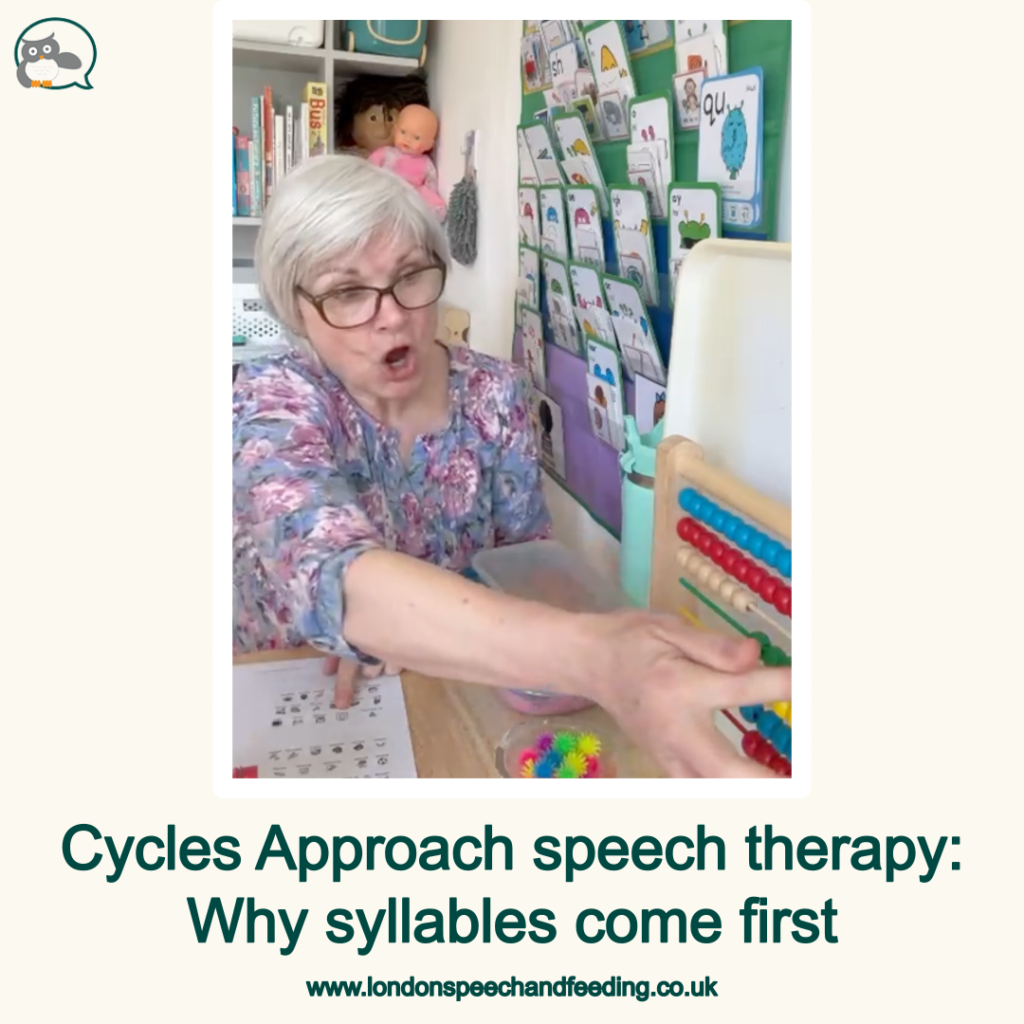
  • · · ·

    The joy of container play: Exploring play development and understanding of how things work

    Have you heard the term ‘Container play’? I use this very often with children in my sessions as it is so versatile and an enjoyable activity that can be done in parallel with a child or together. Container play is a powerful tool for fostering development in young children, especially those with developmental delays. This seemingly mundane activity provides a rich environment for sensory exploration, motor skill development, and cognitive growth.

    What is container play?

    Container play involves children interacting with various containers—boxes, buckets, bowls, cups, various bags, etc.—and filling, emptying, and transferring objects within and between them. Objects can include literally anything: small beads, bead chains, table tennis balls, wooden pegs, dinosaurs or any other little person toy, blocks of varying sizes, sand, water, or any other safe material. Larger containers obviously take larger items: socks, stuffed animals, bigger balls, bigger blocks etc really the choices are endless.

    Benefits for children with developmental delays:

    Sensory exploration:

    • Touch: Children explore different textures and temperatures of containers and objects.
    • Sight: They observe how objects look inside and outside the containers, how light reflects off them, and how colours change.
    • Sound: They listen to the sounds of objects clinking, rattling, and splashing.
    • Proprioception: Filling and emptying containers helps develop body awareness and spatial awareness.

    For neurodivergent children who might have sensory regulation difficulties, consider the following adaptions to accommodate your child’s sensory needs:

    • Over-stimulation: For children who are easily overstimulated, start with simple setups using a limited number of containers and objects. Gradually increase the complexity as they tolerate it.
    • Under-stimulation: For children who seek sensory input, provide a variety of textures and materials, such as sand, water, slime, or beans.
    • Temperature: Offer a variety of temperature options. Some children may enjoy warm water or cool sand.
    • Lighting: Adjust the lighting to create a calming or stimulating environment.
    • Focus on one sense at a time: Initially, focus on one sensory aspect, such as the feel of sand or the sound of water.
    • Weighted containers: Use heavy containers filled with rice or beans to provide deep pressure input.
    • Fidget toys: Incorporate fidget toys into the activity to provide sensory input and help with self-regulation.
    • Tactile exploration: Encourage exploration of different textures using objects with varying surfaces.

    Fine motor skill development:

    • Hand-eye coordination: Scooping, pouring, and transferring objects require precise hand-eye coordination.
    • Pincer grasp: Picking up small objects helps develop fine motor skills like the pincer grasp.
    • Strength and dexterity: Manipulating containers and objects strengthens hand muscles and improves dexterity. Opening and closing containers can be a huge area of interest; how does the top screw back on, or off?

    Cognitive development:

    • Cause and effect: Children learn that their actions (e.g., pouring water or sand) have consequences (e.g., the water spills).
    • Spatial awareness: They develop an understanding of concepts like inside, outside, full, empty, and over/under; also how big is the vessel and how much goes in before it’s full or spills over. How small is the vessel opening and what do I need to do to get the beads into the container.
    • Problem-solving: Children learn to solve problems, such as how to get an object out of a narrow container or how to transfer water without spilling.

    Social and emotional development:

    • Communication: Container play can encourage communication as children interact with others, sharing toys and commenting on their actions. Asking for help to open and close a container is often a great opportunity to practise ‘help me’ or ‘open it’
    • Turn-taking: Sharing containers and materials helps children learn to take turns and cooperate.
    • Sensory regulation: For children with sensory sensitivities, container play can be a calming and self-regulating activity.

    Tips for engaging children in container play:

    • Create a safe and inviting environment. A shower curtain on the floor makes things easier for tidy up afterwards. And it allows for spillages.
    • Provide a variety of containers: Use different sizes, shapes, and materials. Use containers that are visually interesting and pleasing, perhaps a festive biscuit tin, or a tin that looks like train engine. Use see-through containers at first which make the filling and emptying more obvious. This is important for children who have no previous experience with this type of play and need to ‘warm up’ to it. Once a child loves and is used to container play you can go wild with all types of containers.
    • Offer a variety of objects: Include balls, blocks, sand, water, and other age-appropriate materials.
    • Join in the fun! Start off the process, show your child what the joy of the activity is for yourself, how fun it is to fill and empty containers, provide enough containers for your child to start playing alongside you, and comment on their actions.
    • Follow your child’s lead: Allow them to explore and experiment at their own pace.
    • Adapt activities: Adjust the level of challenge based on your child’s abilities and interests.

    Container play is a simple yet powerful tool that can support the overall development of young children, especially those with developmental delays. By providing a rich and engaging sensory experience, container play can help children build essential skills in motor, cognitive, social, and emotional domains.

    If you have any questions or would like to have more in-depths demonstration of this or other play styles for your child please contact me.

    I look forward to hearing from you.

    Sonja McGeachie

    Early Intervention Speech and Language Therapist

    Feeding and Dysphagia (Swallowing) Specialist The London Speech and Feeding Practice

    The London Speech and Feeding Practice


    Find a speech and language therapist for your child in London. Are you concerned about your child’s speech, feeding or communication skills and don’t know where to turn? Please contact me and we can discuss how I can help you or visit my services page.
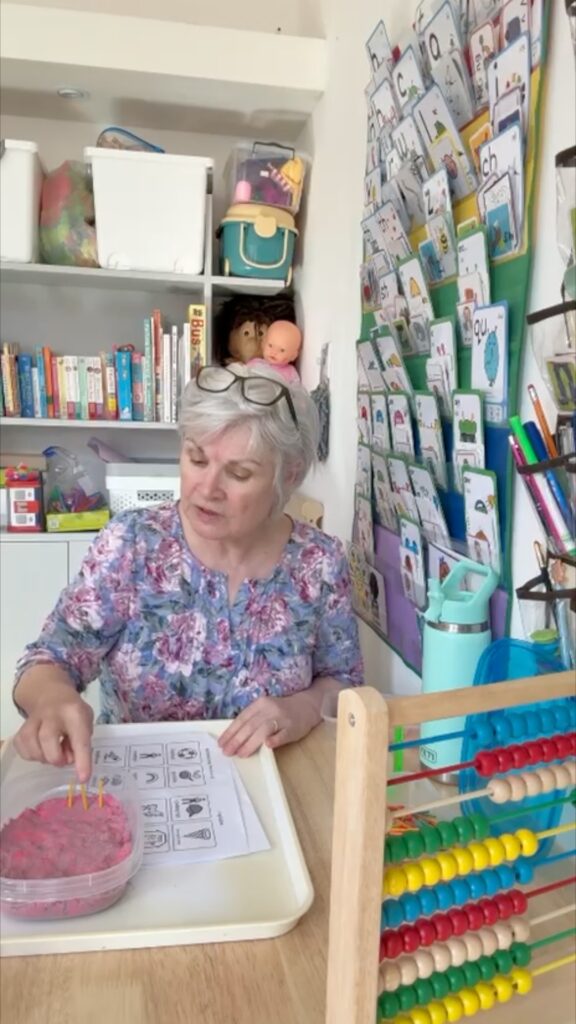
    1
  • · ·

    Your child’s communication journey

    Understanding our neurodiversity-affirming, child-led approach

    Welcome to a different kind of therapy!

    Your child’s communication journey

    The start of a new year often brings fresh hope, and sometimes fresh worries, for parents supporting their child’s communication. I am always genuinely excited to begin a new journey with children and their families, and I know that, for many parents, this kind of therapy may look very different from what they were expecting.

    Parents (and children!) are often surprised to discover that our sessions are playful, joyful, and intentionally low-pressure. You won’t see demands for eye contact, sitting still, or being told to ‘do it this way’ or ‘put the red square there’. Instead, you’ll see your child being met exactly where they are.

    For families who have previously experienced more adult-led or behaviour-based approaches including Applied Behaviour Therapy, this difference can feel unfamiliar at first. Because of that, I want to take a moment to prepare you for what child-led, neurodiversity-affirming therapy looks like, so you can feel confident, comfortable, and reassured from day one.

    Why doesn’t child-led therapy look like ‘traditional’ therapy?

    Many people picture speech and language therapy as sitting at a table, using flashcards, or practising words through repetition. While those approaches can work well for some children, they are often not effective or appropriate for many neurodivergent children—including children with autistic profiles, ADHD, or demand-sensitive nervous systems.

    Our approach is grounded in a simple and powerful truth:

    Children learn best when they feel safe, motivated, and emotionally connected.

    When a child’s nervous system feels calm and secure, learning becomes possible. When a child feels pressured or controlled, communication often shuts down, even if they can speak.

    🎯 Our purpose: Communication through connection

    Our goal is not simply to help your child say more words. Our goals go deeper and are built on strong foundations:

    • Trust and regulation: We focus on building a trusting relationship where your child feels safe, understood, and emotionally regulated. A calm nervous system is the starting point for all communication.
    • Motivation: We follow your child’s intrinsic motivation, the things they naturally enjoy to make communication meaningful, joyful, and purposeful.
    • Spontaneous communication: We create opportunities for your child to communicate because they want to, not because they are asked or instructed to.

    🧸 What to expect in a session

    Our sessions are intentionally child-led and often look very much like play.

    FeatureWhat it looks likeWhy we do this
    Minimal toysWe usually offer just 3–4 carefully chosen activities (such as bubbles, blocks, or sensory play).Less is more. Fewer choices reduce overwhelm and help children focus on what genuinely interests them.
    Child choosesYour child decides what to play with and how to engage.This immediately establishes us as a safe, non-demanding partner and increases motivation.
    The therapist’s roleWe join your child’s play, observing closely and responding naturally.We model language, share attention, and reflect your child’s experiences in a way that feels natural and supportive.
    No pressure or demandsThere are no ‘must-do’ tasks. If your child wants to spin, crash, line up toys, or repeat an activity, we follow.Reducing demands lowers anxiety and supports communication, particularly for children with demand-sensitive profiles.

    Is this really effective?

    It’s completely natural to wonder, ‘Are they just playing?’ The answer is yes, and very intentionally so.

    Our sessions are guided by nearly 30 years of speech and language therapy experience, alongside clear, achievable goals tailored to each individual child. Play is a child’s natural language and their most powerful learning tool.

    Within play, we are constantly creating opportunities to:

    • Build joint attention (sharing focus and interest)
    • Model language at the right level
    • Encourage back-and-forth communication
    • Develop a deep, authentic connection

    If your child has struggled to engage or communicate in more structured or demand-heavy settings, this child-led approach is often the key to unlocking their potential.

    💛 What this might look like at home

    You may notice that when pressure is reduced:

    • Your child begins communicating more during everyday routines
    • Language emerges through play, movement, or shared enjoyment
    • Communication feels more natural and less forced

    Small moments could be a shared smile, a look, a sound, a gesture. All matter. These are the building blocks of meaningful communication.

    📚 Resources for parents

    If you’d like to explore these ideas further, you may find the following helpful:

    I look forward to meeting you and your child. Please bring any questions, uncertainties, or curiosities to our first session, there is no such thing as a silly question. This is a journey we take together. Contact me via my contact form.

    Sonja McGeachie

    Highly Specialist Speech and Language Therapist

    Owner of The London Speech and Feeding Practice.


    Health Professions Council registered
    Royal College of Speech & Language Therapists Member
    Member of ASLTIP

    Find a speech and language therapist for your child in London. Are you concerned about your child’s speech, feeding or communication skills and don’t know where to turn? Please contact me and we can discuss how I can help you or visit my services page.

    3