Understanding phonological processes in 3–7-year-olds: What’s typical and when to seek help

| |

As a speech and language therapist, one of the most common questions I hear from parents is:

‘They can talk, but their speech still sounds immature. Is this normal?’

Many children between the ages of three and seven use speech patterns that make their words sound different from adult speech. These patterns are known as phonological processes, and for younger children, they are a normal part of speech development.

However, when these processes persist beyond the expected age, they can start to affect clarity, confidence and learning, especially once children enter school.

This blog will help you understand:

  • what phonological processes are
  • which patterns are typical at different ages
  • and when it might be time to seek speech therapy support

What are phonological processes?

Phonological processes are patterns of sound simplification that children use while their speech system is developing.

Instead of learning each sound one by one, children initially organise sounds into patterns that make speech easier to produce. This is a normal and efficient strategy for a developing brain.

For example:

  • saying ‘tar’ instead of ‘car’
  • saying ‘poon’ instead of ‘spoon’
  • saying ‘bud’ instead of ‘bus’

These are not ‘bad habits’. They are part of how speech develops.

The key question is how long these patterns last.

Common phonological processes (and when they usually disappear)

Below are some of the most common processes parents notice in 3–7-year-olds.

1. Final consonant deletion

Leaving off the last sound in a word

  • ‘ca’ for cat, ‘da’ for dog
  • Typically resolved by 3–3½ years

2. Fronting

Replacing back sounds (k, g) with front sounds (t, d)

  • ‘tar’ for car, ‘do’ for go
  • Typically resolved by 3½–4 years

3. Cluster reduction

Omitting one sound in a consonant cluster

  • ‘poon’ for spoon, ‘top’ for stop
  • Typically resolves by 4–5 years (some clusters slightly later)

4. Gliding

Replacing /R/ or /L/ with /W/ or /Y/

  • ‘wabbit’ for rabbit, ‘yion’ for lion
  • Can be typical up to 5–6 years

5. Weak syllable deletion

Leaving out unstressed syllables

  • ‘nana’ for banana
  • Usually resolved by 4 years

If these patterns continue past the expected age, speech can remain difficult to understand particularly for unfamiliar listeners such as teachers, peers, and also Auntie Karen or grandparents who visit once in a while.

Why phonological processes matter in school-age children

By the time children reach reception and Year 1, speech clarity becomes increasingly important.

Persistent phonological difficulties can affect:

  • being understood by teachers and peers
  • phonics and early reading
  • spelling
  • confidence in speaking
  • willingness to participate in class

Some children become aware that they ‘sound different’ and may speak less, avoid longer words, or become frustrated when misunderstood.

What’s the difference between a delay and a disorder?

This is an important distinction.

  • A phonological delay means a child is following the normal pattern of development, just more slowly.
  • A phonological disorder means the child is using atypical patterns, or continuing age-expected patterns well beyond when they should have resolved.

A speech and language assessment helps identify:

  • which processes are present
  • how many are affecting speech
  • how consistent the errors are
  • and whether intervention is needed

Signs it may be time to seek speech therapy

You may want to seek professional advice if your child:

  • is 3½ years or older and still hard to understand
  • is understood well by family but not by others
  • becomes frustrated or avoids talking
  • has difficulty with phonics or spelling
  • uses several phonological processes at once
  • has not made progress despite time and encouragement

Early support does not mean something is ‘wrong’. It simply helps speech development move forward more efficiently.Research consistently shows that unresolved phonological processes beyond the expected age can impact intelligibility, literacy and confidence (Dodd, 2014; Bowen, 2015).

How speech therapy helps phonological development

Phonological therapy is not about drilling individual sounds endlessly.

Instead, therapy focuses on:

  • helping children recognise sound patterns
  • building awareness of contrasts (e.g. ‘tar’ vs ‘car’)
  • practising speech in meaningful, playful ways
  • supporting generalisation so progress carries into everyday speech

For school-aged children, therapy is usually structured, motivating and highly targeted and progress can be very encouraging.

A final reassurance

Many children with phonological difficulties go on to develop clear, confident speech with the right support.

If you’re unsure whether your child’s speech is ‘just a phase’ or something that needs attention, a professional assessment can give clarity and peace of mind.

If you’d like support or advice, please contact me and I can help guide the next steps.

Sonja McGeachie

Highly Specialist Speech and Language Therapist

Owner of The London Speech and Feeding Practice.

Research references


Health Professions Council registered
Royal College of Speech & Language Therapists Member
Member of ASLTIP

Find a speech and language therapist for your child in London. Are you concerned about your child’s speech, feeding or communication skills and don’t know where to turn? Please contact me and we can discuss how I can help you or visit my services page.


3

Similar Posts

  • One book, dozens of therapy opportunities: What speech therapy really looks like

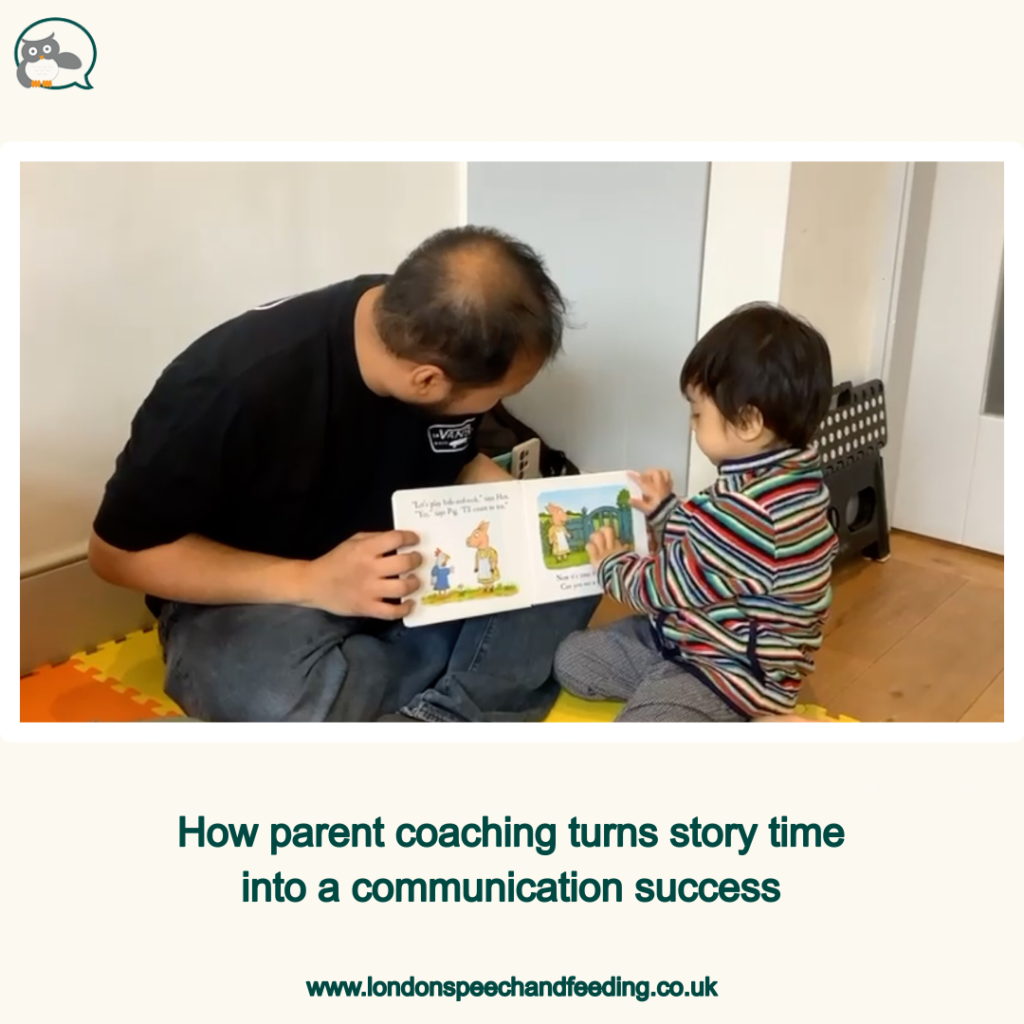
    As speech and language therapists, some of the most effective moments in therapy don’t come from flashcards, worksheets, or even drilling sounds (though to be fair I do drill quite a lot too! needs must…😊).

    By and large they happen in natural interaction — during shared attention, laughter, storytelling, and connection.

    This short video clip captures that.

    In under two minutes, while simply reading a book together with a three-year-old child, we naturally work on:

    • Speech sounds
    • Vowel production
    • Early phonological patterns
    • Motor planning
    • Signing and total communication
    • Visual cueing
    • Repetition and practice
    • Confidence building
    • And engagement through play

    To many people, it may just look like ‘reading a book’.

    But underneath that moment are years of specialist training, clinical decision-making, preparation, and therapeutic skill.

    Therapy hidden inside play

    One of the most important parts of paediatric speech therapy is knowing how to embed targets into meaningful interaction.

    Books are one of my favourite therapy tools! Why: because as speech therapists we need to prepare for our child and our sessions. And having a book gives me the structure to know beforehand what kind of sounds or words might be coming up. Then I can be prepared for providing extra support for them. As you can see in this clip, I had the sound cards just there because I had anticipated what might be coming up!

    A single story can provide opportunities for:

    • Speech sound practice
    • Vocabulary development
    • Sentence building
    • Turn-taking
    • Symbolic understanding
    • Attention and listening
    • Gesture and signing
    • Motor speech cueing
    • And social communication

    In this clip, I follow my little one’s interests while carefully weaving in her individual therapy targets.

    It looks relaxed and spontaneous — and it is — but it is also highly intentional.

    Catching opportunities in the moment

    One lovely example in the clip is when she says ‘yes’.

    She is now starting to say the final /S/ sound, so I immediately model and draw attention to it using the ‘snake sound’ visual cue, giving her positive feedback that she can now also try using this sound at the start of words.

    My gently shaping the word ‘yeSSSS.’ gives her:

    • Auditory feedback
    • Visual support
    • And an achievable opportunity to try again

    A few seconds later, we naturally practise it again.

    That’s responsive therapy.

    Speech therapists are constantly listening, analysing, adapting, and deciding:

    • When should I model?
    • When should I pause?
    • When should I repeat?
    • When should I let it go?
    • How can I keep confidence high while still targeting speech?

    These decisions happen in seconds.

    Working on speech without ‘stopping the play’

    Another moment in the clip focuses on the word ‘out’, where the vowel sound is one of her speech targets.

    Then we move into practising the word ‘open’, a word she has previously found difficult.

    Within this one word, we can support:

    • Sequencing
    • Motor planning
    • Lip shape
    • Vowel production
    • And speech sound accuracy

    We also briefly practise the /K/ sound — a sound produced at the back of the mouth which can be particularly tricky to produce.

    Instead of explaining it verbally (which is often too abstract for young children), I use:

    • Visual demonstration
    • Exaggerated mouth movements
    • Gesture/sign support
    • And playful modelling

    Children learn through seeing, hearing, doing, and experiencing.

    That is why Speech Therapists use multiple layers of cueing simultaneously.

    Why I use signs alongside speech

    Throughout the clip, I also use signs such as ‘book’ and ‘pig’.

    Using signs does not stop children talking.

    In fact, for many children, signs:

    • Reduce frustration
    • Support understanding
    • Increase participation
    • Reinforce vocabulary
    • And help bridge the gap while speech is developing

    Communication always comes first.

    Speech is only one part of communication.

    When children feel successful communicating, they are far more likely to keep trying.

    The skill behind ‘natural’ therapy

    One thing I often hear from parents is:

    ‘You make it look so easy.’

    That is actually one of the biggest compliments a therapist can receive. (Though we also often feel we need to justify our very existence with these thoughts because we don’t just play/just read but we know it can look like that!) 😊 this is the reason for this blog…

    High-quality paediatric therapy should feel warm, playful, responsive, and natural.

    But underneath that natural interaction is:

    • Clinical knowledge
    • Phonological analysis
    • Motor speech understanding
    • Language development expertise
    • Sensory awareness
    • Relationship-building
    • And careful session planning

    Before this session even began, I already knew:

    • Which speech patterns to target
    • Which words would likely appear in the book
    • What visual cues might help
    • Which signs to model
    • And how to adapt depending on the child’s responses

    That preparation allows therapy to stay child-led without losing therapeutic focus.

    Following the child while leading the therapy

    The best therapy is rarely rigid.

    Children do not learn communication through pressure or endless correction. They learn through interaction.

    That is exactly what this short clip demonstrates.

    One book.
    One conversation.
    Hundreds of tiny therapeutic decisions.

    And all within a joyful moment shared together.

    Because good speech therapy should never feel like hard work for a child.

    It should feel like connection, confidence, success — and fun.

    If you’re concerned about your child’s speech and language or wondering whether they might benefit from speech therapy, feel free to get in touch.

    Sonja McGeachie

    Highly Specialist Speech and Language Therapist

    Owner of The London Speech and Feeding Practice.


    Health Professions Council registered
    Royal College of Speech & Language Therapists Member
    Member of ASLTIP

    Find a speech and language therapist for your child in London. Are you concerned about your child’s speech, feeding or communication skills and don’t know where to turn? Please contact me and we can discuss how I can help you or visit my services page.

    3
  • Six ways to prepare your child for the Christmas festivities

    It feels like the Christmas festivities start earlier and earlier every year. This makes it harder for your child with communication difficulties to process what is happening. Whilst you can’t do anything about the events that happen around your child, you can start to put into practice strategies which may support them and allow them to regulate their emotions.

    Speech Therpaist in London
    Six ways to prepare your child for the Christmas festivities

    Explore six ideas here:

    1. Print off or buy a blank calendar to use at home

    You can start to write in activities out of the usual routine and add a picture to allow your child to understand what it’s about. You can also use it as a countdown to Christmas Day to try to prevent ‘how long’ questions.

    2. Make use of visual timetables

    These are useful in everyday settings and activities but also when change occurs.

    3. Be aware of any non-uniform days

    Days like ‘Christmas Jumper Day’ can make your child feel uncomfortable and may affect their behaviour. By giving yourself time, you can have conversations with your child’s teacher to find a more suitable alternative. For example, they can wear a Christmas t-shirt that they find more comfortable.

    4. Think about what will benefit your child

    Do they like being surrounded by people or do they prefer a quiet space on a 1:1 basis? Christmas activities often involve lots of group work in school (e.g., rehearsing for carol concerts or plays). They might prefer to pre-record their part in the Christmas play or create pieces of art which can be used. At home, they may prefer one guest visiting at a time, rather than all at once.

    5. Explore how your child is feeling

    It’s important to find out how your young person is feeling and how these impact on the activities of that day. It might be that your child doesn’t like surprises and the intensity of opening gifts is too much for them. They may prefer gifts to be left unwrapped and given throughout the day, rather than all at once.

    6. Consider sensory needs

    Ensure your young person has everything they need to meet their sensory needs. This can be e.g. noise cancelling headphones, fidget toys, or comforting items. These will particularly be helpful with routines changing, often with little notice. If at home, you may wish to not put lights on the Christmas tree if visual stimuli become too much.

    Remember clear communication between home, school and other family members is vital during this time. By having clear communication and expectations, your young person will feel more secure. And you can have a Christmas that is right for you and your family.


    Find a speech and language therapist for your child in London. Are you concerned about your child’s speech, feeding or communication skills and don’t know where to turn? Please contact me and we can discuss how I can help you or visit my services page.
  • Learn the benefits of Cycles Phonology Approach in Speech Therapy

    A grey, green and orange circle overlaid with Cycles Phonological Approach
    Cycles Phonogogical approach

    When your child attends Speech and Language Therapy, it can look like your child’s therapist is playing. Therapy needs to be fun, which means carrying out therapy through the medium of play. But remember every approach used has evidence behind it. We need to know that therapy will be successful, so an evidence-based approach is essential.

    One of the approaches used for Speech Therapy (i.e., working on speech sound production) is the Cycles Phonology Approach. This approach focuses on the patterns and processes rather than each individual sound. For example, it may be working on final consonant deletion, so the omission of the final sound in words. As Speech and Language Therapists we understand that children can get frustrated and fatigued working on the same sound every day. This approach attempts to solve that. Hodson suggests, the approach is also useful for children with more speech sound errors, as therapists see progress in areas not targeted.

    How does the Cycles Phonology Approach work?

    Your Speech and Language Therapist will assess your child’s speech development and will then analyse the results. They will also look for which sounds they can produce with support (this is called stimulability). They will analyse patterns in the results and will formulate a plan.

    The Cycles Phonology Approach intervention allows your child to work in blocks. This might mean they work for half a week for 30 minutes on (e.g., clusters). Then the next half they’ll work for 30 minutes on a different process (e.g., omission of sounds at the end of words).

    Research has found that the following error patterns respond well to this approach:

    • Syllables (identifying the different parts in a word e.g., “ae-ro-plane”)
    • Final Consonant deletion (omission of the final sound e.g., “ca” instead of “cat”)
    • Initial consonant deletion (omission of the first sound e.g., “at” instead of “cat”)
    • Fronting (instead of making a sound at the back of the mouth, it’s made at the front e.g., “tatinstead of “cat)
    • Backing (instead of making a sound at the front of the mouth, it’s made at the back e.g., “guninstead of “bun)
    • S blends (e.g., “sl, sm, sn, sk, sw”)
    • Gliding of liquids (e.g., “lellow instead of yellow”, “wabbit instead of rabbit)

    What does a Speech and Language Therapy session look like when using the Phonology Cycles Approach?

    The format of the session remains the same for whichever speech sound pattern your child is working on. Your child’s Speech and Language Therapist will review the previous session. Then they will use an activity to work on your child hearing the sound several times (this is called ‘auditory bombardment’). Then your child will practise saying the sound. Next, the Speech and Language Therapist will check if your child can say any of the sounds which they haven’t been able to produce before, with support. This is called a stimulability check. After this, your child will take part in an activity which builds their awareness of sounds in words (such as a rhyming or syllable activity). The session will finish with another auditory bombardment task (i.e., hearing their tricky sound repeatedly).

    I will give you advice for practising at home, as it’s vital that your child learns in the correct way. We aim for 100 turns in therapy sessions, so it’s vital your child is motivated.

    Contact me to improve your child’s speech sounds and improve their confidence when talking.


    Find a speech and language therapist for your child in London. Are you concerned about your child’s speech, feeding or communication skills and don’t know where to turn? Please contact me and we can discuss how I can help you or visit my services page.

    1
  • · ·

    Explaining pronoun reversal: A window into gestalt language processing

    Explaining pronoun reversal: A window into gestalt language processing

    Have you noticed your child referring to themselves as ‘you’, or calling you ‘me’? This seemingly confusing mix-up of pronouns, known as pronoun reversal, often raises concerns for parents. Below I outline why your child does this and want to reassure you that it is to do with his or her unique language learning style.

    Gestalt language processing: Learning in chunks

    Many children, particularly those on the autism spectrum, use a gestalt language processing approach. Unlike analytic language processors who learn individual words and build sentences, gestalt language processors learn language in whole ‘chunks’ or ‘gestalts’. Think of these gestalts as pre-packaged scripts they pick up from their environment — phrases, sentences, even snippets of songs or movie lines.

    As Marge Blanc, author of Natural language acquisition on the autism spectrum, explains, ‘When a child picks up an entire gestalt (script), he’s got the pronoun of the original speaker. So ‘pronoun reversal’ is nothing more than that.’

    So your child is simply repeating what they’ve heard, without yet understanding the individual word meanings or grammatical functions.

    Imagine your child hearing ‘You want a rice cake?’ repeated frequently. They might then use this phrase to express their own desire for a rice cake, even though it doesn’t grammatically fit. So they are thinking and saying ‘You want a rice cake?’ and the meaning of this phrase is: ‘I want a rice cake’. This isn’t a sign of confusion, but a natural step in their language development. They’re working with the tools they have: the scripts they’ve acquired.

    How can we support their natural language journey

    Instead of trying to ‘correct’ pronoun usage, our role as caregivers and speech therapists is to support the child’s natural language progression. Here’s how we can do this:

    1. Learn about their gestalt stage and run with it: In the early stages (1–3) of gestalt language development, correcting pronouns can be counterproductive. These children are still processing language as whole units, not individual words. Direct corrections can lead to frustration and hinder their natural language exploration.
    2. Patience and trust: Gestalt language processing follows a predictable, albeit sometimes non-linear, path. By understanding their current stage, we can provide targeted support. Language sampling and scoring, guided by the Natural Language Acquisition framework, help us pinpoint their stage and tailor our approach.
    3. Model language strategically: In the early stages, avoid using pronouns like ‘you’ and ‘you’re’. Instead, model language from the child’s perspective or use joint perspectives. For example, instead of ‘Are you thirsty?’, try ‘I’m thirsty!’ or ‘Let’s get some water’,

    The big picture: Language unfolds naturally

    Pronoun reversal is a stepping stone, not a stumbling block. As gestalt language processors progress, they begin to break down these gestalts into smaller units and develop their own self-generated language. This is when their understanding and use of pronouns naturally emerge.

    By shifting our perspective from ‘error correction’ to ‘developmental support’, we create a nurturing environment for these children to thrive. We empower them to navigate their unique language journey, ultimately leading to more meaningful and independent communication.

    So, to summarise:

    • Pronoun reversal is a typical characteristic of early-stage gestalt language processing.
    • Focus on modelling language from the child’s perspective or a joint perspective.
    • Avoid correcting pronouns in the early stages.
    • Trust the process and support the child’s natural language development.

    Let’s celebrate the diverse ways our children learn to communicate and empower them to find their unique voice!

    If you have any questions or would like some help with understanding your little gestalt language learner, please get in touch with me via my contact form.

    Sonja McGeachie

    Highly Specialist Speech and Language Therapist

    Owner of The London Speech and Feeding Practice.


    Health Professions Council registered
    Royal College of Speech & Language Therapists Member
    Member of ASLTIP

    Find a speech and language therapist for your child in London. Are you concerned about your child’s speech, feeding or communication skills and don’t know where to turn? Please contact me and we can discuss how I can help you or visit my services page.

    1
  • ·

    Explore activities for Gestalt Language Processors to aid communication

    Speech Therpaist in London

    When you have a child who uses Gestalts it is often difficult to think and adapt clinic activities into those to use at home. More importantly, you find that individualising your activities for your child who uses Gestalt are time-consuming. But you value its importance for their communication development.

    You feel so busy, you are taking them to other appointments, or trying to get through your daily activities, all whilst still ensuring your child’s emotional needs are met. You know life should not get in the way of your child’s therapy activities at home, but it does. We know your spare time is precious and limited, so let us achieve your child’s or young person’s goals in the allotted time you have which meets their way of learning (using Gestalts).

    We wanted to support you by exploring items which you may have at home, and we will give you some key phrases which you can start to model with your child. Whereas our last blog introduced the idea of gestalt language processors, we are now developing ideas to give you the tools to implement activities at home. We recognise how overwhelming it may feel, and this is one of the reasons to make activities as straight forward as possible. Therapy does not need to be complicated; it just needs to be carried out on a regular basis.

    Explore the samples I’ve created to give you an idea of how this might look but please consult with a Speech and Language Therapist who knows about Gestalt Language Processing so that you can work together to develop great home activities for your child.

    Want to learn more about gestalt language processing?

    Please contact me for help.


    Find a speech and language therapist for your child in London. Are you concerned about your child’s speech, feeding or communication skills and don’t know where to turn? Please contact me and we can discuss how I can help you or visit my services page.

    1
  • One activity, endless opportunities for speech and language therapy targets

    Communication does not happen in neat little boxes. In Speech and Language Therapy we often use one great activity to target multiple areas of speech and or language development all at once.

    Children are trying to:

    • understand language
    • build sentences
    • organise their thoughts
    • pronounce sounds
    • remember words
    • use grammar
    • follow social interaction
    • communicate meaning…

    all at the same time.

    This short therapy clip is a little example of that.

    Within one playful interaction, we naturally work on:

    • grammar
    • sentence expansion
    • pronouns
    • speech sound errors
    • modelling
    • visual cueing
    • turn-taking
    • confidence in communication

    And, importantly, the child remains engaged, relaxed, and successful throughout.

    Using language activities to refine speech sound targets

    We all learn language through:

    • shared attention
    • play
    • repetition
    • connection
    • modelling
    • responsive interaction

    As a Speech and Language Therapist I am constantly thinking and considering how to bring in all the targets a child is working on. The reason for that is that often we do not have a full therapy hour to work leisurely and calmly on various targets! Many children have short attention focus and ‘go off the boil’ quickly and often suddenly. Therefore, I always feel a sense of ‘make hay whilst the sun shines’ and pack it all in whilst the going is good. So then we can afford five minutes of trampolining in between activities to help the child regulate themselves without losing valuable speech therapy opportunities or time.

    • How can I expand this sentence?
    • How can I model better grammar?
    • Can I gently shape the pronunciation here?
    • Should I recast that phrase?
    • Is this the right moment to pause and encourage a longer utterance?
    • How can I keep communication flowing while still targeting goals?

    These decisions happen continuously during therapy.

    Building longer sentences naturally

    In this clip, one of the key areas we are targeting is sentence expansion through Colourful Semantics, which is a particularly useful and researched approach, developed by UK Speech and Language Therapist Alison Bryan in 1997 to support children with speech and language difficulties.

    Colourful Semantics is a visual, colour-coded therapy approach that helps children break down, understand, and construct sentences by assigning specific colours to thematic roles (e.g., Who, What Doing, What).

    Many children with language delay use reduced language for example: they might say:

    • ‘dog’ instead of ‘the dog is running fast’
    • ‘eatin a dinner’ instead of we are eating our dinner
    • ‘baby shhh’ instead of ‘the baby is sleeping’.

    Using the Colourful Semantics Framework helps create a solid baseline from which to work and with which to construct basic good sentences using WHO is DOING WHAT and WHERE.

    We are building language upward gently and positively.

    This technique is incredibly powerful because children learn language through hearing it used meaningfully over and over again.

    Supporting pronouns through real conversation

    Pronouns can be surprisingly difficult for many children.

    Words such as:

    • he
    • she
    • him
    • her
    • they

    require children to understand perspective, grammar, and sentence structure all at once. Using pictures and basing the activity on the Colourful Semantics Model I can shape pronouns repeatedly as part of the overall activity.

    Books, pictures, and play scenes are fantastic for this because they create endless opportunities for meaningful repetition.

    Again, this may look simple from the outside.

    But underneath it is highly intentional clinical work.

    Listening for speech sound errors at the same time

    While supporting grammar and language, I am also constantly listening to the child’s speech production.

    In this short interaction, I respond to speech sound errors as they arise.

    Sometimes I:

    • model the correct production
    • emphasise a sound slightly
    • use visual cues
    • slow the word down
    • add gesture or sign support
    • encourage another attempt.

    And sometimes I intentionally let the error go in order to protect confidence and maintain communication flow.

    That balance is incredibly important.

    Children need support. But they also need to feel successful communicating.

    The child simply experiences this as warm, responsive interaction.

    But underneath it is detailed clinical reasoning.

    This is why effective therapy is never about simply owning resources or downloading activities online.

    The real skill lies in:

    • how the therapist uses the activity
    • how they adapt moment by moment
    • how they analyse communication in real time
    • how they shape interaction to maximise learning opportunities.

    One activity. Endless opportunities.

    A single book, picture scene, or playful interaction can provide opportunities to support:

    • speech sounds
    • language development
    • grammar
    • vocabulary
    • attention
    • confidence
    • social communication
    • emotional connection.

    The magic is not in the activity itself.

    The magic is in how a therapist uses it.

    Because excellent speech therapy is never ‘just playing’.

    It is careful, responsive, evidence-based intervention woven seamlessly into joyful interaction.

    Contact me avia my contact form if you would like me to work with your child.

    Sonja McGeachie

    Highly Specialist Speech and Language Therapist

    Owner of The London Speech and Feeding Practice.

    Reference

    Bryan A (1997) Colourful semantics. In: Chiat S, Law J, and Marshall J (eds) Language disorders in children and adults: psycholinguistic approaches to therapy. London: Whurr, 143–61.


    Health Professions Council registered
    Royal College of Speech & Language Therapists Member
    Member of ASLTIP

    Find a speech and language therapist for your child in London. Are you concerned about your child’s speech, feeding or communication skills and don’t know where to turn? Please contact me and we can discuss how I can help you or visit my services page.

    3