How we can help shape smooth consonant blends
|

For many children, especially those navigating Childhood Apraxia of Speech (CAS), the challenge isn’t just making individual sounds. It’s the ‘speech gymnastics’ required to move smoothly from one sound to the next.

You might notice that instead of saying ‘Train’, your child says ‘Ter-ain’, or for ‘Frog’, you hear ‘Fer-og’. That sneaky little ‘uh’ sound in the middle is what we call a schwa vowel. In the world of speech science, this is known as epenthesis. It’s essentially a ‘repair strategy’ the brain uses to break up a difficult cluster of sounds into two easier pieces.

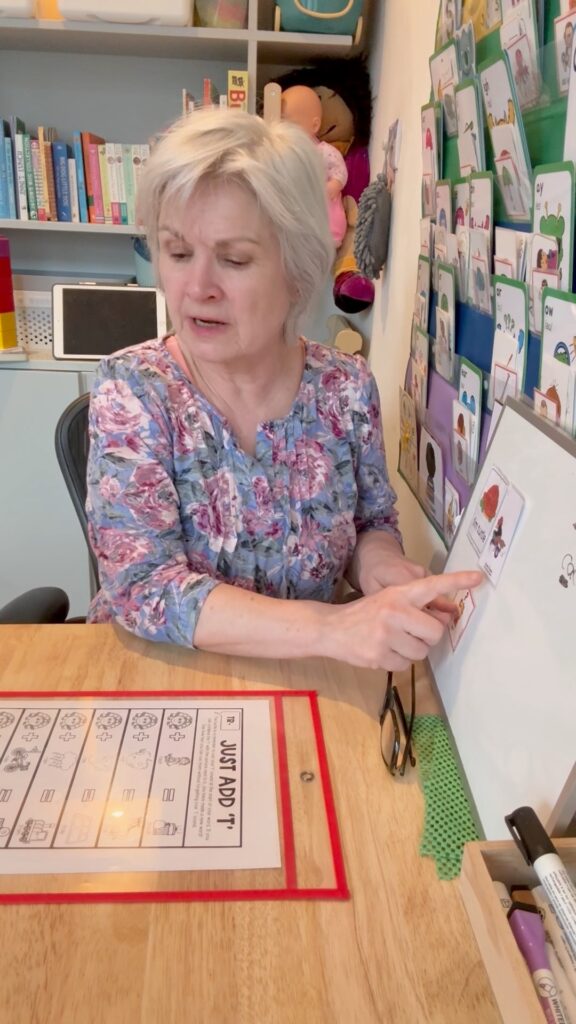
While it might seem like a small detail, that tiny vowel makes a big difference in how fluent and clear a child’s speech sounds. In today’s post (and the video below), I am working with my student on ironing out that schwa by focusing on co-articulation—the art of getting the mouth ready for the second sound while still finishing the first.

The ‘best friends’ strategy

To help my student understand this complex movement, I use visual cues and a story. There are many ways to portray two sounds living closely together, but for this session, I used the ‘Best Friends’ story.

In our story, the /T/ and the /R/ are older brother best friends who want to play together. The ‘schwa’ sound is represented by a little sister who keeps trying to jump in the middle of their game! Because my student has a younger sister, this scenario was instantly familiar and helped him visualise why we needed to ‘close the gap’ between those two sounds.

Alternative methods I often use:

Beyond stories, I often use other visual and tactile methods to show the closeness of two sounds:

  • The sliding finger: I draw two dots on a paper—one for /T/ and one for /R/. We slide a finger quickly from one to the other. I might say, ‘Don’t let the ‘uh’ monster jump in the gap!’
  • The rubber band: We stretch a rubber band as we speak. I tell my student that the word is one long, smooth stretch, rather than two separate ‘pops’.
  • Visual cues for ‘quiet’ sounds: I often put my finger to my lips or tap my throat to remind a child to keep the first sound voiceless. If the voice stays ‘off’ during the /T/, it’s much harder for that schwa vowel to creep in.

The importance of ‘pure’ modelling

A major hurdle in clearing up these blends is how we, as adults, model sounds. Often, when teaching the alphabet, we say ‘Kuh’, ‘Puh’ or ‘Tuh’. But if you listen closely, you’re actually adding a vowel! If a child learns that /K/ says ‘Kuh’, it’s only natural they will say ‘Kuh-R’ for /KR/.

To give your child a cleaner blueprint, try modeling ‘pure’ sounds. Think of whispering rather than talking:

  • The /K/ sound: A short, sharp burst of air from the back of the throat. No voice! (A quiet /K/ click).
  • The /P/ sound: Just a ‘pop’ of air from the lips. If your throat vibrates, the vowel has snuck in.
  • The /T/ sound: A tiny tap of the tongue behind the teeth.

Why is this important?

You might ask, ‘If I can still understand them, does it really matter if they say “ter-ain”?

The goal of speech therapy isn’t just functional communication; it’s building phonological awareness. When a child adds extra vowels, it can eventually impact their literacy. If they hear ‘ter-ain,’ they are much more likely to eventually spell it as ‘terain’ or ‘traint’.

By helping them master these clusters through co-articulation now, we are setting them up for success in reading and writing. And we are giving them the confidence to speak with ease.

Feel free to contact me if your child needs help with clusters or other difficulties either aligned with Childhood Apraxia of Speech or other articulation difficulties.

Sonja McGeachie

Highly Specialist Speech and Language Therapist

Owner of The London Speech and Feeding Practice.

References

  • Hall, N. (2011). Vowel Epenthesis. In The Blackwell Companion to Phonology (eds M. Oostendorp, C.J. Ewen, E. Hume and K. Rice). In this work, epenthesis is defined as the insertion of a vowel to break up complex consonant clusters into simpler, more manageable syllables. This is often viewed as a ‘repair strategy’ used by the brain when a transition between sounds is too complex to execute quickly.
  • Aichert, I., & Ziegler, W. (2004) Brain and Language 88(1):148-59. Syllable frequency and syllable structure in apraxia of speech. This research highlights that children with Apraxia often struggle specifically with word-onset clusters, leading to distortions like the schwa.
  • Browman, C. P., & Goldstein, L. (1992) Phonetica 1992;49(3-4):155-80. Articulatory Phonology: An Overview. This paper explains that fluent speech requires ‘gestural overlap,’ where the movements for two different sounds happen simultaneously. This supports the ‘Best Friends’ method of keeping sounds close together.

Health Professions Council registered
Royal College of Speech & Language Therapists Member
Member of ASLTIP

Find a speech and language therapist for your child in London. Are you concerned about your child’s speech, feeding or communication skills and don’t know where to turn? Please contact me and we can discuss how I can help you or visit my services page.


3

Similar Posts

  • Help! My child has a lisp. What can we do about it?

    What is a LISP?

    There are different types of LISPS. Let me explain:

    A lisp is the difficulty making a clear ‘S’ and ‘Z’. Other sounds can also be affected by the tongue protruding too far forward and touching the upper teeth or the upper lip even. ‘T’ and ‘D’ can be produced with ‘too much tongue at the front’ and this can also have an impact on ‘CH’ and often also ‘SH’.

    1. Interdental lisp

    Protruding the tongue between the front teeth while attempting ‘S’ or ‘Z’ is referred to as interdental lisp; it can make the speech sound ‘muffled’ or ‘hissy’. Often, we associate a lisp with the person sounding a bit immature. The good news is that this type of lisp is the easiest to correct and, in my practice. I have a 100% success rate with this type of lisp.

    1. Lateral lisp

    In a lateral lisp the person produces the ‘S’ and ‘Z’ sounds with the air escaping over the sides of the tongue. This renders the ‘S’ as sounding ‘slushy’ or ‘wet’. This type of lisp is a bit harder to correct than the interdental lisp. In my experience this can be fixed but it might need a bit longer, more intensive therapy than the interdental lisp.

    1. Palatal lisp

    With a palatal lisp the ‘S’ sound is attempted with the tongue touching the palate, much further back than it should be. The ‘S’ sounds ‘windy’ and ‘hissy’. This is a quite rare lisp production but it is also not difficult to correct.

    These types of speech difficulties come under the category of ‘speech delay of unknown origin’ and may persist into adolescence and adulthood as ‘residual errors‘.

    Some thoughts on Treatment in general:

    Lisps can be treated successfully by a Speech and Language Therapist. However, for the treatment to work well, a student needs to be able to cooperate and want to improve his or her speech. Lisp remediation entails a fair amount of repetitive work and very young children or unmotivated older children don’t make the best candidates for treatment for this reason. Often students present with other speech, language or social communication difficulties and here the lisp might not be the priority for treating. For example, it might be that due to a student’s Attention Deficit Disorder they are simply not able to focus on speech practice in their daily life.

    When should treatment of lisp begin?

    Waiting well past 4½ years is not advisable as the longer we wait and do nothing the stronger engrained the erroneous tongue/speech habit will become. The ‘right’ age for therapy for one child may be different from the ‘right’ age for another child even within the same family. So do make an appointment with a speech and language therapist to assess and see whether your child might be ready to start therapy.

    Do lots of children lisp—is it normal?

    Until the age of about 4–4.5 years old it can be a perfectly normal developmental phase for some children to have the interdental lisp. But when we see and hear a lateral or palatal lisp we ought to act and see a speech and language therapist for sure.

    After the age of 4.5 or 5 years old most speech therapists would agree on at least having a look to see if treatment could be started. The longer we wait the harder it is to retrain the brain pathways to adopt new speech habits.

    What happens during the first Speech and Language Consultation?

    The first consultation takes about an hour and involves screening relevant areas of communicative function. We take a detailed history, examine the anatomy of the child’s mouth and tongue movements. We check for tongue tie, teeth formation, palate structure and function, as well as swallowing patterns.

    Then we begin straight away to try and see if any of the alveolar sounds (T/D/L/N) can be produced correctly with the right tongue placement as that would be the starting point from where to shape a good, clear ‘S’ sound.

    The first consultation usually ends with home practice being given, explained to parents and another appointment being made for follow up.

    Therapy – what does a session look like?

    Each therapy session consists of:

    1. Listening to sounds, discriminating sounds, identifying sounds, listening to rhyming sounds, sound awareness. We call this Auditory discrimination of single sounds: can the student hear the difference between two words that are the same apart from the first sound: ‘sing’ and ‘thing’ or ‘sigh’ and ‘thigh’?
    2. Sound production: using a variety of different prompts and cues we will teach how to physically make the new sound. Often, we work on making a NEW sound, instead of correcting the OLD one. We work on imitation of single sounds then gradually we try and make new sounds in short words, then longer words and then phrases and sentences.
    3. Games! We play games and try and have fun in between listening and producing our new sounds to help students stay motivated and even enjoy the therapy session and process.

    How long does it take to ‘fix up’ a lisp?

    It tends to take about one term with weekly sessions to help a student make good ‘S’ sounds in phrases and sentences. If the student can do the home practice every day in between the weekly sessions, then in most cases I am able to pronounce the lisp as ‘fixed’ after about one term.

    After that the student needs to practise, practise, practise, at home and in daily life to keep reminding themselves of their new skills and their new sound production.

    It is a matter of reminding and wanting to get it right. Occasionally a student returns to me for another term of simply practising their skills together with me as they are finding it hard for any number of reasons to practise at home. But generally, 8/10 students will be fine after some 12–13 sessions and their speech will be perceived as perfectly typical by family and friends.

    If your child has a lisp or any other speech error, please do not hesitate to contact me.


    Find a speech and language therapist for your child in London. Are you concerned about your child’s speech, feeding or communication skills and don’t know where to turn? Please contact me and we can discuss how I can help you or visit my services page.

    0
  • Tongue-Tie: A complex issue requiring careful assessment

    Tongue-tie, or ankyloglossia, is a condition where the lingual frenulum, the thin piece of tissue that connects the underside of the tongue to the floor of the mouth, is too short or tight. Tongue-tie is quite common in babies and is often not detected after birth. Tongue-tie can lead to a difficult start with breast feeding as it makes it very difficult for the baby to latch effectively.

    In my clinical experience as a feeding therapist, I have seen many babies who were not able to latch well due to the frenulum being tight. In many cases an experienced feeding speech therapist/lactation consultant can really make a difference and help a new mum to latch the baby even though the tongue is tethered to the floor of the baby’s mouth. In some cases the frenulum can be divided and once this has been done, in some cases, feeding improves immediately or soon after the division. But this is not always the case. I have seen several babies who have had as many as four tongue-tie divisions and feeding was still difficult.

    It is important to say that while tongue-tie can sometimes impact speech and feeding, it’s important to note that it’s not always the root cause of these difficulties. In recent years, there has been a surge of interest in tongue-tie division surgeries, with some cases being unnecessary. It’s crucial to understand the complexities of tongue-tie and the role of speech therapy in addressing related challenges.

    The impact of tongue-tie on speech and feeding

    When tongue-tie is severe, it can interfere with the tongue’s ability to move freely, affecting speech production and swallowing. Some common speech and feeding difficulties associated with tongue-tie include:

    • Feeding difficulties: Challenges with sucking, chewing, and swallowing.
    • Drooling: Excessive drooling due to difficulty controlling saliva.
    • Speech problems: Difficulty producing certain sounds, such as /l/, /r/, /t/, /s/ and /d/.

    The importance of comprehensive assessment

    Before considering any surgical intervention for tongue-tie, it’s essential to undergo a thorough evaluation by a qualified speech-language therapist (SLT). An SLT can assess the severity of the tongue-tie, its impact on speech and feeding, and determine if surgery is necessary.

    • Functional assessment: The SLT will assess the tongue’s range of motion, its impact on speech sounds, and the child’s overall oral motor skills.
    • Feeding evaluation: The SLT will observe the child’s feeding patterns and identify any difficulties related to tongue-tie.
    • Differential diagnosis: The SLT will rule out other potential causes of speech and feeding difficulties, such as apraxia of speech, dysarthria, or sensory processing disorders.

    The role of speech therapy

    Even in cases where tongue-tie is present, speech therapy can often be highly effective in addressing speech and feeding difficulties. Here’s how speech therapy can help:

    • Articulation therapy: Targeting specific speech sounds that may be affected by tongue-tie.
    • Childhood Apraxia of Speech (CAS): if the diagnosis by the SLT has shown that in fact the child has motor planning difficulties then there are very specific and effective treatment programmes that help with this and can make a real difference over time.
    • Feeding therapy: Strategies to improve swallowing, chewing, and oral-motor skills.
    • Sensory integration: Addressing underlying sensory processing issues that may contribute to feeding difficulties.

    London Speech and Feeding Case Study: The importance of comprehensive assessment

    One of my clients was initially diagnosed with tongue-tie and recommended for surgery at the age of eight years old. His speech had been perceived by parents and teachers as ‘mumbled and unclear’.

    However, after a thorough evaluation, I was able to determine that the child’s primary issue was apraxia of speech, a neurological disorder that affects motor planning for speech. Parents decided to wait with surgery and trust my judgment and we proceeded with weekly intensive speech therapy to address motor planning difficulties around tricky sounds and words. I am delighted to say that the child’s speech has improved significantly, demonstrating the importance of comprehensive assessment and individualised treatment. He is no longer seen as a candidate for an operation, which would have been traumatic for him at his age and, as it turned out, entirely unnecessary.

    Below is a short video clip of my working on the /l/ sound with this child.

    Using the Gingo Puppet from GingoTalk

    Conclusion

    Tongue-tie is a complex issue that requires careful evaluation and individualised treatment. While surgery may certainly be necessary in some cases, it’s essential to consider the potential benefits and risks. Speech therapy can be a highly effective approach for addressing speech and feeding difficulties associated with tongue-tie, even in cases where surgery is still required. By working with a qualified speech-language therapist, parents can ensure that their child receives the best possible care and support.

    Please feel free to contact me.

    Sonja McGeachie

    Early Intervention Speech and Language Therapist

    Feeding and Dysphagia (Swallowing) Specialist The London Speech and Feeding Practice

    The London Speech and Feeding Practice


    Find a speech and language therapist for your child in London. Are you concerned about your child’s speech, feeding or communication skills and don’t know where to turn? Please contact me and we can discuss how I can help you or visit my services page.
    1
  • · ·

    AAC Systems and Speech and Language Development

    Introduction

    I see a lot of minimally speaking or non-verbal children in my practice. Some children are autistic and others are severely challenged with motor planning and some are both. Some children are simply delayed in their spoken language for reasons that we don’t quite know yet.

    Regardless of the causes, what is always apparent pretty quickly is that apart from the odd gestures or Makaton signs (mainly ‘more” ‘finished’ and “biscuit) we don’t have a robust alternative for speech in place. Instead, what we often have is a child with lots of frustration and tantrums and some behaviours we really don’t want like: hitting, biting, pushing, grabbing and often throwing… There are others, too many to mention, but we don’t enjoy watching our children in these states. And we are often fearful of what might happen next if we don’t find a way to calm our child.

    Fear not

    In my work, before I get to offer an alternative means of communication, I often have to work with a fair amount of resistance on the parents’ side as parents tend to feel that allowing such a system into their lives will prevent their child from speaking. They fear that their child will so enjoy pressing those buttons that they will become lazy and not talk at all.

    I totally get it!

    Parents often feel overwhelmed by the task of getting their own heads round how to use AAC, either in paper form or a computerised system. This can be a great turn-off for lots of people who feel they are not very “techy” – like myself actually! Indeed, it is true to say that I resisted operating in this field for a long time as I didn’t feel able to navigate electronic devices. But fear not. Truly, most systems are very user-friendly. The support is great. And I have managed to become quite proficient in one or two of these systems, through using it daily. It really is as simple as that.

    Alternative and Augmentative Communication (AAC)

    There is plenty of research on the efficacy of Alternative and Augmentative Communication (AAC). It is now very well understood and proven that, once we introduce our child to a good, attractive way of communicating that they can actually do, in time children who can speak will speak. Speaking is more effective than any AAC system. It is more versatile, more fun, and when human beings have discovered how to speak, most will do so in favour of any other system.

    Many children and adults, for many reasons, were never going to speak an awful lot, or with great difficulty. Or they were not going to like to speak. Or they were going to like to speak some times but not other times… And for all those people an AAC system is invaluable and a wonderful resource.

    Neuro-diversity affirming means that we do not impose one system of communication on our children (speaking with our mouth) only because it is the one we are using and most people we know too.

    Of course, we want the best for our children, and we want them to have the easiest and most straight forward existence on Earth. Of course we do. Speaking with our mouth does help with that. But we must come to understand that not all children and people feel like that and they struggle to use their mouth for talking.

    Personal experience

    I have difficulties understanding this myself, I will be very honest here. And I will say that – shoot me down in flames SLT fraternity – but I am learning to accept that using an AAC system proficiently is a very good alternative for when speech is not coming. I am learning to accept that some people are perfectly able to speak, and might do so but not always and only when conditions are right. I came into the profession as a speech therapist with the idea that I would help anybody that came to me to speak with their mouth. But I have changed my stance on that and now am happy to help anybody that comes to me to communicate most effectively with whatever works for them. I will always try for speech if I can … Just because it’s easiest!

    Acceptance

    Now I will equally celebrate a child pointing to a symbol or making a sign for something. It is a fantastic moment when it happens for the parents and me and the child! And we can always hope for more speech to come as we go. Nothing wrong with our aspirations, is there?

    The basic premise is this: accept any mode of communication as valid, as long as your communication partner understands what it means. Don’t require individuals to repeat themselves in another modality. Do model the response in the modality you are trying to teach. So, a child can point to a symbol and I will respond with speaking (with my mouth) but I will also respond by pointing to a symbol because that way I am signalling that both are ok and that I have understood and am encouraging the person to say some more.

    Here is some research;

    Binger, C., Berens, J., Kent-Walsh, J., & Taylor, S. (2008) The effects of aided AAC interventions on AAC use, speech and symbolic gestures. Seminars in Speech and Language, 29, 101-111.

    Sennott, S.C., Light, J., & McNaughton, D. (2016). AAC modelling intervention research review. Research and Practice for Persons with Severe Disabilities, 41, 101–15.

    Dada, S., & Alant, E. (2009). The effect of aided language stimulation on vocabulary acquisition in children with little or no functional speech. American Journal of Speech-Language Pathology, 18, 50–64.

    Contact me if you would like your child to have neurodiversity affirming speech and language therapy.


    Find a speech and language therapist for your child in London. Are you concerned about your child’s speech, feeding or communication skills and don’t know where to turn? Please contact me and we can discuss how I can help you or visit my services page.

    0
  • A Day In The Life Of An Independent Speech And Language Therapist

    A Day In The Life Of An Independent Speech And Language Therapist

    A Day In The Life Of An Independent Speech And Language Therapist

    I often get asked how many clients/children I see per working day or what my working day/life looks like. I always reply that every day is different, which is true, but there is a sort of average working day which looks a bit like this:

    I usually start preparing for my first client of the day at around 9.30 am: I clean the room, wipe down all the toys and materials (that’s if they are coming to my clinic room) and then it takes me about 30 minutes to select and sometimes make suitable materials, games and activities for the child’s therapy programme. Client arrives at 10.30 am and the fun begins. They leave around 11.30am, and the cleaning and wiping down starts again – yes it’s the pandemic but to be fair I would do this anyway. I quickly write up my notes and send home work to the client via email. Now it’s 12 noon and I start preparing for the next client at 12.30 pm. This might be online parent-child interaction coaching and so I need different materials and activities that are suitable for teletherapy. We finish around 1.30 pm and I will write up my notes before having some lunch.

    Lunch tends to not be around 30 minutes. Around 2.00 pm I start prepping again for the next client: selecting activities, going over their last session, making sure I have everything I need to start at 2.45pm – we finish at 3.45pm, I write up my notes and then have a cuppa. The next client might be more on-line coaching or a child coming to see me: room cleaned and tidy, materials and activities prepared: client arrives at 4.30 pm and we finish at 5.30 pm. I clean the toys again, write up my notes and it is 6.00 pm ready for dinner. So that was four clients between 9 am and 6pm allowing for preparation, aftercare, cleaning and coffee and lunch.

    Other days I might see three clients and do more admin like ordering toys or books or teletherapy activities, or making materials (we therapist make tons of materials, we’d put Blue Peter to shame!) Sometimes I do two home visits, one in the morning and one in the afternoon – the travelling/parking in London is so time consuming that it really reduces the number of clients I can see which is why I don’t do many of those.

    I hand pick my clients to make sure that we are a good fit, and my service is bespoke: no one client gets the same treatment as another; each client is unique, usually very well-known and always highly valued. That takes time and means that in reality each client gets about 2 hours of my time, that is the actual session plus all the preparation and aftercare.

    I love this way of working and would not ever want to return to seeing tons of clients each day, not knowing any of them really well, due to high caseload numbers, staff shortages and an overload of administration.

    My way of working affords all my lovely clients the help they need to be able to feel empowered and to then support their children to make progress; when working with children they make the best progress they can make, fulfilling their potential. My lovely reviews and testimonials tell me that my clients appreciate the extra attention.


    Find a speech and language therapist for your child in London. Are you concerned about your child’s speech, feeding or communication skills and don’t know where to turn? Please contact me and we can discuss how I can help you or visit my services page.

  • Learn the benefits of Cycles Phonology Approach in Speech Therapy

    A grey, green and orange circle overlaid with Cycles Phonological Approach
    Cycles Phonogogical approach

    When your child attends Speech and Language Therapy, it can look like your child’s therapist is playing. Therapy needs to be fun, which means carrying out therapy through the medium of play. But remember every approach used has evidence behind it. We need to know that therapy will be successful, so an evidence-based approach is essential.

    One of the approaches used for Speech Therapy (i.e., working on speech sound production) is the Cycles Phonology Approach. This approach focuses on the patterns and processes rather than each individual sound. For example, it may be working on final consonant deletion, so the omission of the final sound in words. As Speech and Language Therapists we understand that children can get frustrated and fatigued working on the same sound every day. This approach attempts to solve that. Hodson suggests, the approach is also useful for children with more speech sound errors, as therapists see progress in areas not targeted.

    How does the Cycles Phonology Approach work?

    Your Speech and Language Therapist will assess your child’s speech development and will then analyse the results. They will also look for which sounds they can produce with support (this is called stimulability). They will analyse patterns in the results and will formulate a plan.

    The Cycles Phonology Approach intervention allows your child to work in blocks. This might mean they work for half a week for 30 minutes on (e.g., clusters). Then the next half they’ll work for 30 minutes on a different process (e.g., omission of sounds at the end of words).

    Research has found that the following error patterns respond well to this approach:

    • Syllables (identifying the different parts in a word e.g., “ae-ro-plane”)
    • Final Consonant deletion (omission of the final sound e.g., “ca” instead of “cat”)
    • Initial consonant deletion (omission of the first sound e.g., “at” instead of “cat”)
    • Fronting (instead of making a sound at the back of the mouth, it’s made at the front e.g., “tatinstead of “cat)
    • Backing (instead of making a sound at the front of the mouth, it’s made at the back e.g., “guninstead of “bun)
    • S blends (e.g., “sl, sm, sn, sk, sw”)
    • Gliding of liquids (e.g., “lellow instead of yellow”, “wabbit instead of rabbit)

    What does a Speech and Language Therapy session look like when using the Phonology Cycles Approach?

    The format of the session remains the same for whichever speech sound pattern your child is working on. Your child’s Speech and Language Therapist will review the previous session. Then they will use an activity to work on your child hearing the sound several times (this is called ‘auditory bombardment’). Then your child will practise saying the sound. Next, the Speech and Language Therapist will check if your child can say any of the sounds which they haven’t been able to produce before, with support. This is called a stimulability check. After this, your child will take part in an activity which builds their awareness of sounds in words (such as a rhyming or syllable activity). The session will finish with another auditory bombardment task (i.e., hearing their tricky sound repeatedly).

    I will give you advice for practising at home, as it’s vital that your child learns in the correct way. We aim for 100 turns in therapy sessions, so it’s vital your child is motivated.

    Contact me to improve your child’s speech sounds and improve their confidence when talking.


    Find a speech and language therapist for your child in London. Are you concerned about your child’s speech, feeding or communication skills and don’t know where to turn? Please contact me and we can discuss how I can help you or visit my services page.

    1
  • · ·

    Are the Gestalts I model easy to mix and match later on?

    Image by bearfotos on Freepik

    Here are some examples of great phrases and Gestalts that we could use:

    • Let’s get a banana / Let’s go out / Let’s play lego / Let’s go see daddy
    • That’s nice! / That’s really good! / That’s a green one / That’s a submarine
    • Need more help / Need a wee wee / Need that / Need to run
    • How about a biscuit / How about a cuddle / How about watching tv
    • We love bananas / We love a monkey / We love a cuddle

    Why or how could these examples be mixed and matched?

    You can see I have given several examples for each, that is how later a child can take one chunk (let’s) and add another (go out) or (need) + (go out).

    What about our own grammar? Should we be using grammatical phrases?

    In general for NLA 1 (Natural Language Acquisition stage 1) we want to use short phrases and keep them quite generic, something like:

    ‘Let’s go’ or ‘let’s play’ and pick 2-3 phrases per communicative function (see next point below).

    And if we are going to say longer sentences, for example: ‘let’s go and feed the ducks now’, then we should do so with good grammar and really varied intonation. It sometimes helps me to make up a little song/jingle on the spot that has a lot of intonation, more than I would perhaps use just by speaking.

    How many varied communicative functions do we cover with our modelling?

    We want to model a variety of Gestalts other than just requesting for example. In general, we are looking at our child having one or two Gestalts in the following areas before they are ready to move on into stage 2.

    These are the most common ones I see in my practice:

    • Requesting ‘want a banana/biscuit’ ‘Wanna play ball’
    • Transitioning: ‘what now?’ ‘what next?’
    • Ask for help: ‘need help’ ‘help me’ ‘mummy help’
    • Commenting: ‘it’s big’ ‘it’s red’ ‘it’s fast’ ‘too loud’
    • Speak up for self: ‘not that one’ ‘go now’ ‘stop it’

    Is the Gestalt I am modelling meaningful to my child?

    We don’t use all available Gestalts for every child. It has to be meaningful to the individual and has to match their interests. If our child is a big fan of feeding the ducks in the park then we can think about Gestalts like:

    • I see ducks!
    • They’re over there
    • Let’s feed them?
    • Let’s get some seeds
    • They’re coming!
    • They want food / They wanna eat!
    • That’s a big one
    • It’s so hungry
    • It loves the seeds!
    • No more! All done! Finished! Let’s go home

    What is my child actually trying to tell me?

    We have to be become word/phrase detectives! Is the phrase/script/Gestalt they are using right now actually meaning what they said or does it mean something else, and if so, what?

    Here is an example from my own personal experience in my practice:

    The little boy I was working/playing with was building a tall tower with blocks. When it finally fell with a great big bang he said in a sing-song voice ‘ring-a-ring-a roses’ … then he began to collect the blocks again to make a fresh tower. I sat there and thought: why ‘ring-a-ring-a roses’? What does that mean in this context? I then sang the song (silently) to myself with my detective hat on and realised as I came to the end that it finishes with ‘we all fall down’! it was a real AHA!!! moment for me as I saw right there what the meaning of his Gestalt was. He sang the first line of the song to say ‘all fall down!’

    So realising this I waited for the next tower to fall, and there it was again, he sang the first line of the song. I replied thus, copying him at first:

    ‘RING-A-RING-A ROSES – WE ALL FALL DOWN!…

    FALL DOWN

    WE LOVE IT FALLING DOWN.’

    The process to find what we should say is not always straight forward or easy at all, and often we don’t quite know in the moment what our child is trying to say. But we can try and get to know their interests and then gradually we do know more and more what the meaning behind the Gestalt is or could be.

    What pronouns should we use?

    This can be a tricky one.

    We don’t want to use language that uses the pronouns ‘you’ or ‘you’re’. The reason is that our child will likely copy us exactly as we have said it. Therefore, using pronouns ‘you’ and ‘you’re’ will then sound wrong.

    Always try to model language that is from the child’s perspective or in other words how they would say it if they could.

    Alternatively, you can model using WE or US. For example, if the child is tired, rather than saying ‘you are so tired’ model language from his or her point of view: ‘I’m tired’ or ‘let’s go have a lie down’.

    There is so much more to talk about. Stay tuned for a blog on NLA stage 2 coming soon.

    If you need help with your child, please do not hesitate to contact me.


    Find a speech and language therapist for your child in London. Are you concerned about your child’s speech, feeding or communication skills and don’t know where to turn? Please contact me and we can discuss how I can help you or visit my services page.

    0