Does my child need a myofunctional therapist? Lisps, tongue posture and oral function explained

|

Have you ever been told that if your child’s lisp or /R/ sound isn’t improving after months of speech therapy, you should see a myofunctional therapist?

The short answer is: possibly, but not automatically. Whether it will help depends on what is behind your child’s difficulty, and finding that out is exactly what a thorough assessment is for.
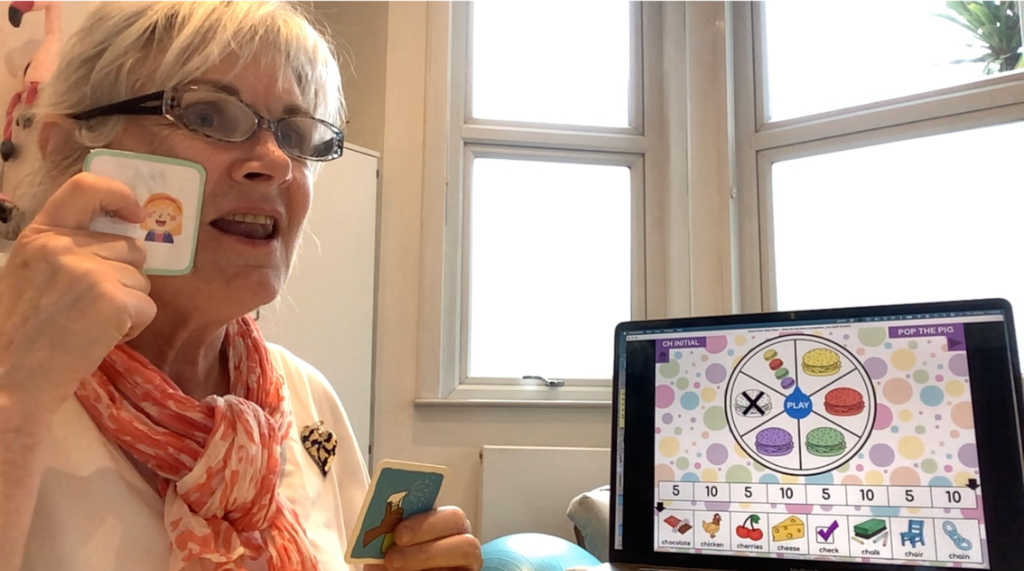
I’m a Speech and Language Therapist with nearly 30 years’ experience in speech sound disorders, feeding and swallowing, and I have additional training in myofunctional therapy. Looking at how the mouth works has been an intrinsic part of my assessments for many years, so I’d like to explain what that involves and when it matters.

What is myofunctional therapy?

Myofunctional therapy (often called orofacial myofunctional therapy, or OMT) is about how the muscles of the mouth and face work. It overlaps with what speech and feeding therapists call oro-motor function, although OMT looks more specifically at things like resting posture, breathing and swallowing patterns. Depending on the therapist’s training and your child’s needs, it may include:

  • tongue movement, resting posture and positioning
  • lip closure and resting posture
  • jaw movement and coordination
  • oral habits, such as thumb sucking or dummy use
  • swallowing patterns
  • how oral function, feeding and speech affect one another.

Some children have difficulties across several of these areas. Others have one specific speech sound difficulty and no wider problem with how their mouth works.

Signs it may be worth having your child’s oral function checked

You might want an assessment if your child:

  • has a lisp or a tricky /R/ that hasn’t changed with therapy
  • often has their mouth hanging open at rest
  • pushes their tongue forward against or between their teeth when speaking or swallowing (sometimes called tongue thrust)
  • is still dribbling or drooling after 18 months
  • finds chewing difficult, or struggles to move their tongue up, out or from side to side
  • breathes mostly through their mouth.

If you are worried about tongue-tie, I can assess how your child’s tongue moves for speech and feeding. If a medical or dental opinion is needed, I will explain why, advise you on who to see and work alongside them, for example an ENT consultant or paediatric dentist.

What does a comprehensive assessment look at?

When a child has a speech sound difficulty, I look at their speech alongside how their mouth is built and how it works. Depending on the concern, that may include:

  • jaw: how steady it is, and how well it moves and coordinates with the lips and tongue
  • teeth and mouth structure: the position of the teeth, the bite, the palate and anything structural that may be relevant
  • lips: closure, movement and resting posture
  • tongue: how well it moves in different directions, where it rests and whether it pushes forward
  • swallowing: relevant aspects of how your child swallows and where the tongue sits
  • palate and voice: anything that may need further investigation, such as concerns about how the palate is working or an unusually nasal sound
  • habits and breathing: things like thumb sucking or mouth breathing, and any signs that a medical or dental check may be needed.

Not every child needs every part of this. The questions we are trying to answer guide what I look at and what happens next.

For example, a child with a lisp may find it hard to coordinate the tongue placement needed for an /S/ sound. They may rest their tongue low in the mouth, or they may have spent years making the /S/ sound with the tongue between the teeth. By looking at how the mouth moves, along with habits and history such as thumb sucking, I can understand what may be contributing and plan therapy accordingly.

The findings help decide whether your child needs direct speech therapy, further assessment, a different approach, or input from another professional such as an ENT consultant, dentist or orthodontist. Assessment isn’t simply about spotting something that looks unusual. It is about understanding what it means for your child and deciding what, if anything, needs to be done. This kind of clinical reasoning is a natural, daily part of my work as a Speech and Language Therapist.

What if my child isn’t making progress in speech therapy?

If your child has been attending therapy for weeks or months without meaningful progress, it is reasonable to ask for a review. In my practice I monitor progress from one session to the next, and if things aren’t moving, I would rather review the plan than simply carry on with the same approach.

Sometimes a child needs more time. Sometimes the approach needs to change. Sometimes we need more information or another professional’s input. Sometimes therapy needs to pause while an underlying issue is looked into.

Whichever it is, you can expect a clear explanation of what we are working towards and how progress will be reviewed. A lack of progress should always prompt a review of the plan.

Does myofunctional therapy help with speech difficulties?

Sometimes. Some children have speech sound difficulties alongside differences in how their mouth works, which is why I assess both and consider whether they are related. A different tongue posture, an open-mouth resting posture or an unusual swallowing pattern is always worth noting, but it is not automatically the cause of a lisp or another speech sound disorder.

For speech sound disorders, treatment should be chosen to match the nature of the speech difficulty and be supported by evidence. The routine use of non-speech oral-motor exercises, meaning exercises that don’t involve practising speech sounds, to improve speech is not supported by the available evidence (the Cochrane review of non-speech oral-motor treatment – Lee & Gibbon, 2015).

That doesn’t mean work on oral function is never appropriate. The important question is what we are trying to achieve. If the aim is clearer speech, therapy needs to work on the speech itself, with plenty of practice of the relevant sounds, syllables and words. If your child also has a separate difficulty with feeding, swallowing or another aspect of oral function, such as resting posture, that may need its own assessment and targeted therapy. This is why I combine evidence-based speech practice with myofunctional assessment and therapy where a child’s oral function needs it, and I will always explain the aim and the reasoning behind what I recommend.

Choosing the right therapist for your child

Whoever you choose, I would encourage you to ask who will be treating your child, what their training covers and whether they are well placed to meet your child’s particular needs. Good clinical practice includes recognising the limits of your own expertise and referring on or working with others when appropriate. No practitioner should feel they have to manage every part of a child’s difficulties alone.

When the main concern is your child’s speech sounds, speech clarity or expressive language, I would recommend starting with an experienced Speech and Language Therapist whose expertise matches your child’s needs. If that therapist also has additional training in myofunctional therapy, so much the better. You can check that any Speech and Language Therapist is registered using the HCPC online register, and it is always fine to ask about a practitioner’s original qualification, clinical experience and the scope of their training.

So that you know who would be working with your child, here is a little about my own training: I am an HCPC-registered Speech and Language Therapist (BSc Clinical Communication Sciences, Royal Central School of Speech and Drama, 1996) with nearly 30 years’ experience, a postgraduate diploma in dysphagia (2000) and certification in the SOS Approach to Feeding (2018) and Orofacial Myofunctional Disorders training in 2026. I also completed IBCLC lactation consultant certification in 2019 (since lapsed, 2024) and worked as a neonatal Speech and Language Therapist and Lactation Consultant at Barnet Hospital in 2019–2020.

Next steps

If your child has a lisp, a tricky /R/, an open-mouth resting posture, a tongue thrust, dribbling or difficulty chewing, I would be happy to look at the whole picture. I assess speech and oral function together, and if your child needs a dentist, orthodontist or ENT consultant, I will tell you.

You can find out more on my Speech and Feeding Difficulties page, or get in touch to arrange an assessment. If you’re not sure whether your child needs one, contact me and we can talk it through.

Sonja McGeachie

Sonja McGeachie

Highly Specialist Speech and Language Therapist

Owner of The London Speech and Feeding Practice.


Health Professions Council registered
Royal College of Speech & Language Therapists Member
Member of ASLTIP

Find a speech and language therapist for your child in London. Are you concerned about your child’s speech, feeding or communication skills and don’t know where to turn? Please contact me and we can discuss how I can help you or visit my services page.

Reference

Lee AS-Y, Gibbon FE. Non-speech oral motor treatment for children with developmental speech sound disorders. Cochrane Database of Systematic Reviews 2015, Issue 3. Art. No.: CD009383. DOI: 10.1002/14651858.CD009383.pub2.

3

Similar Posts

  • ·

    How can I incorporate AAC into my speech therapy sessions?

    Many parents are surprised when I bring AAC into a session, especially if they’ve come to see me primarily for speech sound work.

    They might wonder: ‘If we’re working on pronunciation, why are we using a communication device?’

    The simple answer is this: speech therapy is about communication first, and speech sounds second. Supporting a child’s ability to express themselves clearly and confidently is always the priority, and AAC can be a powerful tool alongside spoken speech.

    What do we mean by AAC?

    AAC stands for Augmentative and Alternative Communication.

    This can include:

    • A speech-generating device (such as LAMP Words for Life or GRID as I used in the photo below)
    • A communication app on a tablet
    • A symbol board or communication book
    • Gestures, signs, or visual supports

    AAC does not replace speech. Instead, it supports language development, reduces frustration, and builds communication success while speech skills are developing.

    Pretend Play using Speech and AAC in my clinic room

    But I mainly work on speech sounds… So how does AAC fit?

    Most of the children I see are working on:

    • Articulation difficulties
    • Phonological delay
    • Motor planning challenges (including apraxia/dyspraxia)
    • Unclear speech affecting confidence

    For these children, AAC isn’t a separate therapy. It’s simply woven naturally into what we are already doing.

    If a child brings their device to sessions, I actively include it. If they don’t yet use AAC but could benefit from visual or symbolic support, I may introduce simple options within activities.

    Using AAC to support speech practice

    Let’s say we are working on early speech targets like: ‘GO’.

    We might practise:

    • Saying the word verbally
    • Listening for the target sound
    • Using play (TOY TRAIN GOING ROUND A TRACK)

    Now we can extend this using AAC.

    On the device or communication board, we might model: ‘LET’S GO’ or ‘IT’s GOING up the hill’.

    This allows the child to:

    • Practise their speech sound target
    • Build a simple sentence
    • Experience successful communication even if speech is not fully clear yet

    All responses are valid and supported.

    AAC helps children communicate more than they can say

    Many children can understand and think in longer phrases than they can physically say.

    For example:

    • A child who verbally says single words may build longer phrases on AAC.
    • A child who struggles to plan speech movements may use AAC to communicate smoothly while still practising verbal attempts.
    • A child who becomes frustrated when misunderstood gains a reliable backup system.

    Rather than slowing speech progress, AAC often:

    • Reduces communication pressure
    • Increases participation in therapy
    • Encourages more attempts at speech
    • Supports language growth

    When children feel understood, they usually become more motivated to try speaking.

    There are no ‘prerequisites’ for AAC

    One of the biggest myths I hear is: ‘My child isn’t ready for AAC yet.’

    In reality, children do not need to:

    • Reach a certain speech level
    • Use pictures first
    • Prove they understand everything
    • Show immediate interest

    Instead, we presume competence and introduce AAC in meaningful, playful ways.

    That means:

    • Modelling words while blowing bubbles
    • Commenting during playdough activities
    • Choosing words during games
    • Building simple phrases in shared reading

    AAC should never feel like extra ‘work’. It’s simply another way to join in communication.

    My goal is always the same: to help each child communicate as clearly, confidently, and successfully as possible, using every helpful tool available.

    If your child uses AAC (or might benefit from it)

     Please feel free to:

    • Bring the device to sessions
    • Show me how your child currently uses it
    • Share advice from school or other therapists

    I am very happy to incorporate AAC into our work together so that speech practice, language development, and real communication all move forward hand-in-hand. Because ultimately, therapy isn’t just about producing perfect sounds. It’s about helping your child be heard and understood.

    If you’d like support or advice, please contact me and I can help guide the next steps.

    Sonja McGeachie

    Highly Specialist Speech and Language Therapist

    Owner of The London Speech and Feeding Practice.

      Health Professions Council registered
      Royal College of Speech & Language Therapists Member
      Member of ASLTIP

      Find a speech and language therapist for your child in London. Are you concerned about your child’s speech, feeding or communication skills and don’t know where to turn? Please contact me and we can discuss how I can help you or visit my services page.

      3
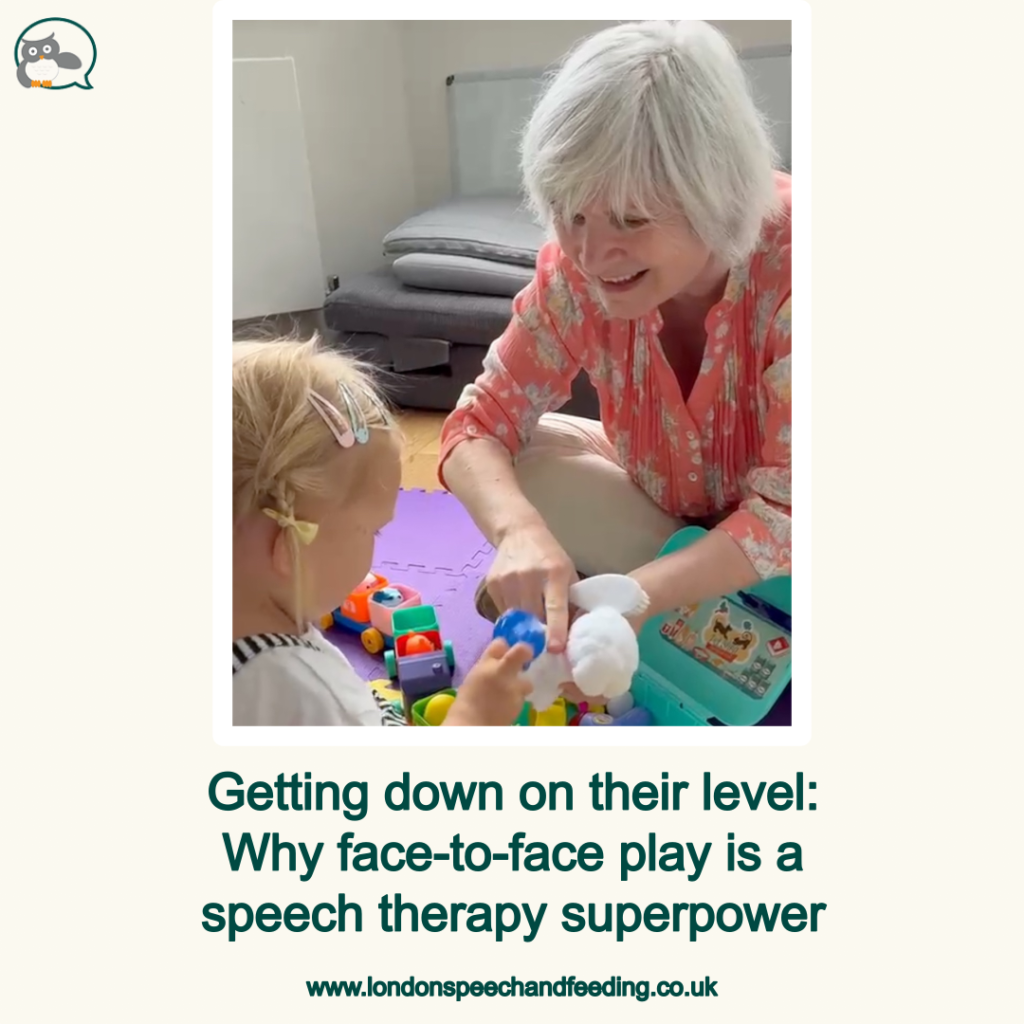
    • Getting down on their level: Why face-to-face play is a speech therapy superpower

      As parents, we spend a massive portion of our days multi-tasking. We are talking to our toddlers while washing dishes, shouting encouraging words from across the living room while folding laundry, or answering their questions from a few feet above them while walking through the supermarket. It is a completely natural dynamic, after all, the adult world happens up here, and their world happens down there.

      But when it comes to actively boosting your child’s speech and language development, one of the simplest, most profound changes you can make costs absolutely nothing and requires no special training.

      It is simply this: Get down on the floor, sit cross-legged, and get face-to-face.

      At London Speech and Feeding I call this physical positioning ‘face to face’. It is also one of the major ‘Hanen Programme’ Strategies. It completely reshapes how your child interacts with you, transforms how they process language, and turns ordinary playtime into an instant communication opportunity.

      Our mouth is the magic: Visual cueing and speech imitation

      When a child is learning to talk, they aren’t just listening to the sounds you make; they are watching how you make them.

      Speech is an incredibly complex motor skill. To say a single word, the brain must coordinate the lips, tongue, teeth, jaw, and vocal cords in a fraction of a second. When you speak to your child from a standing or even a seated chair position while they are on the floor, your mouth is entirely out of their direct line of sight. They miss the visual roadmap of speech.

      When you sit right in front of them at eye level:

      • They see mouth shapes: They can see how your lips round for an /OO/ sound, how your teeth touch your lip for an /F/ sound, or how wide your mouth opens for an /AH/.
      • They read facial expressions: Emotions give context to words. Seeing your eyes widen with excitement or your eyebrows lift in surprise helps them map meaning onto the vocabulary you are using.
      • They mimic naturally: By putting your face directly in your child’s field of vision, you make it infinitely easier for her or him to try and copy your oral movements.

      If you are working on a specific word like ‘pop’ while blowing bubbles or ‘more’ during snack time getting your face just a foot or two away from your child gives her or him the front-row seat she or he needs to learn the mechanics of that word.

      Unlocking joint attention: The foundation of all languages

      Before a child can say their first words, they need to master a milestone called joint attention.

      What is joint attention?

      It is the magic moment when a child looks at an object (like a toy train), looks up at you to share their excitement, and then looks back at the object. It is a three-way loop of shared experience.

      Without joint attention, communication cannot thrive. If a child is entirely hyper-focused on a toy and ignoring your presence, or if you are commenting on a book they aren’t looking at, true communication isn’t happening.

      When you get down on the floor on a play mat, you naturally insert yourself into their bubble. You aren’t a distant narrator anymore; you are a co-player. Being at their level makes it incredibly easy for their eyes to flick from the toy straight to your face. This shared gaze is the exact moment language takes root. It signals to the child, ‘We are experiencing this together, and this thing we are doing has a name.’

      The ‘wait and see’ technique

      Once you are down on the floor, the temptation is often to take over by pointing at everything, asking a million questions like ‘What’s that?’, ‘Is that a blue train?’, or somehow driving the play.

      Instead, the most powerful thing you can do at eye level is to practise the ‘Wait and See’ technique.

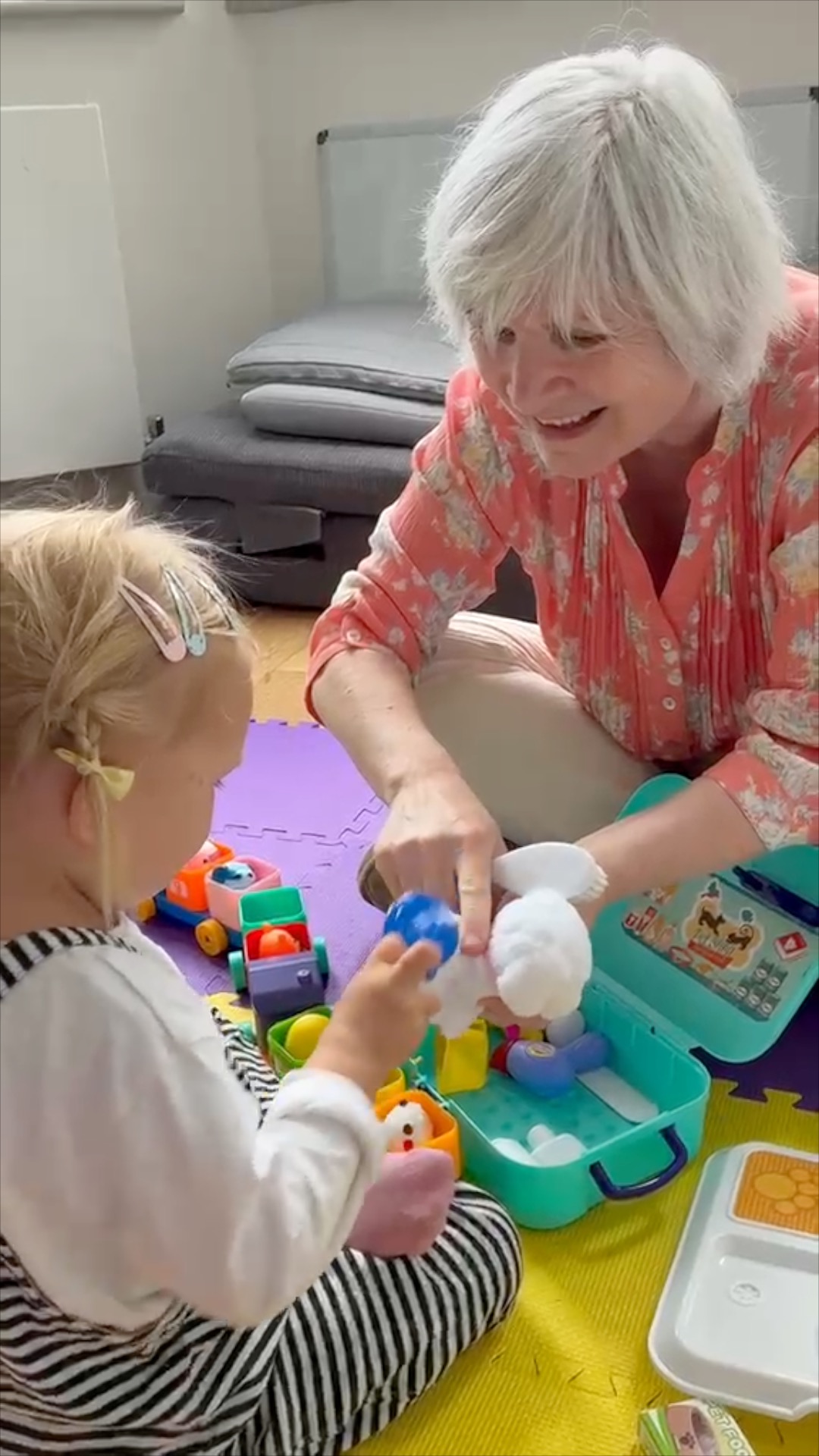
      In the video clip you can see this exact dynamic in action. Look at how I am sitting cross-legged on the mat, at eye level with the toddler. Notice how my hands are on the toy container, but my eyes are locked on the child. I am not forcing the interaction; instead, I am waiting.

      Here is how you can use this strategy at home:

      1. Set the stage: Get down on their level with a high-interest toy that requires help (like a wind-up toy, bubbles, or a tight-lidded box with toys inside).
      2. Create anticipation: Hold the object near your face or place your hands on it, but don’t open or activate it right away.
      3. Lean in and wait: Lean slightly forward, open your eyes wide, adopt an expectant facial expression, and completely pause. Count to five or ten in your head. Do not say anything.
      4. Capture the gaze: Wait for the exact moment your child looks up from the toy to meet your eyes, as if to say, ‘Well? Are you going to open it?’
      5. Reward the eye contact: The instant they make eye contact, deliver the language reward! Model a simple, functional word like ‘Open!’, ‘Go!’, or ‘Look!’ as you immediately do the action.

      By pausing and waiting at eye level, you create a ‘communication temptation’. The child learns that looking at you and engaging with your face is the key that unlocks the fun.

      Making it a daily habit

      You don’t need to spend hours a day sitting on the floor to see a difference. Start small by dedicating just 10 to 15 minutes of undivided, face-to-face play time each day. Turn off the television, put your phone in another room, get down on their level, and let them lead the play while you focus on being their visual communication partner.

      Whether you’re opening a little toy briefcase, pushing a plastic train along a track, or stacking blocks, remember: your face is the best toy in the room.

      Are you wondering if your toddler’s speech and language milestones are on track? At London Speech and Feeding I love helping families navigate early communication. Feel free to explore my services page and reach out directly to schedule a consultation.

      Sonja McGeachie

      Highly Specialist Speech and Language Therapist

      Owner of The London Speech and Feeding Practice.


      Health Professions Council registered
      Royal College of Speech & Language Therapists Member
      Member of ASLTIP

      Find a speech and language therapist for your child in London. Are you concerned about your child’s speech, feeding or communication skills and don’t know where to turn? Please contact me and we can discuss how I can help you or visit my services page.

      3
    • ·

      Milestones of autistic children: Crawling, walking, and talking

      For all children every milestone achieved is a testament to the unique and intricate process unfolding within each young mind. For autistic children, this journey may present a distinct pattern, with some reaching developmental milestones like crawling, walking, and talking later than their neurotypical peers. Let’s have a look into the fascinating realm of Autism and explore why some autistic children might crawl, walk, and talk later, shedding light on the underlying factors contributing to this unique way of developing.

      1. Individual Pacing:

      Child development is not a one-size-fits-all journey. Each child, whether neurotypical or autistic, has a unique timeline for achieving milestones. Autistic children, like any other children, follow their own pacing. This individual rhythm might lead them to focus on one set of skills before they progress to others. Like some neurotypical children might focus on talking earlier than walking, autistic children might prioritise other areas before crawling or talking.

      2. Neurodevelopmental Complexity:

      The human brain is a remarkable entity, with a bewildering array of interconnected processes that lead to us achieving our developmental milestones. Autistic children often have variations in “neural wiring”, which can impact the balance between gross motor skills (crawling, walking) and fine motor skills. Speech and language acquisition falls under fine motor skills and may be momentarily disrupted due to the divergent neurological pathways at play in autism.

      2. Sensory Processing Differences:

      One of the hallmarks of autism is altered sensory processing. Autistic children often experience sensory stimuli differently than their neurotypical peers. This heightened or diminished sensitivity can influence a child’s desire or ability to engage in activities like crawling and walking. The sensation of movement while crawling or walking, for instance, might be overwhelming for some autistic children, causing them to either avoid or delay these activities.

      3. Visual-Spatial Abilities:

      Autistic children and adults frequently display excellent visual-spatial abilities. This strength might lead some children to focus more on activities that engage these skills, potentially delaying their engagement with activities like walking or talking. As they navigate their environment and process information visually, they might naturally invest more time in activities that stimulate this particular cognitive ability and strength.

      4. Communication Challenges:

      For many autistic children, speaking can be a really complex and difficult endeavour. Communication delays are a common feature of autism. This can affect both receptive and expressive language development. While some children might be physically capable of crawling or walking, they may not yet have the tools to communicate their desires and intentions. This leads to a temporary focus on non-speaking forms of expression. This does not mean that they do not communicate at all. But autistic individuals often start out using jargoning or echolalia as a form of communication as well as behaviours and physical forms of communication.

      5. Executive Functioning and Motor Skills:

      Executive functioning, or abilities for planning, organising, and carrying out tasks, can vary in autistic children. These skills are crucial for activities like crawling, walking, and talking, which need coordination and planning. About 40% of autistic persons have a motor planning difficulty.

      6. Intense Interests and Routines:

      Autistic children often develop intense interests in specific subjects, sometimes to the exclusion of other activities. These interests might become their primary mode of engagement. They might side-line milestones like crawling, walking, or talking. The mostly rigid adherence to routines and preferences might cause them to allocate more time to their preferred activities. This delays their engagement with other developmental tasks.

      How can Speech and Language Therapy help:

      Support and Intervention:

      Early intervention and regular Speech and Language Therapy play a pivotal role in the developmental journey of autistic children. Therapies tailored to individual needs can aid in bridging the gaps between milestones. Occupational therapy, for example, can help address sensory sensitivities and motor skill challenges that might impact crawling and walking. Speech therapy can help communication development, gradually bridging the gap between non-verbal expressions and spoken language.

      For example, we now know that echolalia or jargoning of longer phrases with intonation, repeating scripts from favourite tv shows or songs have many meanings and communicative functions. For example, a child who utters long strings of echolalic utterances, often difficult to understand, might want to do any one of the following:

      • Comment
      • greet
      • ask a question
      • make a request
      • express surprise
      • negate something.

      We now understand that the way to support a child with echolalia is to acknowledge all utterances and try and find out what the meaning is behind these scripts. This is very supportive. Over time it will lead a child to move on to understanding and saying more clear and self-generated language. For more information about this Natural Language Acquisition here are some other great websites for you to look at:

      Conclusion

      In conclusion, the journey of an autistic child’s development is a testament to the uniqueness and complexity of the human mind. The delays or differences in achieving milestones like crawling, walking, and talking can be attributed to a range of factors, including

      • neurodevelopmental intricacies,
      • sensory processing variations,
      • and communication challenges.

      It’s crucial to recognise that these delays are not indicative of a lack of potential, but rather a manifestation of the intricate interplay between an autistic child’s strengths and challenges. By embracing these differences and providing tailored support, we can help each autistic child unfold their potential at their own pace.

      Do get in touch if you would like to book an appointment where we can explore how to help your child develop and thrive

      Do get in touch if you would like to book an appointment where we can explore how to help your child develop and thrive


      Find a speech and language therapist for your child in London. Are you concerned about your child’s speech, feeding or communication skills and don’t know where to turn? Please contact me and we can discuss how I can help you or visit my services page.

      0
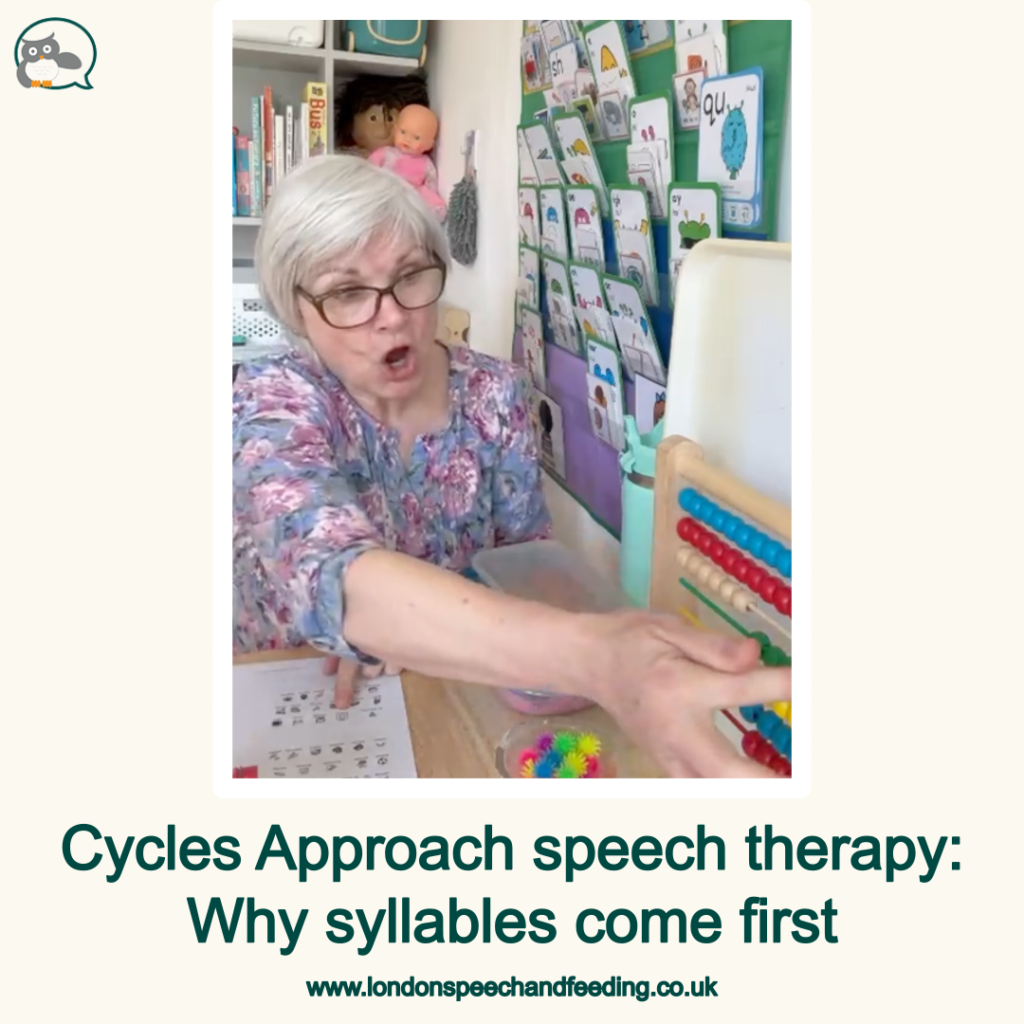
    • Cycles Approach speech therapy: Why syllables come first

      and why it matters more than you might think!

      If your child’s speech is difficult to understand, it can feel tempting to focus straight away on individual sounds: those tricky /S/, /K/, or /SH/ sounds that just won’t come out clearly.

      But in therapy, we don’t always start there.

      When a child is very difficult to understand, and I have ruled out that the underlying cause is motor-based, I often opt for the Cycles Phonological Approach. This is helpful for those kids where we can feel like we don’t know where to start! The Cycles Approach helps to generate a broad overall increase in speech clarity by sequentially targeting a variety of speech patterns over the course of 8–10 weeks.

      So rather than working on one sound until it’s ‘fixed,’ we:

      • Work on patterns (not just individual sounds)
      • Target each pattern for a short period of time
      • Then cycle to the next one
      • And come back around again later

      This mirrors how speech development naturally happens: gradually, with increasing accuracy over time.

      Why don’t we start by fixing erroneous sounds straight away?

      To use a metaphor, if a child doesn’t have a strong syllable structure, working on individual sounds is like decorating a house that doesn’t have solid walls yet.

      Many children with speech sound difficulties:

      • Drop syllables (e.g. ‘banana’ → ‘nana’)
      • Simplify longer words
      • Struggle to maintain rhythm and stress patterns

      So, before we refine speech sounds, we need to build the framework of speech.

      Why syllables come first in every cycle

      In the Cycles Approach, we always begin with 2- and 3-syllable words, even if that’s not the main concern.

      Why?

      Because syllable awareness supports:

      • Speech clarity (intelligibility)
      • Word structure and sequencing
      • Prosody (rhythm and stress)
      • Motor planning for longer words

      Without this, even perfectly produced sounds can still be hard to understand in real speech.

      What do ‘2 and 3 beats’ mean?

      When we talk about ‘beats’ we mean syllables you can clap.

      Try it:

      • ‘Table’ → ta-ble (2 beats 👏👏)
      • ‘Banana’ → ba-na-na (3 beats 👏👏👏)

      In therapy, we help children:

      • Hear the beats
      • Feel the rhythm
      • Produce the full word (without dropping parts)

      What this looks like in therapy

      In my sessions, this part of the cycle is active, visual, and repetitive.

      You might see me using:

      • 👏 Clapping or tapping out syllables
      • 🧩 Using visual supports or blocks for each beat
      • 🎲 Play-based repetition of target words
      • 🎯 High-frequency practice (lots of turns!)

      I also keep the focus on success and flow, rather than correction.

      If you’re watching the video clip I’ve shared here, you’ll notice:

      • I’m not over-correcting every sound
      • I’m prioritising getting the whole word out
      • I’m building rhythm, confidence, and consistency

      Why this stage is so powerful

      It can look simple, but it’s doing a lot of heavy lifting.

      Working on syllables helps children:

      • Say longer words more clearly
      • Reduce ‘mumbling’ or collapsing of words
      • Improve overall intelligibility quickly
      • Prepare for more precise sound work later

      Often, parents notice early wins like:

      ✨ ‘They’re easier to understand already’

      ✨ ‘They’re saying longer words!’

      ✨ ‘They’re more confident speaking’

      And that’s before we’ve even fully targeted specific sounds.

      But will my child still learn their sounds?

      Yes. Absolutely.

      The Cycles Approach is structured so that after syllables, we move into:

      • Early developing sounds
      • Then more complex patterns (like fronting or clusters)

      And  importantly, we come back around again.

      Nothing is missed. It’s just sequenced in a way that supports success.

      A different way of thinking about progress

      One of the biggest mindset shifts with the Cycles Approach is this:

      👉 We’re not aiming for perfection straight away

      👉 We’re aiming for gradual system-wide change

      That means:

      • Your child doesn’t need to ‘master’ something before moving on
      • Progress builds across cycles
      • Speech becomes clearer over time, not overnight

      So, to sum up

      Starting with syllables might seem unexpected but it’s one of the most powerful foundations we can give a child whose speech is hard to understand.

      By building rhythm, structure, and confidence first, we make everything that comes next more effective.

      If your child is starting speech therapy and you notice we’re clapping words like ‘banana’ or ‘elephant’, there’s a very good reason for it.

      We’re not going backwards.

      We’re building from the ground up.

      We’re making later sound work more effective and more likely to generalise into everyday talking.

      Next steps:

      If you’re concerned about your child’s speech clarity or wondering whether they might benefit from a structured approach like this, feel free to get in touch. I offer individualised assessments and therapy plans tailored to each child’s speech profile whether that’s early sound development, phonology, or motor speech difficulties.

      Sonja McGeachie

      Highly Specialist Speech and Language Therapist

      Owner of The London Speech and Feeding Practice.


      Health Professions Council registered
      Royal College of Speech & Language Therapists Member
      Member of ASLTIP

      Find a speech and language therapist for your child in London. Are you concerned about your child’s speech, feeding or communication skills and don’t know where to turn? Please contact me and we can discuss how I can help you or visit my services page.

      Parent FAQ section

      Why is my child practising words like ‘banana’ instead of sounds like /K/ or /S/?

      Because your child first needs to be able to hold and produce the full shape of a word. If they’re dropping syllables (e.g. ‘banana’ → ‘nana’), working on individual sounds won’t carry over into real speech. We build the structure first, then refine the sounds.

      What if my child can already say some long words?

      That’s great. But we’re looking for consistency and clarity across many words, not just a few familiar ones. This stage helps stabilise that skill so it becomes reliable in everyday talking.

      How long will we stay on syllables?

      Usually, this is a short but important phase within each cycle. We revisit it regularly, but we also move on to other patterns (like specific sounds or sound processes) within the same therapy block.

      Will this delay my child learning their sounds?

      No. In fact, it often speeds things up overall. Once the syllable structure is in place, children are much more able to use correct sounds in longer words and sentences.

      What can I do at home?

      Keep it simple and playful:

      • Clap out words together (e.g. ‘el-e-phant’)
      • Emphasise full words naturally in conversation
      • Repeat back what your child says with the full structure (without pressure)

      Consistency and exposure matter more than correction.

      My child gets frustrated. Will this help?

      Yes. Many children become frustrated when they’re not understood. Improving syllable structure often leads to quick wins in clarity, which can boost confidence and reduce that frustration.

      Building clearer speech: Why we practise syllables first

      What are syllables?

      Syllables are the ‘beats’ in words.

      • ‘Table’ = 2 beats (ta-ble)
      • ‘Banana’ = 3 beats (ba-na-na)

      Why is my child working on this?

      If your child:

      • Drops parts of words (‘banana’ → ‘nana’)
      • Mumbles longer words
      • Is hard to understand

      …then we need to build the structure of words first.

      This helps your child:

      ✔ Say longer words clearly

      ✔ Be easier to understand

      ✔ Feel more confident speaking

      What does this look like in therapy?

      We practise:

      • Clapping or tapping out beats 👏
      • Saying full words with rhythm
      • Repeating target words through play
      • Using visuals or actions to support learning

      How you can help at home

      Keep it light and playful, little and often!

      Try this:

      • Clap words together أثناء play (e.g. toys, food, animals)
      • Model full words naturally (‘Yes, ba-na-na!’)
      • Repeat and expand what your child says

      Example:

      Child: ‘nana’

      You: ‘Yes! Ba-na-na‘

      Important to know

      • This is a key first step in speech therapy
      • We will move on to sounds—but this helps them stick
      • Small changes here can make a big difference in clarity
      3
    • · ·

      LAMP Words for Life: A revolutionary AAC system

      Introduction

      When working with non-speaking or minimally speaking children the LAMP Words for Life AAC (Augmentative and Alternative Communication) system is my absolute go-to every time. For me it stands out as a revolutionary system that has transformed the lives of many of my non-speaking students. LAMP Words for Life is a ROBUST, comprehensive language-based AAC system and it is designed to help any user to express their thoughts, feelings, and needs effectively, thereby achieving maximal independence in their daily life. A winner!

      There is a whole host of AAC apps and systems out there and each has their own advantages and benefits for sure. I have tried a good number of other systems. I do also like certain features of other AAC systems for sure. For example GRID: I love the versatility of GRID and the ease of editing the system is fantastic.

      Why I think it works so well

      However, strangely I always return to LAMP when push comes to shove. I have thought very carefully about it and so here are my thoughts on why this is and why it works so well:

      1. Intuitive interface: LAMP Words for Life features are for me really user-friendly and it is easy to navigate and understand (this is very important for non-techy people). I think it makes sense and it is accessible to users of all ages and abilities. Yes the pictures are a little bit different to other symbol systems we use, especially here in the UK to be sure, and this is one of the reasons why it is good to have a variety of systems available, so that we can cater for students who are used to other symbols or do very well with specific symbol core boards. I have learned though that the pictures are not that important when using LAMP because the entire system is based on MOTOR PLANNING. And once one knows the motor plan to find a picture it is in our brain and we do not look at the picture any more. So, the motor plan to find a word is much more important when using LAMP than worrying about what the picture looks like.
      2. Comprehensive vocabulary: The system offers a vast vocabulary of words and phrases, covering a wide range of topics and contexts. This enables users to express themselves effectively on a variety of subjects. That said, almost every time I use LAMP there is a little word I need and it’s not on there. But that’s not a problem: for example, I was looking for ‘sunglasses’ the other day. Sure, there is ‘sun’ and ‘glasses’ but that would be two separate motor plans and for my student that would be too many for now, so it was very easy to quickly add the new word ‘sunglasses’ under ‘accessories’ or ‘beach wear’ — I added it within less than one minute. Likewise, there are a ton of words which cater for the US market, and I tend to change them to fit the UK vocabulary like ‘nappy’ for ‘diaper’. Or I delete them entirely if I feel my child will never need to use a certain word like ‘conference’ or ‘nun’. PS: should they get to a point of using the system as an adult independently then these words can surely be added again, or if my student ever moves to the US then the words can be changed back to US terms again without any problem.
      3. Grammar support: LAMP provides built-in grammar support, helping users construct grammatically correct sentences. This can be particularly beneficial for individuals with language processing difficulties. But what I love about the way LAMP is organised here is that, in contrast with other systems I have used, it does not PREDICT what you want to say, it lets the user decide and find the right grammatical structure. I appreciate this because, just like I hate my phone or email offering predictive text or offer corrections to my words, I really do not get the systems that offer automatically a grammar change which mostly I don’t want. Where that is the case, I am often confused and hindered in finding the correct wording. I love the simplicity of LAMP and at the same the complexity that can be achieved gradually with practice. LAMP is fully designed to enable a user to build up not only vocabulary but a full language system. On a course recently I was able to hear adult LAMP users speaking to the audience in full and quick grammatically well-rounded sentences on a host of topics.
      4. Customisation: LAMP can be customised to meet the individual needs of each user. This includes options for adjusting the vocabulary, layout, and accessibility features. It is not as easy to edit as GRID I will say and that can cause me a little bit of frustration at times, but on balance I still vastly prefer the system as a whole. It can also be customised quite well for Gestalt Language Processors. It takes a little bit of practice and thinking about how best to do this but I have found a way that works well which I demonstrate in the short video clip.
      5. Community support: LAMP Words for Life has a thriving community of users on Facebook and this is so valuable and inspiring. Therapists and families of LAMP users alike share experiences, provide resources, and offer encouragement. This can be a valuable source of support for both users and their families.
      6. Comprehensive support: LAMP Words for Life offers quick and thorough support services, including training, resources, and ongoing assistance. This is invaluable and reassuring for both users and caregivers.
      7. Research-based: The development of LAMP Words for Life is based on extensive research and evidence-based practices. This ensures that the system is grounded in sound scientific principles.

      Conclusion

      To conclude LAMP Words for Life is a powerful AAC which provides us with a means of effective communication, language development, and social interaction. Whether you are a parent of a non-speaking child or a speech therapist looking for innovative AAC solutions, LAMP Words for Life is worth exploring.

      Example on how to use AAC at story time

      Feel free to contact me if you need help with your child.

      Sonja McGeachie

      Early Intervention Speech and Language Therapist

      Feeding and Dysphagia (Swallowing) Specialist The London Speech and Feeding Practice

      The London Speech and Feeding Practice


      Find a speech and language therapist for your child in London. Are you concerned about your child’s speech, feeding or communication skills and don’t know where to turn? Please contact me and we can discuss how I can help you or visit my services page.

      1
    • · · ·

      Autism – Benefits of Early Assessment and Intervention

      I think my child might be autistic – how can we help?
      Image by macrovector on Freepik

      Consulting a Specialist Speech and Language Therapist can help you in several ways: assessment, informal and formal observation, discussion and advice, onward referrals, direct intervention, parent coaching, educational support and much more, all geared towards supporting you the parents, and helping your child to flourish and thrive.

      First up, we can help you with assessment and advice: with a wealth of expertise in observing childrens’ play and communication, as well as knowledge of the latest research we can see a child’s strengths and areas of struggle very quickly indeed.

      Within a short space of time, we can identify the areas we need to focus on and start guiding you towards helping your child to connect, respond, react and feel better.

      Early detection is key

      If autism is detected in infancy, then therapy can take full advantage of the brain’s plasticity. It is hard to diagnose Autism before 18 months but there are early signs we know to look out for. Let’s have a brief look at the sorts of things we look at.

      The earliest signs of Autism involve more of an absence of typical behaviours and not the presence of atypical ones.

      • Often the earliest signs are that a baby is very quiet and undemanding. Some babies don’t respond to being cuddled or spoken to. Baby is being described as a ‘good baby, so quiet, no trouble at all’.
      • Baby is very object focused: he/she may look for long periods of time at a red spot/twinkly item further away, at the corner of the room for example.
      • Baby does not make eye contact: we can often see that a baby looks at your glasses for example instead of ‘connecting’ with your eyes.
      • At around 4 months we should see a baby copying adults’ facial expressions and some body movements, gestures and then increasingly cooing sounds we make; babies who were later diagnosed with autism were not seen to be doing this.
      • Baby does not respond with smiles by about 6 months.
      • By about 9 months, baby does not share sounds in a back-and-forth fashion.
      • By about 12 months baby does not respond/turn their heads when their name is called.
      • By around 16 months we have no spoken words; perhaps we hear sounds that sound like ‘speech’ but we cannot make out what the sounds are.
      • By about 24 months we see no meaningful two-word combinations that are self-generated by the toddler. We might see some copying of single words.

      24 months plus:

      • Our child is not interested in other children or people and seems unaware of others in the same room/play area.
      • Our child prefers to play alone, and dislikes being touched, held or cuddled.
      • He/she does not share an interest or draw attention to their own achievements e.g., ‘daddy look I got a dog’.
      • We can see our child not being aware that others are talking to them.
      • We see very little creative pretend play.
      • In the nursery our child might be rough with other children, pushing, pinching or scratching, biting sometimes; or our child might simply not interact with others and be unable to sit in a circle when asked to.

      What sort of speech and language difficulties might we see?

      Our child might do any of the following:

      • have no speech at all, but uses body movements to request things, takes adults by the hand
      • repeat the same word or phrase over and over; sometimes straight away after we have said it or sometimes hours later
      • repeat phrases and songs from adverts or videos, nursery rhymes or what dad says every day when he gets back from work etc.
      • copy our way of intonation
      • not understand questions – and respond by repeating the question just asked:
        • adult: Do you want apple? child: do you want apple?
      • not understand directions or only high frequency directions in daily life
      • avoid eye contact or sometimes ‘stares’
      • lack of pointing or other gestures

      Common behaviours:

      • Hand flapping
      • Rocking back-and-forth
      • Finger flicking or wriggling/moving
      • Lining up items/toys
      • Wheel spinning, spinning around self
      • Flicking lights on and off, or other switches
      • Running back-and-forth in the room, needing to touch each wall/door
      • Loud screaming when excited
      • Bashing ears when frustrated or excited
      • Atypical postures or walking, tip toeing, can be falling over easily, uncoordinated
      • Can be hyper sensitive to noises, smells, textures, foods, clothing, hair cutting, washing etc.
      • Being rigid and inflexible, needing to stick to routines, unable to transition into new environments
      • Food sensitivity, food avoidance, food phobias

      I mentioned this to be a ‘brief’ look at the areas and it is: each topic is looked at very deeply and each area is multi-facetted therefore a diagnosis is rarely arrived at very quickly. We want to make sure we have covered all aspects and have got to know your child very well before coming to conclusions.

      Early detection is key, because we want to start helping your child to make progress as quickly as is possible. If you feel /know that your child is delayed in their speech and language development and you would like a professional opinion then please do contact me, I look forward to supporting you. It is important to know at this point, that if your child only has one or two of the above aspects it may mean that your child is simply delayed for reasons other than Autism and if that is the case, we will be able to help you iron out a few areas of need so that your child can go on thriving.

      If you need help with your child, please do not hesitate to contact me.


      Find a speech and language therapist for your child in London. Are you concerned about your child’s speech, feeding or communication skills and don’t know where to turn? Please contact me and we can discuss how I can help you or visit my services page.

      1