SLP Life

  • · ·

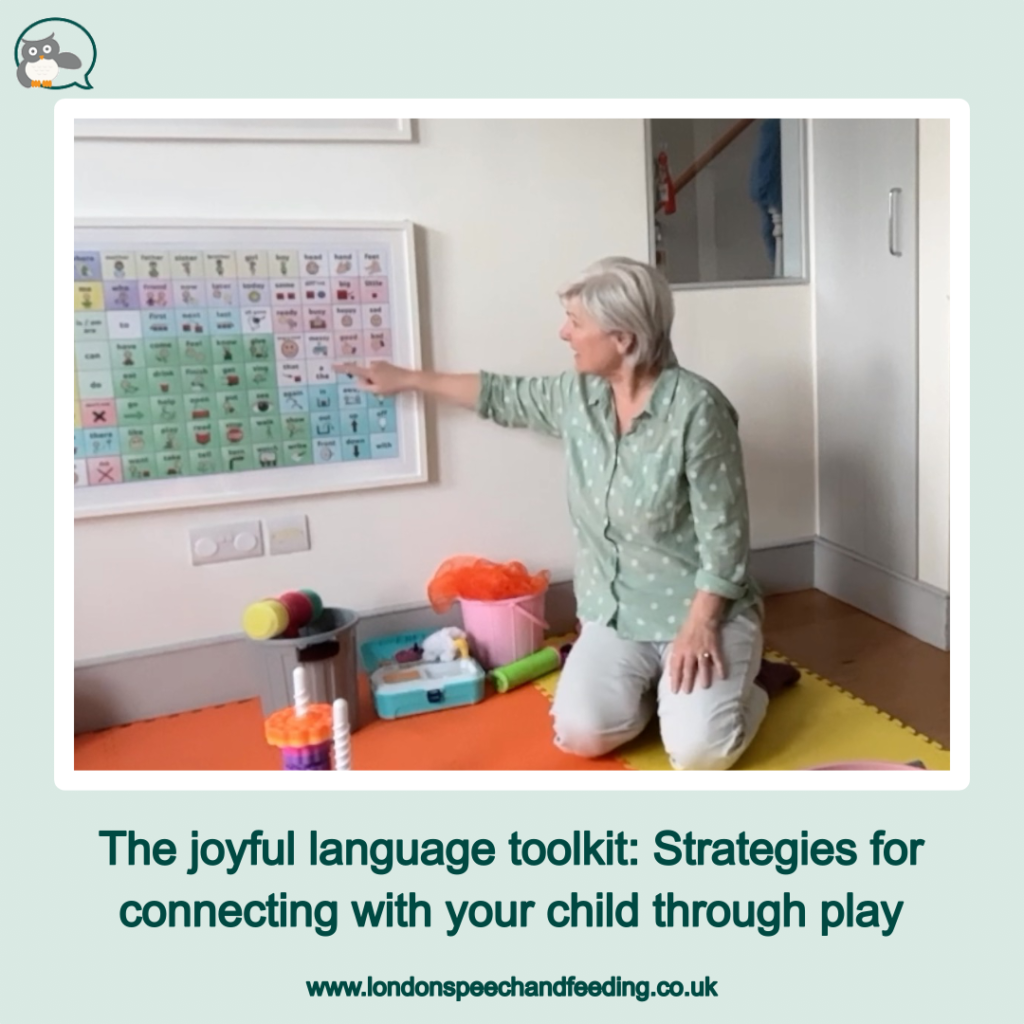
    The joyful language toolkit: Strategies for connecting with your child through play

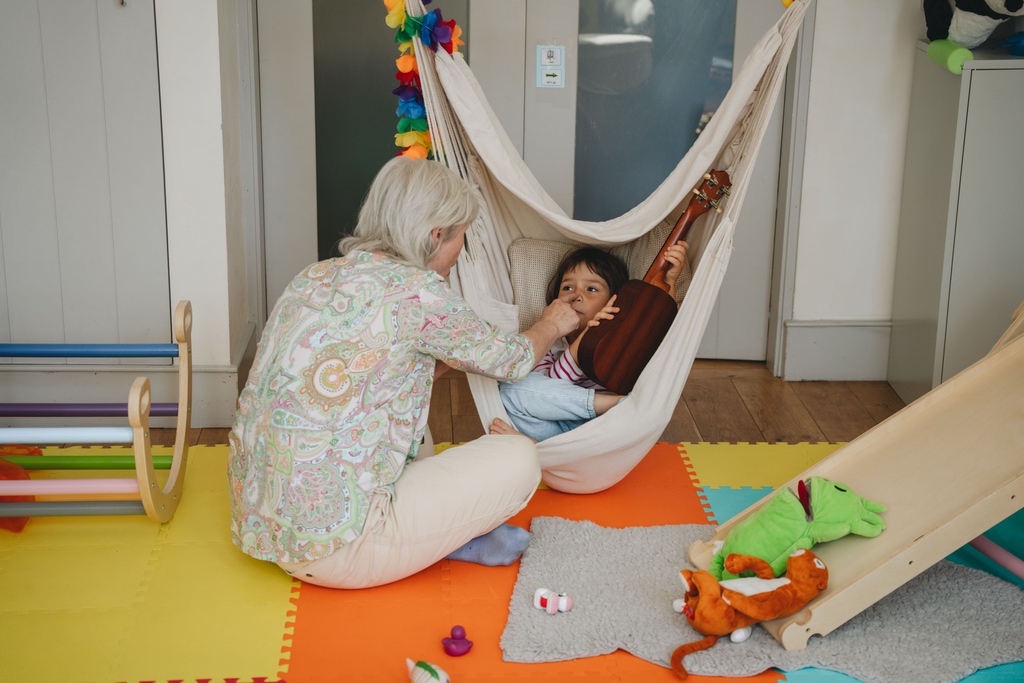
    As parents and therapists, we all want to help our children communicate. But sometimes, the process can feel like ‘work’. If I had a penny for every parent saying ‘I find it so boring!’… Ok hang in… what if I told you the most effective therapy happens when it doesn’t look like therapy at all?

    My approach centres on connection, enthusiasm, and multi-sensory engagement. We don’t just teach words; we teach the joy of using them. These strategies can be used whether your child is speaking, using a core board, or communicating in his or her own unique way.

    Some of my favourite strategies

    Today I want to share a few of my favourite strategies to turn everyday interactions into powerful communication opportunities regardless of why or how big a delay your child is having.

    1. Facial expressions & exaggeration: Use an exaggerated facial expression to show surprise (wide eyes!), excitement (big smile!), or confusion (a crinkled brow!). Your face is a powerful teaching tool. I am always talking like a clown in my sessions. I can announce that I have also a normal speaking voice outside my clinic room! 😊
    2. Using your voice with intonation: Your voice is music! Use a singsong or ‘tuneful’ repeat to make words stand out. For example, ‘It’s a BIIIG ball!’ or ‘Let’s GO-O-O!’. Again think: clown!!
    3. Hands and body to show: Use gestures, hands, and body movements to demonstrate. Say ‘OPEN’ while pulling your hands apart, or ‘UP’ while raising the toy high above your head.
    4. Elongating our words: Stretching out key sounds or words gives them emphasis and more time for your child to process. ‘Criiiinkley’ ‘tiiickleyyyy’
    5. Core board & language modelling:
      • Model the core board with joy: Don’t just point: point with energy!
      • Model the core board repeatedly throughout the activity, showing genuine excitement. This demonstrates the board is a joyful tool, not homework.
      • Pointing to the core board: When you say a core word, point to the corresponding symbol. You are showing your child, ‘My words live here, and your words can too’.
    6. Describing it for your child: Help your child build his or her vocabulary by providing rich sensory language. ‘It’s squishy’, ‘It’s very noisy’, or ‘It’s so smooth’.
    7. Catchy phrases: Repetitive, positive phrases create a sense of shared fun. Use them consistently: ‘Oh, that’s a nice one!’ or ‘We like that!
    8. Following your child’s Interest: Put down your agenda and follow your child’s lead. If they pick up a block, talk about the block. This ensures they are engaged and ready to learn.
    9. Allowing for pauses: This is critical! After you made a comment, allow for a significant pause (count to five in your head) for your child to fill. The silence creates a powerful opportunity for them to initiate communication.
    10. Copying your child’s sounds: If he or she makes a sound (‘buh!’), you make the sound back! Copying your child’s sounds shows him or her ‘I hear you, and your communication is important’.
    11. Lots of repetition: Hearing a word many times in meaningful contexts is how we learn! Repeat key phrases and core words throughout the activity. Repetition is the key to retention.
    12. Getting turns: Explicitly teach and celebrate getting turns in a game. ‘My turn! Your turn!’ This is a foundational social and communication skill.
    13. Using tidy up as a teaching activity: Turn cleanup into a fun game! It’s a goldmine for core words like PUT IN, ALL DONE, HELP, and MORE. For example, ‘Let’s PUT IN the red block! Yay!’
    14. Using exaggerated repeats: When your child tries a sound or word, give it back with exaggerated, tuneful repeats.

    Try out all or even just a few of these strategies, and I can promise you, you’re not just encouraging language; you’re building a joyful, reciprocal relationship based on genuine communication!

    Which strategy are you excited to try first? Let me know in the comments!

    If I can help you with any of the above, if you want to practise these a bit more, I would love to help you!

    Sonja McGeachie

    Highly Specialist Speech and Language Therapist

    Owner of The London Speech and Feeding Practice.


    Health Professions Council registered
    Royal College of Speech & Language Therapists Member
    Member of ASLTIP

    Find a speech and language therapist for your child in London. Are you concerned about your child’s speech, feeding or communication skills and don’t know where to turn? Please contact me and we can discuss how I can help you or visit my services page.

    2
  • ·

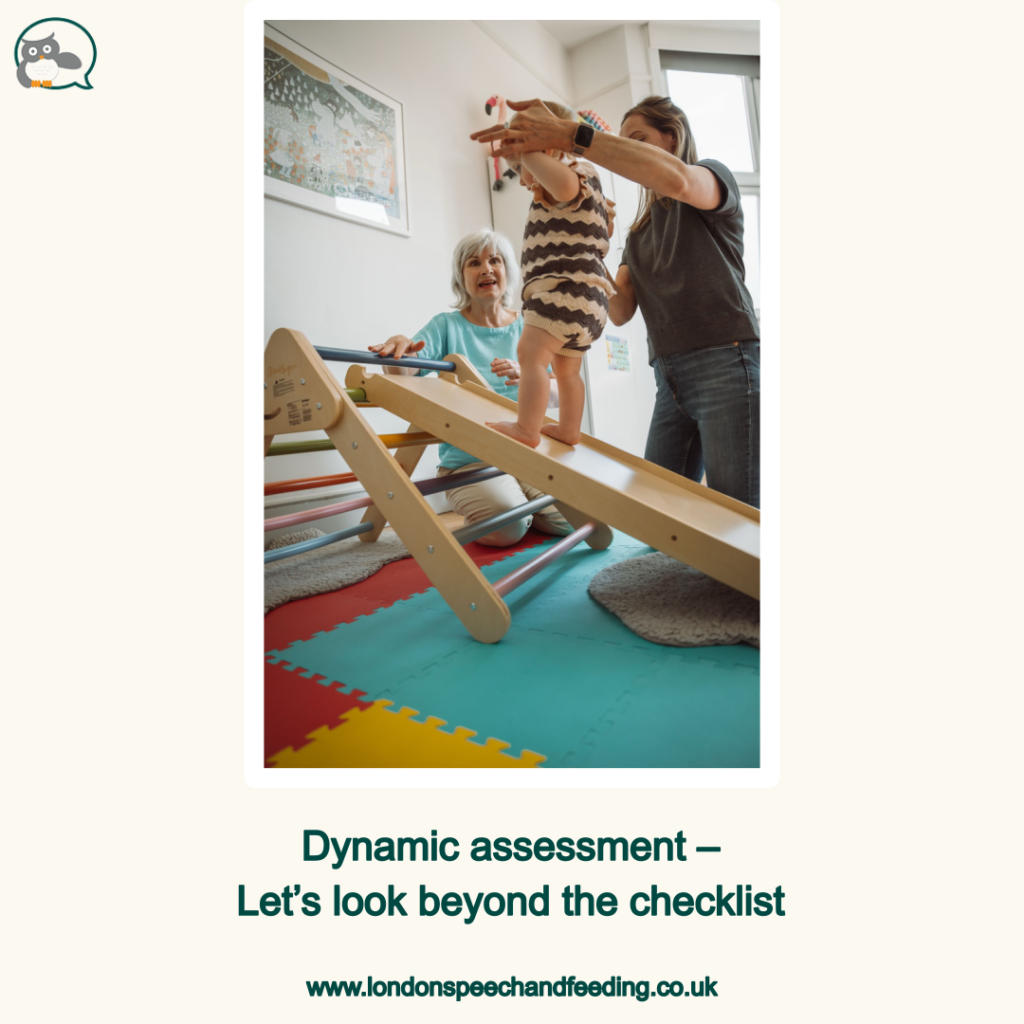
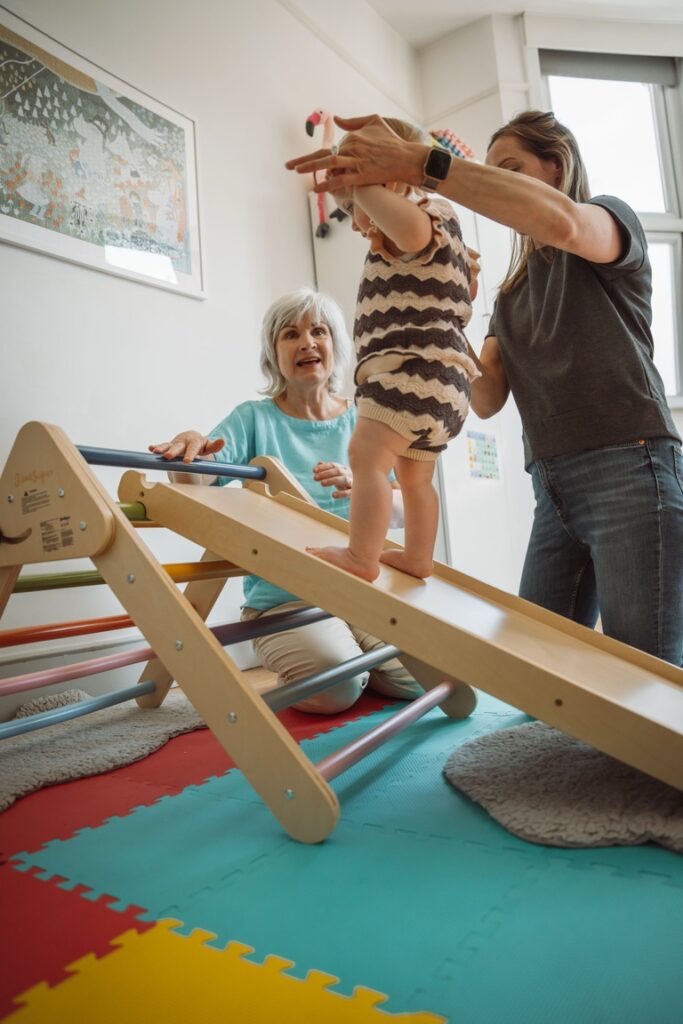
    Dynamic assessment – Let’s look beyond the checklist

    Dynamic assessment – Let’s look beyond the checklist

    As a parent, you’re always observing your child, celebrating his or her milestones, and sometimes, wondering if he or she is quite on track. When it comes to speech, language, play, attention, and listening, these early years are a whirlwind of development! It’s natural to seek guidance if you have concerns, and that’s where a truly comprehensive assessment comes in.

    But what exactly does ‘comprehensive’ mean, especially when it goes beyond a typical checklist? You can find any number of check lists online these days but whilst they can give you an overall idea of what a child is typically expected to do at any given age, it can also start leading you into a rabbit hole of anxiety of ‘what-iffery’.

    At The London Speech and Feeding Practice I believe in something far more insightful than a static evaluation: Dynamic Assessment. Think of it as an in-depth, interactive investigation into your child’s unique communication landscape, exploring not just what he or she can do, but how he or she learns and why he or she might be facing challenges. This is so important.

    What makes an assessment ‘dynamic’?

    Imagine trying to understand a child’s personality by just looking at a single photograph. It gives you a glimpse, but it hardly tells the whole story. Traditional, formal assessments, while valuable, can sometimes be like that photograph – a snapshot of skills at one specific moment.

    Dynamic assessment, on the other hand, is a living, breathing process. It’s called ‘dynamic’ because:

    • It’s interactive and responsive: It adapts to your child’s needs in real-time. It’s not about sticking rigidly to a pre-set schedule of tests. Instead, it’s about observing, gently prompting, and providing support to see how your child responds and learns. This allows me to understand his or her learning potential, not just his or her current performance.
    • It’s holistic and multi-faceted: I look at the whole child. We delve deep into not just speech and language, but also his or her play skills (a crucial window into cognitive and social development), attention and listening abilities, and his or her social engagement. These areas are intricately linked, and a delay in one can often impact others.
    • It integrates multiple perspectives: Your insights as a parent are invaluable! Before we even meet, my comprehensive onboarding questionnaire gathers essential background. During the assessment, your feedback, observations, and comments are woven into the fabric of our session. You are the expert on your child, and your voice is central to forming a complete picture.
    Dynamic assessment – Let’s look beyond the checklist

    More than just ‘speech’: A deep dive into development

    You might initially be concerned about your child’s speech sounds, or perhaps his or her ability to form sentences. These are vital areas, but my approach goes much further. I’m keen to understand:

    • The ‘why’ behind the ‘what’: Is a child struggling with language because of difficulties with understanding instructions (receptive language), or with expressing themselves (expressive language)? Are his or her attention skills impacting his or her ability to follow a conversation? Is his or her play demonstrating imaginative thought, or does he or she prefer more structured, repetitive activities? These nuances are critical.
    • Differential diagnosis: This is where the skill of an experienced clinician truly comes into its own. Through dynamic assessment, I can differentiate between a developmental delay (where a child is following a typical progression but at a slower pace) and a disorder (where his or her development is following an atypical pattern). This distinction is vital because it guides the type of support and intervention that will be most effective. Understanding the cause of the delay or disorder is paramount to creating a targeted, impactful therapy plan.

    The art of observation

    While I draw upon evidence-based practice as well as a formal, standardised assessment as well as my extensive clinical knowledge, I also rely heavily on the art of observation. From the moment your child walks into the room, I’m establishing rapport, engaging them in play, and creating a safe, fun environment. It’s through this genuine interaction – often without them even realising they’re being ‘assessed’ – that the most authentic insights emerge.

    This is where the magic happens:

    • Building rapport: A child who feels comfortable and connected will show you so much more of his or her true abilities and personality. I pride myself on creating an atmosphere where children can relax and simply be themselves.
    • Play as a window: Play isn’t just fun; it’s a child’s natural language. It reveals his or her understanding of the world, his or her problem-solving skills, his or her social engagement, and his or her ability to use symbols and language.
    • Skilled interpretation: My years of experience allow me to see beyond surface-level behaviours and interpret the subtle cues that might indicate underlying strengths or challenges. This goes far beyond what any standardised test alone can capture.

    Why choose a clinician who offers dynamic assessment?

    In essence, a dynamic assessment provides a rich, nuanced, and truly personalised understanding of your child. It’s an investment in:

    • Accuracy: Leading to a more precise diagnosis and understanding of his or her unique profile.
    • Tailored support: Enabling the creation of highly individualised therapy goals that truly meet your child where he or she is and gently guide him or her forward.
    • Empowerment: You’ll leave with not just answers, but also practical strategies and a clear path forward, feeling confident and informed.

    If you’re seeking a thorough, empathetic, and truly insightful assessment for your child’s communication development in London, I invite you to get in touch. Let’s work together to unlock your child’s full potential.

    Sonja McGeachie

    Highly Specialist Speech and Language Therapist

    Owner of The London Speech and Feeding Practice.

    Health Professions Council registered
    Royal College of Speech & Language Therapists Member
    Member of ASLTIP

    Find a speech and language therapist for your child in London. Are you concerned about your child’s speech, feeding or communication skills and don’t know where to turn? Please contact me and we can discuss how I can help you or visit my services page.
    1
  • · ·

    The picky eater’s plate: Introducing solids to toddlers with ARFID

    Designed by Freepik

    Mealtimes can be a battleground for parents of picky eaters, especially toddlers with Avoidant/Restrictive Food Intake Disorder (ARFID). I see a great number of toddlers with Autism traits and many of my clients are picky eaters from mild to severe. Take a look at my blog for an outline of what the issues are and how to try and help.

    ARFID goes beyond typical ‘picky eating’ and can significantly impact a child’s growth, nutrition, and social-emotional well-being. If your toddler is resistant to trying new foods or has a very limited diet, here are some strategies to navigate the introduction of solids:

    1. Understand ARFID:

    ARFID is a diagnosable eating disorder characterised by:

    • Limited food variety: Eating only a small range of foods, often with specific textures or colours.
    • Fear of new foods: Intense anxiety or aversion to trying unfamiliar foods.
    • Sensory sensitivities: Heightened sensitivity to taste, smell, texture, or appearance of food.
    • Lack of interest in eating: May show little interest in food or mealtimes.

    2. Seek professional guidance:

    • Paediatrician and/or gastroenterologist: Rule out any underlying medical conditions.
    • Registered dietitian: Assess nutritional needs and create a balanced meal plan.
    • Speech and language therapist (SLT): If oral-motor skills or sensory sensitivities are contributing to feeding difficulties.
    • Occupational therapist (OT): If sensory processing challenges are affecting mealtime behaviours.
    • Child psychologist: If anxiety or emotional factors are contributing to ARFID.

    3. Strategies for introducing solids:

    • Start small: Introduce one new food at a time, in small amounts, alongside familiar favourites.
    • Patience is key: It can take multiple exposures (up to 10–15 times!) for a child to accept a new food. Don’t give up!
    • Positive reinforcement: Praise and encouragement for any interaction with the new food, even just touching or smelling it.
    • No pressure: Avoid forcing or pressuring the child to eat. This can create negative associations with food.
    • Make it fun: Present food in playful ways, use cookie cutters for fun shapes, or involve the child in food preparation.
    • Sensory exploration: Encourage exploration of food through touch, smell, and sight before tasting.
    • Role modelling: Show the child that you enjoy eating a variety of foods.
    • Use fun utensils: your child might like characters from ‘Frozen’ or ‘Dinosaurs’ or ‘Diggers’ there are a host of character-based cutlery and cups/plates to be had. Also, I really rate these two items very highly they are so good so I want to share these with you. Both are available online. But warning: the cup is outrageously expensive as it comes from the United States and is sold by a small scale company. But I feel this is cup very worth trying, I have had good results with this.
    • Gradual desensitisation: Start with foods that are similar in texture or taste to accepted foods, then gradually introduce more challenging options.
    • Food chaining: Introduce new foods that are similar in taste, texture, or appearance to accepted foods.

    4. Mealtime Environment:

    • Positive and relaxed: Create a calm and enjoyable mealtime atmosphere.
    • No distractions: Minimise distractions like TV or toys.
    • Consistent schedule: Offer meals and snacks at regular times.
    • Child-sized portions: Offer small, manageable portions to avoid overwhelming the child.
    • Involve the child: Let the child choose their utensils, plate, or cup.

    5. Remember:

    • Every child is different: What works for one child may not work for another.
    • Progress takes time: Be patient and celebrate small victories.
    • Focus on the positive: Praise any positive interaction with food.
    • Seek support: Connect with other parents or support groups.

    Introducing solids to toddlers with ARFID can be challenging, but with patience, persistence, and professional guidance, you can help your child develop a healthier relationship with food.

    Get in touch with me via my contact form if you need support

    Sonja McGeachie

    Early Intervention Speech and Language Therapist

    Feeding and Dysphagia (Swallowing) Specialist The London Speech and Feeding Practice

    The London Speech and Feeding Practice


    Find a speech and language therapist for your child in London. Are you concerned about your child’s speech, feeding or communication skills and don’t know where to turn? Please contact me and we can discuss how I can help you or visit my services page.
    1
  • The tricky /R/: Mastering tongue placement for clear speech

    The /R/ sound is notoriously challenging for many children (and even some adults!). It’s one of the most complex sounds in the English language, with various pronunciations depending on its position in a word. If your child is struggling with their /R/s, you’re not alone. As Speech and Language Therapists (SLTs), we frequently work on this sound, and a key component of our therapy is focusing on proper tongue placement.

    Why is the /R/ so difficult?

    The /R/ sound requires precise coordination of the tongue, jaw, and lips. Unlike sounds like /P/ or /B/ that involve simple lip movements, the /R/ involves intricate tongue movements and tension. There are also different ways to produce the /R/ sound, which adds to the complexity:

    • Retroflex /R/: The tongue tip curls up and back towards the roof of the mouth.
    • Bunched /R/: The body of the tongue bunches up towards the roof of the mouth, while the tongue tip remains down.

    The importance of tongue placement

    Regardless of which /R/ variation is being targeted, accurate tongue placement is crucial. Even a slight deviation can result in a distorted or inaccurate sound. That’s why SLTs dedicate significant time to teaching and practising tongue positioning.

    Speech therapy techniques: Focusing on the tongue

    Here’s a glimpse into how I address /R/ sound difficulties, with a focus on tongue placement:

    • Visual aids:
      • Mirrors: I use a mirror to help children see their tongue movements and make adjustments.
      • Tongue diagrams and models: These visual tools provide a clear representation of where the tongue should be positioned.
    • Tactile cues:
      • Tongue depressors: These can be used to gently guide the tongue into the correct position.
      • Food-grade tools: Sometimes, I use flavoured tongue depressors or other tools to provide tactile feedback and increase awareness of tongue placement.
    • Auditory discrimination:
      • I help children distinguish between correct and incorrect /R/ sounds.
      • I use auditory cues and verbal feedback to reinforce proper pronunciation.
    • Exercises and drills:
      • Tongue strengthening exercises: Strengthening the tongue muscles can improve control and coordination.
      • Tongue placement drills: We practise positioning the tongue in the desired location and holding it there.
      • Sound approximation techniques: Sometimes we use other sounds to help approximate the /R/ sound. For example, I use the /L/ sound, to help achieve the correct tongue placement. Once my child has found the /L/ sound it is then a matter of pulling back just slightly to get a good /R/.
    • Contextual practice:
      • Once the child can produce the /R/ sound in isolation, we gradually introduce it into syllables, words, phrases, and sentences.
      • We also practise the /R/ sound in different contexts, such as at the beginning, middle, and end of words.

    Tips for Parents:

    • Be patient and supportive: Learning the /R/ sound takes time and practice.
    • Practise regularly: Short, frequent practice sessions are more effective than long, infrequent ones.
    • Make it fun! Use games, stories, and other engaging activities to keep your child motivated.
    • Work with an SLT: A qualified SLT can provide personalised guidance and support.

    In conclusion:

    The /R/ sound can be challenging, but with targeted speech therapy and a focus on tongue placement, most children can achieve clear and accurate pronunciation.

    I hope this blog post is helpful!

    Get in touch with me via my contact form if you need support

    Sonja McGeachie

    Early Intervention Speech and Language Therapist

    Feeding and Dysphagia (Swallowing) Specialist The London Speech and Feeding Practice

    The London Speech and Feeding Practice


    Find a speech and language therapist for your child in London. Are you concerned about your child’s speech, feeding or communication skills and don’t know where to turn? Please contact me and we can discuss how I can help you or visit my services page.
    1
  • · ·

    Great toys and books for our toddlers (around 1–2 years old)

    As a speech and language therapist, I often get asked by parents what toys and books they should buy for their toddlers. It can feel overwhelming with so many options available! So, I’ve put together a list based on my experience and what I’ve found works well.

    Remember, every child is unique!

    Observe your toddler’s interests and play style. Some toys that are popular might not be engaging for your child.

    Here are a few ideas to get you started:

    Sensory Toys:

    • Stacking cups: These are fantastic for developing hand-eye coordination, fine motor skills, and understanding size relationships. (Various brands available) Note: You can stack many things you have around the house, like bowls or measuring cups, for a similar experience!
    • Shape sorters: Help with shape recognition, hand-eye coordination, and problem-solving. (Melissa & Doug, Vtech)
    • Sensory balls: Balls with different textures (soft, bumpy, squishy) provide tactile stimulation. (Various brands)
    • Push and pull toys: Encourage gross motor development and exploration. (Vtech, Fisher-Price)

    Communication-focused toys:

    • Picture books with flaps: Engage curiosity and encourage language development. (Various brands)
    • Talking toys: Introduce new vocabulary and encourage imitation. (Vtech, Fisher-Price)
    • Simple puzzles: Develop hand-eye coordination, problem-solving, and spatial awareness. (Melissa & Doug, Ravensburger)
    • Musical instruments: Encourage exploration of sounds and develop auditory skills. (Bright Starts, Fisher-Price)

    Now, let’s talk about books:

    • The Very Hungry Caterpillar by Eric Carle: A classic with repetitive text and vibrant illustrations, great for introducing vocabulary and concepts like days of the week.
    • Brown Bear, Brown Bear, What Do You See? by Bill Martin Jr. and Eric Carle: Simple, repetitive text and engaging illustrations make this a favourite for many toddlers.
    • Goodnight Moon by Margaret Wise Brown: A soothing bedtime story with calming illustrations.
    • Pat the Bunny by Dorothy Kunhardt: An interactive book with textures and flaps to engage young children.
    • Corduroy by Don Freeman: A heartwarming story about a teddy bear who loses his button.

    Remember:

    • Observe your child’s interests: Choose toys and books that capture their attention and encourage exploration.
    • Engage with your child: Play with the toys together and read books aloud with enthusiasm.
    • Keep it simple: Start with a few toys and books and gradually introduce new ones.
    • Rotate toys: Keep playtime fresh by rotating toys and books regularly.
    • Most importantly, have fun! Reading and playing with your child should be a joyful experience for both of you.

    Also consider the power of open-ended play

    In today’s world filled with electronic gadgets, it’s easy to overlook the value of open-ended play. Open-ended toys lack specific functions or prescribed outcomes, allowing children to use their imaginations to explore and create. Unlike toys with pre-determined ways to play, open-ended toys encourage:

    • Creative thinking: Children can use them in countless ways, developing their own rules and narratives. A block can become a car, a house, or a spaceship, depending on the child’s imagination.
    • Problem-solving skills: Children learn to figure out how to use the toys, experimenting and adapting as they go. Don’t immediately rush in and fix things for your little one, let them think for themselves and then communication incentive: let them come and find you!
    • Fine motor skills: Many open-ended toys, like blocks, encourage the development of fine motor skills like grasping, stacking, and building.
    • Cognitive development: Children learn about cause and effect, spatial relationships, and problem-solving as they play with open-ended toys.
    • Social-emotional development: Open-ended play can foster social interaction and cooperation as children play together and share ideas.

    Simple toys with big impact

    Some of the best toys for toddlers are often the simplest ones. Here are a few examples:

    • Wooden blocks: Building towers, bridges, and forts encourages creativity and problem-solving.
    • Balls: Throwing, kicking, and rolling balls promote gross motor skills and hand-eye coordination.
    • Fabric: Bits of fabric can be draped, draped, and used for imaginative play.
    • Empty boxes: From cardboard boxes to tissue boxes, these can be transformed into anything a child can imagine: a car, a house, a spaceship!
    • Natural materials: Sticks, leaves, pinecones, and rocks can be used for imaginative play and sensory exploration.

    Remember, the key to open-ended play is to let children explore and discover

    Step back and observe, allowing your child to use his or her imaginations without too much direction. You might be surprised at the creative ways he or she uses simple toys!

    Happy play times with your little one!

    Contact me via my contact form.

    Sonja McGeachie

    Early Intervention Speech and Language Therapist

    Feeding and Dysphagia (Swallowing) Specialist The London Speech and Feeding Practice

    The London Speech and Feeding Practice


    Find a speech and language therapist for your child in London. Are you concerned about your child’s speech, feeding or communication skills and don’t know where to turn? Please contact me and we can discuss how I can help you or visit my services page.

    1
  • ·

    Tongue training: Why tongue placement matters for clear speech

    As speech and Language therapists (SLTs), we know that where your tongue goes, so goes your sound. This blog post will explore why tongue placement is so vital for speech correction and how we use tools and techniques to help our clients find their ‘sweet spot’ for sound production.

    Let me show you here a little video clip where I am using my dentist’s mouth/teeth model to help my clients navigate their tongue movements.

    The tongue: A tiny muscle with a big job

    The tongue is a small but mighty muscle. It’s incredibly versatile, playing a key role in eating, swallowing, and, of course, speaking. For each speech sound, the tongue, along with the lips and jaw, needs to move to a very specific spot. Think of it like a dance: every part of your mouth has a choreographed movement to produce the correct sound. If the tongue is out of sync, the sound comes out muffled, distorted, or just plain wrong.

    The trouble with our tongue movements is that most of us never think about how the tongue has to move and what it does to: swallow, chew, drink, suck and speak. Most parents when asked to think about their own tongue placement for say the /S/ sound are completely lost as to what their tongue is doing. Yet, of course, they produce a perfect /S/ and perfect speech in general. The same goes for swallowing. When did you last think about what happens in your mouth when you swallow? I bet you have not thought about it. We ‘just do it’, right?

    Why is tongue placement so important?

    Accurate tongue placement is the foundation of clear articulation. When a child struggles with a particular sound, it’s often because his or her tongue isn’t quite reaching the right spot or moving in the correct way. For example, the /S/ sound requires the tongue to be slightly raised and positioned behind the top teeth, creating a narrow channel for air to flow through. If the tongue is too far forward, you might get a /TH/ sound instead. If it’s too far back, the /S/ can sound muffled.

    Visual aids: Our secret weapon

    We SLTs love our visual aids! They’re incredibly helpful for showing clients exactly where their tongue needs to be. Here are some of our favourite tools:

    • Mirrors: Mirrors provide instant feedback. Clients can see their tongue’s position and make adjustments in real-time. We often use hand mirrors or even the mirror on a compact for quick checks.
    • Tongue depressors: These simple tools can gently guide the tongue to the correct position. We might use them to show where the tongue tip should rest for the /L/ sound or how the sides of the tongue should touch the molars for the /K/ and /G/ sounds.
    • Diagrams and models: Pictures and models of the mouth can help clients visualise the tongue’s movements. We might use a cross-section diagram of the mouth to show how the tongue forms different sounds.

    Beyond the tongue: The jaw’s role

    While the tongue takes centre stage, the jaw plays a supporting role. It provides a stable base for the tongue and helps control the opening and closing of the mouth. Sometimes, jaw stability is an issue, and we might use techniques to help clients find a comfortable and stable jaw position.

    Making it fun and engaging

    Learning correct tongue placement can be challenging, but we make it fun! We use games, stories, and playful activities to keep clients motivated. For younger children, we might use silly voices or pretend to be animals. For older children, we might incorporate their interests, like using a car analogy for tongue movements.

    The takeaway

    Correct tongue placement is essential for clear speech. By using visual aids, interactive techniques, and a bit of creativity, we can help our clients master their speech sounds and communicate with confidence.

    If you have any concerns about your child’s speech, don’t hesitate to reach out to a qualified speech and language therapist, we are here to help! Contact me via my contact form.

    Sonja McGeachie

    Early Intervention Speech and Language Therapist

    Feeding and Dysphagia (Swallowing) Specialist The London Speech and Feeding Practice

    The London Speech and Feeding Practice


    Find a speech and language therapist for your child in London. Are you concerned about your child’s speech, feeding or communication skills and don’t know where to turn? Please contact me and we can discuss how I can help you or visit my services page.

    2
  • · ·

    Navigating the exciting 9–18 months journey: Your baby’s communication milestones

    Between 9 and 18 months, your little one undergoes a remarkable transformation, blossoming from a curious explorer into a budding communicator. This period is filled with exciting milestones in speech, language, and social development. Let’s delve into what you can expect.

    9–12 months: The world opens up

    Communication takes flight

    • Babbling becomes more complex with a wider range of sounds. By babbling we mean syllables like: pa ga ka ma da and then ‘baba’ gohgoh’. First we hear one and two syllables together and then longer and longer strings! This is so exciting!
    • First words! One day around the 12 months–14 months mark we hear a first word! My older son’s first word was ‘Licht’ which is the German word for ‘light’ as literally every time I carried him along the corridors in our home, I pointed out the light switches to him and turned them off and on a few times. And each time I said ‘Licht!’ and it stuck! PS: sadly I cannot remember what my younger son’s first word was… poor second and third babies they just have to muddle along and call loudly to get noticed!
    • Understanding grows! Baby now understands simple instructions like ‘where is your ball’ and responds by looking to the ball across the room!

    Social butterflies

    • Your baby now starts to show interest in other children, and may try to copy their actions. Now we are getting proper traction with simple social games like peek-a-boo and patty-cake. Whilst your baby is generally interested in other people and children he or she may show separation anxiety when mum or dad or other familiar person suddenly leaves the room and they feel alone with strangers.

    Fine motor skills

    • Pincer grasp develops. This is where your child puts an index finger to the thumb in order to pick up of small objects, hold them and transfer them to either a box, back on the floor or into the other hand.
    • Your baby may start to explore objects by banging, shaking, and mouthing.

    12–15 months: Words are taking shape

    • Language explosion: From our early words we now suddenly see baby’s vocabulary expanding, with new words added each week. I would highly recommend parents keep a little journal of all the words they hear. If nothing else this is a wonderful aide-memoire for years down the road when you might like to reminisce about the first ten words. I promise you otherwise you won’t recall! (especially for second and third babies; I would do this now, had I the time again).
    • Understanding grows:
      • By about 15 months our baby can follow simple two-step instructions like ‘Go get your shoes and bring them here.’
      • Begins to understand the concept of ‘no.’ and that’s a very useful thing. Though before you breathe a sigh of relief… your toddler may well show you that he is understanding a ‘no’ though he may not stop doing what he is doing or come down off the table!
    • Playtime gets interactive:
      • Now we engage in more complex play, such as stacking blocks, pretending to eat with a spoon, and imitating actions.
      • Many toddlers now start showing an interest in picture books.

    15–18 months: Communication blossoms

    • Words combine: Towards 18 months or around about then your toddler may start to put two words together, such as ‘more milk’ or ‘bye-bye dada.’
    • Gestures and sounds: Now we also use gestures to communicate, such as pointing, shaking head ‘no,’ and waving ‘bye-bye.’
    • Exploration and curiosity:
      • Your toddler is now EVERYWHERE! Turn your back and he or she is gone! Your toddler now shows a strong sense of curiosity and explores their environment with enthusiasm.
    • Copying
    • Look out for actions and gestures your toddler will copy such as clapping hands or patting a cushion or banging a spoon on the table .

    Remember

    • Every child develops at his or her own pace.
    • These are just general guidelines, and some children may reach certain milestones earlier or later than others.
    • If you have any concerns about your child’s development, please consult with your speech and language therapist. We are always keen to hear from parents and happy to help promote all those lovely early skills.

    General tips to encourage communication if you feel your child needs a little more help

    • Talk, talk, talk! Engage in frequent chatting with your child.
    • Listen to your child: Allow for periods of silence when playing with your child to allow them to say something or make sounds which you can then copy and respond to.
    • Read aloud regularly. Use books with simple words and pictures.
    • Play interactive games: Hickory Dickory Dock, Row Row the boat, Old McDonalds, 5 little monkeys jumping on the bed, chasing and catching, tickling games.
    • Respond to your child’s babbling and gestures. You can copy them or if your toddler says long strings of babbling you cannot understand you could just say: ‘Oh ok!? ‘yes that’s great!’ ‘who knew!’ ‘wow you’ve got much to say!’ as if you understood.
    • Limit screen time or if your child is very passionate about watching clips then sit and watch with your child so that you can see what is the best bit, which songs they like the best and what sort of phrases they love hearing.

    This exciting period of rapid growth and development is a precious time for both you and your child.

    By providing a loving, stimulating, and responsive environment, you will naturally nurture their communication skills! Any more questions, please get in touch!

    Sonja McGeachie

    Early Intervention Speech and Language Therapist

    Feeding and Dysphagia (Swallowing) Specialist The London Speech and Feeding Practice

    The London Speech and Feeding Practice


    Find a speech and language therapist for your child in London. Are you concerned about your child’s speech, feeding or communication skills and don’t know where to turn? Please contact me and we can discuss how I can help you or visit my services page.

    1
  • · ·

    Speech Sound Challenges: A focus on /L/ and /Y/

    Have you ever thought about how difficult it can be to produce certain speech sounds? Some sounds are definitely trickier than others. This is especially true for children with speech sound disorders like Childhood Apraxia of Speech (CAS).

    My student with CAS has been working hard on producing the /L/ sound especially when it was followed by an /O/ or /OO/ like, ‘log’ or ‘look’. We’ve practised lots and now that he’s got a good handle on /L/, he’s started replacing another difficult sound, /Y/, with it. So, ‘yes’ becomes ‘less’ and ‘yuck’ becomes ‘luck.’

    This is a common pattern in speech development. Once a child masters a new sound, they may start using it in place of other sounds they find even more challenging.

    Minimal Pair therapy

    I use different evidence-based methods to help my students. And I often like to start out with phonemic awareness and then I move to contrasting the error sound with another sound to make completely different words. This approach is called ‘minimal pair’ therapy: both words are the same except for the initial/final sound which has the error sound, and this is contrasted with the correct sound.

    Below is an example of this:

    After we have worked on sound awareness, listening and becoming aware of small units of sound matter, then we can move to working on tongue placement and movement.

    Tongue placement and movement to produce correct /L/ and /Y/ sounds

    To produce these sounds correctly, the tongue needs to be in specific positions and make specific movements.

    • /L/ sound:
      • Tip of the tongue touches the alveolar ridge (the bony ridge behind your upper teeth)
      • Sides of the tongue are raised to the sides of the upper teeth
      • Airflow escapes through the sides of the tongue
    • /Y/ sound:
      • Tip of the tongue touches the roof of the mouth behind the alveolar ridge
      • Sides of the tongue are raised to the sides of the upper teeth
      • Airflow escapes through the centre of the mouth

    I also use:

    • Auditory bombardment: Auditory bombardment is a technique that involves repeatedly listening to a target sound. This can help children to develop a better understanding of the sound and how to produce it.
    • Visual cues: Visual cues can be helpful for children who are having difficulty producing a particular sound. Here I use the image of a ‘standing tongue’ versus a ‘sitting tongue’.
    • Physical cues: I use my hands to show a ‘standing tongue’ for the /L/ versus a ‘sitting tongue’ for the /Y/. But what worked even better and sadly I don’t have the video clip for it:
    • Semantic cues: For example a picture of an ‘EAR’ to make the sound /Y/ so we shape the sound /EA/ to /Y/.
    • Parent involvement: Parents play an important role in their child’s speech sound development by providing opportunities for them to practise their speech sounds at home. This can be done through activities such as reading books, singing songs, and playing games.
    • Reinforcement: It is important to praise children for their efforts, even if they are not perfect. This will help them to feel motivated to keep practising. Important here for speech correction is concrete reinforcement: I feed back to my student what exactly they were doing correctly with their tongue or lips. Rather than saying ‘well done’, I mention what my student has just done with the tongue to change the sound: ‘I saw you lowered your tongue! That made a good /Y/’.

    Another great way of reinforcing positively is to ask the student how they feel they have done? For the older ones I often ask them to self-rate their sound production out of 10. Then we can work towards the next incremental number upwards. This is very effective and gives the student control over their own work.

    Please contact me if your child has speech sound difficulties.

    Sonja McGeachie

    Early Intervention Speech and Language Therapist

    Feeding and Dysphagia (Swallowing) Specialist The London Speech and Feeding Practice

    The London Speech and Feeding Practice


    Find a speech and language therapist for your child in London. Are you concerned about your child’s speech, feeding or communication skills and don’t know where to turn? Please contact me and we can discuss how I can help you or visit my services page.

    1
  • · ·

    Chaining: A powerful tool for phonological development

    Understanding chaining

    Chaining is a therapeutic technique I like to use in my speech therapy work with children who have Childhood Apraxia of Speech (CAS) or phonological speech sound difficulties. It helps to break down a complex target behaviour into smaller, more manageable steps. By systematically teaching and reinforcing each step, I can help my students achieve their communication goals.

    There are two types of chaining: Forward and backward chaining

    Today I am going to show and talk about backward chaining. This technique involves starting with the last step and working backward to the first. This approach can be particularly effective for children with persistent speech sound difficulties where combining consonants into clusters, such as /BL/ or /FR/ or /SHR/ is very difficult.

    Backward chaining allows my student to experience immediate success and build his confidence.

    In my video I show you how I applied backward chaining to the words ‘Shriek’, ‘Shrub’, ‘Shrimp’ etc

    My student struggles with both the /SH/ and the /R/ sounds and we have been working on both sounds for some weeks now. He has mild Childhood Apraxia of Speech and he has difficulties with coordinating his tongue movements, breathing and using his jaw effectively to make words. His sound repertoire has grown a lot since we started working together last year. Today in this session I show you how we pulled both the sound /SH/ together with /REEK/ to make ‘SHRIEK’. I love using the pictures and therapy materials from Adventures in Speech Pathology.

    This is also part of the Complexity approach which I will explain in a separate blog post.

    • Step 1 (not shown in the video): I explain what the word means; I find that when my student understands what a word means he is much better at saying it. It increases his confidence and motivation to say a word that he knows the meaning of. Often this student does not tell me that he does not know what a word means, so I always remind myself to check that out first.
    • Step 2 (not shown in the video): We do a little rhyming game and think about what any one word rhymes with: ‘Shriek’ – ‘meek’, ‘weak’, ‘seek’.
    • Step 3: I show my student that there are two parts to this word /reek/ and the sound /SH/.
    • Step 3: We practise the easier part: /reek/ /reek/ /reek/.
    • Step 4: We add the /SH/ sound and pull it together to make our target word ‘Shriek’.

    /REEK/ /REEK/ /REEK/ + /SH/ = ‘SHRIEK’
    /RUB/ /RUB/ /RUB/ + /SH/ = ‘SHRUB’
    /RUG/ /RUG/ /RUG/ + /SH/ = ‘SHRUG’

    By breaking down the word into smaller, manageable steps, my student can focus on each syllable individually, get that right and then gradually build up to the full word. This approach can help to reduce frustration and increase motivation.

    Forward chaining

    Forward chaining is the same process but in reverse: we start with the front sound or syllable and work forward towards the next/last part of the word:

    /SH/ + /REEK/ = ‘SHRIEK’
    /SH/ + /RUB/ = ‘SHRUB’
    /SH/ + /RUG/ = ‘SHRUG’

    Benefits of chaining

    • Increased motivation: By starting with the last step, my student experiences success, which boosts his motivation to continue trying to say the word and trying other words.
    • Reduced frustration: Breaking down the target behaviour into smaller steps can make the task less overwhelming, reducing frustration and anxiety.
    • Improved confidence: As the little learner masters each of the step, his confidence and self-esteem increases. Again, this leads to increased motivation.
    • Faster learning: By focusing on the final step first, and practising lots of chaining (forward and backward), a student can quickly learn to generalise to other words.

    Backward chaining (and forward chaining) is a really great tool for teaching complex speech sounds and words to children with phonological disorders.

    Watch out for my next blog which is all about the complexity approach in Phonology.

    Do get in touch if your child has a speech sound disorder, I would love to help.

    Any questions or need help with supporting your little one’s language please contact me via my contact form, or you could also check out www.hanen.org for advice and lots of inspiration.

    Sonja McGeachie

    Early Intervention Speech and Language Therapist

    Feeding and Dysphagia (Swallowing) Specialist The London Speech and Feeding Practice

    The London Speech and Feeding Practice


    Find a speech and language therapist for your child in London. Are you concerned about your child’s speech, feeding or communication skills and don’t know where to turn? Please contact me and we can discuss how I can help you or visit my services page.

    1
  • · ·

    Speech sounds practice at home

    Speech therapists use a variety of tools to help children master specific sounds, and then the students are sent home with some practice sheets to use daily. Parents are able to observe what we do in the session, but I know that back at home three days later they can’t quite remember what it was all about and how to do the practice.

    Here I explain the importance of visual cues, finger shapes, pictures, and semantic prompts (fancy speech therapy term for word clues!). By understanding these tools, you can turn practice time into a fun and engaging experience for both of you.

    Why Visual Cues matter?

    Imagine learning a new language just by listening. It’s tough, right? Young children learning new speech sounds face a similar challenge. Visual cues act like flashcards for their minds, giving them a clear picture of how to position their mouth and tongue.

    • Mirrors: Encourage your child to watch your face (and theirs) in the mirror as you make the sound together. This helps them see the tongue placement and lip movements required.
    • Mouth pictures: Speech therapy sheets often have pictures of mouths making specific sounds. Point to the picture and explain how the tongue and lips look, then have your child try to imitate it.
    • Your face is the best cue! Don’t underestimate the power of your own face. Over-enunciate the sound and let your child observe your mouth movements. Watch this little video clip where I am teaching the /SH/ sound to my little student. You cannot see him but we are both sitting on the floor opposite one another so that he can see me easily.

    Finger fun: making sounds with our hands

    Finger shapes are another powerful tool in my speech therapy arsenal. Think of them as fun reminders of how to position the tongue.

    • ‘Open Wide’ fingers: For sounds like /AH/ and /OH/, hold your fingers wide apart, mimicking an open mouth.
    • ‘Tongue Up’ fingers: For sounds like /T/ and /D/, touch the tip of your thumb to your other fingers, creating a little ‘wall’ like the tongue tip touches the teeth ridge.
    • ‘Snake Tongue’ fingers: For the /S/ sound, wiggle your pinky finger to represent the snake-like tongue tip.
    • In this little video clip I am demonstrating the C-shape moving forward which I had taught my child, showing how the windy sound (/SH/) travels forward with lips open and slightly pursed.

    Bringing sounds to life with pictures

    Pictures serve as visual prompts to connect the sound with a familiar word.

    • Video clip: I am using the WINDY SOUND picture and the FLAT TYRE sound picture to represent /SH/ and /S/ respectively
    • Point and Say: Point to each picture and say the word clearly, emphasising the target sound. Encourage your child to repeat.

    Unlocking sounds with semantic prompts

    Semantic prompts are fancy words for clues that help your child guess the target sound. They can be simple questions or descriptive words.

    • ‘Can you feel the wind whooshing?’ (/SH/)
    • Think of tyre going flat, or a balloon losing air, or a train coming to a slow halt (/S/)

    Practice makes progress, but fun makes it funnier!

    Remember, the key is to keep practice sessions light and engaging. Here are some extra tips:

    • Short and sweet: Stick to short practice times (5-10 minutes) to avoid frustration.
    • Make it a routine: Integrate practice time into your daily routine, like after breakfast or before bedtime.
    • Positive reinforcement: Celebrate your child’s efforts with praise and high fives!
    • Make it multisensory: Incorporate sensory activities like blowing bubbles for /F/ or feeling the wind for /SH/.

    Parents you’re a vital part of your child’s speech development, and together we can make huge progress quickly.

    Please contact me if your child has speech sound difficulties.

    Sonja McGeachie

    Early Intervention Speech and Language Therapist

    Feeding and Dysphagia (Swallowing) Specialist The London Speech and Feeding Practice

    The London Speech and Feeding Practice


    Find a speech and language therapist for your child in London. Are you concerned about your child’s speech, feeding or communication skills and don’t know where to turn? Please contact me and we can discuss how I can help you or visit my services page.

    1
  • ·

    Correcting a lisp

    Correcting A Lisp

    This is a surprisingly common speech error and it can be corrected really well in my experience. I have helped lots of children of all ages learn how to control their tongue movements and produce clear, sharp /S/ sounds and good /SH/ sounds.

    Initial consideration

    There are some factors which need to be considered before we can dive into therapy proper and these are they, in a nutshell:

    1. The student is not currently displaying negative oral habits such as thumb sucking or excessive sucking on clothing. This is because thumb sucking exerts pressure on the teeth and therefore can, over time, push teeth out of their natural order/position.
    2. The student does not have a restricted lingual frenulum or tongue tie which can cause at times restricted movements of the tongue (pending on how tight the frenulum is attaching the tongue to the base of the oral cavity); equally a labial frenulum or lip-tie can restrict lip movement and therefore physically restrict good speech sound production.
    3. The student does not have enlarged tonsils as they can sometimes push a tongue forward and also cause open mouth posture and open mouth breathing.
    4. The student’s motivation to change their speech pattern is high. (this is an important factor though with younger students I can get round this with a lot of fun games and good parental involvement!)

    When I do an Oral Assessment of my student these are the first factors I want to look at and consider. Often I will refer to other agencies such as Orthodontists, dentists or ENT specialists to advise and help with some of these factors before we can get going. However, there are strategies that we can work on almost straight away.

    Most of my Lisp students present with an open mouth posture: that is where the student has their mouth always slightly open for breathing. Over time the tongue starts to fall forward and rests on the front teeth or the bottom lip instead of finding a comfortable resting place either at the alveolar ridge (the bumpy spot behind the upper front teeth) or, alternatively, resting at the bottom of the mouth behind the lower front teeth.

    Another common problem is that the tongue is not moving independently from the jaw and so is reluctant to pull back or lift up inside the mouth as the tongue is guided in movement by the jaw.

    Combine those two factors and your tongue is not pulling back, or lifting up or doing very much at all without the jaw moving as well. This makes for unclear speech sounds, especially all the sounds we make at the front with our tongue or with our lips: /B/ /P/ /L/ /N/ and of course /S/ and /SH/ are particularly hard to make. We often also struggle with the /Y/ sound so ‘LELLOW’ instead of ‘yellow’.

    Do not fear!

    But no fear, these problems can be treated over time for sure! We often start with lip, tongue, and jaw exercises that help to move the tongue independently from the Jaw, our student learns that the tongue is a muscle and can be trained to do amazing acrobatic things in the mouth! WOW! It can actually pull back, lift up, and come down again all on its own!

    We work on breathing, holding our breath for a bit then pushing it out and then holding it again.

    And when it comes to the actual /S/ sound I often try and go a NEW route bypassing the Snake-Sound route if that is what had previously been tried and failed so that we can create completely new sound patterns in our brain and think about our sounds in a completely new way.

    We then work on producing the sound /S/ on its own for a bit, at the end of words, then on either side of complimentary sounds, for instance : ‘EASY” – the sound patterns here are EEE-S–EE : the /EEE/ sound is complimentary to the /S/ sound as the tongue is at the right hight for the /S/ already once you have it in place for /EEE/ -……see?! EASY!

    And gradually we work towards saying the /S/ sound clearly at the front of short words, then phrases and then sentences.

    The process takes some time and it depends on how ready the student is. This varies of course hugely so I can never promise the exact number of sessions we will take to get that Lisp fixed. A lot depends on home practice in between sessions, and this is of course crucial to all therapy! Every day 15-20 mins practice is a good average time to aim for and when this is done it shortens the therapy block drastically.

    I always give plenty of home work so there is never a chance of it getting boring or there being “nothing to do”!

    Do contact me. I really enjoy working with this type of student and get a great kick out of FIXING THAT LISP!


    Find a speech and language therapist for your child in London. Are you concerned about your child’s speech, feeding or communication skills and don’t know where to turn? Please contact me and we can discuss how I can help you or visit my services page.