Your child’s speech, language and communication difficulties may impact their self-esteem. And they may show signs of increased frustration. You want them to be full of confidence, increasing their participation in school and fully engaging with their peers.
1. Practise active listening
Speech difficulties can mean that it’s more challenging to understand what your child says. It’s important to show that you’re paying attention, giving them time to express themselves. Focus on what your child says rather than how they are speaking. Remember to maintain eye contact, and actively listen. Active listening and giving time can be trickier than it sounds. I can provide strategies to support your active listening skills.
2. Give other means and forms of communication
Allowing children to express themselves in a variety of ways (e.g., gesture, signs, written, use descriptions to describe a word (e.g., sand – you find it out the beach, it can have pebbles on it, it’s not the sea), use of symbols or high-tech augmentative communication methods such as a computer). Using different ways is vital in reducing frustration and communicating their message. If you’re unsure of what other forms of communication you can use, please contact me for some top tips.
3. Praise efforts
Providing specific praise allows your child to understand what they’ve achieved. E.g., you could praise the way your child listens, or how they take turns, or their resilience (e.g., “I like the way you listened” or “good listening”). Think of different ways you could praise you child during different activities, so you are prepared with phrases that you can use.
4. Have clear start and end points in activities
Some children with speech, language and communication needs have difficulties with transitioning from one activity to another. They also have difficulties with changes in routine. This can add to their frustration and changes in behaviour. So, how do you show a clear start and end to an activity? You can have a visual timetable, or you could have ‘start’ and ‘finish’ boxes where you place all the materials in the box labelled ‘start’. And once the activity has finished, you put the items in the box labelled ’finished’. If you need support with transitions, please contact me.
5. Use visuals
Visuals can support your child to understand routine and spoken language. Visuals can range from symbols to online images, to photographs, or a combination. Explore which type of visuals work well for your children. Using visuals can be powerful if used correctly. Make the most of the opportunities that visuals can provide for your family.
Increase confidence and reduce frustration in children with speech and language and communication difficulties today. Please feel free to contact me if you need any support or tips on maximising these opportunities.
Find a speech and language therapist for your child in London. Are you concerned about your child’s speech, feeding or communication skills and don’t know where to turn? Please contact me and we can discuss how I can help you or visit my services page.
There’s often this idea that autistic children have extensive vocabulary and knowledge, but this is not always the case. In fact, 30% of autistic children have language regression.
Goldberg (2003) suggested that speech and language regression refers to the decline in a young child’s speech and communication abilities. We know that regression in speech, language and communication skills often occur before the age of two years. 25% of autistic children develop language at word level between 12 and 18 months of age before losing this language they have learned. As you’re probably aware this regression in communication is a diagnostic indicator of Autism.
We understand that you want your child to progress, and you struggle to watch as their frustration grows as you feel helpless. I want to provide you with tips so that you can feel empowered to support your autistic child and reduce the impact their communication skills have on the family.
Reduce frustration by providing visuals to support their communication
Praise the ability to communicate. Focus on what they say not how they say it. E.g., good listening, nice talking.
Provide your child with choices (using real objects to represent your choices). E.g., do you want an apple or banana?
Your child must be motivated and have a purpose to communicate. So, ensure you use highly motivating objects for conversations
Provide them with opportunities to communicate. We need to teach children that if they want something, there’s a process that you need to have the opportunity to ask for it. We find that if parents understand what their child wants (without them asking), the object is given to them, and so there’s no reason for your child to ask.
There’s this idea that we need to teach children eye contact. This is not always the case. Your child is unique, we do not want to take their unique skills away.
Model words which are concrete. E.g., words such as ‘finished’, ‘more’. You can model these several times within the day. You can use a gesture to make the word more visual (see the images below). We know that autistic children are often visual learners.
Remember that if your child has speech, language and communication regression, it doesn’t mean your child will stay static.
It’s vital that you seek support from a qualified Speech and Language Therapist. We can tell you at what point in the communication development that your child is at. And we can support you through the process. We can provide you with an individualised plan specifically for your child to ensure you maximise their potential.
Find a speech and language therapist for your child in London. Are you concerned about your child’s speech, feeding or communication skills and don’t know where to turn? Please contact me and we can discuss how I can help you or visit my services page.
You (as parents) often describe yourselves as being under constant pressure and stress when looking after your children and young people with Special Educational Needs and Disabilities (SEND). You may find going out to do the simplest of tasks a challenge. And you will try to avoid social situations out of fear and anxiety. One of the most important factors to you is having like-minded people who understand your position as a parent with a young person with additional needs. Let’s look at some of the challenges you face and how I can support you and your family.
1. Challenging behaviour and going out to the shops
When your child displays challenging behaviour and won’t go into a shop without buying a toy that they insist on having, it can be tough on your family. You see people around you staring as you try to manage the situation. They do not understand the pressures you face, or that the simplest of tasks are a huge challenge.
I can support you by giving strategies to use when out and about. I know that using visuals is important for your child. They may not understand or take in language when they are in a heightened state of anxiety or feeling overwhelmed. You could print pictures of the places you’re going to and put them on an easily accessible chain. Then you could use that chain when out and about at the shops. You may want to introduce a visual timetable at home. That way your child or young person understands where they are going. This may lessen their anxiety and subsequent behaviour.
2. Your child is not able to communicate their needs to an unfamiliar communication partner
When your child has difficulty communicating to an unfamiliar person it can be hard to manage. You feel yourself explaining your situation repeatedly. I can provide your child with individualised strategies or communication aids which support your child to communicate with both familiar and unfamiliar communication partners. We’ll work together to find which communication methods work in different situations and how your child will use these to help their independence.
3. Being overwhelmed
Your child or young person may easily be overwhelmed which may contribute to behaviour changes. I’ll work with your family to understand what the behaviour means, looking at what happened before and what happened afterwards. We’ll not only look at the behaviour but at the environment as well. This can inform how you can support your child or young person in the future, to reduce sensory stimuli (if needed) and for them to feel emotionally regulated.
4. People avoid engaging with you
One of the hardest things as a parent is for others to avoid you. You see them crossing the street because they don’t know what to say to you. All you want is them to accept you, to maintain your identity as a person and not as a SEND parent. I can support you emotionally. I can give you advice on local support networks where you can find other parents in a similar situation.
We know the stresses that being a parent with a child with SEND comes with. Please know I am always here to support you, to find solutions so that when you’re next out and about. Your experience will be a little easier and you’ll feel less isolated.
Find a speech and language therapist for your child in London. Are you concerned about your child’s speech, feeding or communication skills and don’t know where to turn? Please contact me and we can discuss how I can help you or visit my services page.
Communication skills are critical in all areas of communication throughout childhood and into adulthood. They are needed for understanding, narrating, making predictions and to develop social skills, for example in understanding everyday language or talking in the classroom or socialising with peers. Children with communication needs can experience low self-esteem, potential behavioural difficulties, lower school attendance and attainment.
Communication skills have a strong impact on literacy. Let’s look at some of the facts:
50% of children with language delays also have challenges with literacy (Burns et al, 1999).
73% of poor readers in year three had a history of difficulties with phonemic awareness (the ability to hear, identify and manipulate sounds) or spoken language in pre-school (Catts et al, 1999).
The effect of expressive language on spelling and reading
The ability to read is very much dependent on competent language skills. Furthermore, a limited vocabulary will also have an impact on literacy skills. The more we know about a word, the easier it is to retrieve, recall, understand and use. So, if a young person has a poorer vocabulary, it’s likely that they will not have the same decoding skills as a peer with a richer set of vocabulary. By decoding we mean the ability to apply knowledge of letter-sound relationships including pronunciation of words. Decoding is a vital skill used in literacy.
Whilst learning to read is a key skill, it’s important to remember that a solid foundation is needed for success. We need to ensure that no steps are missed, otherwise there will be gaps in knowledge.
As your child moves further through the education system, they will be “reading to learn”. This is where young people with poorer language skills may show literacy difficulties (for example, reading comprehensions become more challenging, and their expressive language skills impact on their written abilities).
When should I seek advice or support?
Always seek the advice from a qualified professional such as a Speech and Language Therapist. You need appropriate advice for the age and stage of your child’s development and early intervention is of course key to success. It is never too late to ask for advice. The earlier you seek support, the better the outcome for your child in all areas (language, literacy, and emotional well-being).
Have you still got unanswered questions? Contact me here and we can have a look at your child’s phonemic awareness, auditory processing skills, verbal understanding and assess his/her ability and likelihood of reading and literacy struggles. If we find that your child has dyslexia I can refer on to a specialist colleague who can help you further.
Find a speech and language therapist for your child in London. Are you concerned about your child’s speech, feeding or communication skills and don’t know where to turn? Please contact me and we can discuss how I can help you or visit my services page.
If your child is using echolalia and/or has a diagnosis of autism, then your child’s way of processing language is most likely different to the classic way children typically learn language. We call this process Natural Language Acquisition or Gestalt Language Processing.
Step by Step guide to Gestalt Learning
Let’s explore the following stages of Gestalt Processing:
Stage 1: communicative use of whole language gestalts
(e.g., “let’s get out of here”)
Children and young people in this stage use echolalia. They need to hear more gestalts or scripts. So, your job is to model, model, model and to use functional language that your child can repeat back.
Stage 2: mitigated into chunks and re-combining these chunks
(e.g., “let’s get” + “some more”) and (e.g., “let’s get” + “out of here”)
This is when you take parts of gestalts or phrases and then combine it with other parts.
Stage 3: further mitigation (single words recombining words, formulating two-word phrases)
(e.g., “get…more”)
They are going beyond their gestalts. Furthermore, they may begin to label different objects.
Stage 4: formulating first sentences
(e.g., “let’s get more toys”)
You may see more grammatical errors during this phase as they are creating unique sentences. Please don’t worry about this, it means they are playing and experimenting with language. As communication partners, you could model the correct form of the sentence.
Stages 5 & 6: formulating more complex sentences
(e.g., “how long do you want to play inside for?”)
You can see that language learning is a process, that is trialled and tested, used in different contexts for children to be able to learn and use language appropriately.
My next blog will give you activities ideas and how you might use them specifically with a Gestalt Language Processor.
Remember early intervention is vital. So, if you have any concerns, please seek the advice of a Speech and Language Therapist.
Find a speech and language therapist for your child in London. Are you concerned about your child’s speech, feeding or communication skills and don’t know where to turn? Please contact me and we can discuss how I can help you or visit my services page.
When you have a child who uses Gestalts it is often difficult to think and adapt clinic activities into those to use at home. More importantly, you find that individualising your activities for your child who uses Gestalt are time-consuming. But you value its importance for their communication development.
You feel so busy, you are taking them to other appointments, or trying to get through your daily activities, all whilst still ensuring your child’s emotional needs are met. You know life should not get in the way of your child’s therapy activities at home, but it does. We know your spare time is precious and limited, so let us achieve your child’s or young person’s goals in the allotted time you have which meets their way of learning (using Gestalts).
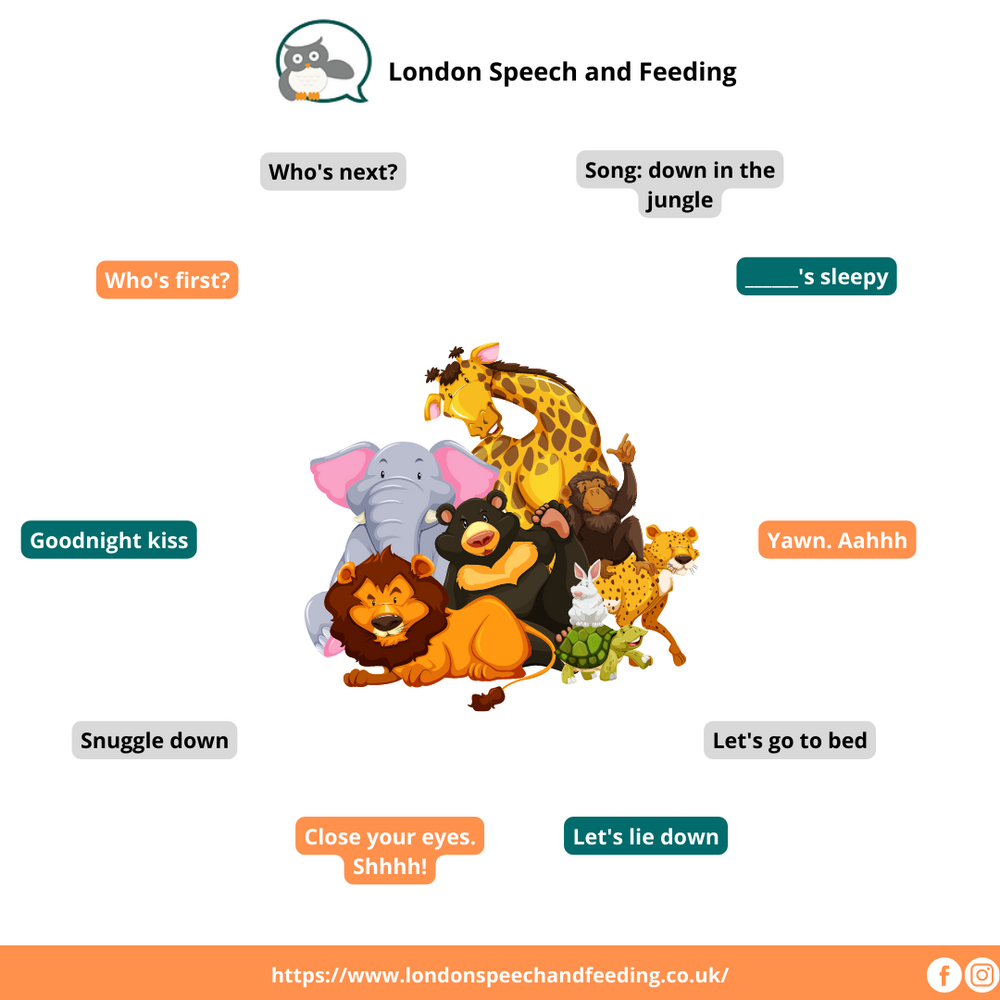
We wanted to support you by exploring items which you may have at home, and we will give you some key phrases which you can start to model with your child. Whereas our last blog introduced the idea of gestalt language processors, we are now developing ideas to give you the tools to implement activities at home. We recognise how overwhelming it may feel, and this is one of the reasons to make activities as straight forward as possible. Therapy does not need to be complicated; it just needs to be carried out on a regular basis.
Explore the samples I’ve created to give you an idea of how this might look but please consult with a Speech and Language Therapist who knows about Gestalt Language Processing so that you can work together to develop great home activities for your child.
Want to learn more about gestalt language processing?
Find a speech and language therapist for your child in London. Are you concerned about your child’s speech, feeding or communication skills and don’t know where to turn? Please contact me and we can discuss how I can help you or visit my services page.
Let’s break it down into steps to make these complicated words easier to understand. Once you have a deeper understanding, you will then be able to support your child or young person develop their communication skills in the best way as a Gestalt Language Processor. Remember not every child will be a Gestalt Language Processor; if your child uses echolalia and/or has a diagnosis of autism then your child’s way of processing language is most likely different to the classic way children typically learn language.
Let’s start with understanding what each of these words “Gestalt Language Processors” mean.
Gestalt: “the way a thing has been placed or put together”
Language: “a system of human communication”
Processors: “responds to and processes basic instruction”
So, let’s put those meanings together. “Gestalt Language Processors are children who process early language in strings of sounds or chunks.” They tend not to process single words.
It is important to understand this way of processing communication because between 75-90% of children with Autistic Spectrum Conditions process language in this way (Blanc, 2012). We know that it’s important for young people to have their voice heard and to be able to express themselves. So, it’s vital that they move from echolalia to self-generated communication to be able to do this. This means that our children’s communication partners play a vital role in supporting their child’s language. We can support our children by modelling phrases until the child has learnt the process themselves.
Let’s explore an example together
X (who is a gestalt language processor) and his family love to feed the ducks in their spare time; this is an activity that takes place regularly. Let’s look at how you, as the adults, could support X in his communication. Look at the phrases that are used. They are meaningful to the activity with repetition used throughout.
Top tip: You could think of an activity you and your child or young person take part in on a regular basis and brainstorm some key phrases that you could use.
Need a boost in confidence to support your child’s gestalt language processing?
Find a speech and language therapist for your child in London. Are you concerned about your child’s speech, feeding or communication skills and don’t know where to turn? Please contact me and we can discuss how I can help you or visit my services page.
Below are two reviews I got from grateful clients over the past 4-6 weeks; this blog is more about how Feeding Therapy can help you than blowing my own trumpet…. though that said, it is always so nice and gratifying to hear when parents are happy and hopeful about their little one’s feeding journey. Feeding Therapy is a substantial part of my work as a Children’s Speech and Language Therapist. One of my specialist subjects is Autism and we find that many children on the Autism Spectrum are very specific about eating, and will often refuse a range of typical family foods in favour of a narrow range of foods/snacks.
Mostly, feeding difficulties are a combination and complex cocktail of factors that have contributed to the current status quo: sure, there may have been some physical problems to start off with, such as reflux causing the baby discomfort, constipation, a very tight tongue tie or a swallowing problem caused by neurological difficulties and of course sensory processing difficulties are also very physical experiences. We always begin with a very thorough case history taking and information gathering, followed by an oral assessment and observation of the actual swallow to establish what might have been – or still might be – the cause for the feeding difficulties.
In most of the cases I see in my practice, the original obvious cause is no longer present, especially with older children. So, if the swallowing is fine, the reflux is no longer present, the tongue was divided (twice!) why are they still not eating much, refusing to try new foods, only accept certain textures etc.
The answer is extremely complex and multi-faceted and this little blog is not covering any factors in detail (we would be here all night) -I mentioned sensory processing difficulties earlier on. These are mostly still present but often not acknowledged or recognised by parents. And it is certainly the case that one of the contributors is parental anxiety; this tends to run very high and has been for many months, sometimes years. This in turn often leads to very tense and unpleasant, endlessly long meal times and many times children are force-fed several times a day in order to “get something down there” as otherwise they would probably starve themselves.
Additionally, parents end up only offering a very narrow range of foods because that is all their child will eat. This ends up in a vicious cycle of children being fed porridge-style food for all meal times and of course they won’t progress to more mature foods if these mature foods are never on offer.
In order to help address and disentangle some of the issues I often introduce the “Division of Responsibility in Feeding” as researched and recommended by Ellyn Satter (The Satter Feeding Dynamics Model)
Here are the main points of her approach:
Children have a natural ability with eating, they eat as much as they need and they grow in the way that is right for them and they learn to eat what their parents eat. (E Satter). The parent is responsible for WHAT the child eats, WHERE and WHEN the child eats. The child is responsible for HOW MUCH they eat or WHETHER to eat. Satter proposes that parents should guide their child’s transition from nipple feeding through semi-solids, then thick and lumpy foods to finger foods and then on to normal family meals.
Please note: this model is only appropriate for children where the original physical cause is no longer present!
Of course it’s not easy! It requires a huge shift in thinking about feeding and it requires to trust our children to know what is best for them. This is very big for most parents, as it is not how we were brought up and it is not commonly known that babies and children know what is good for them!
However, it is certainly true that parents who follow this particular approach and make small, steady changes in the way the offer foods, and in the way they create family meal times differently, children make very nice, pleasing progress and over some months we often see remarkable positive changes.
I like to work in a team and especially for this type of problem it is essential to have a multi-disciplinary approach. A knowledgeable dietician is an enormous plus in any feeding team as is of course a
Paediatrician and/ or a Gastroenterologist and the most important people in the team are the parents!
Feeding Therapy is all about collaboration and a ‘team around the child” approach. When we have this in place and there is trust amongst the team members then we make fantastic progress.
I visited London Speech and Feeding a couple of days ago with my 8-month-old granddaughter and her mother. Sonja made us feel comfortable and at ease from our first introductions. She was able to pinpoint my granddaughter’s mum’s anxiety around weaning very quickly. She not only gave her the tools to do this successfully, but also really encouraged my granddaughter’s mum and instilled confidence that she had everything she needed to make this sometimes-difficult transition without further anxiety.
Sonja was very thorough in her initial assessment of my granddaughter’s physical milestones and her developing speech. My granddaughter felt very comfortable with Sonja and happily played along with her. Then came the big moment – trying out various foods! We were amazed to see just how easily my granddaughter, with Sonja’s expert encouragement, took to sampling the wonderful array of different delicious morsels Sonja had prepared for the session. My granddaughter even drank from a cup for the first time! Wonderful!
Sonja then emailed a summary of the session and an extensive array of resources with suggestions for my granddaughter’s mum which she has now put into action. My granddaughter’s mum couldn’t thank Sonja enough for her caring attitude, extensive knowledge, and warm professionalism. I have no hesitation in recommending Sonja, she’s a fantastic Feeding Therapist!
–
Sonja (and her lovely colleague, Sandra) were stupendous. I had brought my one-year-old son to see them as I was concerned that he wasn’t eating enough. They looked at his history and we ate together to make sure they had all the information they needed to give an accurate diagnosis. Whilst our outcome was that Henry was in fact doing brilliantly (and I just needed to chill out a bit!), I would imagine if there was something more serious going on, Sonja would make you feel just as supported and empowered as she did with us. Excellent follow-ups too. Money well spent for a bit of reassurance for a stressed out mama. Thank you, Sonja!
Find a speech and language therapist for your child in London. Are you concerned about your child’s speech, feeding or communication skills and don’t know where to turn? Please contact me and we can discuss how I can help you or visit my services page.
This is a surprisingly common speech error and it can be corrected really well in my experience. I have helped lots of children of all ages learn how to control their tongue movements and produce clear, sharp /S/ sounds and good /SH/ sounds.
Initial consideration
There are some factors which need to be considered before we can dive into therapy proper and these are they, in a nutshell:
The student is not currently displaying negative oral habits such as thumb sucking or excessive sucking on clothing. This is because thumb sucking exerts pressure on the teeth and therefore can, over time, push teeth out of their natural order/position.
The student does not have a restricted lingual frenulum or tongue tie which can cause at times restricted movements of the tongue (pending on how tight the frenulum is attaching the tongue to the base of the oral cavity); equally a labial frenulum or lip-tie can restrict lip movement and therefore physically restrict good speech sound production.
The student does not have enlarged tonsils as they can sometimes push a tongue forward and also cause open mouth posture and open mouth breathing.
The student’s motivation to change their speech pattern is high. (this is an important factor though with younger students I can get round this with a lot of fun games and good parental involvement!)
When I do an Oral Assessment of my student these are the first factors I want to look at and consider. Often I will refer to other agencies such as Orthodontists, dentists or ENT specialists to advise and help with some of these factors before we can get going. However, there are strategies that we can work on almost straight away.
Most of my Lisp students present with an open mouth posture: that is where the student has their mouth always slightly open for breathing. Over time the tongue starts to fall forward and rests on the front teeth or the bottom lip instead of finding a comfortable resting place either at the alveolar ridge (the bumpy spot behind the upper front teeth) or, alternatively, resting at the bottom of the mouth behind the lower front teeth.
Another common problem is that the tongue is not moving independently from the jaw and so is reluctant to pull back or lift up inside the mouth as the tongue is guided in movement by the jaw.
Combine those two factors and your tongue is not pulling back, or lifting up or doing very much at all without the jaw moving as well. This makes for unclear speech sounds, especially all the sounds we make at the front with our tongue or with our lips: /B/ /P/ /L/ /N/ and of course /S/ and /SH/ are particularly hard to make. We often also struggle with the /Y/ sound so ‘LELLOW’ instead of ‘yellow’.
Do not fear!
But no fear, these problems can be treated over time for sure! We often start with lip, tongue, and jaw exercises that help to move the tongue independently from the Jaw, our student learns that the tongue is a muscle and can be trained to do amazing acrobatic things in the mouth! WOW! It can actually pull back, lift up, and come down again all on its own!
We work on breathing, holding our breath for a bit then pushing it out and then holding it again.
And when it comes to the actual /S/ sound I often try and go a NEW route bypassing the Snake-Sound route if that is what had previously been tried and failed so that we can create completely new sound patterns in our brain and think about our sounds in a completely new way.
We then work on producing the sound /S/ on its own for a bit, at the end of words, then on either side of complimentary sounds, for instance : ‘EASY” – the sound patterns here are EEE-S–EE : the /EEE/ sound is complimentary to the /S/ sound as the tongue is at the right hight for the /S/ already once you have it in place for /EEE/ -……see?! EASY!
And gradually we work towards saying the /S/ sound clearly at the front of short words, then phrases and then sentences.
The process takes some time and it depends on how ready the student is. This varies of course hugely so I can never promise the exact number of sessions we will take to get that Lisp fixed. A lot depends on home practice in between sessions, and this is of course crucial to all therapy! Every day 15-20 mins practice is a good average time to aim for and when this is done it shortens the therapy block drastically.
I always give plenty of home work so there is never a chance of it getting boring or there being “nothing to do”!
Do contact me. I really enjoy working with this type of student and get a great kick out of FIXING THAT LISP!
Find a speech and language therapist for your child in London. Are you concerned about your child’s speech, feeding or communication skills and don’t know where to turn? Please contact me and we can discuss how I can help you or visit my services page.
First up try and get down at eye level or Face-to-Face with your child
Try to sit so that your child can see you easily, i. e. your child does not have to look up to make eye contact with you. We call that Face to Face: try and sit opposite your child. This makes it easier for you to see facial expressions and therefore pick up nonverbal /pre-verbal communication. Now you can connect and share the moment with your child.
OWL (Observe, Wait and Listen)
Never skip this step as it prepares us for what happens next !
Observe
First, try and simply watch your child quietly and listen and observe what he/she says or does; you need to know what your little one is interested in. For example with this toy (pictured below) we could observe that your child loves the actual spinning of the marble, perhaps more than that noisy click-clacking down the run. Or perhaps he loves collecting the marble at the end and feeling it in his hand.
You could start off with showing once how the marble goes down and say:“ look it goes round and round !” Then hold back and observe, without speaking, so that your child has time to explore the toy.
Wait
Just sit and avoid telling or showing your child what he or she could do with the toy. This gives your child an opportunity to explore and experiment.
Listen
Listen to what your child says, or look at your child’s non-verbal communication without interrupting. Your child will now feel and know that you are really present and that what they have to say is important. It’s best to avoid questions like, “What are you doing or “What’s this?” as that might be a lot of pressure when they don’t know what to say about that yet.
Respond immediately by showing interest
Once you have all the information from OWLing you can respond in the right way, for example: if she catches the marble at the end of the run and looks up with a smile or a sound you could respond with: you’ve got it! One marble in your hand! Nice playing!
Now how to join in the play:
First you can copy what your child is doing
If your child puts the first marble at the top of the run you can take a turn and do exactly the same once his marble is done. Ideally you might have another marble run, perhaps a similar one, it does not have to be exactly the same! Once your child has put the first marble in you can do the exact same with your own marble on your run. Your child is likely to look at what you are doing and you might well see a smile on their face or perhaps she might say: look at mine!
Next you can build on that
You can respond with simple comments like: “Wow! Yes I am looking at yours now! It’s spinning on the red one lots! I love the noise!” Now wait once more to see what your child says or does.
To summarise
We are signalling to our child that we are really interested in what they are doing and saying so we can “collect” our child, i.e. bring him/her back into a joint interaction.
Important
We want to try and not direct our child but respond with interest and fun! This creates a lovely stage for interaction and joint play! And this leads in turn to practising conversation and ever more opportunities for great speech and language skills to emerge.
Great activities we use in Speech and Language Therapy:
Any cause and effect toys like this Marble Run
Creative activities, such as mark making with crayons
Train tracks (building and running the trains)
Find a speech and language therapist for your child in London. Are you concerned about your child’s speech, feeding or communication skills and don’t know where to turn? Please contact me and we can discuss how I can help you or visit my services page.
A Day In The Life Of An Independent Speech And Language Therapist
I often get asked how many clients/children I see per working day or what my working day/life looks like. I always reply that every day is different, which is true, but there is a sort of average working day which looks a bit like this:
I usually start preparing for my first client of the day at around 9.30 am: I clean the room, wipe down all the toys and materials (that’s if they are coming to my clinic room) and then it takes me about 30 minutes to select and sometimes make suitable materials, games and activities for the child’s therapy programme. Client arrives at 10.30 am and the fun begins. They leave around 11.30am, and the cleaning and wiping down starts again – yes it’s the pandemic but to be fair I would do this anyway. I quickly write up my notes and send home work to the client via email. Now it’s 12 noon and I start preparing for the next client at 12.30 pm. This might be online parent-child interaction coaching and so I need different materials and activities that are suitable for teletherapy. We finish around 1.30 pm and I will write up my notes before having some lunch.
Lunch tends to not be around 30 minutes. Around 2.00 pm I start prepping again for the next client: selecting activities, going over their last session, making sure I have everything I need to start at 2.45pm – we finish at 3.45pm, I write up my notes and then have a cuppa. The next client might be more on-line coaching or a child coming to see me: room cleaned and tidy, materials and activities prepared: client arrives at 4.30 pm and we finish at 5.30 pm. I clean the toys again, write up my notes and it is 6.00 pm ready for dinner. So that was four clients between 9 am and 6pm allowing for preparation, aftercare, cleaning and coffee and lunch.
Other days I might see three clients and do more admin like ordering toys or books or teletherapy activities, or making materials (we therapist make tons of materials, we’d put Blue Peter to shame!) Sometimes I do two home visits, one in the morning and one in the afternoon – the travelling/parking in London is so time consuming that it really reduces the number of clients I can see which is why I don’t do many of those.
I hand pick my clients to make sure that we are a good fit, and my service is bespoke: no one client gets the same treatment as another; each client is unique, usually very well-known and always highly valued. That takes time and means that in reality each client gets about 2 hours of my time, that is the actual session plus all the preparation and aftercare.
I love this way of working and would not ever want to return to seeing tons of clients each day, not knowing any of them really well, due to high caseload numbers, staff shortages and an overload of administration.
My way of working affords all my lovely clients the help they need to be able to feel empowered and to then support their children to make progress; when working with children they make the best progress they can make, fulfilling their potential. My lovely reviews and testimonials tell me that my clients appreciate the extra attention.
Find a speech and language therapist for your child in London. Are you concerned about your child’s speech, feeding or communication skills and don’t know where to turn? Please contact me and we can discuss how I can help you or visit my services page.
Why imitation is so important and how can speech and language therapy help children who struggle to imitate?
Imitation or copying starts in early infancy. When we observe a young baby and his parent or familiar adult we can see clearly and frequently that the baby will be intently looking at adult’s face and try to copy their facial expressions, smiles and all those funny baby sounds we often make with young babies.
These sounds are called “motherese” and are the beginnings of a little conversation between the parent and the baby. The “conversation can go back and forth for a long time and include sounds, as well as facial expressions.
A little later on, once the baby can crawl and sit up unaided the copying then goes on to include toys and objects. Mum or Dad will show their toddler how to use a drum or how to put a little train on the wooden tracks and the toddler will try and copy this. They may not succeed and be a little clumsy perhaps but the act of copying anything and everything their favourite adult does is typically seen throughout the day.
We all know and have laughed at mums or dads saying; ssshhh don’t say that in front of the baby he/she will copy you, watch your mouth! (as dad is swearing at the broken radiator….)
This imitation goes on for years and includes eventually of course little words, more words, putting words together and then creating sentences, all the while our toddler is listening to how their adults speak, not only what they say but how they say it. This is how dialects and accents can be transmitted easily from parent /family to child.
Copying in Children with Autism
We know that children with autism often struggle to imitate. We see children on the spectrum typically having great difficulty to copy adults or children; this can be seen in very reduced play with their peers in nursery for example.
Children with autism tend to have reduced joint attention and engagement with others and need to develop the ability and awareness to copy others in order to then engage more jointly with others.
Speech and Language Therapy can help with Parent Child Interaction work and Coaching, here is how:
During my coaching work with parents I teach step by step how to help a child who struggles to imitate:
We look at all the researched skills and actions that adults can take to help their little one to copy, starting with close observation of their child’s interests, then following and including their child’s play and copying/imitating their child in how they play. I teach steps in a graduated way so that it is easy to see the progress and joyful to have the results at the end.
The results are clear to see over time: our children on the spectrum learn to imitate actions, with objects and gestures, then sounds and words. Alongside this increased imitation skill the child can then develop more joint attention and engagement.
Find a speech and language therapist for your child in London. Are you concerned about your child’s speech, feeding or communication skills and don’t know where to turn? Please contact me and we can discuss how I can help you or visit my services page.