When you have a child who uses Gestalts it is often difficult to think and adapt clinic activities into those to use at home. More importantly, you find that individualising your activities for your child who uses Gestalt are time-consuming. But you value its importance for their communication development.
You feel so busy, you are taking them to other appointments, or trying to get through your daily activities, all whilst still ensuring your child’s emotional needs are met. You know life should not get in the way of your child’s therapy activities at home, but it does. We know your spare time is precious and limited, so let us achieve your child’s or young person’s goals in the allotted time you have which meets their way of learning (using Gestalts).
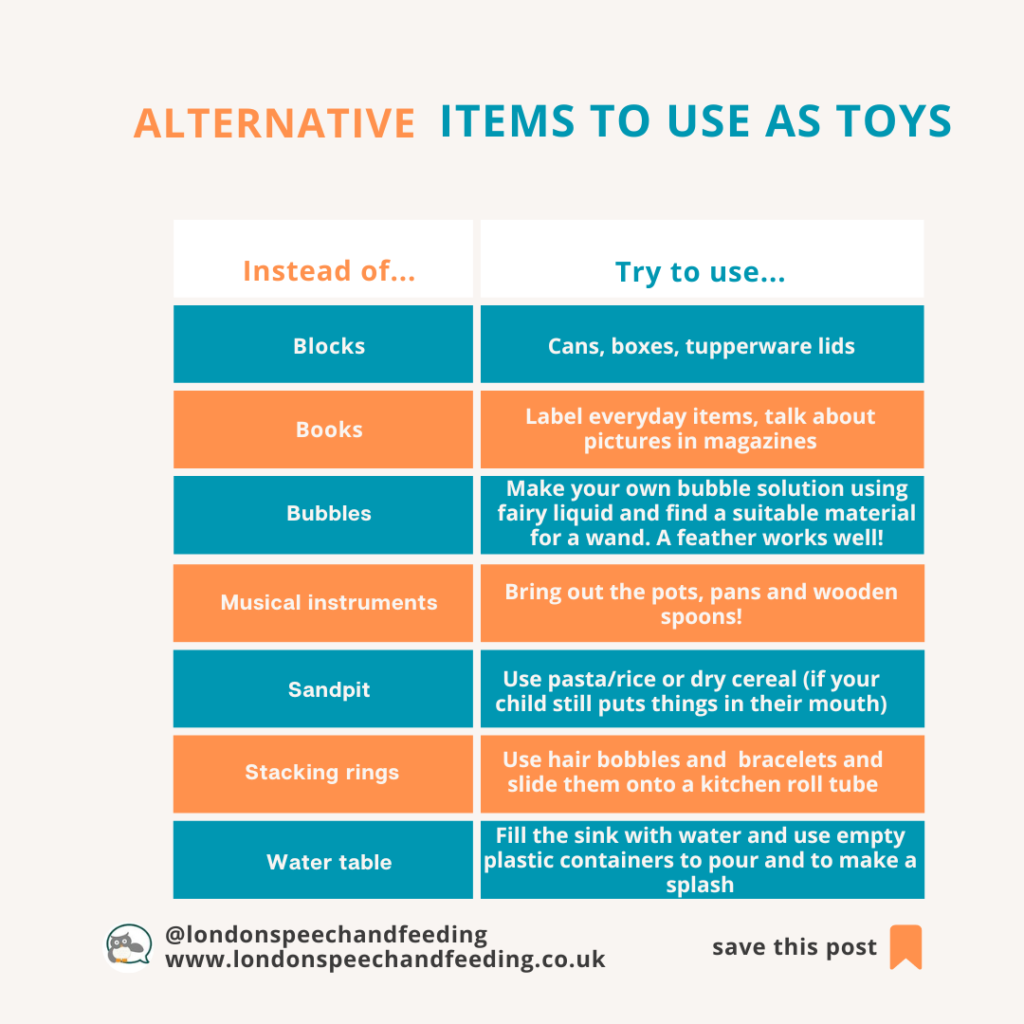
We wanted to support you by exploring items which you may have at home, and we will give you some key phrases which you can start to model with your child. Whereas our last blog introduced the idea of gestalt language processors, we are now developing ideas to give you the tools to implement activities at home. We recognise how overwhelming it may feel, and this is one of the reasons to make activities as straight forward as possible. Therapy does not need to be complicated; it just needs to be carried out on a regular basis.
Explore the samples I’ve created to give you an idea of how this might look but please consult with a Speech and Language Therapist who knows about Gestalt Language Processing so that you can work together to develop great home activities for your child.
Want to learn more about gestalt language processing?
Find a speech and language therapist for your child in London. Are you concerned about your child’s speech, feeding or communication skills and don’t know where to turn? Please contact me and we can discuss how I can help you or visit my services page.
Let’s break it down into steps to make these complicated words easier to understand. Once you have a deeper understanding, you will then be able to support your child or young person develop their communication skills in the best way as a Gestalt Language Processor. Remember not every child will be a Gestalt Language Processor; if your child uses echolalia and/or has a diagnosis of autism then your child’s way of processing language is most likely different to the classic way children typically learn language.
Let’s start with understanding what each of these words “Gestalt Language Processors” mean.
Gestalt: “the way a thing has been placed or put together”
Language: “a system of human communication”
Processors: “responds to and processes basic instruction”
So, let’s put those meanings together. “Gestalt Language Processors are children who process early language in strings of sounds or chunks.” They tend not to process single words.
It is important to understand this way of processing communication because between 75-90% of children with Autistic Spectrum Conditions process language in this way (Blanc, 2012). We know that it’s important for young people to have their voice heard and to be able to express themselves. So, it’s vital that they move from echolalia to self-generated communication to be able to do this. This means that our children’s communication partners play a vital role in supporting their child’s language. We can support our children by modelling phrases until the child has learnt the process themselves.
Let’s explore an example together
X (who is a gestalt language processor) and his family love to feed the ducks in their spare time; this is an activity that takes place regularly. Let’s look at how you, as the adults, could support X in his communication. Look at the phrases that are used. They are meaningful to the activity with repetition used throughout.
Top tip: You could think of an activity you and your child or young person take part in on a regular basis and brainstorm some key phrases that you could use.
Need a boost in confidence to support your child’s gestalt language processing?
Find a speech and language therapist for your child in London. Are you concerned about your child’s speech, feeding or communication skills and don’t know where to turn? Please contact me and we can discuss how I can help you or visit my services page.
Below are two reviews I got from grateful clients over the past 4-6 weeks; this blog is more about how Feeding Therapy can help you than blowing my own trumpet…. though that said, it is always so nice and gratifying to hear when parents are happy and hopeful about their little one’s feeding journey. Feeding Therapy is a substantial part of my work as a Children’s Speech and Language Therapist. One of my specialist subjects is Autism and we find that many children on the Autism Spectrum are very specific about eating, and will often refuse a range of typical family foods in favour of a narrow range of foods/snacks.
Mostly, feeding difficulties are a combination and complex cocktail of factors that have contributed to the current status quo: sure, there may have been some physical problems to start off with, such as reflux causing the baby discomfort, constipation, a very tight tongue tie or a swallowing problem caused by neurological difficulties and of course sensory processing difficulties are also very physical experiences. We always begin with a very thorough case history taking and information gathering, followed by an oral assessment and observation of the actual swallow to establish what might have been – or still might be – the cause for the feeding difficulties.
In most of the cases I see in my practice, the original obvious cause is no longer present, especially with older children. So, if the swallowing is fine, the reflux is no longer present, the tongue was divided (twice!) why are they still not eating much, refusing to try new foods, only accept certain textures etc.
The answer is extremely complex and multi-faceted and this little blog is not covering any factors in detail (we would be here all night) -I mentioned sensory processing difficulties earlier on. These are mostly still present but often not acknowledged or recognised by parents. And it is certainly the case that one of the contributors is parental anxiety; this tends to run very high and has been for many months, sometimes years. This in turn often leads to very tense and unpleasant, endlessly long meal times and many times children are force-fed several times a day in order to “get something down there” as otherwise they would probably starve themselves.
Additionally, parents end up only offering a very narrow range of foods because that is all their child will eat. This ends up in a vicious cycle of children being fed porridge-style food for all meal times and of course they won’t progress to more mature foods if these mature foods are never on offer.
In order to help address and disentangle some of the issues I often introduce the “Division of Responsibility in Feeding” as researched and recommended by Ellyn Satter (The Satter Feeding Dynamics Model)
Here are the main points of her approach:
Children have a natural ability with eating, they eat as much as they need and they grow in the way that is right for them and they learn to eat what their parents eat. (E Satter). The parent is responsible for WHAT the child eats, WHERE and WHEN the child eats. The child is responsible for HOW MUCH they eat or WHETHER to eat. Satter proposes that parents should guide their child’s transition from nipple feeding through semi-solids, then thick and lumpy foods to finger foods and then on to normal family meals.
Please note: this model is only appropriate for children where the original physical cause is no longer present!
Of course it’s not easy! It requires a huge shift in thinking about feeding and it requires to trust our children to know what is best for them. This is very big for most parents, as it is not how we were brought up and it is not commonly known that babies and children know what is good for them!
However, it is certainly true that parents who follow this particular approach and make small, steady changes in the way the offer foods, and in the way they create family meal times differently, children make very nice, pleasing progress and over some months we often see remarkable positive changes.
I like to work in a team and especially for this type of problem it is essential to have a multi-disciplinary approach. A knowledgeable dietician is an enormous plus in any feeding team as is of course a
Paediatrician and/ or a Gastroenterologist and the most important people in the team are the parents!
Feeding Therapy is all about collaboration and a ‘team around the child” approach. When we have this in place and there is trust amongst the team members then we make fantastic progress.
I visited London Speech and Feeding a couple of days ago with my 8-month-old granddaughter and her mother. Sonja made us feel comfortable and at ease from our first introductions. She was able to pinpoint my granddaughter’s mum’s anxiety around weaning very quickly. She not only gave her the tools to do this successfully, but also really encouraged my granddaughter’s mum and instilled confidence that she had everything she needed to make this sometimes-difficult transition without further anxiety.
Sonja was very thorough in her initial assessment of my granddaughter’s physical milestones and her developing speech. My granddaughter felt very comfortable with Sonja and happily played along with her. Then came the big moment – trying out various foods! We were amazed to see just how easily my granddaughter, with Sonja’s expert encouragement, took to sampling the wonderful array of different delicious morsels Sonja had prepared for the session. My granddaughter even drank from a cup for the first time! Wonderful!
Sonja then emailed a summary of the session and an extensive array of resources with suggestions for my granddaughter’s mum which she has now put into action. My granddaughter’s mum couldn’t thank Sonja enough for her caring attitude, extensive knowledge, and warm professionalism. I have no hesitation in recommending Sonja, she’s a fantastic Feeding Therapist!
–
Sonja (and her lovely colleague, Sandra) were stupendous. I had brought my one-year-old son to see them as I was concerned that he wasn’t eating enough. They looked at his history and we ate together to make sure they had all the information they needed to give an accurate diagnosis. Whilst our outcome was that Henry was in fact doing brilliantly (and I just needed to chill out a bit!), I would imagine if there was something more serious going on, Sonja would make you feel just as supported and empowered as she did with us. Excellent follow-ups too. Money well spent for a bit of reassurance for a stressed out mama. Thank you, Sonja!
Find a speech and language therapist for your child in London. Are you concerned about your child’s speech, feeding or communication skills and don’t know where to turn? Please contact me and we can discuss how I can help you or visit my services page.
This is a surprisingly common speech error and it can be corrected really well in my experience. I have helped lots of children of all ages learn how to control their tongue movements and produce clear, sharp /S/ sounds and good /SH/ sounds.
Initial consideration
There are some factors which need to be considered before we can dive into therapy proper and these are they, in a nutshell:
The student is not currently displaying negative oral habits such as thumb sucking or excessive sucking on clothing. This is because thumb sucking exerts pressure on the teeth and therefore can, over time, push teeth out of their natural order/position.
The student does not have a restricted lingual frenulum or tongue tie which can cause at times restricted movements of the tongue (pending on how tight the frenulum is attaching the tongue to the base of the oral cavity); equally a labial frenulum or lip-tie can restrict lip movement and therefore physically restrict good speech sound production.
The student does not have enlarged tonsils as they can sometimes push a tongue forward and also cause open mouth posture and open mouth breathing.
The student’s motivation to change their speech pattern is high. (this is an important factor though with younger students I can get round this with a lot of fun games and good parental involvement!)
When I do an Oral Assessment of my student these are the first factors I want to look at and consider. Often I will refer to other agencies such as Orthodontists, dentists or ENT specialists to advise and help with some of these factors before we can get going. However, there are strategies that we can work on almost straight away.
Most of my Lisp students present with an open mouth posture: that is where the student has their mouth always slightly open for breathing. Over time the tongue starts to fall forward and rests on the front teeth or the bottom lip instead of finding a comfortable resting place either at the alveolar ridge (the bumpy spot behind the upper front teeth) or, alternatively, resting at the bottom of the mouth behind the lower front teeth.
Another common problem is that the tongue is not moving independently from the jaw and so is reluctant to pull back or lift up inside the mouth as the tongue is guided in movement by the jaw.
Combine those two factors and your tongue is not pulling back, or lifting up or doing very much at all without the jaw moving as well. This makes for unclear speech sounds, especially all the sounds we make at the front with our tongue or with our lips: /B/ /P/ /L/ /N/ and of course /S/ and /SH/ are particularly hard to make. We often also struggle with the /Y/ sound so ‘LELLOW’ instead of ‘yellow’.
Do not fear!
But no fear, these problems can be treated over time for sure! We often start with lip, tongue, and jaw exercises that help to move the tongue independently from the Jaw, our student learns that the tongue is a muscle and can be trained to do amazing acrobatic things in the mouth! WOW! It can actually pull back, lift up, and come down again all on its own!
We work on breathing, holding our breath for a bit then pushing it out and then holding it again.
And when it comes to the actual /S/ sound I often try and go a NEW route bypassing the Snake-Sound route if that is what had previously been tried and failed so that we can create completely new sound patterns in our brain and think about our sounds in a completely new way.
We then work on producing the sound /S/ on its own for a bit, at the end of words, then on either side of complimentary sounds, for instance : ‘EASY” – the sound patterns here are EEE-S–EE : the /EEE/ sound is complimentary to the /S/ sound as the tongue is at the right hight for the /S/ already once you have it in place for /EEE/ -……see?! EASY!
And gradually we work towards saying the /S/ sound clearly at the front of short words, then phrases and then sentences.
The process takes some time and it depends on how ready the student is. This varies of course hugely so I can never promise the exact number of sessions we will take to get that Lisp fixed. A lot depends on home practice in between sessions, and this is of course crucial to all therapy! Every day 15-20 mins practice is a good average time to aim for and when this is done it shortens the therapy block drastically.
I always give plenty of home work so there is never a chance of it getting boring or there being “nothing to do”!
Do contact me. I really enjoy working with this type of student and get a great kick out of FIXING THAT LISP!
Find a speech and language therapist for your child in London. Are you concerned about your child’s speech, feeding or communication skills and don’t know where to turn? Please contact me and we can discuss how I can help you or visit my services page.
First up try and get down at eye level or Face-to-Face with your child
Try to sit so that your child can see you easily, i. e. your child does not have to look up to make eye contact with you. We call that Face to Face: try and sit opposite your child. This makes it easier for you to see facial expressions and therefore pick up nonverbal /pre-verbal communication. Now you can connect and share the moment with your child.
OWL (Observe, Wait and Listen)
Never skip this step as it prepares us for what happens next !
Observe
First, try and simply watch your child quietly and listen and observe what he/she says or does; you need to know what your little one is interested in. For example with this toy (pictured below) we could observe that your child loves the actual spinning of the marble, perhaps more than that noisy click-clacking down the run. Or perhaps he loves collecting the marble at the end and feeling it in his hand.
You could start off with showing once how the marble goes down and say:“ look it goes round and round !” Then hold back and observe, without speaking, so that your child has time to explore the toy.
Wait
Just sit and avoid telling or showing your child what he or she could do with the toy. This gives your child an opportunity to explore and experiment.
Listen
Listen to what your child says, or look at your child’s non-verbal communication without interrupting. Your child will now feel and know that you are really present and that what they have to say is important. It’s best to avoid questions like, “What are you doing or “What’s this?” as that might be a lot of pressure when they don’t know what to say about that yet.
Respond immediately by showing interest
Once you have all the information from OWLing you can respond in the right way, for example: if she catches the marble at the end of the run and looks up with a smile or a sound you could respond with: you’ve got it! One marble in your hand! Nice playing!
Now how to join in the play:
First you can copy what your child is doing
If your child puts the first marble at the top of the run you can take a turn and do exactly the same once his marble is done. Ideally you might have another marble run, perhaps a similar one, it does not have to be exactly the same! Once your child has put the first marble in you can do the exact same with your own marble on your run. Your child is likely to look at what you are doing and you might well see a smile on their face or perhaps she might say: look at mine!
Next you can build on that
You can respond with simple comments like: “Wow! Yes I am looking at yours now! It’s spinning on the red one lots! I love the noise!” Now wait once more to see what your child says or does.
To summarise
We are signalling to our child that we are really interested in what they are doing and saying so we can “collect” our child, i.e. bring him/her back into a joint interaction.
Important
We want to try and not direct our child but respond with interest and fun! This creates a lovely stage for interaction and joint play! And this leads in turn to practising conversation and ever more opportunities for great speech and language skills to emerge.
Great activities we use in Speech and Language Therapy:
Any cause and effect toys like this Marble Run
Creative activities, such as mark making with crayons
Train tracks (building and running the trains)
Find a speech and language therapist for your child in London. Are you concerned about your child’s speech, feeding or communication skills and don’t know where to turn? Please contact me and we can discuss how I can help you or visit my services page.
A Day In The Life Of An Independent Speech And Language Therapist
I often get asked how many clients/children I see per working day or what my working day/life looks like. I always reply that every day is different, which is true, but there is a sort of average working day which looks a bit like this:
I usually start preparing for my first client of the day at around 9.30 am: I clean the room, wipe down all the toys and materials (that’s if they are coming to my clinic room) and then it takes me about 30 minutes to select and sometimes make suitable materials, games and activities for the child’s therapy programme. Client arrives at 10.30 am and the fun begins. They leave around 11.30am, and the cleaning and wiping down starts again – yes it’s the pandemic but to be fair I would do this anyway. I quickly write up my notes and send home work to the client via email. Now it’s 12 noon and I start preparing for the next client at 12.30 pm. This might be online parent-child interaction coaching and so I need different materials and activities that are suitable for teletherapy. We finish around 1.30 pm and I will write up my notes before having some lunch.
Lunch tends to not be around 30 minutes. Around 2.00 pm I start prepping again for the next client: selecting activities, going over their last session, making sure I have everything I need to start at 2.45pm – we finish at 3.45pm, I write up my notes and then have a cuppa. The next client might be more on-line coaching or a child coming to see me: room cleaned and tidy, materials and activities prepared: client arrives at 4.30 pm and we finish at 5.30 pm. I clean the toys again, write up my notes and it is 6.00 pm ready for dinner. So that was four clients between 9 am and 6pm allowing for preparation, aftercare, cleaning and coffee and lunch.
Other days I might see three clients and do more admin like ordering toys or books or teletherapy activities, or making materials (we therapist make tons of materials, we’d put Blue Peter to shame!) Sometimes I do two home visits, one in the morning and one in the afternoon – the travelling/parking in London is so time consuming that it really reduces the number of clients I can see which is why I don’t do many of those.
I hand pick my clients to make sure that we are a good fit, and my service is bespoke: no one client gets the same treatment as another; each client is unique, usually very well-known and always highly valued. That takes time and means that in reality each client gets about 2 hours of my time, that is the actual session plus all the preparation and aftercare.
I love this way of working and would not ever want to return to seeing tons of clients each day, not knowing any of them really well, due to high caseload numbers, staff shortages and an overload of administration.
My way of working affords all my lovely clients the help they need to be able to feel empowered and to then support their children to make progress; when working with children they make the best progress they can make, fulfilling their potential. My lovely reviews and testimonials tell me that my clients appreciate the extra attention.
Find a speech and language therapist for your child in London. Are you concerned about your child’s speech, feeding or communication skills and don’t know where to turn? Please contact me and we can discuss how I can help you or visit my services page.
Why imitation is so important and how can speech and language therapy help children who struggle to imitate?
Imitation or copying starts in early infancy. When we observe a young baby and his parent or familiar adult we can see clearly and frequently that the baby will be intently looking at adult’s face and try to copy their facial expressions, smiles and all those funny baby sounds we often make with young babies.
These sounds are called “motherese” and are the beginnings of a little conversation between the parent and the baby. The “conversation can go back and forth for a long time and include sounds, as well as facial expressions.
A little later on, once the baby can crawl and sit up unaided the copying then goes on to include toys and objects. Mum or Dad will show their toddler how to use a drum or how to put a little train on the wooden tracks and the toddler will try and copy this. They may not succeed and be a little clumsy perhaps but the act of copying anything and everything their favourite adult does is typically seen throughout the day.
We all know and have laughed at mums or dads saying; ssshhh don’t say that in front of the baby he/she will copy you, watch your mouth! (as dad is swearing at the broken radiator….)
This imitation goes on for years and includes eventually of course little words, more words, putting words together and then creating sentences, all the while our toddler is listening to how their adults speak, not only what they say but how they say it. This is how dialects and accents can be transmitted easily from parent /family to child.
Copying in Children with Autism
We know that children with autism often struggle to imitate. We see children on the spectrum typically having great difficulty to copy adults or children; this can be seen in very reduced play with their peers in nursery for example.
Children with autism tend to have reduced joint attention and engagement with others and need to develop the ability and awareness to copy others in order to then engage more jointly with others.
Speech and Language Therapy can help with Parent Child Interaction work and Coaching, here is how:
During my coaching work with parents I teach step by step how to help a child who struggles to imitate:
We look at all the researched skills and actions that adults can take to help their little one to copy, starting with close observation of their child’s interests, then following and including their child’s play and copying/imitating their child in how they play. I teach steps in a graduated way so that it is easy to see the progress and joyful to have the results at the end.
The results are clear to see over time: our children on the spectrum learn to imitate actions, with objects and gestures, then sounds and words. Alongside this increased imitation skill the child can then develop more joint attention and engagement.
Find a speech and language therapist for your child in London. Are you concerned about your child’s speech, feeding or communication skills and don’t know where to turn? Please contact me and we can discuss how I can help you or visit my services page.
AMAZINGLY EASY Activities that we can do at home and in the clinic to help our children practise those targets!
I bet you have wondered what amazing things are done by a therapist in the clinic that you could not possibly do at home…? Well, if so I am here to tell you that you will be absolutely fine with just a few select toys and games and you will be able to get those targets done in a jiffy!
What we clinicians do very well and what you probably can’t do yourself is formulate and design the targets that are important for your child to practice. Once we have assessed or reviewed your child’s progress and needs we can then design the perfect next step of targets for you.
So for example, we have decided your little one needs to be practicing their ‘r’ sounds at the beginning of short words. We decided that based on our clinical expertise and our assessment and we have already worked with your child and managed to get this tricky ‘r’ sound just about right on its own. Now we are ready for short word practice.
It has been researched that in order for the brain pathways to re-shape or reform we need to get about 100 words in per day of our target sound. That sounds like quite a lot, right? But actually….. it’s not that bad. After all you only need to say 5-7 words about 20 times and hey presto that’s about 80-100 words.
So here are some simple games I use in my clinic all the time and these games are easily available online or in your local toy shops and this is how to do them:
Pop the Pirate
Pop the Pirate, sooo good and popular:
Lay out your target words which you will have been given by your speech therapist and put a few swords on each word.
Each time your child picks up a sword they will need to say the target word 5 x, like:
rip rip rip rip rip or run run run run run just like that in a row, bish bash bosh.
Then they can stick the sword into the barrel. Onto the next sword which they can pick and then again
race race race race race and stick in another sword
So with this little lot I put out 5 target words and 3 swords on each.
You will therefore get…… 15 words per picture, and that makes….75 words , there that is nearly all you need to do.
If you then do another little game like this one:
Magnetic board game
This is a Magnetic Board game, and they are suddenly EVERYWHERE. But you could also just take a baking sheet and some fridge magnet you might have kicking about.
Same principle as before, but now since this is your SECOND game of the day and you have already got 75 targets under your belt you only need to do one more round of 5 target words each:
Each time your child picks up a magnet piece they will say the target word 5 more times:
Ray ray ray ray ray and DONE you will now at the end of this short round have 105!! target words done with just two little fun games.
How good is this? Your child won’t hardly notice that they are in fact doing their speech therapy homework.
You’re welcome 🙂
Get in touch if you would like me to help finding good targets for your child to work on. They can be speech and/or language targets with this game method.
Find a speech and language therapist for your child in London. Are you concerned about your child’s speech, feeding or communication skills and don’t know where to turn? Please contact me and we can discuss how I can help you or visit my services page.
Many of my students have difficulties telling stories. When looking at a book together, even books they love and have seen many times, they often struggle to understand what they are reading and cannot therefore retell the story in any sequence. A great method I often use with those students is called Colourful Semantics.
What is Colourful Semantics?
Colourful Semantics is an approach aimed at helping children develop grammar and meaning of phrases and sentences. We help children identify WHO is the subject in a story, what is he/she/it DOING to WHAT and WHERE. There are lots of colour coded stages but we tend to start with the basic 4:
WHO = ORANGE
DOING = YELLOW
WHAT = GREEN
WHERE = BLUE
Once a student is accomplished at this level, we move on to different colour codes for describing words (adjectives), connecting words (with/together/and/therefore) feeling words (PINK), timing words (BROWN) eg. when, tomorrow, last week etc.
Colourful Semantics is a really useful method and helps children to organise their sentences. It also helps me knowing how to guide a student in thinking about the story.
The approach can be used with children with a range of Speech and Language Needs, such as:
Developmental Delay / Disorder
Autistic Spectrum Condition
Down Syndrome
Any other syndromes and related speech and language delays
General Literacy difficulties
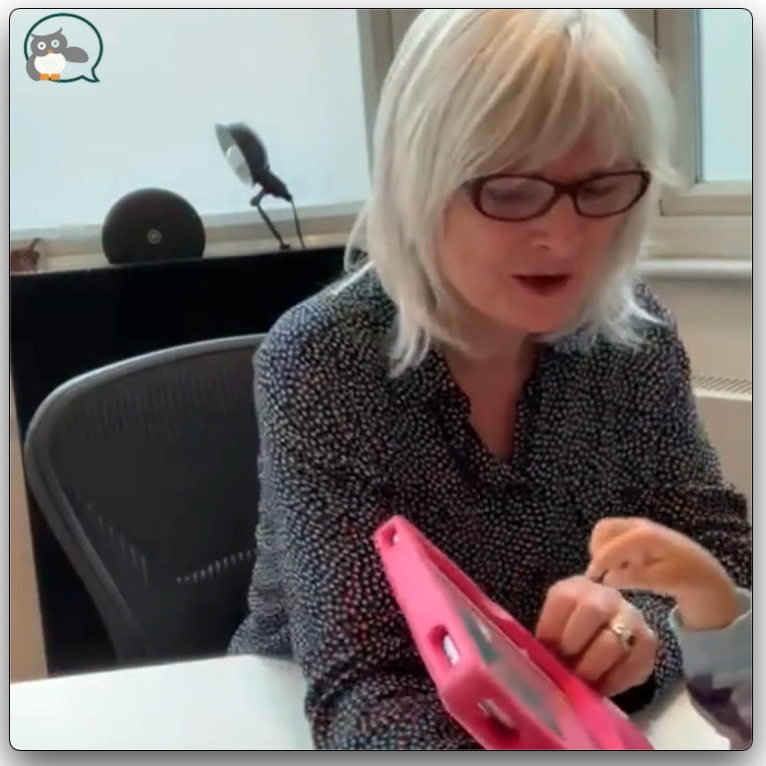
There are a wide range of benefits to using this approach and I use it in my therapeutic work with children of around 3 years plus. Below is a little video which shows how I use it with this student who has general language difficulties associated with Autism. One of the main benefits with this student is that seeing the Cue Cards helps her to use a much wider range of vocabulary than she would ordinarily generate. Her sentences are getting longer and she is more able to answer questions. In general, I find it useful to help with storytelling and to guide us through the story in a sequence.
There are many on-line games these days that have incorporated the Colourful Semantics Approach. Once a child is familiar with the basic colour scheme then gradually the visual prompts can be reduced to using verbal prompts.
Find a speech and language therapist for your child in London. Are you concerned about your child’s speech, feeding or communication skills and don’t know where to turn? Please contact me and we can discuss how I can help you or visit my services page.
There are various great ways to treat speech sound disorders and I use all the approaches available selectively; I decide what works with each individual child and I also vary the approach depending on the child’s frame of mind at any given time during my session.
Some of the approaches are more “drill-based” and require a child to be able to pay attention and really participate actively in the therapy, and this is what I am showing you today with this video clip.
My little student here has been working with me for some time and from only saying a handful of words which were not very easy to understand he has come a long way. He does have some features of Verbal Dyspraxia which I shall briefly outline here:
Making sounds in general is a struggle, especially when asked to copy certain sounds, example: ‘can you say: a ee ou oo?”
Repeating sound sequences or words sequences is hard, for example: “say p-t-k in sequence” or “say fish chips fish chips fish chips
When saying the same word again and again, different mistakes can be heard
Intonation difficulties: speech sounds monotonous
Vocabulary is very limited
Some therapy approaches are more play based, for example the Core Word method: here we pick a few words at a time which are very significant to the child and therefore highly motivating to try and say. These could be characters of Pokemon or Minecraft for example, or simple words like “GO!”
When you watch the video you will see that I use a lot of visual prompting, such as showing him where the tongue is moving to or from. I do this with my index finger and this approach is called Tactile Cueing or “Cued Articulation”. Part of the approach is to give a visual prompt and then reduce the prompt as the learner is more able to produce the correct sounds. Once he can produce the sound on its own, we quickly move to the sound within a word.
I do mix and match my approaches and in fact here I am drilling but I also use the Core Word which for him (YELLOW) — it’s his favourite colour and I happen to have quite a few good games where a YELLOW something or other can be asked for….. WHO KNEW!? 🙂
Find a speech and language therapist for your child in London. Are you concerned about your child’s speech, feeding or communication skills and don’t know where to turn? Please contact me and we can discuss how I can help you or visit my services page.
What is Speech and Language Therapy (SLT) and what does a Speech Therapist do?
Speech and language therapists provide treatment, support and care for children and adults who have difficulties with communication, eating, drinking and swallowing. We help children and adults who have problems speaking and communicating.
How to find the perfect therapist for my child/client:
There are a huge number of speech and language difficulties, or feeding and swallowing problems that we can help with and the first thing to think about is what age group the person is you are seeking help for. Most SLT’s specialise in a range of disorders and treatments and they often treat specific age ranges. This could be, for instance, very young children up to 3 years, or school aged children, adolescents or just adults. Once you have narrowed it down to age and general area of difficulty you can then go and seek your perfect SLT match.
Generally it is my view that SLT’s with a narrow area of specialist interest are most likely to help you better if the problem you or your child/adult is having is significant and/or profound. For example, if your child has a very severe stutter/stammer but is otherwise developing fine and has good skills all round, then I would recommend to look for an SLT who only specialises in stammering/stuttering, or has only a small range of other specialist areas related to stammering , such as speech and language delay.
The reason is that it is a tall order for any professional to stay up to date with latest research, latest clinical developments and training for more than, say, five distinct areas of interest.
However, a more generalist Speech therapist who has lots of experience in many different areas could be a very good option for your child or adult who has more general speech and language delay in a number of areas, perhaps a global delay or a syndrome which means that their learning is delayed in general. It also means that your child might benefit from a Generalist SLT because they have many more tools in their SLT bag and your child might need a variety of approaches for several areas.
A good place to start is www.asltip.com which is the Association for Independent Speech and Language Therapists in the UK. Any SLT registered with ASLTIP will also be registered with the HCPC (Health Care Professionals Council), as well as RCSLT (Royal College of Speech and Language Therapists). These two important UK professional regulatory bodies ensure all its members are fully qualified, and are fully up to date with latest developments within their areas of work.
Here you can enter your post code and look for a therapist near you and you can look for specific problems such as stammering for example and narrow down your search. Most therapists have a website which you can then access too. I would recommend you speak to a few therapists on your list and then go with the person you had the best rapport with. You and the therapist will be spending a lot of time together and you will need to feel that you trust them and that you can relax into the process.
How I can help you:
I have 3 main areas of specialism:
Parent Child Interaction Coaching
This is an amazing way to help children with the following difficulties:
Social Communication Difficulties, Autistic Spectrum Disordersand
Speech and Language Delay – for children under the age of 4 years old, this is my preferred way of working because it is so very effective and proven to work. If your child is not developing words or not interacting, has reduced attention and listening and you feel is not progressing or, in fact even regressing, then this way of working is the best. For anyone wanting to read a bit more about the efficacy of this method, below are some research articles. You may also like to check out www.hanen.org which is the mainstay of my work and method when it comes to Parent-Interaction Coaching. You can also look at my latest blog, entitled: Tele-therapy, does it work?
In brief, what’s so great about Parent Coaching is that it empowers you the parent to help your child in daily life! This is where speech, language and social communication develop typically, in a naturalistic way and environment. Simple steps and strategies are discussed and demonstrated every week and you are encouraged to use these strategies with your child in daily routines: getting dressed, having breakfast, on the school run, whilst out in the park or shopping or simply playing at home or having dinner or bath time. Whatever your family routine happens to be, every strategy I teach you will help create a responsive communication environment; generally, if your child is able to develop speech then they will do so in direct response to your changed interaction style.
Speech Sound Disorders, Verbal Dyspraxia, Phonology and Articulation
I love working with children of all ages on developing their speech sounds. Whether your child has a lisp, or a couple of tricky sounds they simply cannot produce quite right, or perhaps your child is really unintelligible because he/she is having lots of different sound errors, making it really hard to understand them. I typically work on getting “most bang for your buck” , meaning I address the sounds that cause the most problems and, therefore, when they are fixed your child/person’s speech becomes that much clearer fairly quickly.
Feeding and Swallowing Difficulties
Having worked for over 20 years in NHS Child Development Clinics and Special Needs Schools I trained and worked with feeding and swallowing difficulties early on in my SLT career. I later trained as a Lactation Consultant and so I am well placed helping and support all types of Infant feeding, both breast or bottle, as well as toddler weaning. I aim to ensure that your little one swallows the right kind of foods and drinks for their abilities. I am experienced in managing and supporting children with physical needs and mobility problems, Cerebral Palsy, Down Syndrome or any other type of syndrome or presentation.
What does a speech therapy session look like?
All sessions differ slightly depending on the age of the child and the nature of the difficulties.
However, mostly our sessions look like FUN! After arrival and washing hands we tend to start off with the tricky work straight away whilst our child still has energy and the will to engage. So, for speech work we will focus on the target sounds first: this could be sitting at a table doing work sheets together, playing games using the target sound and really any type of activity that gives us around 70-100 repeats of the target pattern. For example, a child who is working towards saying a ‘K’ at the end of the word I will try and get around 100 productions of words like: pack/sack/lick/ pick/bike/lake and so on.
Then we often play a fun game where I might try for a ‘rhyming’ activity or other sound awareness type activities, for perhaps 10 minutes and within that time I aim to trial the next sound pattern we need to improve on; I will test which sound your child can do with help from me. During he last 10 minutes we might look at a book, again listening to and producing whatever sound we are working on. If I did not get 100 sounds earlier on in the session I will try and practice them now as part of the story. In total I aim to have about 40-45 minutes of activities, all aimed at the target sound we are working on.
What does a Coaching session look like?
During a Parent Coaching Session we meet online for about an hour and we discuss how the week has been for you trying out the strategies. Typically parents start off recalling what went well, what progress was made and what had been more tricky. We work through it all, and then follow on to the next strategies: I will show you examples and demonstrations of each strategy and I will get you to think about how you can use this with your child and in what situation you might use it. I will explain what we are doing and what the purpose is. You might want to write down what you are going to work on for the week. Over the course of about sessions we can cover all the major strategies that are proven to help kickstart spoken language and/or help your child to connect more with you. Through that connection spoken words most often develop.
Research Papers on the Efficacy of Parent Child Interaction Coaching
The It Takes Two to Talk Program has been shown to be effective in changing how parents interact with their children, and that children’s communication and language skills improve as a result.
Baumwell, L.B., Tamis-LeMonda, C.S. & Bornstein, M.H. (1997). Maternal verbal sensitivity and child language comprehension. Infant Behavior and Development, 20(2), 247-258.
Beckwith, L. & Cohen, S.E. (1989). Maternal responsiveness with preterm infants and later competency. In M.H. Bornstein (Ed.). Maternal responsiveness: Characteristics and consequences: New directions for child development (pp. 75-87). San Francisco: Jossey Bass.
Bronfenbrenner, U. (1974). Is early intervention effective? (Publication No. (CDH) 74-25). Washington, DC: Department of Health, Education, and Welfare, Office of Child Development.
Girolametto, L. (1988). Improving the social-conversational skills of developmentally delayed children: An intervention study. Journal of Speech and Hearing Disorders, 53, 156-167.
Sonja has been a real help for my 5 year old daughter. Due to her support, my daughter is now able to clearly and correctly enunciate ‘th’ ‘f’ and ’s’. She was also helpful in making positional changes to her seating to help her concentrate better and kept her engaged throughout all the lessons which is a feat in itself on zoom!
Helen, Mother of Catherine Age 5.
Find a speech and language therapist for your child in London. Are you concerned about your child’s speech, feeding or communication skills and don’t know where to turn? Please contact me and we can discuss how I can help you or visit my services page.
Your Speech Therapist might have been advising you to introduce words to your child with the help of a CORE BOARD. What on earth is she talking about and why would we want to do this, I hear you think – and in fact this is what I get asked a lot, as I often do recommend using Core Boards.
Core boards belong to the category of Augmentative and Alternative Communication (AAC ) and they can be really useful for:
Children or adults who cannot speak at all or who are very hard to understand.
Children who are slow to speak and have difficulty expressing themselves verbally, due to genetic conditions as Down Syndrome, Verbal dyspraxia, Autism or any other learning difficulty that means a child is slow to develop speech.
Here is what a Core board might look like, in fact this is one that I love to use. It is made by Beautiful Speech Life, there are a ton of similar boards out there for free. I have also made my own, you can check it out on my Instagram feed.
What is Core Vocabulary/ Core words?
Core vocabulary consists of the most common words used by children throughout a day. In 2003 Banajee and Dicarlo et al found that 50 % of pre-schoolers in their project used nine words consistently across their daily play and meal routines. These words are Core words and are typically the ones you can see on a board, like the one above.
How To Use It
Adults always first need to consistently model and show their child how to use a board. This is key! For example: Adult can point to “YOU” “WANT” ‘MORE” and then point to the cup of Water on the counter. Child could then reply either by shaking his/her head and/or pointing to “NOT” which also stands for “NO”. Then adult can point to “NOT” “MORE” and do an OK sign as well. Eventually Child can initiate a request and point to “I” “ WANT” “MORE” and then point to the cup on the counter.
This is not as cumbersome or limited as it first sounds or appears. Here’s why: As adult you can talk normally and, of course, many words you are using will not be on this board. But some will be, and you will be surprised how many you can find when you start using it. So you could say quite normally: Hey lovely (name of your child) would YOU LIKE some MORE water? The words in capital are on the board which you can point to as you speak normally. Basically, you are showing/saying to your child: “We can speak and these are the pictures we can use to help us; We call this TOTAL COMMUNICATION, as communication is so much more than just words! Great communication can be silent, where we use our facial expression, our smile, our eyes, our hand gestures, body movements and yes, of course, words. But when words fail us, these boards are so helpful.
This still does not answer your original question of: why would I want to do this, I want my child to talk!? You are a SPEECH Therapist, please help my child TALK, not point to pictures, that is not what I had in mind.
Let Me Explain
When speech is difficult for a child it doesn’t mean that there is nothing to talk about! Of course, we want all our children and all people to speak because it is the easiest and most effective way of communicating, no doubt! However, sometimes this is very hard for some children and whilst we are always working towards speech where possible, we also want to make sure that whilst figuring out how to speak, your child has a MEANS TO COMMUNICATE. Using a board like this might well be a temporary strategy but whilst you are using it and working on their speech you will find a reduction in tantrums and frustration as you child is able to express themselves more effectively.
Often we find that as soon as we offer a CORE VOCABULARY like the above sample a child who has had no or very few words suddenly blossoms and starts to point to new words on the board and starts to PRACTICE USING THESE WORDS!! Practice makes perfect, right? Yes it totally does! There is lots of evidence that tells us that using Core Vocabulary Boards ENHANCE AND SUPPORT SPEECH PRODUCTION AND NOT HINDER IT. Using a board like this will only ever be helpful to your child and will never make your child “lazy” – too lazy to speak? NO SUCH THING!
Here is what one of my parents says about the core board we use with her little boy:
“the board has been a game changer, my son is a visual learner so it really helps to have the board as he associates communication so much easier this way. We have incorporated his twin sister who models it’s use and have definitely seen improvement in speech through its support and his frustration around being unable to verbally communicate at times has definitely lessened”
K Connolly, Mother of Tom (aged 3.5 years).
Reading and hearing this makes me so happy!
In addition to general core board above I also sometimes use a Core Board that is specific to an activity, such as for example BLOWING BUBBLES. Below is an example of such a board, which you can use very nicely during a bubble blowing activity and sometimes it is a nice place to start for newcomers, this can be an easy introduction. You can download this and many similar boards on www.widgit.com for free!
There is so much more to say about AAC and using Coreboards, visit my Instagram you can find a bit more information on how I use them.
Find a speech and language therapist for your child in London. Are you concerned about your child’s speech, feeding or communication skills and don’t know where to turn? Please contact me and we can discuss how I can help you or visit my services page.