Many of my students have difficulties telling stories. When looking at a book together, even books they love and have seen many times, they often struggle to understand what they are reading and cannot therefore retell the story in any sequence. A great method I often use with those students is called Colourful Semantics.
What is Colourful Semantics?
Colourful Semantics is an approach aimed at helping children develop grammar and meaning of phrases and sentences. We help children identify WHO is the subject in a story, what is he/she/it DOING to WHAT and WHERE. There are lots of colour coded stages but we tend to start with the basic 4:
WHO = ORANGE
DOING = YELLOW
WHAT = GREEN
WHERE = BLUE
Once a student is accomplished at this level, we move on to different colour codes for describing words (adjectives), connecting words (with/together/and/therefore) feeling words (PINK), timing words (BROWN) eg. when, tomorrow, last week etc.
Colourful Semantics is a really useful method and helps children to organise their sentences. It also helps me knowing how to guide a student in thinking about the story.
The approach can be used with children with a range of Speech and Language Needs, such as:
Developmental Delay / Disorder
Autistic Spectrum Condition
Down Syndrome
Any other syndromes and related speech and language delays
General Literacy difficulties
There are a wide range of benefits to using this approach and I use it in my therapeutic work with children of around 3 years plus. Below is a little video which shows how I use it with this student who has general language difficulties associated with Autism. One of the main benefits with this student is that seeing the Cue Cards helps her to use a much wider range of vocabulary than she would ordinarily generate. Her sentences are getting longer and she is more able to answer questions. In general, I find it useful to help with storytelling and to guide us through the story in a sequence.
There are many on-line games these days that have incorporated the Colourful Semantics Approach. Once a child is familiar with the basic colour scheme then gradually the visual prompts can be reduced to using verbal prompts.
Find a speech and language therapist for your child in London. Are you concerned about your child’s speech, feeding or communication skills and don’t know where to turn? Please contact me and we can discuss how I can help you or visit my services page.
There are various great ways to treat speech sound disorders and I use all the approaches available selectively; I decide what works with each individual child and I also vary the approach depending on the child’s frame of mind at any given time during my session.
Some of the approaches are more “drill-based” and require a child to be able to pay attention and really participate actively in the therapy, and this is what I am showing you today with this video clip.
My little student here has been working with me for some time and from only saying a handful of words which were not very easy to understand he has come a long way. He does have some features of Verbal Dyspraxia which I shall briefly outline here:
Making sounds in general is a struggle, especially when asked to copy certain sounds, example: ‘can you say: a ee ou oo?”
Repeating sound sequences or words sequences is hard, for example: “say p-t-k in sequence” or “say fish chips fish chips fish chips
When saying the same word again and again, different mistakes can be heard
Intonation difficulties: speech sounds monotonous
Vocabulary is very limited
Some therapy approaches are more play based, for example the Core Word method: here we pick a few words at a time which are very significant to the child and therefore highly motivating to try and say. These could be characters of Pokemon or Minecraft for example, or simple words like “GO!”
When you watch the video you will see that I use a lot of visual prompting, such as showing him where the tongue is moving to or from. I do this with my index finger and this approach is called Tactile Cueing or “Cued Articulation”. Part of the approach is to give a visual prompt and then reduce the prompt as the learner is more able to produce the correct sounds. Once he can produce the sound on its own, we quickly move to the sound within a word.
I do mix and match my approaches and in fact here I am drilling but I also use the Core Word which for him (YELLOW) — it’s his favourite colour and I happen to have quite a few good games where a YELLOW something or other can be asked for….. WHO KNEW!? 🙂
Find a speech and language therapist for your child in London. Are you concerned about your child’s speech, feeding or communication skills and don’t know where to turn? Please contact me and we can discuss how I can help you or visit my services page.
What is Speech and Language Therapy (SLT) and what does a Speech Therapist do?
Speech and language therapists provide treatment, support and care for children and adults who have difficulties with communication, eating, drinking and swallowing. We help children and adults who have problems speaking and communicating.
How to find the perfect therapist for my child/client:
There are a huge number of speech and language difficulties, or feeding and swallowing problems that we can help with and the first thing to think about is what age group the person is you are seeking help for. Most SLT’s specialise in a range of disorders and treatments and they often treat specific age ranges. This could be, for instance, very young children up to 3 years, or school aged children, adolescents or just adults. Once you have narrowed it down to age and general area of difficulty you can then go and seek your perfect SLT match.
Generally it is my view that SLT’s with a narrow area of specialist interest are most likely to help you better if the problem you or your child/adult is having is significant and/or profound. For example, if your child has a very severe stutter/stammer but is otherwise developing fine and has good skills all round, then I would recommend to look for an SLT who only specialises in stammering/stuttering, or has only a small range of other specialist areas related to stammering , such as speech and language delay.
The reason is that it is a tall order for any professional to stay up to date with latest research, latest clinical developments and training for more than, say, five distinct areas of interest.
However, a more generalist Speech therapist who has lots of experience in many different areas could be a very good option for your child or adult who has more general speech and language delay in a number of areas, perhaps a global delay or a syndrome which means that their learning is delayed in general. It also means that your child might benefit from a Generalist SLT because they have many more tools in their SLT bag and your child might need a variety of approaches for several areas.
A good place to start is www.asltip.com which is the Association for Independent Speech and Language Therapists in the UK. Any SLT registered with ASLTIP will also be registered with the HCPC (Health Care Professionals Council), as well as RCSLT (Royal College of Speech and Language Therapists). These two important UK professional regulatory bodies ensure all its members are fully qualified, and are fully up to date with latest developments within their areas of work.
Here you can enter your post code and look for a therapist near you and you can look for specific problems such as stammering for example and narrow down your search. Most therapists have a website which you can then access too. I would recommend you speak to a few therapists on your list and then go with the person you had the best rapport with. You and the therapist will be spending a lot of time together and you will need to feel that you trust them and that you can relax into the process.
How I can help you:
I have 3 main areas of specialism:
Parent Child Interaction Coaching
This is an amazing way to help children with the following difficulties:
Social Communication Difficulties, Autistic Spectrum Disordersand
Speech and Language Delay – for children under the age of 4 years old, this is my preferred way of working because it is so very effective and proven to work. If your child is not developing words or not interacting, has reduced attention and listening and you feel is not progressing or, in fact even regressing, then this way of working is the best. For anyone wanting to read a bit more about the efficacy of this method, below are some research articles. You may also like to check out www.hanen.org which is the mainstay of my work and method when it comes to Parent-Interaction Coaching. You can also look at my latest blog, entitled: Tele-therapy, does it work?
In brief, what’s so great about Parent Coaching is that it empowers you the parent to help your child in daily life! This is where speech, language and social communication develop typically, in a naturalistic way and environment. Simple steps and strategies are discussed and demonstrated every week and you are encouraged to use these strategies with your child in daily routines: getting dressed, having breakfast, on the school run, whilst out in the park or shopping or simply playing at home or having dinner or bath time. Whatever your family routine happens to be, every strategy I teach you will help create a responsive communication environment; generally, if your child is able to develop speech then they will do so in direct response to your changed interaction style.
Speech Sound Disorders, Verbal Dyspraxia, Phonology and Articulation
I love working with children of all ages on developing their speech sounds. Whether your child has a lisp, or a couple of tricky sounds they simply cannot produce quite right, or perhaps your child is really unintelligible because he/she is having lots of different sound errors, making it really hard to understand them. I typically work on getting “most bang for your buck” , meaning I address the sounds that cause the most problems and, therefore, when they are fixed your child/person’s speech becomes that much clearer fairly quickly.
Feeding and Swallowing Difficulties
Having worked for over 20 years in NHS Child Development Clinics and Special Needs Schools I trained and worked with feeding and swallowing difficulties early on in my SLT career. I later trained as a Lactation Consultant and so I am well placed helping and support all types of Infant feeding, both breast or bottle, as well as toddler weaning. I aim to ensure that your little one swallows the right kind of foods and drinks for their abilities. I am experienced in managing and supporting children with physical needs and mobility problems, Cerebral Palsy, Down Syndrome or any other type of syndrome or presentation.
What does a speech therapy session look like?
All sessions differ slightly depending on the age of the child and the nature of the difficulties.
However, mostly our sessions look like FUN! After arrival and washing hands we tend to start off with the tricky work straight away whilst our child still has energy and the will to engage. So, for speech work we will focus on the target sounds first: this could be sitting at a table doing work sheets together, playing games using the target sound and really any type of activity that gives us around 70-100 repeats of the target pattern. For example, a child who is working towards saying a ‘K’ at the end of the word I will try and get around 100 productions of words like: pack/sack/lick/ pick/bike/lake and so on.
Then we often play a fun game where I might try for a ‘rhyming’ activity or other sound awareness type activities, for perhaps 10 minutes and within that time I aim to trial the next sound pattern we need to improve on; I will test which sound your child can do with help from me. During he last 10 minutes we might look at a book, again listening to and producing whatever sound we are working on. If I did not get 100 sounds earlier on in the session I will try and practice them now as part of the story. In total I aim to have about 40-45 minutes of activities, all aimed at the target sound we are working on.
What does a Coaching session look like?
During a Parent Coaching Session we meet online for about an hour and we discuss how the week has been for you trying out the strategies. Typically parents start off recalling what went well, what progress was made and what had been more tricky. We work through it all, and then follow on to the next strategies: I will show you examples and demonstrations of each strategy and I will get you to think about how you can use this with your child and in what situation you might use it. I will explain what we are doing and what the purpose is. You might want to write down what you are going to work on for the week. Over the course of about sessions we can cover all the major strategies that are proven to help kickstart spoken language and/or help your child to connect more with you. Through that connection spoken words most often develop.
Research Papers on the Efficacy of Parent Child Interaction Coaching
The It Takes Two to Talk Program has been shown to be effective in changing how parents interact with their children, and that children’s communication and language skills improve as a result.
Baumwell, L.B., Tamis-LeMonda, C.S. & Bornstein, M.H. (1997). Maternal verbal sensitivity and child language comprehension. Infant Behavior and Development, 20(2), 247-258.
Beckwith, L. & Cohen, S.E. (1989). Maternal responsiveness with preterm infants and later competency. In M.H. Bornstein (Ed.). Maternal responsiveness: Characteristics and consequences: New directions for child development (pp. 75-87). San Francisco: Jossey Bass.
Bronfenbrenner, U. (1974). Is early intervention effective? (Publication No. (CDH) 74-25). Washington, DC: Department of Health, Education, and Welfare, Office of Child Development.
Girolametto, L. (1988). Improving the social-conversational skills of developmentally delayed children: An intervention study. Journal of Speech and Hearing Disorders, 53, 156-167.
Sonja has been a real help for my 5 year old daughter. Due to her support, my daughter is now able to clearly and correctly enunciate ‘th’ ‘f’ and ’s’. She was also helpful in making positional changes to her seating to help her concentrate better and kept her engaged throughout all the lessons which is a feat in itself on zoom!
Helen, Mother of Catherine Age 5.
Find a speech and language therapist for your child in London. Are you concerned about your child’s speech, feeding or communication skills and don’t know where to turn? Please contact me and we can discuss how I can help you or visit my services page.
Why is joint engagement important for communication development?
It has been well-documented that the development of joint attention is impaired in children who have social communication difficulties or autism. It is, in fact, this impairment which distinguishes children with ASD from children who have other developmental delays.
A lack of joint attention in very young children is an early sign of autism as it is a signal that there is a disruption in the motivation to connect socially with others. Since this is a crucial element, I thought I would outline what we mean by Joint Attention as supported by the research undertaken at Hanen.org.
In typically developing children, the ability to shift attention between a person and an object for the purposes of connecting socially or for requesting develops around the same time. However, for children with ASD, these components emerge one at a time and in a linear fashion. Children with ASD usually start with requesting something and later they may learn to share attention for social sharing. (see pattern below as a general guide).
As with typical development, there is variation in the order that these skills emerge but the following patterns of development is commonly seen:
Reaching, taking adult’s arm/hand or pointing to ask for something — but without looking at the adult
Gradually alternating looking between person and object of desire
Then learning to follow the point of another — which is responding to joint attention initiated by another
Directing attention to share interests — without looking at the adult: pointing to a truck on the road/ helicopter circling above
Then directing attention to share interest by alternating gaze shift between person and object — here the child is now initiating joint attention.
What is important to note is that in order to fulfil the criteria for true joint attention, the purpose of directing the attention of another person must be social in nature. In other words, it must not be exclusively to obtain a desirable object or event/action. True Joint Attention is seen verbally or non-verbally; we want to share a thought with another person and direct them to something we are interested or excited or spooked by.
For example: we can see an amazing firework display in the distance and we want to quickly direct our friend’s attention to this. In order to do this we might be tugging their sleeve/arm whilst pointing to the display in the distance, and perhaps we might add “wow look over there!” We are doing so simply to share an interest without obtaining anything, we are just being social with each other. So True Joint Attention is not just looking at what we want to have, then look at the person who can get this for us and then point to the item. We can say that this is the precursor to true joint attention, which is purely social in nature.
Because true joint attention is an essential precursor to typical language development, the absence of joint attention in children with ASD contributes to difficulties with language learning. Beuker, K., Rommelse, N., Donders, R. & Buitelaar, J. (2013).
The Hanen programme for Parent Child Interaction teaches parents of children with Social Communication Difficulties step by step how to enable their children to learn to pay attention to an object and the parent at the same time.
We learn how to enable a child to:
engage take turns
shift eye gaze between toy and adult
copy adult’s actions, gestures and then words
play with toys in different, new ways
interact and for longer periods of time
have fun whilst playing
If you would like to know more about the Hanen programme please get in touch. I look forward to exploring the topic with you and help guide you forward if this is something your child is struggling with.
Find a speech and language therapist for your child in London. Are you concerned about your child’s speech, feeding or communication skills and don’t know where to turn? Please contact me and we can discuss how I can help you or visit my services page.
Does your child say “Dough” instead of “Go”? Or “Tea” instead of “Key”? Do you hear a /Sh/ instead of an /S/ does “see” sound more like “she”?
We Speechies call this a Fronting Pattern which means that a sound that should be produced at the back of the throat with the back of the tongue, like K or G , is said at the front of the mouth with the tip of the tongue, like a T or a D or SH. When this happens speech can be really hard to make out because these sounds are literally everywhere in everyday sentences. Just think how many K’s and G’s we hear in a simple sentence?
For example, I heard my little student say earlier today: “I know what game we can play in your garden? It’s the one with cones and rings and cushions! I know where it is I can get it.”
But it sounded like:
“I know what DAME we DAN play in the DARDEN! It’s the one with TONES and rings and TUSHIONS! I know where it is I TAN DED it.”
If that sounds familiar to you, here is a little overview of what we can do about it:
First up it’s always good to start with general speech sounds awareness: does a child hear syllables and intonation? Do they know words that rhyme? Can they follow or copy a simple beat with a drum? Can they listen and hear quiet sounds and loud sounds and can they copy those? Can they follow mouth and tongue movements:, for example : stick out your tongue, lick your lips, click your tongue, blow raspberries?
Then it really helps to talk about BACK and FRONT of things and to draw attention to the back of the mouth and the back of the tongue and the front tip of the tongue and how sounds are made in the mouth. I often use a puppet to show this or a model of a mouth like this one here in the picture.
Next we try and listen to words starting with a BACK sounds like a K or a G , and I read out a list of words with those sounds: COW, CORE, CAT, CONE, KEY etc or ARK, EEK, OAK, ACHE…
Or GOO GUY GUM GONE
After that we try and see if a student can actually produce a single sound like a K or a G just by itself. If they can, that’s a really great start and if they can’t I help them to produce one – over a few sessions we usually get there. We call this Sound production in isolation.
Once a child can produce a sound correctly, on its own, we try and start working on very simple words that are really powerful like “GO”!!!!! in a motivating game or “CAR” for little ones who love a car racing track.
Now that we have established the back sounds and are using it in short words, we can gradually re-train brain pathways and oral- motor/movement pathways to use these new sounds in many words and then short phrases. That can take time!! This is called generalisation and it is not uncommon for it to take up a whole year for fluent speech to be error-free .
Why does it take so long? Being able to produce a correct and clear K or G sound does not mean it will be used easily. Our brain pathways are fixated or habituated to the error sound. It takes time for habits to change. A child might be able to hear the word TIGER with a G in the middle and she knows that it is not a TIDER but when saying it her tongue automatically moves forward rather than lifts up at the back. It’s a bit like a person who has a rounded back: the brain knows to stand upright and how not to slouch, but when we don’t focus on it, ooops we have slouched again because that is what we are comfortable doing and our body moves with our habit.
It takes effort and motivation to change our movement patterns and that includes our tongue and lip patterns! We usually get there through a huge variety of games and practice. Lots and lots of repetition is key as is motivation to change.
Parents and carers are crucial in the success of Speech Therapy!
We need your feedback at home, the regular short and sweet exercises, the constant positive encouragement and great modelling of speech sounds. We often find that parents are tuned into their child’s error sounds and can understand them much better than anyone else. This is great of course in many ways, however, it also means that the child has less motivation to change: if mummy understands me then my world is ok.
I will give you a short outline of what different speech therapy models I use in my practice, be it in clinic face to face or on-line in my future blogs soon.
Find a speech and language therapist for your child in London. Are you concerned about your child’s speech, feeding or communication skills and don’t know where to turn? Please contact me and we can discuss how I can help you or visit my services page.
One of my all time favourite book series, Pip and Posy, oh sooo good.
Before I tell you a bit about this book, just a few tips on reading aloud to children who are behind with their language and struggle to talk.
It is often assumed that “reading a book” means that we read the text exactly as it stands. We tend to read it quite quickly and, therefore, we also turn the pages quite quickly to match our reading. This may be too quick and not quite the right way of reading to your child, if she/he is struggling with speech and language development.
Instead, perhaps try this:
Sit opposite your child so that she can see you easily – check out my previous post – and start by letting your child open the book.
Now, instead of reading and pointing to everything you see, it can be really helpful to “hang back” and wait for your child to lead. S/he can point to what is interesting and then talk about freely what s/he can see. You can then respond and expand on what your child is pointing to or saying.
So, for example:
Child points to Posy looking out of the window and says: “Posy”.
You can then fill it and reply with : yes! there she is! – now give her some time to reply and take her turn.
If she is struggling to say anything more you might add: She is looking at the rain…. . – take another break and wait and let your child take her turn.
Letting your child take the lead and waiting, allowing your child to fill in and take a turn, is a great way to encourage a two-way conversation and it allows your child to lead the pace of what is being said.
So then, Pip and Posy – the scary Monster:
What’s it about:
Posy is bored indoors as it’s raining. She decides to bake some cupcakes and whilst waiting for her cakes to bake there is a knock at the door…..a big blue monster appears. Posy feels scared and starts to cry. Soon she realises that it’s her friend Pip dressed up in a monster costume and now she feels fine and both end up having fun trying on the monster costume. The sun has now come out and they go and play in the garden. It all finishes with a lovely picnic and those home made cupcakes. Happy end!
All Pip and Posy books are simple in that your child will discover every day situations and they are truly beautifully written and illustrated by Axel Scheffler.
Age group:
Around 1-6 years
Explore these themes:
animals
foods and drinks
friendships
household activities
toys and games
dress up and monsters
places – kitchen, garden
what’s a picnic
Develop Speech Sounds, particularly good for:
K – kitchen, cupcakes, cases, careful , costume, cry
Nosy Crow Ltd in the UK in 2013 (ISBN: 9780857632432)
Find a speech and language therapist for your child in London. Are you concerned about your child’s speech, feeding or communication skills and don’t know where to turn? Please contact me and we can discuss how I can help you or visit my services page.
Your Speech Therapist might have been advising you to introduce words to your child with the help of a CORE BOARD. What on earth is she talking about and why would we want to do this, I hear you think – and in fact this is what I get asked a lot, as I often do recommend using Core Boards.
Core boards belong to the category of Augmentative and Alternative Communication (AAC ) and they can be really useful for:
Children or adults who cannot speak at all or who are very hard to understand.
Children who are slow to speak and have difficulty expressing themselves verbally, due to genetic conditions as Down Syndrome, Verbal dyspraxia, Autism or any other learning difficulty that means a child is slow to develop speech.
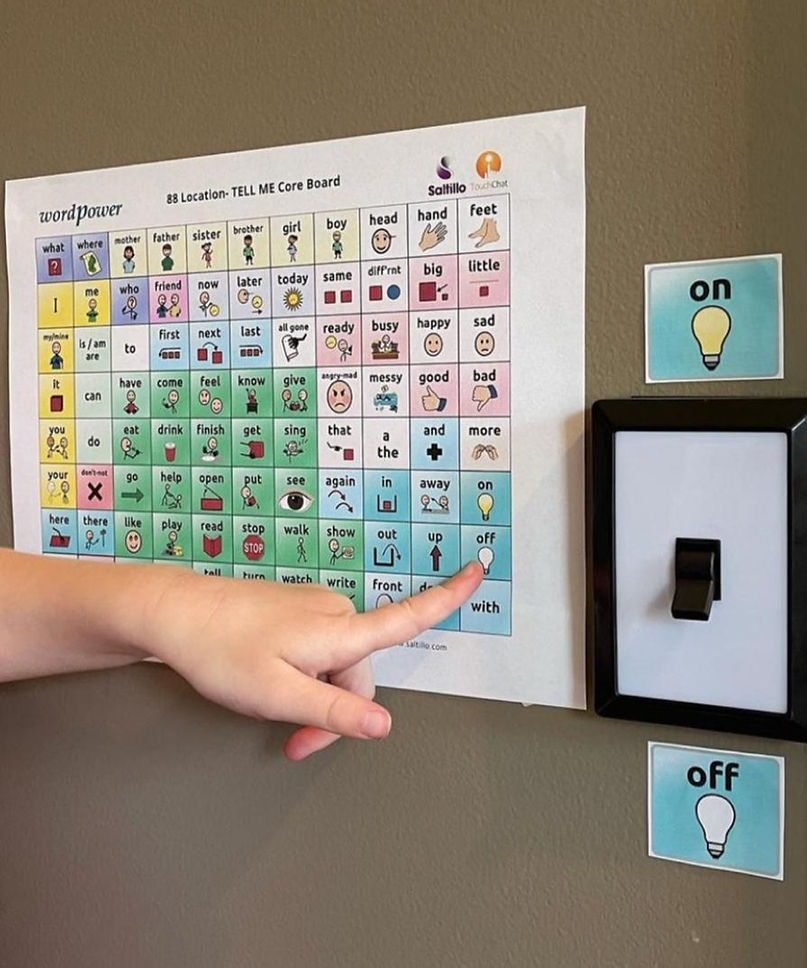
Here is what a Core board might look like, in fact this is one that I love to use. It is made by Beautiful Speech Life, there are a ton of similar boards out there for free. I have also made my own, you can check it out on my Instagram feed.
What is Core Vocabulary/ Core words?
Core vocabulary consists of the most common words used by children throughout a day. In 2003 Banajee and Dicarlo et al found that 50 % of pre-schoolers in their project used nine words consistently across their daily play and meal routines. These words are Core words and are typically the ones you can see on a board, like the one above.
How To Use It
Adults always first need to consistently model and show their child how to use a board. This is key! For example: Adult can point to “YOU” “WANT” ‘MORE” and then point to the cup of Water on the counter. Child could then reply either by shaking his/her head and/or pointing to “NOT” which also stands for “NO”. Then adult can point to “NOT” “MORE” and do an OK sign as well. Eventually Child can initiate a request and point to “I” “ WANT” “MORE” and then point to the cup on the counter.
This is not as cumbersome or limited as it first sounds or appears. Here’s why: As adult you can talk normally and, of course, many words you are using will not be on this board. But some will be, and you will be surprised how many you can find when you start using it. So you could say quite normally: Hey lovely (name of your child) would YOU LIKE some MORE water? The words in capital are on the board which you can point to as you speak normally. Basically, you are showing/saying to your child: “We can speak and these are the pictures we can use to help us; We call this TOTAL COMMUNICATION, as communication is so much more than just words! Great communication can be silent, where we use our facial expression, our smile, our eyes, our hand gestures, body movements and yes, of course, words. But when words fail us, these boards are so helpful.
This still does not answer your original question of: why would I want to do this, I want my child to talk!? You are a SPEECH Therapist, please help my child TALK, not point to pictures, that is not what I had in mind.
Let Me Explain
When speech is difficult for a child it doesn’t mean that there is nothing to talk about! Of course, we want all our children and all people to speak because it is the easiest and most effective way of communicating, no doubt! However, sometimes this is very hard for some children and whilst we are always working towards speech where possible, we also want to make sure that whilst figuring out how to speak, your child has a MEANS TO COMMUNICATE. Using a board like this might well be a temporary strategy but whilst you are using it and working on their speech you will find a reduction in tantrums and frustration as you child is able to express themselves more effectively.
Often we find that as soon as we offer a CORE VOCABULARY like the above sample a child who has had no or very few words suddenly blossoms and starts to point to new words on the board and starts to PRACTICE USING THESE WORDS!! Practice makes perfect, right? Yes it totally does! There is lots of evidence that tells us that using Core Vocabulary Boards ENHANCE AND SUPPORT SPEECH PRODUCTION AND NOT HINDER IT. Using a board like this will only ever be helpful to your child and will never make your child “lazy” – too lazy to speak? NO SUCH THING!
Here is what one of my parents says about the core board we use with her little boy:
“the board has been a game changer, my son is a visual learner so it really helps to have the board as he associates communication so much easier this way. We have incorporated his twin sister who models it’s use and have definitely seen improvement in speech through its support and his frustration around being unable to verbally communicate at times has definitely lessened”
K Connolly, Mother of Tom (aged 3.5 years).
Reading and hearing this makes me so happy!
In addition to general core board above I also sometimes use a Core Board that is specific to an activity, such as for example BLOWING BUBBLES. Below is an example of such a board, which you can use very nicely during a bubble blowing activity and sometimes it is a nice place to start for newcomers, this can be an easy introduction. You can download this and many similar boards on www.widgit.com for free!
There is so much more to say about AAC and using Coreboards, visit my Instagram you can find a bit more information on how I use them.
Find a speech and language therapist for your child in London. Are you concerned about your child’s speech, feeding or communication skills and don’t know where to turn? Please contact me and we can discuss how I can help you or visit my services page.