The festive season is a wonderful time for many families, but for children with feeding challenges, sensory differences, or autism traits, December can feel overwhelming. Changes in routine, busier environments, travel, new foods, disrupted sleep, and well-meaning relatives giving ‘advice’ can all affect a child’s feeding, communication and overall regulation.
As a speech and language therapist specialising in Early Years, I see the same pattern each year: children often make progress during the term, only to struggle in late December when everything becomes unpredictable. The good news? With a bit of preparation, children can not only cope better, but they can actually make significant developmental gains during the holidays.
This blog will help you feel confident, supported and prepared for the transition from ‘festive mode’ to a smoother, regulated start in January.
1. Why routines matter so much. Especially now
Young children thrive on predictability. For neurodivergent children or those with sensory, feeding or communication needs, routine isn’t just helpful: it’s the backbone of emotional regulation.
In December, typical patterns change:
Mealtimes shift or become irregular
Bedtime slides
New foods appear
Loud social gatherings overwhelm
Travel disrupts naps and comfort routines
Therapies pause
Childcare closes
Any one of these can lead to feeding refusals, more meltdowns, increased stimming, reduced communication attempts or regression in speech sounds.
It’s simply the nervous system responding to too much change.
2. Protecting feeding progress during holiday mealtimes
My last blog and insta post have a nice social story on festive meals. They are often the trickiest part of the season for families I support. Children with sensory-based feeding challenges, or ARFID traits may find holiday foods completely unfamiliar and challenging.
What helps:
Offer one ‘safe food’ at every meal
Keep portion sizes tiny
Use the ‘buffet rule’
Rehearse tricky moments
3. Supporting communication when routines are disrupted
Holiday time actually offers more opportunities for communication, just in different ways.
Strategies:
Slow down and follow your child’s lead
Use everyday routines as language opportunities
Keep AAC going even if casually
4. Understanding holiday ‘regressions’ and know they’re temporary
This is almost always due to nervous system overload. Children don’t truly ‘lose’ skills; they temporarily prioritise regulation over learning.
5. A gentle January reset: How to start the New Year smoothly
Re-establish predictability early
Return to preferred foods
Book early support if needed
Focus on regulation first
Sonja McGeachie
Highly Specialist Speech and Language Therapist
Owner of The London Speech and Feeding Practice.
Find a speech and language therapist for your child in London. Are you concerned about your child’s speech, feeding or communication skills and don’t know where to turn? Please contact me and we can discuss how I can help you or visit my services page.
It feels like the Christmas festivities start earlier and earlier every year. This makes it harder for your child with communication difficulties to process what is happening. Whilst you can’t do anything about the events that happen around your child, you can start to put into practice strategies which may support them and allow them to regulate their emotions.
Six ways to prepare your child for the Christmas festivities
Explore six ideas here:
1. Print off or buy a blank calendar to use at home
You can start to write in activities out of the usual routine and add a picture to allow your child to understand what it’s about. You can also use it as a countdown to Christmas Day to try to prevent ‘how long’ questions.
2. Make use of visual timetables
These are useful in everyday settings and activities but also when change occurs.
3. Be aware of any non-uniform days
Days like ‘Christmas Jumper Day’ can make your child feel uncomfortable and may affect their behaviour. By giving yourself time, you can have conversations with your child’s teacher to find a more suitable alternative. For example, they can wear a Christmas t-shirt that they find more comfortable.
4. Think about what will benefit your child
Do they like being surrounded by people or do they prefer a quiet space on a 1:1 basis? Christmas activities often involve lots of group work in school (e.g., rehearsing for carol concerts or plays). They might prefer to pre-record their part in the Christmas play or create pieces of art which can be used. At home, they may prefer one guest visiting at a time, rather than all at once.
5. Explore how your child is feeling
It’s important to find out how your young person is feeling and how these impact on the activities of that day. It might be that your child doesn’t like surprises and the intensity of opening gifts is too much for them. They may prefer gifts to be left unwrapped and given throughout the day, rather than all at once.
6. Consider sensory needs
Ensure your young person has everything they need to meet their sensory needs. This can be e.g. noise cancelling headphones, fidget toys, or comforting items. These will particularly be helpful with routines changing, often with little notice. If at home, you may wish to not put lights on the Christmas tree if visual stimuli become too much.
Remember clear communication between home, school and other family members is vital during this time. By having clear communication and expectations, your young person will feel more secure. And you can have a Christmas that is right for you and your family.
Find a speech and language therapist for your child in London. Are you concerned about your child’s speech, feeding or communication skills and don’t know where to turn? Please contact me and we can discuss how I can help you or visit my services page.
If your child is using echolalia and/or has a diagnosis of autism, then your child’s way of processing language is most likely different to the classic way children typically learn language. We call this process Natural Language Acquisition or Gestalt Language Processing.
Step by Step guide to Gestalt Learning
Let’s explore the following stages of Gestalt Processing:
Stage 1: communicative use of whole language gestalts
(e.g., “let’s get out of here”)
Children and young people in this stage use echolalia. They need to hear more gestalts or scripts. So, your job is to model, model, model and to use functional language that your child can repeat back.
Stage 2: mitigated into chunks and re-combining these chunks
(e.g., “let’s get” + “some more”) and (e.g., “let’s get” + “out of here”)
This is when you take parts of gestalts or phrases and then combine it with other parts.
Stage 3: further mitigation (single words recombining words, formulating two-word phrases)
(e.g., “get…more”)
They are going beyond their gestalts. Furthermore, they may begin to label different objects.
Stage 4: formulating first sentences
(e.g., “let’s get more toys”)
You may see more grammatical errors during this phase as they are creating unique sentences. Please don’t worry about this, it means they are playing and experimenting with language. As communication partners, you could model the correct form of the sentence.
Stages 5 & 6: formulating more complex sentences
(e.g., “how long do you want to play inside for?”)
You can see that language learning is a process, that is trialled and tested, used in different contexts for children to be able to learn and use language appropriately.
My next blog will give you activities ideas and how you might use them specifically with a Gestalt Language Processor.
Remember early intervention is vital. So, if you have any concerns, please seek the advice of a Speech and Language Therapist.
Find a speech and language therapist for your child in London. Are you concerned about your child’s speech, feeding or communication skills and don’t know where to turn? Please contact me and we can discuss how I can help you or visit my services page.
As a parent, you’re always observing your child, celebrating his or her milestones, and sometimes, wondering if he or she is quite on track. When it comes to speech, language, play, attention, and listening, these early years are a whirlwind of development! It’s natural to seek guidance if you have concerns, and that’s where a truly comprehensive assessment comes in.
But what exactly does ‘comprehensive’ mean, especially when it goes beyond a typical checklist? You can find any number of check lists online these days but whilst they can give you an overall idea of what a child is typically expected to do at any given age, it can also start leading you into a rabbit hole of anxiety of ‘what-iffery’.
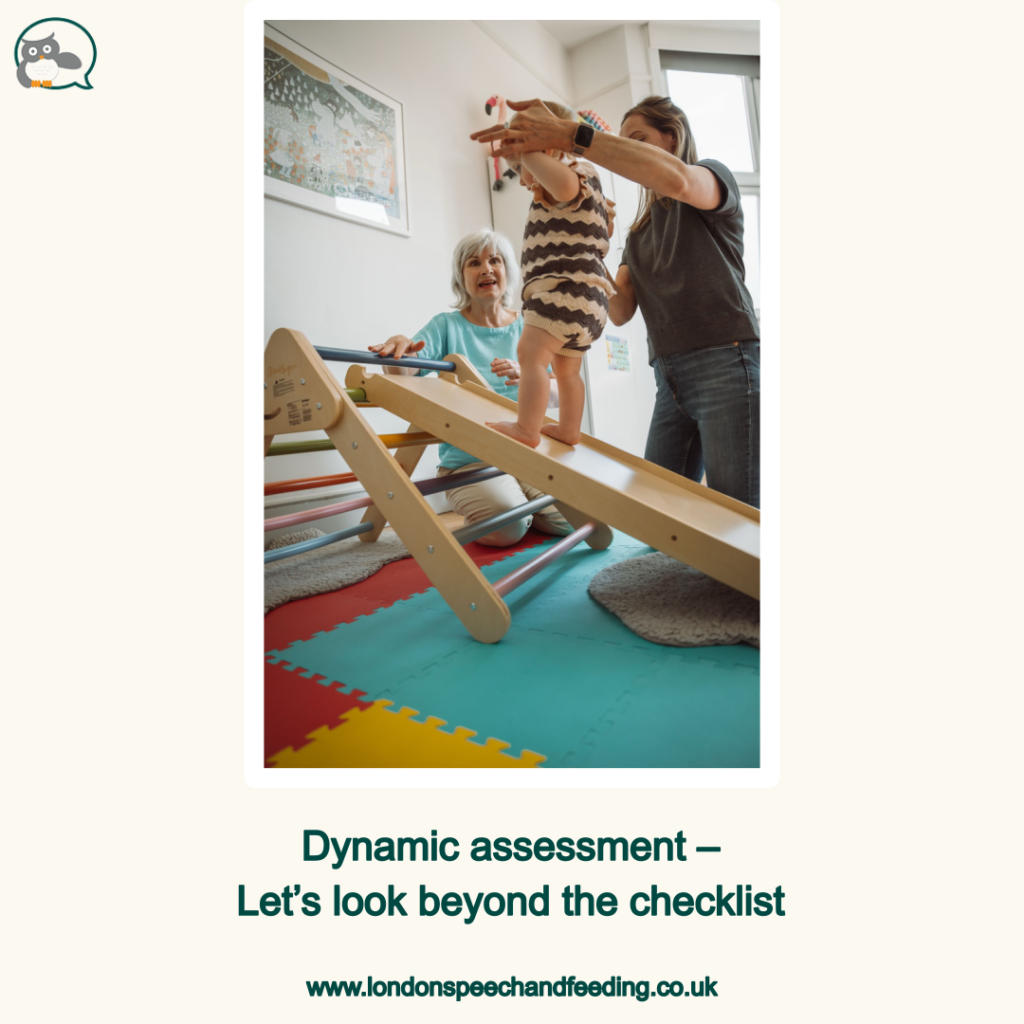
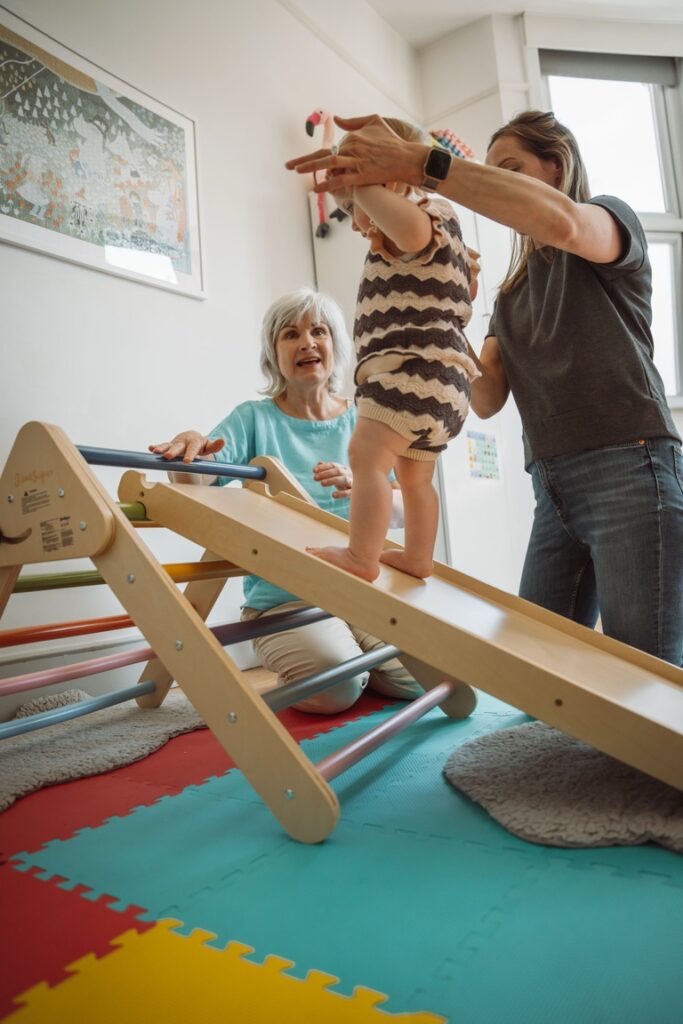
At The London Speech and Feeding Practice I believe in something far more insightful than a static evaluation: Dynamic Assessment. Think of it as an in-depth, interactive investigation into your child’s unique communication landscape, exploring not just what he or she can do, but how he or she learns and why he or she might be facing challenges. This is so important.
What makes an assessment ‘dynamic’?
Imagine trying to understand a child’s personality by just looking at a single photograph. It gives you a glimpse, but it hardly tells the whole story. Traditional, formal assessments, while valuable, can sometimes be like that photograph – a snapshot of skills at one specific moment.
Dynamic assessment, on the other hand, is a living, breathing process. It’s called ‘dynamic’ because:
It’s interactive and responsive: It adapts to your child’s needs in real-time. It’s not about sticking rigidly to a pre-set schedule of tests. Instead, it’s about observing, gently prompting, and providing support to see how your child responds and learns. This allows me to understand his or her learning potential, not just his or her current performance.
It’s holistic and multi-faceted: I look at the whole child. We delve deep into not just speech and language, but also his or her play skills (a crucial window into cognitive and social development), attention and listening abilities, and his or her social engagement. These areas are intricately linked, and a delay in one can often impact others.
It integrates multiple perspectives: Your insights as a parent are invaluable! Before we even meet, my comprehensive onboarding questionnaire gathers essential background. During the assessment, your feedback, observations, and comments are woven into the fabric of our session. You are the expert on your child, and your voice is central to forming a complete picture.
More than just ‘speech’: A deep dive into development
You might initially be concerned about your child’s speech sounds, or perhaps his or her ability to form sentences. These are vital areas, but my approach goes much further. I’m keen to understand:
The ‘why’ behind the ‘what’: Is a child struggling with language because of difficulties with understanding instructions (receptive language), or with expressing themselves (expressive language)? Are his or her attention skills impacting his or her ability to follow a conversation? Is his or her play demonstrating imaginative thought, or does he or she prefer more structured, repetitive activities? These nuances are critical.
Differential diagnosis: This is where the skill of an experienced clinician truly comes into its own. Through dynamic assessment, I can differentiate between a developmental delay (where a child is following a typical progression but at a slower pace) and a disorder (where his or her development is following an atypical pattern). This distinction is vital because it guides the type of support and intervention that will be most effective. Understanding the cause of the delay or disorder is paramount to creating a targeted, impactful therapy plan.
The art of observation
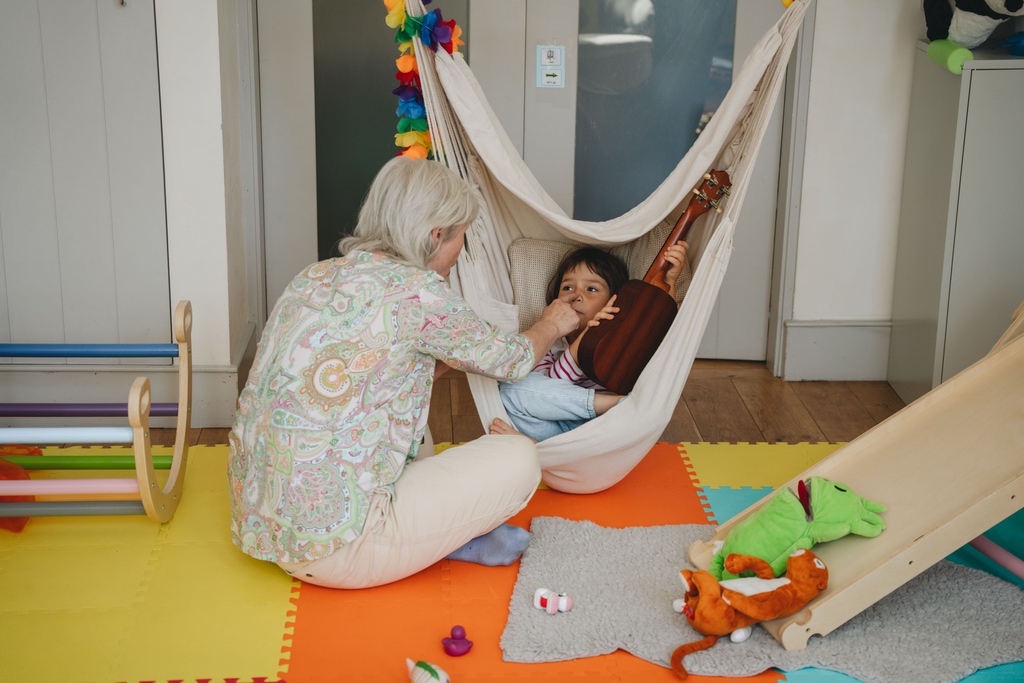
While I draw upon evidence-based practice as well as a formal, standardised assessment as well as my extensive clinical knowledge, I also rely heavily on the art of observation. From the moment your child walks into the room, I’m establishing rapport, engaging them in play, and creating a safe, fun environment. It’s through this genuine interaction – often without them even realising they’re being ‘assessed’ – that the most authentic insights emerge.
This is where the magic happens:
Building rapport: A child who feels comfortable and connected will show you so much more of his or her true abilities and personality. I pride myself on creating an atmosphere where children can relax and simply be themselves.
Play as a window: Play isn’t just fun; it’s a child’s natural language. It reveals his or her understanding of the world, his or her problem-solving skills, his or her social engagement, and his or her ability to use symbols and language.
Skilled interpretation: My years of experience allow me to see beyond surface-level behaviours and interpret the subtle cues that might indicate underlying strengths or challenges. This goes far beyond what any standardised test alone can capture.
Why choose a clinician who offers dynamic assessment?
In essence, a dynamic assessment provides a rich, nuanced, and truly personalised understanding of your child. It’s an investment in:
Accuracy: Leading to a more precise diagnosis and understanding of his or her unique profile.
Tailored support: Enabling the creation of highly individualised therapy goals that truly meet your child where he or she is and gently guide him or her forward.
Empowerment: You’ll leave with not just answers, but also practical strategies and a clear path forward, feeling confident and informed.
If you’re seeking a thorough, empathetic, and truly insightful assessment for your child’s communication development in London, I invite you to get in touch. Let’s work together to unlock your child’s full potential.
Sonja McGeachie
Highly Specialist Speech and Language Therapist
Owner of The London Speech and Feeding Practice.
Find a speech and language therapist for your child in London. Are you concerned about your child’s speech, feeding or communication skills and don’t know where to turn? Please contact me and we can discuss how I can help you or visit my services page.
Below are two reviews I got from grateful clients over the past 4-6 weeks; this blog is more about how Feeding Therapy can help you than blowing my own trumpet…. though that said, it is always so nice and gratifying to hear when parents are happy and hopeful about their little one’s feeding journey. Feeding Therapy is a substantial part of my work as a Children’s Speech and Language Therapist. One of my specialist subjects is Autism and we find that many children on the Autism Spectrum are very specific about eating, and will often refuse a range of typical family foods in favour of a narrow range of foods/snacks.
Mostly, feeding difficulties are a combination and complex cocktail of factors that have contributed to the current status quo: sure, there may have been some physical problems to start off with, such as reflux causing the baby discomfort, constipation, a very tight tongue tie or a swallowing problem caused by neurological difficulties and of course sensory processing difficulties are also very physical experiences. We always begin with a very thorough case history taking and information gathering, followed by an oral assessment and observation of the actual swallow to establish what might have been – or still might be – the cause for the feeding difficulties.
In most of the cases I see in my practice, the original obvious cause is no longer present, especially with older children. So, if the swallowing is fine, the reflux is no longer present, the tongue was divided (twice!) why are they still not eating much, refusing to try new foods, only accept certain textures etc.
The answer is extremely complex and multi-faceted and this little blog is not covering any factors in detail (we would be here all night) -I mentioned sensory processing difficulties earlier on. These are mostly still present but often not acknowledged or recognised by parents. And it is certainly the case that one of the contributors is parental anxiety; this tends to run very high and has been for many months, sometimes years. This in turn often leads to very tense and unpleasant, endlessly long meal times and many times children are force-fed several times a day in order to “get something down there” as otherwise they would probably starve themselves.
Additionally, parents end up only offering a very narrow range of foods because that is all their child will eat. This ends up in a vicious cycle of children being fed porridge-style food for all meal times and of course they won’t progress to more mature foods if these mature foods are never on offer.
In order to help address and disentangle some of the issues I often introduce the “Division of Responsibility in Feeding” as researched and recommended by Ellyn Satter (The Satter Feeding Dynamics Model)
Here are the main points of her approach:
Children have a natural ability with eating, they eat as much as they need and they grow in the way that is right for them and they learn to eat what their parents eat. (E Satter). The parent is responsible for WHAT the child eats, WHERE and WHEN the child eats. The child is responsible for HOW MUCH they eat or WHETHER to eat. Satter proposes that parents should guide their child’s transition from nipple feeding through semi-solids, then thick and lumpy foods to finger foods and then on to normal family meals.
Please note: this model is only appropriate for children where the original physical cause is no longer present!
Of course it’s not easy! It requires a huge shift in thinking about feeding and it requires to trust our children to know what is best for them. This is very big for most parents, as it is not how we were brought up and it is not commonly known that babies and children know what is good for them!
However, it is certainly true that parents who follow this particular approach and make small, steady changes in the way the offer foods, and in the way they create family meal times differently, children make very nice, pleasing progress and over some months we often see remarkable positive changes.
I like to work in a team and especially for this type of problem it is essential to have a multi-disciplinary approach. A knowledgeable dietician is an enormous plus in any feeding team as is of course a
Paediatrician and/ or a Gastroenterologist and the most important people in the team are the parents!
Feeding Therapy is all about collaboration and a ‘team around the child” approach. When we have this in place and there is trust amongst the team members then we make fantastic progress.
I visited London Speech and Feeding a couple of days ago with my 8-month-old granddaughter and her mother. Sonja made us feel comfortable and at ease from our first introductions. She was able to pinpoint my granddaughter’s mum’s anxiety around weaning very quickly. She not only gave her the tools to do this successfully, but also really encouraged my granddaughter’s mum and instilled confidence that she had everything she needed to make this sometimes-difficult transition without further anxiety.
Sonja was very thorough in her initial assessment of my granddaughter’s physical milestones and her developing speech. My granddaughter felt very comfortable with Sonja and happily played along with her. Then came the big moment – trying out various foods! We were amazed to see just how easily my granddaughter, with Sonja’s expert encouragement, took to sampling the wonderful array of different delicious morsels Sonja had prepared for the session. My granddaughter even drank from a cup for the first time! Wonderful!
Sonja then emailed a summary of the session and an extensive array of resources with suggestions for my granddaughter’s mum which she has now put into action. My granddaughter’s mum couldn’t thank Sonja enough for her caring attitude, extensive knowledge, and warm professionalism. I have no hesitation in recommending Sonja, she’s a fantastic Feeding Therapist!
–
Sonja (and her lovely colleague, Sandra) were stupendous. I had brought my one-year-old son to see them as I was concerned that he wasn’t eating enough. They looked at his history and we ate together to make sure they had all the information they needed to give an accurate diagnosis. Whilst our outcome was that Henry was in fact doing brilliantly (and I just needed to chill out a bit!), I would imagine if there was something more serious going on, Sonja would make you feel just as supported and empowered as she did with us. Excellent follow-ups too. Money well spent for a bit of reassurance for a stressed out mama. Thank you, Sonja!
Find a speech and language therapist for your child in London. Are you concerned about your child’s speech, feeding or communication skills and don’t know where to turn? Please contact me and we can discuss how I can help you or visit my services page.
When your baby reaches around 12 months, there is a lot going on developmentally. They are learning to walk, communicate, feed themselves and become increasingly independent. One small but important milestone that can sometimes get overlooked is learning to drink from an open cup.
Many toddlers continue to have milk from a bottle well beyond their first birthday, and parents are often understandably reluctant to take it away. The bottle may be familiar, comforting and convenient, particularly at bedtime.
But moving towards an open cup is not simply about changing the way your child drinks. It is part of their development of oral-motor skills, feeding independence and mealtime development.
And there is another piece of the puzzle that is often overlooked: how your toddler is sitting while they eat and drink.
The way the body is supported can make a real difference to what the mouth is able to do.
Babies can begin learning to drink from an open cup much earlier than many parents realise. By around 12 months, most children should be given regular opportunities to practise drinking from an open cup alongside other suitable drinking vessels.
An open cup encourages your toddler to learn a different pattern of drinking from the sucking pattern they have used with a bottle.
With an open cup, your child needs to:
lean towards the cup and control its position
grade how much liquid enters the mouth
use their lips to help control the liquid
coordinate breathing and swallowing
develop increasingly mature tongue and jaw movements
learn to take a drink without relying on a teat or nipple.
These are useful skills for developing efficient eating and drinking.
This doesn’t mean that a toddler who still has a bottle at 14 or 18 months has somehow ‘missed their chance’. Children develop at different rates, and there is always an opportunity to work towards new skills.
However, if a bottle remains the main or only way a child drinks for a long time, there can be fewer opportunities to practise these more mature drinking skills.
The occasional bottle is not the issue. The concern is when a toddler continues to rely heavily on a bottle and therefore has little reason or opportunity to develop other drinking skills.
A bottle encourages a sucking pattern which is appropriate for infancy. As children mature, we want to see increasing use of their lips, tongue, jaw and facial muscles in more sophisticated ways.
Long-term bottle use can also make the transition to an open cup more difficult simply because the child has become very accustomed to the bottle.
There can also be practical considerations around dental health, particularly when milk is offered frequently throughout the day or overnight.
For many toddlers, the bottle has also become associated with comfort, sleep or emotional regulation. This can make giving it up feel like a very big change for the whole family.
So rather than thinking, ‘The bottle has to disappear tomorrow’, think:
‘How can I gradually increase opportunities for open-cup drinking?’
Offer the open cup regularly at meals. Let your toddler experiment. Expect spills. Keep the amount of liquid small initially and provide plenty of encouragement.
Learning to drink is a skill. And skills need practice.
When we think about feeding, we naturally tend to focus on the mouth. We watch what the tongue is doing, whether a child chews, whether they cough or gag and what foods they accept.
But feeding is a whole-body activity.
Your child needs a stable body position before they can use their mouth efficiently.
Think about trying to drink from a cup while sitting on a wobbly stool with your feet dangling in the air. You would probably find it much easier if your body was well supported.
The same principle applies to toddlers.
A well-designed highchair such as a Tripp Trapp chair can provide a stable base when it is correctly adjusted for the individual child. Ideally, your toddler should have:
hips well supported
knees comfortably bent
feet resting firmly on a footplate
a stable pelvis and trunk
the table or tray at an appropriate height
This gives your child a solid foundation from which to move.
And that matters because stability in the body supports movement and control in the mouth.
I sometimes hear parents say, ‘He doesn’t need the footrest don’t worry about it (as I crouch down with my Allenn key to adjust the Tripp Trapp chair) but I always explain it is very important to have his feet supported. Dangling legs can make it much harder to maintain a stable sitting position.
When the feet are supported, your toddler can push gently through their feet and stabilise their pelvis and trunk. This can help them maintain a more organised position while eating and drinking.
They can then devote more attention to the job in front of them:
looking, reaching, grasping, chewing, swallowing and drinking.
This is particularly important for toddlers who are developing their chewing skills or who find mealtimes physically demanding.
Eating involves an extraordinary amount of coordination.
Your toddler is managing food in their hands, bringing it to their mouth, biting, chewing, moving food around with their tongue, forming a bolus and swallowing, often while simultaneously looking around, communicating and interacting with you.
Drinking from an open cup adds another layer of coordination.
Good postural support doesn’t teach a child to drink from a cup, but it can give them a much better physical foundation from which to practise the skill.
This is why, when I assess a toddler’s feeding, I don’t just look inside the mouth.
I also look at how the child is positioned.
Making open-cup drinking part of everyday life
You don’t need a complicated programme.
At meals, offer a small amount of water in an open cup. You can help your toddler hold the cup initially, tipping it gently towards their lips and allowing them to control the drinking as much as possible.
Some mess is completely normal!
You might also use a small, lightweight open cup that is easy for little hands to manage.
And remember that the goal is not to make every drink perfect. The goal is to give your child regular, positive opportunities to practise.
If your toddler is struggling with drinking, frequently coughing or choking, refusing cups, relying heavily on a bottle, or experiencing difficulties with chewing and eating, it is worth seeking professional advice from a Speech and Language Therapist with expertise in paediatric feeding.
The bigger picture
Open-cup drinking and good sitting are not two unrelated developmental skills.
They are part of the same picture.
A stable body provides a foundation for skilled movement. Skilled movement supports feeding. And feeding skills develop through practice and opportunity.
So as your toddler approaches and moves beyond their first birthday, think beyond simply asking, ‘How much milk are they drinking?’
Think about how they are drinking, how they are sitting, and what opportunities they have to develop the skills they will need as they grow.
And if you have a little one sitting beautifully at the table in a well-supported Tripp Trapp chair, remember: you’re not just creating a comfortable seat.
You’re creating a stable foundation for eating, drinking, learning and growing.
Do get in touch with me. I would love to hear from you and help your little one develop good sitting and drinking habits.
Sonja McGeachie
Highly Specialist Speech and Language Therapist
Owner of The London Speech and Feeding Practice.
Find a speech and language therapist for your child in London. Are you concerned about your child’s speech, feeding or communication skills and don’t know where to turn? Please contact me and we can discuss how I can help you or visit my services page.
Have you heard the term ‘Container play’? I use this very often with children in my sessions as it is so versatile and an enjoyable activity that can be done in parallel with a child or together. Container play is a powerful tool for fostering development in young children, especially those with developmental delays. This seemingly mundane activity provides a rich environment for sensory exploration, motor skill development, and cognitive growth.
What is container play?
Container play involves children interacting with various containers—boxes, buckets, bowls, cups, various bags, etc.—and filling, emptying, and transferring objects within and between them. Objects can include literally anything: small beads, bead chains, table tennis balls, wooden pegs, dinosaurs or any other little person toy, blocks of varying sizes, sand, water, or any other safe material. Larger containers obviously take larger items: socks, stuffed animals, bigger balls, bigger blocks etc really the choices are endless.
Benefits for children with developmental delays:
Sensory exploration:
Touch: Children explore different textures and temperatures of containers and objects.
Sight: They observe how objects look inside and outside the containers, how light reflects off them, and how colours change.
Sound: They listen to the sounds of objects clinking, rattling, and splashing.
Proprioception: Filling and emptying containers helps develop body awareness and spatial awareness.
For neurodivergent children who might have sensory regulation difficulties, consider the following adaptions to accommodate your child’s sensory needs:
Over-stimulation: For children who are easily overstimulated, start with simple setups using a limited number of containers and objects. Gradually increase the complexity as they tolerate it.
Under-stimulation: For children who seek sensory input, provide a variety of textures and materials, such as sand, water, slime, or beans.
Temperature: Offer a variety of temperature options. Some children may enjoy warm water or cool sand.
Lighting: Adjust the lighting to create a calming or stimulating environment.
Focus on one sense at a time: Initially, focus on one sensory aspect, such as the feel of sand or the sound of water.
Weighted containers: Use heavy containers filled with rice or beans to provide deep pressure input.
Fidget toys: Incorporate fidget toys into the activity to provide sensory input and help with self-regulation.
Tactile exploration: Encourage exploration of different textures using objects with varying surfaces.
Pincer grasp: Picking up small objects helps develop fine motor skills like the pincer grasp.
Strength and dexterity: Manipulating containers and objects strengthens hand muscles and improves dexterity. Opening and closing containers can be a huge area of interest; how does the top screw back on, or off?
Cognitive development:
Cause and effect: Children learn that their actions (e.g., pouring water or sand) have consequences (e.g., the water spills).
Spatial awareness: They develop an understanding of concepts like inside, outside, full, empty, and over/under; also how big is the vessel and how much goes in before it’s full or spills over. How small is the vessel opening and what do I need to do to get the beads into the container.
Problem-solving: Children learn to solve problems, such as how to get an object out of a narrow container or how to transfer water without spilling.
Social and emotional development:
Communication: Container play can encourage communication as children interact with others, sharing toys and commenting on their actions. Asking for help to open and close a container is often a great opportunity to practise ‘help me’ or ‘open it’
Turn-taking: Sharing containers and materials helps children learn to take turns and cooperate.
Sensory regulation: For children with sensory sensitivities, container play can be a calming and self-regulating activity.
Tips for engaging children in container play:
Create a safe and inviting environment. A shower curtain on the floor makes things easier for tidy up afterwards. And it allows for spillages.
Provide a variety of containers: Use different sizes, shapes, and materials. Use containers that are visually interesting and pleasing, perhaps a festive biscuit tin, or a tin that looks like train engine. Use see-through containers at first which make the filling and emptying more obvious. This is important for children who have no previous experience with this type of play and need to ‘warm up’ to it. Once a child loves and is used to container play you can go wild with all types of containers.
Offer a variety of objects: Include balls, blocks, sand, water, and other age-appropriate materials.
Join in the fun! Start off the process, show your child what the joy of the activity is for yourself, how fun it is to fill and empty containers, provide enough containers for your child to start playing alongside you, and comment on their actions.
Follow your child’s lead: Allow them to explore and experiment at their own pace.
Adapt activities: Adjust the level of challenge based on your child’s abilities and interests.
Container play is a simple yet powerful tool that can support the overall development of young children, especially those with developmental delays. By providing a rich and engaging sensory experience, container play can help children build essential skills in motor, cognitive, social, and emotional domains.
If you have any questions or would like to have more in-depths demonstration of this or other play styles for your child please contact me.
I look forward to hearing from you.
Sonja McGeachie
Early Intervention Speech and Language Therapist
Feeding and Dysphagia (Swallowing) Specialist The London Speech and Feeding Practice
The London Speech and Feeding Practice
Find a speech and language therapist for your child in London. Are you concerned about your child’s speech, feeding or communication skills and don’t know where to turn? Please contact me and we can discuss how I can help you or visit my services page.