Echolalia is a term used when assessing or treating children with Autism. The term refers to the repetition or echoing of utterances, either our own or others’. It can also be echoing phrases heard on television, advertising jingles or catchy repeat phrases used in tv programmes or nursery rhymes and songs. Whilst we all use echolalia occasionally and it can be observed in typically developing children, we tend not to see/hear it beyond the age of 2.5 years old. Children with ASD, however, do use echolalia often into late childhood.
There are generally two types of Echolalia:
Immediate echolalia
Here the repeated phrases or words are produced immediately after someone has spoken the original words or within two conversational turns of the original utterance.
Delayed echolalia
The repeat echoing of the original utterance occurs sometime later, more than two conversational turns or with a much longer time delay. Due to the delay it can be hard to interpret the meaning of the echolalic utterance as it may refer to something that happened long ago and in a different context to the originally utterance.
(Stiegler, 2015, Fay 1967, Blanc 2014)
There are other unconventional speech behaviours which include:
Perseveration of Speech – persistent repetition of speech
Repetitive questioning – persisting even though answers were given
Vocalisations such as: humming, whistling, clicking, squealing etc.
Much research has gone into the meaning and treatment of Echolalia and the following list consists of possible functions that have been identified:
Information sharing
Responding to answers
Labelling
Drawing attention to self
Protesting
Requesting
Giving instructions
Self-regulation, calming
(Stiegler 2015, Prizant 1983)
Echolalia does have a function and is part of the Gestalt Learning Process (where longer units of speech are memorised and then used as a whole without the individual words being meaningful).
As a Speech and Language Therapist I promote sound and proven Intervention based on the Hanen Programme which helps provide a highly facilitative Interaction Style and I will tell you a bit more in my next blog how the “More Than Words” approach can help children with echolalia move through their Gestalt Learning into more analytic processing of language, grammar and meaning.
Find a speech and language therapist for your child in London. Are you concerned about your child’s speech, feeding or communication skills and don’t know where to turn? Please contact me and we can discuss how I can help you or visit my services page.
The practice of wrapping or swaddling children, often referred to as ‘containment,’ has been used for centuries to soothe and comfort infants. I use this therapeutic approach with autistic children at the London Speech and Feeding Practice. While it might seem counterintuitive, the act of being tightly wrapped can provide significant benefits for children who struggle with sensory processing, emotional regulation, and communication.
Understanding sensory processing and autism
Autistic persons often experience challenges with sensory processing, which is their brain’s ability to interpret and respond to sensory information. This can lead to sensory overload or under-responsivity. Containment can be a valuable tool in helping children regulate their sensory input.
To summarise, here are some of the benefits of containment:
Sensory Regulation:
Provides deep pressure input: The tight, enveloping sensation of being wrapped can provide deep pressure input, which is calming and organising for many children.
Reduces sensory overload: By creating a controlled sensory environment, containment can help to reduce overstimulation and promote a sense of safety.
Emotional Regulation:
Containment creates a sense of security: Being wrapped tightly can mimic the feeling of being in the womb, providing a sense of security and comfort.
Facilitates calming: The deep pressure input can help to calm the nervous system and reduce anxiety.
Improved Body Awareness:
Enhances proprioception: Containment can improve the child’s awareness of their body in space, which is essential for motor development and sensory integration. I often provide extra pressure on a child’s arms and legs sticking out of the yoga mat; this helps my child understand where their limbs are in space: I can feel my legs and I can feel my arms and I can feel where they are right now, i.e. they are under Sonja’s hand, I can feel them.
Facilitates Communication – and this is obviously where I come in as a Speech and Language Therapist:
Swaddling creates a safe space: When a child feels calm and secure, they are more likely to engage in communication.
Enhances joint attention: The shared experience of being wrapped can foster joint attention, which is essential for language development. You can see this one in my highlights where I swaddle my student in the yoga mat (picture above). She absolutely loves it, and what is more she is calm and steady when usually this child likes to be on the move constantly. Here we have a wonderful moment of joint engagement. She looks at me, she can listen to what I say or sing, and she can tell me in her own way to carry on rolling her or to carry on singing or providing calming pressure to her legs and arms or to stop.
A few pointers for when you try this at home: How to practise containment safely and effectively
Create a safe environment: Ensure the wrapping material is soft, breathable, and free from any hazards.
Observe your child’s cues: Pay attention to your child’s body language and verbal cues to determine their comfort level.
Respect your child’s boundaries: If your child shows signs of distress, stop the containment immediately – this might seem obvious but sometimes we adults get so carried away with some ‘great idea’ that we have seen work elsewhere. And so we can be a little too ‘determined’ sometimes to ‘make it happen’… perhaps this rings a bell with some of my readers.
MAKE IT FUN: Start carefully and take it step by step. See if the student is having a nice time. It is all about trust and therefore it might not work the very first time you do it.
It’s important to remember that containment is not a one-size-fits-all approach. Some children may respond better to other sensory-based interventions. However, for many autistic children containment can be a valuable tool in their journey towards improved communication and emotional regulation.
Feeding and Dysphagia (Swallowing) Specialist The London Speech and Feeding Practice
The London Speech and Feeding Practice
Find a speech and language therapist for your child in London. Are you concerned about your child’s speech, feeding or communication skills and don’t know where to turn? Please contact me and we can discuss how I can help you or visit my services page.
When parents visit me with their child, their stress is palpable. Often parents don’t relish or even expect to be asked to practise strategies at home with their child between sessions. Let alone to practise whilst on holiday. I understand that you don’t necessarily want anything extra added to your daily ‘to do’ lists. This is why we try our best to incorporate all speech and language therapy practice into children’s daily activities.
For example:
during bath time;
mealtimes;
getting ready for bedtime;
story time
yes, playtime!
These are activities that all parents will engage with anyway, so it seems to make sense to incorporate both. This is to avoid adding extra pressure on parents’ already stressful and time-poor daily lives. I am hoping my blog will come in handy, especially for the summer holidays.
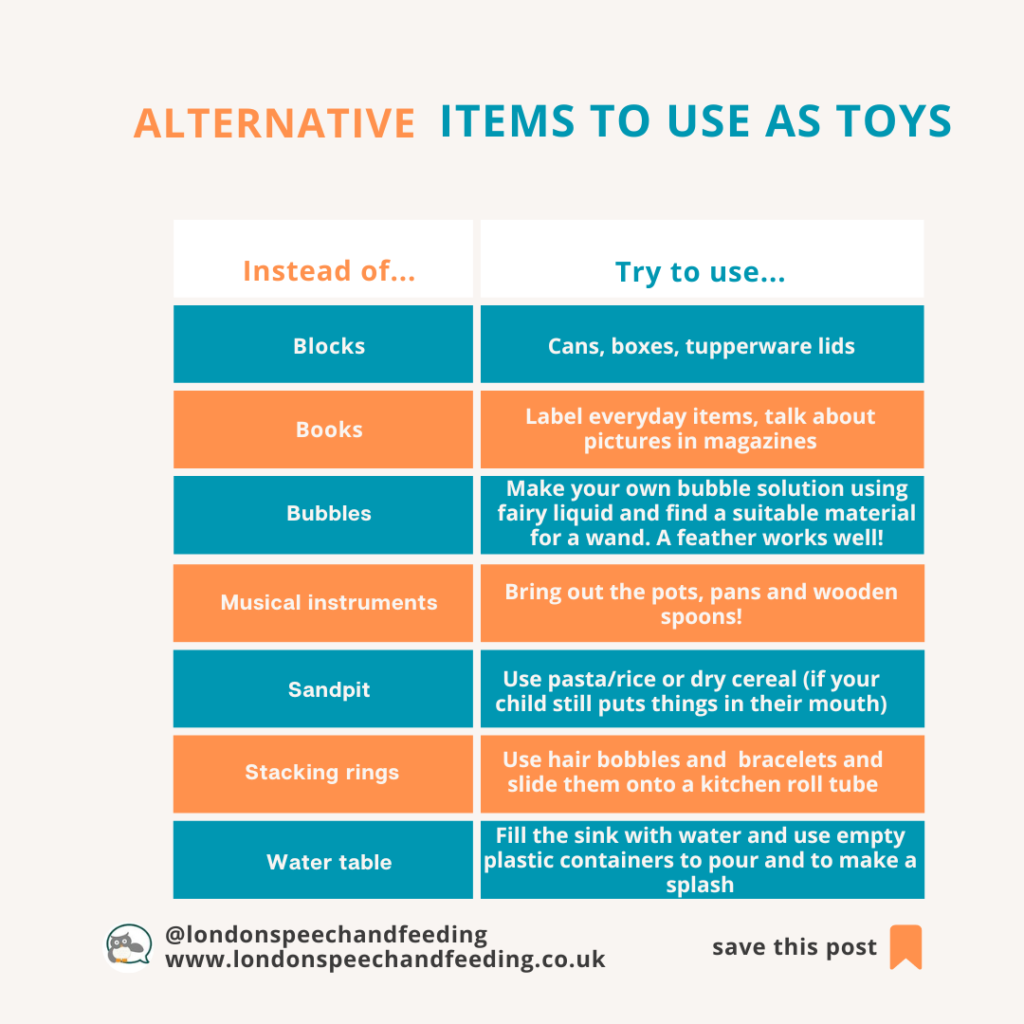
On holiday you are unlikely to have your usual games and toys with you – so here is a nice little list of things you can use instead of traditional games and toys:
If you can think of any other alternatives on holiday and would like to tell me about them, I would love to see your comments below. We can never have too many holiday games!!
If you are at home over the summer and you do have some games in the cupboard you might want to dust these ones down or buy one or two new ones (if you want to).
Most games have multiple uses, and it’s always best to adapt a game to match your child’s interests and what motivates them.
So let’s start…
Pop up pirate: pop a sword into the barrel and watch the pirate pop up randomly. Practise social skills, speech sounds, expressive language (e.g., put a sword on a picture, say the word/sentence then pick up the sword and push it into the barrel).
Word games such as ‘ISpy’, ‘I went to the shop and I bought…’, ‘describe a person and guess who they are’: perfect for when you’re on the move, whether travelling or walking. You can play this anywhere and still support speech, language and communication. You could play ISpy using your child’s special sound, or ‘I went to the shop and bought all things beginning with [insert special sound here]’.
Shopping list: Orchard game is a game to practise categorising. We explain the analogy of the brain being like a filing cabinet. If information is all in the correct place, it’s easier to find, retrieve and use. You can also practise specific speech sounds in this activity. You could also put the words in a sentence to add more of an expressive language element.
Wiggly worms: this Orchard game is all about phonological (awareness of sounds) awareness. Matching a letter with the word. You can also practise the sounds in the words (e.g, g-o-l-d = gold; m-a-ke = make). Talk about the elements, e.g., ‘g-o-l-d’ has 4 sounds, 1 syllable; ‘m-a-ke has 3 sounds, one syllable. You can talk about what words rhyme with the different words and what makes a rhyming word (i.e., the middle and end sounds remain the same).
Sound detectives: this Orchard game allows children to identify sounds. It also has an app (if your child prefers a tech-way of learning). Children identify the sound then they can add the picture card to their path and become closer to being a successful detective. This game can also support memory skills.
Conversation cubes: throw the dice and start building a story. You can also create and use ‘colourful semantics’ sentence strips to support expressive (spoken) language as support to build the narrative.
Think words: ‘name it, press it, pass it’. A great game to expand word knowledge. You can talk about the words at the end of each round exploring semantic (meanings) and phonemic (sounds) links. Your child can also develop social skills (such as attention, listening and turn-taking).
Poo bingo: this is perfectly disgusting but equally fun for kids of about 3.5 years plus – if your child’s target is to practise /p/ sound this is the one for you. You can also learn all about the different animal’s poo, which I am sure you have always wanted to do!! The more we know about a word, the easier it is to store, retrieve and use. Yes, even talking about poo can help!! Also, it’s great for our visual learners.
Simon says: a game that can be played indoors or outdoors. Parents can take turns being “Simon” and give various commands that your child must follow. This means that your child can practise their receptive (understanding of) language as well as their expressive language, speech sounds and social skills (such as turn-taking and initiating).
Ker-plunk: this is perfect for practising your child’s special sound. Repetition is very important, but also can be monotonous, so finding a game that they enjoy is vital. Take turns to pull out a stick. Next, your child can either say their special sound or word (depending on what stage they are at) or hear a good model from other players.
Find a speech and language therapist for your child in London. Are you concerned about your child’s speech, feeding or communication skills and don’t know where to turn? Please contact me and we can discuss how I can help you or visit my services page.
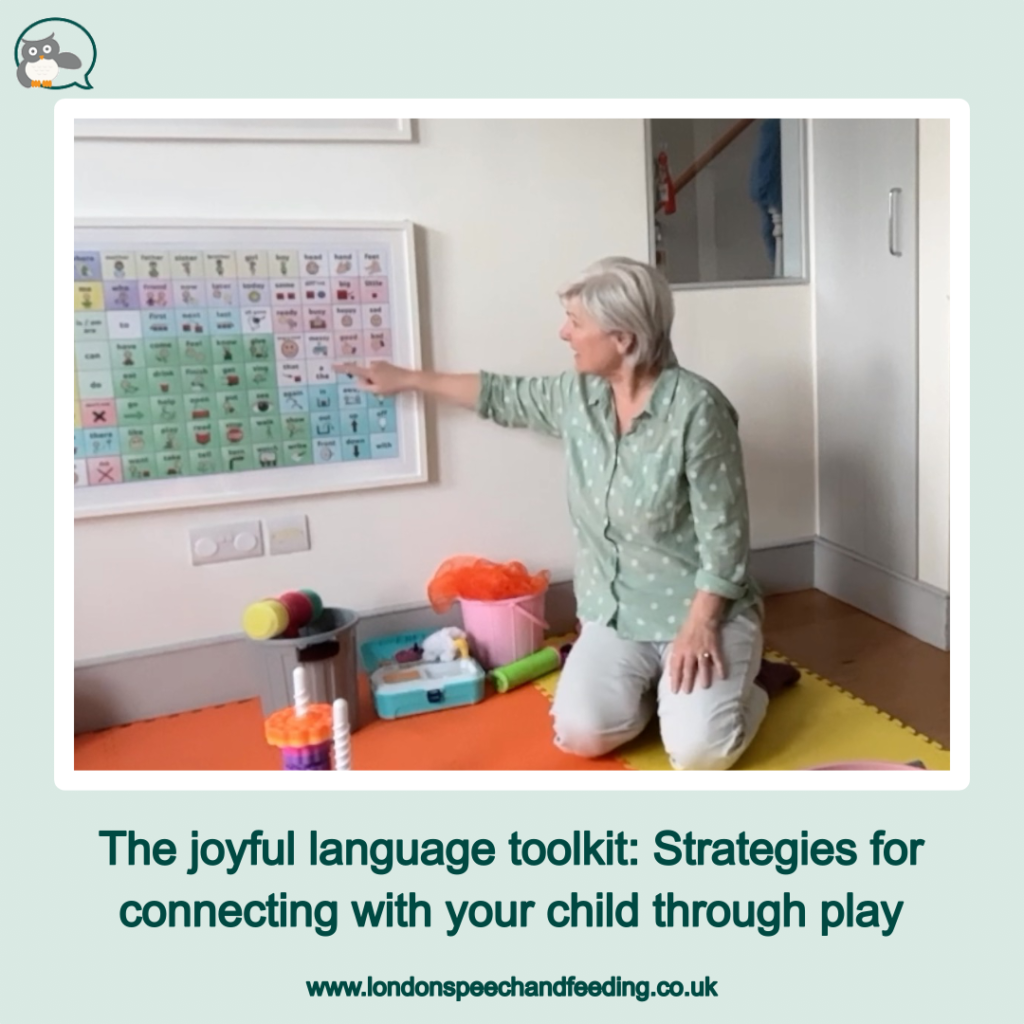
As parents and therapists, we all want to help our children communicate. But sometimes, the process can feel like ‘work’. If I had a penny for every parent saying ‘I find it so boring!’… Ok hang in… what if I told you the most effective therapy happens when it doesn’t look like therapy at all?
My approach centres on connection, enthusiasm, and multi-sensory engagement. We don’t just teach words; we teach the joy of using them. These strategies can be used whether your child is speaking, using a core board, or communicating in his or her own unique way.
Some of my favourite strategies
Today I want to share a few of my favourite strategies to turn everyday interactions into powerful communication opportunities regardless of why or how big a delay your child is having.
Facial expressions & exaggeration: Use an exaggerated facial expression to show surprise (wide eyes!), excitement (big smile!), or confusion (a crinkled brow!). Your face is a powerful teaching tool. I am always talking like a clown in my sessions. I can announce that I have also a normal speaking voice outside my clinic room! 😊
Using your voice with intonation: Your voice is music! Use a singsong or ‘tuneful’ repeat to make words stand out. For example, ‘It’s a BIIIG ball!’ or ‘Let’s GO-O-O!’. Again think: clown!!
Hands and body to show: Use gestures, hands, and body movements to demonstrate. Say ‘OPEN’ while pulling your hands apart, or ‘UP’ while raising the toy high above your head.
Elongating our words: Stretching out key sounds or words gives them emphasis and more time for your child to process. ‘Criiiinkley’ ‘tiiickleyyyy’
Core board & language modelling:
Model the core board with joy: Don’t just point: point with energy!
Model the core board repeatedly throughout the activity, showing genuine excitement. This demonstrates the board is a joyful tool, not homework.
Pointing to the core board: When you say a core word, point to the corresponding symbol. You are showing your child, ‘My words live here, and your words can too’.
Describing it for your child: Help your child build his or her vocabulary by providing rich sensory language. ‘It’s squishy’, ‘It’s very noisy’, or ‘It’s so smooth’.
Catchy phrases: Repetitive, positive phrases create a sense of shared fun. Use them consistently: ‘Oh, that’s a nice one!’ or ‘We like that!’
Following your child’s Interest: Put down your agenda and follow your child’s lead. If they pick up a block, talk about the block. This ensures they are engaged and ready to learn.
Allowing for pauses: This is critical! After you made a comment, allow for a significant pause (count to five in your head) for your child to fill. The silence creates a powerful opportunity for them to initiate communication.
Copying your child’s sounds: If he or she makes a sound (‘buh!’), you make the sound back! Copying your child’s sounds shows him or her ‘I hear you, and your communication is important’.
Lots of repetition: Hearing a word many times in meaningful contexts is how we learn! Repeat key phrases and core words throughout the activity. Repetition is the key to retention.
Getting turns: Explicitly teach and celebrate getting turns in a game. ‘My turn! Your turn!’ This is a foundational social and communication skill.
Using tidy up as a teaching activity: Turn cleanup into a fun game! It’s a goldmine for core words like PUT IN, ALL DONE, HELP, and MORE. For example, ‘Let’s PUT IN the red block! Yay!’
Using exaggerated repeats: When your child tries a sound or word, give it back with exaggerated, tuneful repeats.
Try out all or even just a few of these strategies, and I can promise you, you’re not just encouraging language; you’re building a joyful, reciprocal relationship based on genuine communication!
Which strategy are you excited to try first? Let me know in the comments!
If I can help you with any of the above, if you want to practise these a bit more, I would love to help you!
Sonja McGeachie
Highly Specialist Speech and Language Therapist
Owner of The London Speech and Feeding Practice.
Find a speech and language therapist for your child in London. Are you concerned about your child’s speech, feeding or communication skills and don’t know where to turn? Please contact me and we can discuss how I can help you or visit my services page.
We often hear from parents who are trying their best to connect with their child, especially when reading books, but are met with frustration. They’ll say, ‘I read the book exactly as it’s written, but my child can’t focus for very long and just runs off!’ or ‘my child just flicks through the pages then turns it upside down and runs off with it’ or similar.
It’s a common story. Traditional reading—going through the text from cover-to-cover—has its place of course, but for little ones with a language delay or autism it can move too quickly and place all the focus on the book’s words, not on the interaction.
But what if I told you that story time could become one of the most fun and productive times for your child’s communication development?
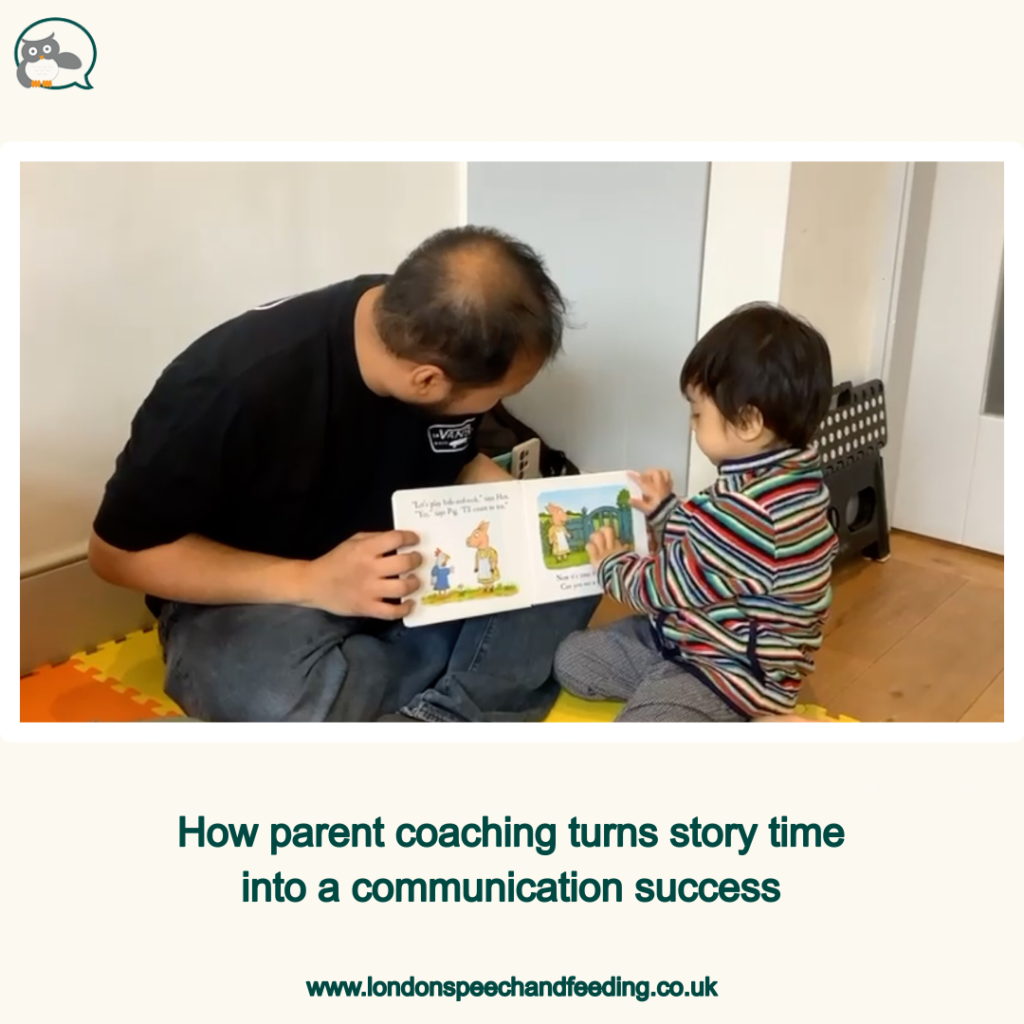
Watch the fantastic little video clip above! You can see the pure joy and connection between this dad and his son. This is the same family who, just a few weeks ago, felt defeated when trying to read a book, with their child quickly losing interest and leaving the reading/book corner.
What changed?
The power of parent coaching and Hanen principles
The difference you see in the video is the direct result of parent interaction therapy, or parent coaching, based on the internationally recognised Hanen principles.
I didn’t ‘fix’ the child. Instead, I coached the parents in a few simple, powerful strategies that completely changed the dynamic of their interaction. Instead of being a time for teaching and instruction, story time became a back-and-forth conversation.
Here are the four major transformations that coaching helped this family achieve:
1. From reader to play partner
Before coaching, the parents felt their job was to read the text and to teach the words in it to their child. Now, their job is to follow their child’s lead. They learned to Observe, Wait, and Listen (OWL). If the child points to the tree or the badger on the page, the parent talks about the tree or the badger.
The result
The child is now initiating and leading the conversation! He is sharing what he finds interesting, which makes him feel powerful and keeps him deeply engaged.
2. Building connection and attention
When parents focus solely on reading, they often forget to make frequent eye contact and use animated facial expressions. The principles taught them to put the text aside and prioritise connection.
The result
Our little boy is looking at his dad more frequently, making great eye contact, and clearly having fun! When the interaction is fun, the child’s attention span naturally lengthens, allowing him to attend to the book and the interaction for a much longer time.
3. Creating opportunities for communication
The parents learned simple ways to prompt communication without pressure. They stopped asking knowledge-based questions (‘What colour is that? Or point to the pig!’), which can feel like a test.
Instead, they learned to use techniques like ‘Saying less and pausing’ or ‘copying their little one’s echolalia ‘, signalling that they are very interested in what he is saying and that his communication matters!
The result
The child is now spontaneously using strings of sounds and gestures to communicate his needs and interests, knowing and enjoying his parents’ enthusiastic responses.
This video is a testament to the fact that you are your child’s best therapist. With the right tools and coaching, you can transform everyday routines, like reading a book, into the most joyful and effective communication sessions.
4. Acknowledging and interpreting echolalia
In the video, you may hear the little boy repeat a phrase from the book or from what his dad just said. This is called echolalia, and for a long time, it was often dismissed or discouraged.
However, a core principle of our parent coaching is that echolalia is communication. For children who are ‘Gestalt Language Processors,’ these memorised phrases (or ‘gestalts’) are their building blocks of language.
The key is not to stop the repetition, but to become a ‘language detective’ and ‘interpreter’!
By modelling the correct, first-person phrase right after the echo, parents/caregivers are teaching a child how to break down the ‘chunk’ and use the individual words functionally. They are showing their child: ‘I heard you. Your communication makes sense to me.’
This strategy is a game-changer because it:
Validates the child’s communication: It honours the child’s natural way of learning language, which boosts their confidence and willingness to communicate.
Facilitates language development: It provides the child with the next step—a meaningful, functional phrase—to move them from repeating language to generating their own spontaneous sentences.
Look at the child’s face again in the video. When his dad acknowledges and interprets his communication, you see that spark of joy and connection—that’s the moment when true, functional language learning happens!
Ready to unlock the potential in your family’s story time? Contact me to learn more about our parent coaching programs.
Sonja McGeachie
Highly Specialist Speech and Language Therapist
Owner of The London Speech and Feeding Practice.
Find a speech and language therapist for your child in London. Are you concerned about your child’s speech, feeding or communication skills and don’t know where to turn? Please contact me and we can discuss how I can help you or visit my services page.
We use powerful motor learning principles to help children with CAS (Childhood Apraxia of Speech) learn how to produce better, clearer speech sounds in words, phrases and sentences.
What are these principles?
Principle 1: MASSED PRACTICE
This is where you see a child for lots of sessions in a shorter period of time, so for instance six weeks of three times weekly for 30 minutes.
This leads to motor performance or automaticity.
Principle 2. DISTRIBUTED PRACTICE
This is what I use, as most of my clients are not able to come and see me that often on a weekly basis. It is hard to travel in London and life is hectic. So I favour one session a week over say a term or two terms and a session is usually 45 minutes long.
This leads to improved Motor Learning and good generalisation.
During either Massed or Distributed Practice, we choose between 4 variables:
Principle 3: Constant vs Variable
Principle 4: Blocked vs Random
To explain:
Constant Practice is where we repeat the practice of a small handful of target words.
We practise the same target sound in the same word position, e.g. at the beginning of a word: ‘bee’, ‘bye’, ‘bow’, ‘baa’ or ‘key’, ‘car’, ‘cow’, ‘Kaye’ etc.
We keep the rate, pitch and intonation constant.
Variable Practice is where we vary the rate, volume, pitch and intonation of the targets
We use a larger number of sounds, and words that are motivating to say for the child.
For example, if a child loves Peppa Pig then I might choose the words: ‘Peppa’, ‘Daddy Pig’, ‘George’, ‘Mummy Pig’ and a couple of other favourite characters. My child might struggle with a number of sound sequences there but we will target them one by one.
We can also select simpler words like ‘cape’ and ‘cake’ or ‘tick’ and ‘tip’.
Blocked Practice is where we practise one target word for say five minutes then we move to another target word for the next five minutes and then we revert back to the first target word again and so on, so blocks of practice.
RandomPractice means we practise several target words at the same time.
How do I decide on what to use?
Good question!
I always opt for distributed practice (weekly for up to 45 minutes).
Within that, I tend to find it most successful to start out with constant practice when a child is finding a certain sound sequence really hard and we need to just ‘nail it’. Bearing in mind I only pick sounds that my student can actually make in isolation, so we are not working on articulation! (where we focus on trying to elicit single sounds correctly – or even at all sometimes) Here in CAS work, we are working with sounds the student can make but is having trouble to add together, into a sequence that is needed to make a word sound right.
As soon as I feel we have some traction I will go to variable practice, i.e. I pick words that are either funny or interesting for the child and it can be a slightly larger number.
I tend to use blocked practice in the beginning or when working on vowels. That’s because it is more important we get our vowels right. They carry a word and are very important for overall speech intelligibility. Once we are on a roll, I tend to go more for random practice.
Example
Here in the video clip, we try and work the /e/ vowel in short words likes ‘bell’, ’fell’, ‘dell’, ‘sell’, ‘smell’ and I am using an AAC device to give a child’s voice as auditory feedback as well as using the PROMPT approach to help my student shape his vowels.
So this is:
Distributed (1 x week for 45 minutes)
Constant – we are practising the /e/ vowel in the same position in six different words
Blocked – we did this: several repetitions of each word and after the sixth we moved to another sound, and then later we came back to this.
Please feel free to contact me if your child has speech sound difficulties. It is my passion. I love supporting children with apraxia.
Sonja McGeachie
Early Intervention Speech and Language Therapist
Feeding and Dysphagia (Swallowing) Specialist The London Speech and Feeding Practice
The London Speech and Feeding Practice
Find a speech and language therapist for your child in London. Are you concerned about your child’s speech, feeding or communication skills and don’t know where to turn? Please contact me and we can discuss how I can help you or visit my services page.
Many parents are surprised when I bring AAC into a session, especially if they’ve come to see me primarily for speech sound work.
They might wonder: ‘If we’re working on pronunciation, why are we using a communication device?’
The simple answer is this: speech therapy is about communication first, and speech sounds second. Supporting a child’s ability to express themselves clearly and confidently is always the priority, and AAC can be a powerful tool alongside spoken speech.
What do we mean by AAC?
AAC stands for Augmentative and Alternative Communication.
This can include:
A speech-generating device (such as LAMP Words for Life or GRID as I used in the photo below)
A communication app on a tablet
A symbol board or communication book
Gestures, signs, or visual supports
AAC does not replace speech. Instead, it supports language development, reduces frustration, and builds communication success while speech skills are developing.
Pretend Play using Speech and AAC in my clinic room
But I mainly work on speech sounds… So how does AAC fit?
Most of the children I see are working on:
Articulation difficulties
Phonological delay
Motor planning challenges (including apraxia/dyspraxia)
Unclear speech affecting confidence
For these children, AAC isn’t a separate therapy. It’s simply woven naturally into what we are already doing.
If a child brings their device to sessions, I actively include it. If they don’t yet use AAC but could benefit from visual or symbolic support, I may introduce simple options within activities.
Using AAC to support speech practice
Let’s say we are working on early speech targets like: ‘GO’.
We might practise:
Saying the word verbally
Listening for the target sound
Using play (TOY TRAIN GOING ROUND A TRACK)
Now we can extend this using AAC.
On the device or communication board, we might model: ‘LET’S GO’ or ‘IT’s GOING up the hill’.
This allows the child to:
Practise their speech sound target
Build a simple sentence
Experience successful communication even if speech is not fully clear yet
All responses are valid and supported.
AAC helps children communicate more than they can say
Many children can understand and think in longer phrases than they can physically say.
For example:
A child who verbally says single words may build longer phrases on AAC.
A child who struggles to plan speech movements may use AAC to communicate smoothly while still practising verbal attempts.
A child who becomes frustrated when misunderstood gains a reliable backup system.
Rather than slowing speech progress, AAC often:
Reduces communication pressure
Increases participation in therapy
Encourages more attempts at speech
Supports language growth
When children feel understood, they usually become more motivated to try speaking.
There are no ‘prerequisites’ for AAC
One of the biggest myths I hear is: ‘My child isn’t ready for AAC yet.’
In reality, children do not need to:
Reach a certain speech level
Use pictures first
Prove they understand everything
Show immediate interest
Instead, we presume competence and introduce AAC in meaningful, playful ways.
That means:
Modelling words while blowing bubbles
Commenting during playdough activities
Choosing words during games
Building simple phrases in shared reading
AAC should never feel like extra ‘work’. It’s simply another way to join in communication.
My goal is always the same: to help each child communicate as clearly, confidently, and successfully as possible, using every helpful tool available.
If your child uses AAC (or might benefit from it)
Please feel free to:
Bring the device to sessions
Show me how your child currently uses it
Share advice from school or other therapists
I am very happy to incorporate AAC into our work together so that speech practice, language development, and real communication all move forward hand-in-hand. Because ultimately, therapy isn’t just about producing perfect sounds. It’s about helping your child be heard and understood.
Find a speech and language therapist for your child in London. Are you concerned about your child’s speech, feeding or communication skills and don’t know where to turn? Please contact me and we can discuss how I can help you or visit my services page.