It feels like the Christmas festivities start earlier and earlier every year. This makes it harder for your child with communication difficulties to process what is happening. Whilst you can’t do anything about the events that happen around your child, you can start to put into practice strategies which may support them and allow them to regulate their emotions.
Six ways to prepare your child for the Christmas festivities
Explore six ideas here:
1. Print off or buy a blank calendar to use at home
You can start to write in activities out of the usual routine and add a picture to allow your child to understand what it’s about. You can also use it as a countdown to Christmas Day to try to prevent ‘how long’ questions.
2. Make use of visual timetables
These are useful in everyday settings and activities but also when change occurs.
3. Be aware of any non-uniform days
Days like ‘Christmas Jumper Day’ can make your child feel uncomfortable and may affect their behaviour. By giving yourself time, you can have conversations with your child’s teacher to find a more suitable alternative. For example, they can wear a Christmas t-shirt that they find more comfortable.
4. Think about what will benefit your child
Do they like being surrounded by people or do they prefer a quiet space on a 1:1 basis? Christmas activities often involve lots of group work in school (e.g., rehearsing for carol concerts or plays). They might prefer to pre-record their part in the Christmas play or create pieces of art which can be used. At home, they may prefer one guest visiting at a time, rather than all at once.
5. Explore how your child is feeling
It’s important to find out how your young person is feeling and how these impact on the activities of that day. It might be that your child doesn’t like surprises and the intensity of opening gifts is too much for them. They may prefer gifts to be left unwrapped and given throughout the day, rather than all at once.
6. Consider sensory needs
Ensure your young person has everything they need to meet their sensory needs. This can be e.g. noise cancelling headphones, fidget toys, or comforting items. These will particularly be helpful with routines changing, often with little notice. If at home, you may wish to not put lights on the Christmas tree if visual stimuli become too much.
Remember clear communication between home, school and other family members is vital during this time. By having clear communication and expectations, your young person will feel more secure. And you can have a Christmas that is right for you and your family.
Find a speech and language therapist for your child in London. Are you concerned about your child’s speech, feeding or communication skills and don’t know where to turn? Please contact me and we can discuss how I can help you or visit my services page.
As a speech and language therapist, one of the most common questions I hear from parents is:
‘They can talk, but their speech still sounds immature. Is this normal?’
Many children between the ages of three and seven use speech patterns that make their words sound different from adult speech. These patterns are known as phonological processes, and for younger children, they are a normal part of speech development.
However, when these processes persist beyond the expected age, they can start to affect clarity, confidence and learning, especially once children enter school.
Phonological processes are patterns of sound simplification that children use while their speech system is developing.
Instead of learning each sound one by one, children initially organise sounds into patterns that make speech easier to produce. This is a normal and efficient strategy for a developing brain.
For example:
saying ‘tar’ instead of ‘car’
saying ‘poon’ instead of ‘spoon’
saying ‘bud’ instead of ‘bus’
These are not ‘bad habits’. They are part of how speech develops.
The key question is how long these patterns last.
Common phonological processes (and when they usually disappear)
Below are some of the most common processes parents notice in 3–7-year-olds.
1. Final consonant deletion
Leaving off the last sound in a word
‘ca’ for cat, ‘da’ for dog
Typically resolved by 3–3½ years
2. Fronting
Replacing back sounds (k, g) with front sounds (t, d)
‘tar’ for car, ‘do’ for go
Typically resolved by 3½–4 years
3. Cluster reduction
Omitting one sound in a consonant cluster
‘poon’ for spoon, ‘top’ for stop
Typically resolves by 4–5 years (some clusters slightly later)
4. Gliding
Replacing /R/ or /L/ with /W/ or /Y/
‘wabbit’ for rabbit, ‘yion’ for lion
Can be typical up to 5–6 years
5. Weak syllable deletion
Leaving out unstressed syllables
‘nana’ for banana
Usually resolved by 4 years
If these patterns continue past the expected age, speech can remain difficult to understand particularly for unfamiliar listeners such as teachers, peers, and also Auntie Karen or grandparents who visit once in a while.
Why phonological processes matter in school-age children
By the time children reach reception and Year 1, speech clarity becomes increasingly important.
Persistent phonological difficulties can affect:
being understood by teachers and peers
phonics and early reading
spelling
confidence in speaking
willingness to participate in class
Some children become aware that they ‘sound different’ and may speak less, avoid longer words, or become frustrated when misunderstood.
What’s the difference between a delay and a disorder?
This is an important distinction.
A phonological delay means a child is following the normal pattern of development, just more slowly.
A phonological disorder means the child is using atypical patterns, or continuing age-expected patterns well beyond when they should have resolved.
You may want to seek professional advice if your child:
is 3½ years or older and still hard to understand
is understood well by family but not by others
becomes frustrated or avoids talking
has difficulty with phonics or spelling
uses several phonological processes at once
has not made progress despite time and encouragement
Early support does not mean something is ‘wrong’. It simply helps speech development move forward more efficiently.Research consistently shows that unresolved phonological processes beyond the expected age can impact intelligibility, literacy and confidence (Dodd, 2014; Bowen, 2015).
How speech therapy helps phonological development
Phonological therapy is not about drilling individual sounds endlessly.
Instead, therapy focuses on:
helping children recognise sound patterns
building awareness of contrasts (e.g. ‘tar’ vs ‘car’)
practising speech in meaningful, playful ways
supporting generalisation so progress carries into everyday speech
For school-aged children, therapy is usually structured, motivating and highly targeted and progress can be very encouraging.
A final reassurance
Many children with phonological difficulties go on to develop clear, confident speech with the right support.
If you’re unsure whether your child’s speech is ‘just a phase’ or something that needs attention, a professional assessment can give clarity and peace of mind.
Find a speech and language therapist for your child in London. Are you concerned about your child’s speech, feeding or communication skills and don’t know where to turn? Please contact me and we can discuss how I can help you or visit my services page.
When parents visit me with their child, their stress is palpable. Often parents don’t relish or even expect to be asked to practise strategies at home with their child between sessions. Let alone to practise whilst on holiday. I understand that you don’t necessarily want anything extra added to your daily ‘to do’ lists. This is why we try our best to incorporate all speech and language therapy practice into children’s daily activities.
For example:
during bath time;
mealtimes;
getting ready for bedtime;
story time
yes, playtime!
These are activities that all parents will engage with anyway, so it seems to make sense to incorporate both. This is to avoid adding extra pressure on parents’ already stressful and time-poor daily lives. I am hoping my blog will come in handy, especially for the summer holidays.
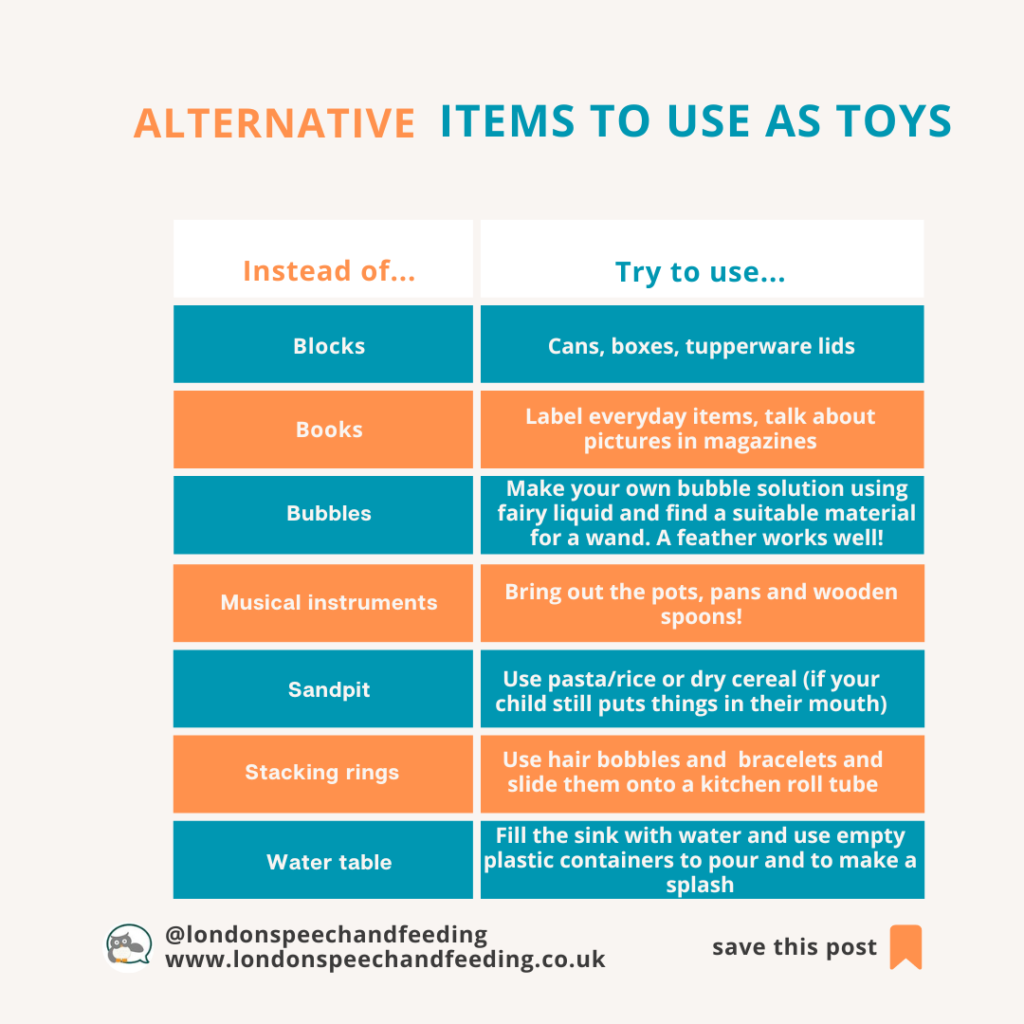
On holiday you are unlikely to have your usual games and toys with you – so here is a nice little list of things you can use instead of traditional games and toys:
If you can think of any other alternatives on holiday and would like to tell me about them, I would love to see your comments below. We can never have too many holiday games!!
If you are at home over the summer and you do have some games in the cupboard you might want to dust these ones down or buy one or two new ones (if you want to).
Most games have multiple uses, and it’s always best to adapt a game to match your child’s interests and what motivates them.
So let’s start…
Pop up pirate: pop a sword into the barrel and watch the pirate pop up randomly. Practise social skills, speech sounds, expressive language (e.g., put a sword on a picture, say the word/sentence then pick up the sword and push it into the barrel).
Word games such as ‘ISpy’, ‘I went to the shop and I bought…’, ‘describe a person and guess who they are’: perfect for when you’re on the move, whether travelling or walking. You can play this anywhere and still support speech, language and communication. You could play ISpy using your child’s special sound, or ‘I went to the shop and bought all things beginning with [insert special sound here]’.
Shopping list: Orchard game is a game to practise categorising. We explain the analogy of the brain being like a filing cabinet. If information is all in the correct place, it’s easier to find, retrieve and use. You can also practise specific speech sounds in this activity. You could also put the words in a sentence to add more of an expressive language element.
Wiggly worms: this Orchard game is all about phonological (awareness of sounds) awareness. Matching a letter with the word. You can also practise the sounds in the words (e.g, g-o-l-d = gold; m-a-ke = make). Talk about the elements, e.g., ‘g-o-l-d’ has 4 sounds, 1 syllable; ‘m-a-ke has 3 sounds, one syllable. You can talk about what words rhyme with the different words and what makes a rhyming word (i.e., the middle and end sounds remain the same).
Sound detectives: this Orchard game allows children to identify sounds. It also has an app (if your child prefers a tech-way of learning). Children identify the sound then they can add the picture card to their path and become closer to being a successful detective. This game can also support memory skills.
Conversation cubes: throw the dice and start building a story. You can also create and use ‘colourful semantics’ sentence strips to support expressive (spoken) language as support to build the narrative.
Think words: ‘name it, press it, pass it’. A great game to expand word knowledge. You can talk about the words at the end of each round exploring semantic (meanings) and phonemic (sounds) links. Your child can also develop social skills (such as attention, listening and turn-taking).
Poo bingo: this is perfectly disgusting but equally fun for kids of about 3.5 years plus – if your child’s target is to practise /p/ sound this is the one for you. You can also learn all about the different animal’s poo, which I am sure you have always wanted to do!! The more we know about a word, the easier it is to store, retrieve and use. Yes, even talking about poo can help!! Also, it’s great for our visual learners.
Simon says: a game that can be played indoors or outdoors. Parents can take turns being “Simon” and give various commands that your child must follow. This means that your child can practise their receptive (understanding of) language as well as their expressive language, speech sounds and social skills (such as turn-taking and initiating).
Ker-plunk: this is perfect for practising your child’s special sound. Repetition is very important, but also can be monotonous, so finding a game that they enjoy is vital. Take turns to pull out a stick. Next, your child can either say their special sound or word (depending on what stage they are at) or hear a good model from other players.
Find a speech and language therapist for your child in London. Are you concerned about your child’s speech, feeding or communication skills and don’t know where to turn? Please contact me and we can discuss how I can help you or visit my services page.
As a speech therapist, few things are as rewarding as helping a child find their clear, confident voice. Among the various speech sound disorders, the ‘lateral lisp’ – often described as a ‘slushy’ or ‘wet’ /S/ sound – presents a unique challenge. While it can be tricky to treat, I’m thrilled to share that I’ve had significant success in helping children overcome this particular hurdle.
What is a lateral lisp?
Most people are familiar with a frontal lisp, where the tongue protrudes between the front teeth, resulting in a /TH/ sound for an /S/ (e.g., ‘thun’ for ‘sun’). A lateral lisp, however, is different. Instead of the air escaping over the front of the tongue, it escapes over the sides, often giving the /S/ and /Z/ sounds a distinct, muffled, or ‘slushy’ quality. This happens because the tongue is not forming the correct central groove, allowing air to spill out laterally.
The science behind a perfect /S/ vs. a slushy one
To understand how to fix a lateral lisp, it’s helpful to understand how a ‘perfect’ /S/ sound is made. Imagine a narrow, focused stream of air. For a clear /S/ sound, your tongue forms a shallow groove down its centre, directing a precise, thin stream of air right down the middle, over the tip of your tongue, and out through a tiny opening between your tongue and the roof of your mouth, just behind your front teeth. This focused airflow creates that crisp, sharp /SSSS/ sound we recognise.
Now, picture what happens with a lateral lisp. Instead of that neat, central channel, the tongue is often flatter or positioned in a way that allows the air to escape over one or both sides. Think of it like a river overflowing its banks – the air, instead of flowing in a controlled stream, spills out sideways, creating that characteristic ‘slushy’ sound. This lateral airflow is what we need to retrain.
Why is it tricky to treat?
Treating a lateral lisp can be challenging for a few reasons:
Habitual muscle memory: The way the tongue moves and positions itself for a lateral lisp is deeply ingrained. It’s a motor habit that needs to be unlearned and replaced with a new, more precise movement.
Subtle differences: The difference between a lateral lisp and a correct /S/ sound can be quite subtle to perceive, both for the child and sometimes even for parents. This makes it harder for the child to self-monitor and correct.
Oral motor control: It requires fine motor control of the tongue muscles to create and maintain that central groove for airflow.
My success with children aged six years and over
I’ve found great success in treating lateral lisps, particularly with children aged six years and older. Why this age group? By this age, children typically have:
Increased awareness: They are more aware of their speech and often more motivated to make changes. They can better perceive the difference between their ‘slushy’ /S/ and a clear one.
Improved cognitive skills: They can understand and follow more complex instructions and strategies.
Better self-monitoring: Their ability to listen to themselves and correct their own speech improves significantly.
Enhanced oral motor control: Their fine motor skills, including those of the tongue, are more developed, allowing for greater precision.
My approach focuses on a combination of auditory discrimination, tactile cues, and targeted myofunctional exercises to help children ‘feel’ the correct airflow and tongue placement. We use a variety of engaging activities to make the process fun and effective.
It is crucial to understand tongue functioning and focusing on correcting improper oral resting posture and muscle function, which are often significant contributors to a lateral lisp. For example, if the tongue rests low and wide in the mouth consistently, or if there’s a tongue thrust during swallowing, these habits can prevent the tongue from achieving the precise, midline placement necessary for a clear /S/ or /Z/ sound. Through targeted exercises I aim to re-educate the oral and facial muscles, promoting correct tongue posture at rest, during swallowing, and, ultimately, during speech production. By strengthening the muscles responsible for tongue lifting and encouraging a more appropriate swallowing pattern we can establish the correct oral motor skills needed to overcome a lateral lisp and achieve clearer articulation.
The recipe for success: Little and often
The single most crucial ingredient for success in treating a lateral lisp is daily home practice of all the strategies given. This isn’t about long, arduous sessions; it’s about consistency. Think of it like building a muscle: short, frequent workouts yield better results than sporadic, intense ones.
My recommended formula is ‘little and often’. This means:
Short, focused sessions: Aim for 5-10 minutes of practice, 2-3 times a day. This prevents fatigue and keeps the child engaged.
Integrate into daily routines: Practise while waiting for dinner, during a car ride, or before bedtime. Make it a natural part of their day.
Positive reinforcement: Celebrate every small success! Encouragement goes a long way in building confidence and motivation.
Parental involvement: Parents play a vital role in providing consistent cues and encouragement at home. I equip families with clear, easy-to-follow strategies.
Overcoming a lateral lisp requires dedication, but with the right guidance and consistent practice, a clear, confident /S/ sound is achievable. If your child is struggling with a ‘slushy’ /S/, please don’t hesitate to reach out. Together, we can achieve success!
Sonja McGeachie
Highly Specialist Speech and Language Therapist
Owner of The London Speech and Feeding Practice.
Find a speech and language therapist for your child in London. Are you concerned about your child’s speech, feeding or communication skills and don’t know where to turn? Please contact me and we can discuss how I can help you or visit my services page.
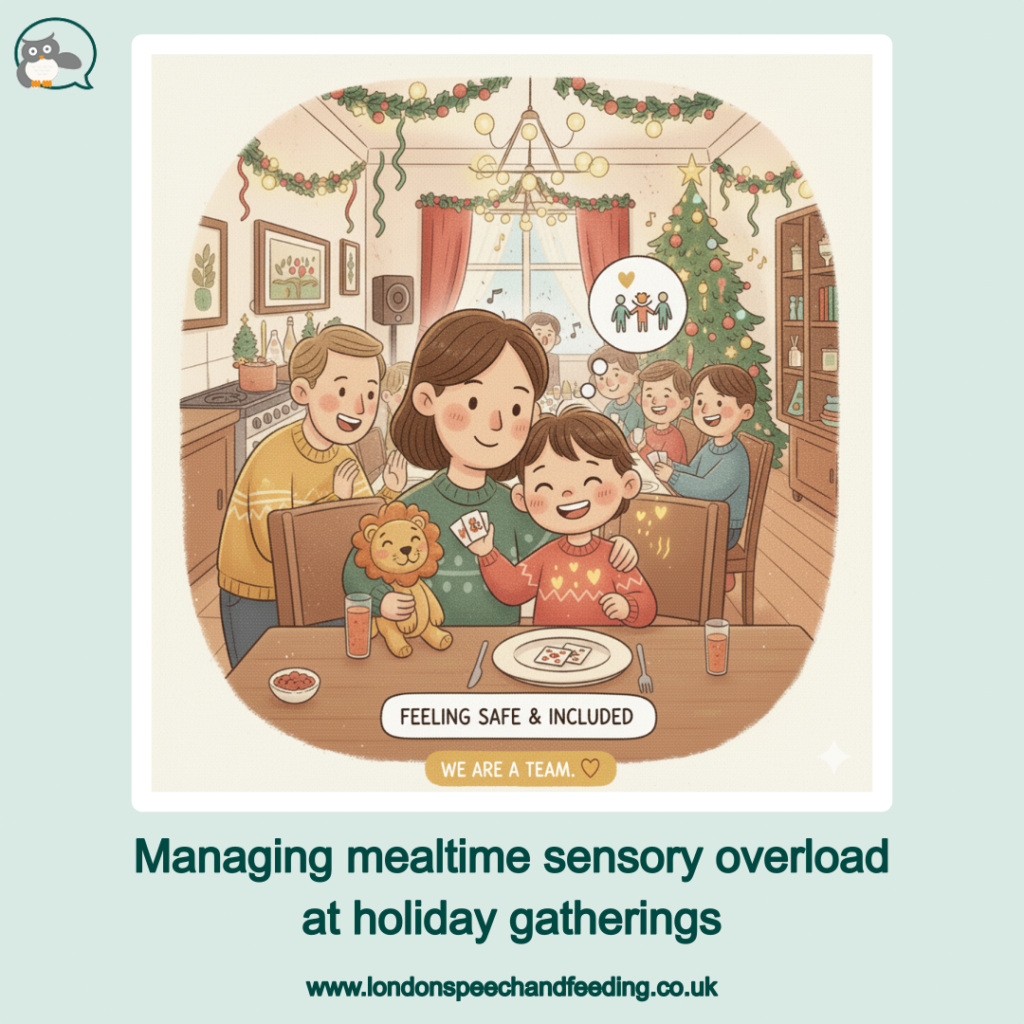
Holiday meals are meant to be joyful and something we all look forward to. But for many children and their families, these occasions can be overwhelming and be the cause of dread and worry. The combination of new smells, unfamiliar foods, loud environments, social expectations, and allergy anxieties can quickly turn what should be a festive time into a stressful one.
For parents of children with sensory processing differences, selective eating challenges, or food allergies, holiday gatherings often require careful planning and a big dose of tolerance and compassion. The good news is that with awareness and a few gentle strategies, you can support your child to feel safe, regulated, and included during festive meals without pressure, tears, or discomfort.
Let’s explore how to make holiday mealtimes calmer, safer, and more connected this season.
🎄 Why holiday meals feel so overwhelming
Holiday gatherings usually combine several sensory triggers all at once:
Noisy, chaotic rooms
Strong smells from a mix of foods we don’t normally cook
Expectations to ‘try everything’ or ‘enjoy it’s sooo good!’
New environments, seating arrangements, or routines
For children with sensory sensitivities, this can feel like a tidal wave of input. Research shows that children who are sensory-sensitive often have heightened responses to smell, taste, and texture, which may lead to avoidance or distress at mealtimes (Cermak, Curtin, & Bandini, 2010).
Add food allergies into the picture and anxiety increases even further for both children and parents. A 2020 study by DunnGalvin et al. found that children with food allergies experience significantly higher stress in shared eating environments, especially when food preparation or contamination risk is hard to control.
So, if your child becomes tearful, shuts down, or refuses to sit at the festive table, it isn’t ‘bad behaviour.’ It’s sensory overload, heightened vigilance, or discomfort communicating through their body.
🌟 Preparing your child for a calmer festive meal
Preparation is especially important for sensory-sensitive or allergy-aware children. Here’s how to set them up for success:
1. Offer predictability through previewing
Before the event, show your child pictures of:
where you’re going
who will be there
the types of foods that might be served
where they might sit
A visual schedule or social story can help reduce anxiety and give your child a sense of control.
2. Pack safe foods without apology
If your child has allergies or selective eating, bring:
‘Safe foods’ you know they will eat
Backup snacks
A separate (their own) plate, if needed
Emergency medication
Announce clear, firm boundaries such as:
‘Ok people, these are Jamie’s safe foods — we’ll stick with these today.’ This will help relatives understand without pressure or judgement.
3. Choose seating that supports sensory regulation
If possible, seat your child:
at the end of the table
near a familiar adult
away from the kitchen (strong smells)
away from noise clusters
give them their favourite toy or fidget whilst waiting
Let them take breaks when needed. This isn’t ‘rude,’ it’s self-regulation.
🍽️ Supporting children during the meal
1. Focus on connection, not consumption
The holidays are not the time to expand your child’s food range. Keeping mealtimes low-pressure actually supports long-term progress.
In fact, the research is clear: pressuring children to eat decreases acceptance and increases refusal (Galloway et al., 2006).
So instead of ‘Just try it!’ try:
‘You don’t have to eat it, you can look at it.’
‘You’re in charge of what goes in your mouth.’
‘You can keep your safe foods on your plate.’
2. Protect your child’s allergy safety
Holiday meals often include:
cross-contamination risks
shared utensils
buffets
homemade dishes without ingredient lists
Use gentle but firm scripts:
‘Because of Ellie’s allergies, we’ll keep her plate separate.’
‘We’ll serve her food ourselves to make sure she stays safe.’
Confidence in your boundary helps others respect it.
3. Manage sensory load in real time
Offer:
headphones
a small chew or fidget toy
a designated ‘calm corner’
time outside for fresh air
a predictable signal for breaks (e.g., a hand squeeze or card)
Remember, sensory regulation is healthcare, not ‘giving in.’
4. Model calm eating
Children learn most from watching.
Slow, happy bites and relaxed facial expressions tell the nervous system: ‘This environment is safe’.
💛 What to say to well-meaning relatives
Families often have big feelings about food. You can prepare nice phrases like:
‘We’re focusing on helping him feel safe around food today.’
‘She has allergies, so we’re sticking to our plan.’
‘We’re avoiding pressure because it helps him eat better long term.’
‘We’re celebrating together, eating is not the goal today.’
Setting expectations ahead of time can reduce awkward moments later.
🎁 The bigger picture: It’s about safety, not ‘picky eating’
Children with allergies, sensory differences, or feeding challenges aren’t trying to be difficult. They are trying to stay safe, regulated, and comfortable.
Your calm presence, gentle boundaries, and preparation create the conditions for a holiday that feels peaceful, not pressured.
Sonja McGeachie
Highly Specialist Speech and Language Therapist
Owner of The London Speech and Feeding Practice.
Find a speech and language therapist for your child in London. Are you concerned about your child’s speech, feeding or communication skills and don’t know where to turn? Please contact me and we can discuss how I can help you or visit my services page.
As parents and caregivers, our natural instinct when interacting with a child, especially one who struggles with communication, is often to fill every silence. We might ask lots of questions, offer constant commentary, or try to prompt him or her to speak. Our hearts are in the right place. We want to help him or her communicate! However, for children with language delays or those on the autism spectrum, this well-intentioned approach can sometimes inadvertently create more pressure and fewer opportunities for them to truly initiate and develop their own communication skills.
What if I told you that one of the most powerful tools in your communication toolkit is often silence? And that responding to your child, rather than always initiating, can unlock incredible potential?
Let’s explore why these seemingly simple strategies are so profoundly beneficial.
The unspoken benefits of silence
In our fast-paced world, silence can feel awkward, but for a child who is processing language differently, it’s a gift:
Time to process: Children with language delays often need more time to process what they hear and to formulate their own thoughts or responses. When we bombard them with words, we don’t give their brains the crucial milliseconds they need to catch up. A pause of 5–10 seconds can make all the difference.
Reduces pressure: Constant questioning or prompting can feel like a test. Silence removes this pressure, creating a more relaxed environment where the child feels safe to communicate without fear of being ‘wrong’ or rushed.
Creates opportunity to initiate: If you’re always talking, when does your child get a turn to start the conversation? Silence opens up a space for him or her to initiate, whether it’s through a sound, a gesture, eye contact, or a word. This is vital for developing spontaneous communication.
Encourages independent thinking: When a child is given space, he or she is more likely to try to figure things out himself or herself. This fosters problem-solving skills and reduces reliance on adult prompts.
Prevents overwhelm (especially for ASD): Many children on the autism spectrum can be sensitive to auditory input. A constant stream of language can be overwhelming, leading to withdrawal or challenging behaviours. Strategic pauses can help them regulate and engage more effectively.
The power of responding (not just initiating)
Think of a tennis match: if only one person serves, it’s not a game. Communication is a rally, a back-and-forth exchange. When you primarily respond to your child’s communication attempts, you’re teaching him or her the rhythm of conversation:
Follow the child’s lead: This is a cornerstone of effective language intervention, famously championed by programs like Hanen’s ‘It Takes Two to Talk’. When you respond to what your child is already interested in or doing, the interaction becomes immediately relevant and motivating for him or her.
Validates his or her attempts: Every sound, gesture, glance, or partial word your child offers is a communication attempt. By responding to it, you’re telling him or her, ‘I see you. I hear you. Your communication matters.’ This builds immense confidence and encourages him or her to try again.
Builds confidence and motivation: When a child feels understood and successful in his or her communication, he or she are more likely to communicate more often. It’s a positive feedback loop.
Teaches turn-taking naturally: By taking your turn after his or hers, you model the natural flow of conversation. He or she learns that communication is a shared activity, not a one-sided lecture.
Makes interactions meaningful: When you respond to his or her interests, you’re talking about things that are inherently motivating to him or her. This makes the language you use more easily understood and remembered.
Practical strategies for parents: Observe, Wait, Listen (OWL)
Observe: Watch your child closely. What is he or she looking at? What is he or she doing? What sounds is he or she making? What gestures is he or she using?
Wait: After you’ve observed, wait. Give him or her time. Resist the urge to jump in with a question or comment immediately. Count to five (or even ten) in your head. This silence is an invitation for him or her to communicate.
Listen: When he or she does communicate (in any way!), listen intently. Try to understand his or her message or intent.
Beyond OWL – More tips:
Reduce questions, increase comments: Instead of ‘What’s that?’ try ‘Oh, a big red ball!’ or ‘The car is going fast!’ Comments provide language models without demanding a verbal response.
Expand, don’t just prompt: If your child says ‘Car’, you could respond with ‘Yes, That’s a big car!’ or ‘It’s really fast!’ You’re building on his or her communication with a slightly richer language model.
Create opportunities for communication: Place desired items slightly out of reach. This creates a natural reason for your child to communicate his or her wants (e.g., reaching, pointing, vocalising).
Respond to all communication: Don’t just wait for words. If your child points, look where he or she is pointing and comment. If he or she makes a sound, imitate it or respond with a related word.
In summary
Embracing silence and prioritising responsiveness might feel counterintuitive at first, especially when you’re eager for your child to talk. However, these powerful strategies create a nurturing, low-pressure environment that encourages spontaneous communication, builds confidence, and truly meets your child where he or she is. By giving your child the space and the meaningful responses he or she needs, you’re laying a strong foundation for his or her communication journey.
Try incorporating these ‘quiet powers’ into your daily interactions and watch your child’s communication blossom.
Sonja McGeachie
Highly Specialist Speech and Language Therapist
Owner of The London Speech and Feeding Practice.
Find a speech and language therapist for your child in London. Are you concerned about your child’s speech, feeding or communication skills and don’t know where to turn? Please contact me and we can discuss how I can help you or visit my services page.
Playtime! It’s a magic time for exploration, learning, and connection.
If your child is struggling to use words with his/her mouth, we can always use a robust Augmentative and Alternative Communication (AAC) device to help find their words. We know that using such a device does never stop or delay children to speak with their mouths. On the contrary it helps, enormously!
Can playtime still be a blast? Absolutely! In fact, incorporating AAC into play can be a powerful way to boost communication skills, build confidence, and create a truly inclusive play experience. Here’s how to make it happen, with a focus on core words and core scripts for our GLP’s (the building blocks of communication used by everyone). In this video I am using the core word ‘IN’ and ‘MORE’.
The Magic of Core Words
Core words are the most frequently used words in everyday communication. They might be verbs like ‘want’, ‘more’, ‘go’, or ‘stop’, or adjectives like ‘happy’, ‘sad’, and ‘hot’. These words are the foundation for building sentences and expressing needs and desires. They’re perfect for children using AAC because they’re simple to understand and use.
Let’s Play! Here’s How
1. Choose Your AAC System
Many options exist! It could be a low-tech picture board with core words, such as the one you see pasted on my cabinet door in the background, or it can be a dedicated AAC app on your tablet. Here I am using the GRID app but I also love using others, such as LAMP Words for Life.
2. Make it Fun and Functional
No pressure! Integrate your AAC system seamlessly into your play routine. Here are some ideas:
Car/trains: Use core words to describe what the cars are doing: (‘down’, ‘go’, ‘stop’, ‘again’ ‘fast’ ‘slow’).
Dress-up: Use core words to choose clothes (‘want’, ‘hat’, ‘shoes’).
Tea Party: Use core words to ask for and share (‘more’, ‘juice’, ‘give’).
Building Blocks: Use core words to describe what you’re building (‘tall’, ‘big’, ‘house’).
Dolls/Stuffed Animals: Use core words to act out scenarios (‘sleep’, ‘eat’, ‘cry’).
Arts and Crafts: Use core words to describe colours (‘red’, ‘blue’), actions (‘draw’, ‘paint’), and feelings (‘happy’, ‘sad’).
If your child is a Gestalt Language Processor you will want to model meaningful, fun scripts instead of single words! As above, but use phrases:
Car/trains: Use scripts to describe what the cars are doing: (‘it’s going down’, ‘let’s go’, ‘make it stop’, ‘want it again’, ‘that was fast’, ‘it’s so slow’).
Dress-up: Use scripts to choose clothes (‘I’m gonna wear this’ ‘that’s a lovely hat’, ‘let’s choose shoes’).
Tea Party: Use scripts to ask for and share (‘I want more’, ‘more juice’, ‘give me this’).
Building Blocks: Use scripts to describe what you’re building (‘a tall one’, ‘that’s so big’, ‘it’s a house’).
Dolls/Stuffed Animals: Use scripts to act out scenarios (‘it’s time to sleep’, ‘let’s eat’, ‘he’s crying’).
Arts and Crafts: Use scripts to describe colours (‘a red crayon’), actions (‘let’s draw’, ‘I’m gonna paint’), and feelings (‘I’m happy’, ‘that’s so sad’).
3. Model, Model, Model
This is key! As you play, constantly model using your child’s AAC system.
Point to the picture or word or script you’re using.
Speak clearly and slowly while pointing.
When using core words for either Analytical or Gestalt Language Processors, try using good phrases. For example, instead of just saying ‘juice’, say, ‘you want more juice?’
4. Make it a Team Effort
Get everyone involved! Encourage siblings, grandparents, and caregivers to use the AAC system with your child during playtime. The more consistent the approach, the faster your child will learn and feel confident using their voice.
5. Celebrate Progress, Big and Small!
Every step counts! Acknowledge and celebrate your child’s efforts, whether it’s reaching for their AAC system or successfully using a core word. This positive reinforcement will keep them motivated.
Remember
Playtime should be fun, not stressful. Don’t force your child to use their AAC system. Let them lead the way and follow their interests.
Every child develops at their own pace. Celebrate your child’s unique communication journey.
Seek professional help when needed. Your SLT can provide tailored strategies and resources to support your child’s development.
By incorporating AAC and core words into playtime, you’re not just fostering communication; you’re creating a space for your child to thrive, explore, and build strong connections.
So, grab those toys, power up your AAC system, and get ready for a playtime adventure filled with fun, connection and, therefore, communication!
Feeding and Dysphagia (Swallowing) Specialist The London Speech and Feeding Practice
The London Speech and Feeding Practice
Find a speech and language therapist for your child in London. Are you concerned about your child’s speech, feeding or communication skills and don’t know where to turn? Please contact me and we can discuss how I can help you or visit my services page.