Joint attention for children with autism

|
Kids Speech Therapist London

Why is joint engagement important for communication development?

It has been well-documented that the development of joint attention is impaired in children who have social communication difficulties or autism. It is, in fact, this impairment which distinguishes children with ASD from children who have other developmental delays.

A lack of joint attention in very young children is an early sign of autism as it is a signal that there is a disruption in the motivation to connect socially with others. Since this is a crucial element, I thought I would outline what we mean by Joint Attention as supported by the research undertaken at Hanen.org.

In typically developing children, the ability to shift attention between a person and an object for the purposes of connecting socially or for requesting develops around the same time. However, for children with ASD, these components emerge one at a time and in a linear fashion. Children with ASD usually start with requesting something and later they may learn to share attention for social sharing. (see pattern below as a general guide).

As with typical development, there is variation in the order that these skills emerge but the following patterns of development is commonly seen:

  • Reaching, taking adult’s arm/hand or pointing to ask for something — but without looking at the adult
  • Gradually alternating looking between person and object of desire
  • Then learning to follow the point of another — which is responding to joint attention initiated by another
  • Directing attention to share interests — without looking at the adult: pointing to a truck on the road/ helicopter circling above
  • Then directing attention to share interest by alternating gaze shift between person and object — here the child is now initiating joint attention.

What is important to note is that in order to fulfil the criteria for true joint attention, the purpose of directing the attention of another person must be social in nature. In other words, it must not be exclusively to obtain a desirable object or event/action. True Joint Attention is seen verbally or non-verbally; we want to share a thought with another person and direct them to something we are interested or excited or spooked by.

For example: we can see an amazing firework display in the distance and we want to quickly direct our friend’s attention to this. In order to do this we might be tugging their sleeve/arm whilst pointing to the display in the distance, and perhaps we might add “wow look over there!” We are doing so simply to share an interest without obtaining anything, we are just being social with each other. So True Joint Attention is not just looking at what we want to have, then look at the person who can get this for us and then point to the item. We can say that this is the precursor to true joint attention, which is purely social in nature.

Because true joint attention is an essential precursor to typical language development, the absence of joint attention in children with ASD contributes to difficulties with language learning. Beuker, K., Rommelse, N., Donders, R. & Buitelaar, J. (2013).

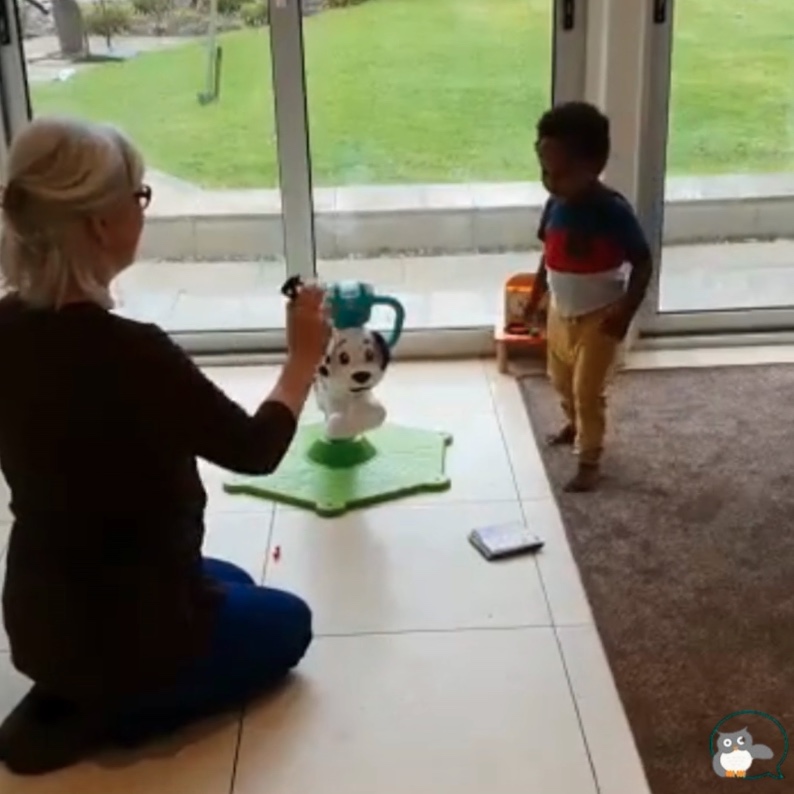
The Hanen programme for Parent Child Interaction teaches parents of children with Social Communication Difficulties step by step how to enable their children to learn to pay attention to an object and the parent at the same time.

We learn how to enable a child to:

  • engage take turns
  • shift eye gaze between toy and adult
  • copy adult’s actions, gestures and then words
  • play with toys in different, new ways
  • interact and for longer periods of time
  • have fun whilst playing

If you would like to know more about the Hanen programme please get in touch. I look forward to exploring the topic with you and help guide you forward if this is something your child is struggling with.


Find a speech and language therapist for your child in London. Are you concerned about your child’s speech, feeding or communication skills and don’t know where to turn? Please contact me and we can discuss how I can help you or visit my services page.
Similar Posts

  • · · ·

    The purpose and nature of a speech and language therapy assessment

    If you have ever wondered what happens when you bring your child to a speech and language therapy assessment, then this blog will shed light on the ins and outs of it for you.

    At its heart, a speech and language therapy assessment is a systematic and thorough evaluation of your child’s communication or eating/swallowing abilities. It’s more than just asking a few questions. It is a carefully constructed process designed to identify strengths, pinpoint challenges, and ultimately pave the way for effective intervention.

    Establishing a detailed profile – a few bullet points:

    • Identification of communication and swallowing difficulties: I aim to determine if a communication or swallowing disorder exists. I will establish if the difficulty is a delay or a more complex disorder.
    • Diagnosis of the specific disorder/autism: The assessment delves deeper to pinpoint the specific type and nature of the difficulty. For instance, is your child’s language delay due to a specific learning disability, a developmental delay, or another underlying condition?
    • Knowing the aetiology or what is causing a difficulty is crucial for targeted intervention. And whilst we are on the topic let’s talk about an autism assessment: I am trained and experienced in assessing and diagnosing autism. However, when it comes to the diagnosis of autism I provide a preliminary ‘working hypothesis’ rather than giving a definite final diagnosis. The reason for this is that it is considered the ‘gold standard’ and ‘best practice’ to diagnose autism in a multi-disciplinary setting and context. Since I work on my own, I always refer to highly recommended multi-disciplinary clinics for the ultimate diagnostic assessment.
    • Determination of severity: Understanding the severity of the difficulty is essential for prioritising intervention and measuring progress. Is your child’s difficulty mild, moderate, or severe? This helps me choose a particular approach and then tailor it to suit each individual child.
    • Identification of underlying strengths and weaknesses: An assessment doesn’t just focus on what’s wrong. It also highlights your child’s strengths and areas of relative ease. This information is invaluable for building upon existing skills during therapy. Understanding weaknesses provides specific targets for intervention.
    • Guiding intervention planning: The assessment provides the crucial information I need to develop an individualised intervention plan. The findings directly inform the selection of therapy goals, strategies, and techniques. Without a thorough assessment, therapy would be a shot in the dark.

    A multi-faceted approach

    A speech and language therapy assessment is not a ‘one-size-fits-all’ procedure. The specific tools and techniques used will vary depending on a child’s age, the nature of the suspected difficulty, and other relevant factors. However, most comprehensive assessments incorporate several key components:

    • Case history: This involves gathering information about your child’s developmental, medical, social, and educational background. We will go through all the relevant milestones and throughout the process I will make notes which will help bring all the puzzle pieces together.
    • Observation: I will observe how parent and child play together and we also look at how the child plays by themselves. Additionally of interest is how a child plays with me, the therapist. Through discussion I will also endeavour to find out how your child plays with other children, be it at the nursery or within the family.
    • Standardised assessments: These are commercially available tests with specific administration and scoring procedures. They provide norm-referenced data, allowing to compare the individual child’s performance to that of his or her peers. Examples include articulation tests, language comprehension and production tests, and fluency assessments. I tend not to use these assessments a lot.
    • Instead, I use non-standardised assessments: These are more flexible and allow to probe specific areas of concern in more detail. This might include language samples (analysing spontaneous speech), dynamic assessment (testing and teaching to identify learning potential), and informal observation of play or interaction.
    • Immediate feedback and report writing: During and thenfollowing the assessment, I will bring all the gathered information together and I will discuss with the parents what my findings are and what my recommendations in the short term are. Parents always go home with a good handful of useful strategies that they can implement at home right away. In addition, I provide a comprehensive report outlining the findings, diagnosis (if applicable), severity, strengths and weaknesses, and recommendations for intervention.

    In conclusion, a speech and language therapy assessment is a dynamic and essential process. It is a journey of discovery, aiming to understand a child and the child’s family and his or her unique communication or feeding profile. The assessment is usually the start of our wonderful learning journey together.

    Below is a short video clip of an assessment where you see me in action explaining a particular therapy approach to a set of parents. It perhaps shows a tiny bit of how relaxed we are in our sessions and that assessment is not at all daunting, but a hugely informative event overall which will leave you feeling empowered and hopeful.

    What happens after an assessment?

    Please feel free to get in touch with me via my contact form if you wish to have an assessment for your child’s communication difficulties or feeding difficulties.

    An assessment is always a stand-alone event and does not mean you need to automatically book follow up sessions at all. It will give a lot of information and based on this you can decide if you would like more therapy or follow up for you and your child. Many times ongoing therapy is not needed! I only recommend a course of therapy if it is really needed and where it would be immediately beneficial for your child.

    Sonja McGeachie

    Highly Specialist Speech and Language Therapist

    Owner of The London Speech and Feeding Practice.


    Health Professions Council registered
    Royal College of Speech & Language Therapists Member
    Member of ASLTIP

    Find a speech and language therapist for your child in London. Are you concerned about your child’s speech, feeding or communication skills and don’t know where to turn? Please contact me and we can discuss how I can help you or visit my services page.

    1
  • · ·

    Halloween without the tears: Supporting children through the Spooky Season

    For many families, Halloween is an exciting time filled with costumes, decorations, and sweets. But for children who are sensory sensitive, whether they’re autistic, have sensory processing differences, or simply find new experiences overwhelming, Halloween can feel like a night of chaos rather than fun.

    The bright lights, unexpected noises, strange textures, and social pressure to ‘join in’ can quickly become too much. The good news? With some thoughtful planning and gentle support, you can make Halloween a positive and manageable experience for your child.

    Understanding sensory overload

    Sensory overload happens when a child’s brain receives more sensory input than it can process. This might mean:

    • Costumes that itch, squeeze, or feel strange on the skin.
    • Loud sounds like doorbells, fireworks, or shrieking decorations.
    • Crowds and unpredictability during trick-or-treating.
    • Strong smells or tastes from face paint or unfamiliar sweets.

    When overloaded, children may cry, cover their ears, hide, run away, or ‘shut down.’ These reactions aren’t ‘bad behaviour’, they’re signs of distress. The goal isn’t to eliminate Halloween fun, but to adjust it to your child’s comfort level.

    Step 1: Choose costumes wisely

    Costumes are often the biggest trigger. Scratchy fabrics, tight seams, or masks that restrict breathing can be unbearable for some children.

    Try these tips:

    • Go sensory-friendly: Use soft, breathable fabrics and remove tags. Many retailers now sell sensory-safe costumes.
    • Test it early: Let your child wear the outfit around the house before Halloween. If it’s too much, simplify — maybe themed pyjamas or a favourite T-shirt with Halloween accessories.
    • Skip the mask: Face paint can be equally challenging, always test on a small patch of skin first. A comfortable headband or hat might be enough to feel ‘in costume.’

    Remember, participation doesn’t require perfection. Your child can still ‘be’ their favourite character without a full costume.

    Step 2: Plan your Halloween environment

    Before the big day, think about what parts of Halloween your child enjoys — and what might overwhelm them.

    At home:

    • Keep decorations minimal and predictable. Avoid motion-activated sounds or flashing lights.
    • Practise knocking at your own front door or saying ‘trick or treat’ with a trusted adult.
    • Have a ‘quiet space’ ready, a cosy corner or room where your child can retreat if things get too intense.

    If you’re going out:

    • Choose earlier, quieter times for trick-or-treating.
    • Visit a few familiar houses instead of the whole street.
    • Bring ear defenders or noise-cancelling headphones.
    • Have a clear exit plan if your child needs a break.

    Sometimes, watching from the window and handing out sweets can be just as enjoyable! it still offers social participation without sensory overload.

    Step 3: Prepare socially and emotionally

    Halloween involves a lot of unexpected social interaction: strangers at the door, unfamiliar greetings, and different rules.

    Help your child by:

    • Using visuals or stories: Read picture books about Halloween or make a short social story about what will happen.
    • Role-playing: Practise saying ‘Trick or treat!’ or handing out sweets in a fun, low-pressure way.
    • Labelling feelings: Explain that it’s okay to feel nervous or to take a break if something feels ‘too loud’ or ‘too much.’

    Children feel safer when they know what to expect. Predictability reduces anxiety and makes participation more enjoyable.

    Step 4: Rethink the treats

    Not every child enjoys sweets; some dislike sticky textures or strong flavours. Offer non-food alternatives like stickers, glow sticks, or small toys.

    If your child has feeding difficulties or oral sensitivities, it’s okay to opt out of the traditional treats entirely. They can still join in by giving treats or decorating treat bags instead.

    It’s also helpful to prepare your child that others might offer sweets they don’t want. Practising polite ‘no thank you’ responses can make these moments easier. (check out my symbol download for children who struggle to speak)

    Step 5: Celebrate your way

    Halloween doesn’t have to look like anyone else’s version. Maybe your family watches a ‘not-too-scary’ film, carves pumpkins, or does a flashlight treasure hunt indoors. The goal is joyful connection, not conformity.

    A calm, happy experience, even if it looks simple from the outside builds positive associations your child will carry into future celebrations.

    In summary

    Halloween can be full of sensory surprises, but with empathy, planning, and flexibility, it doesn’t have to end in tears.

    The more you adapt to your child’s sensory needs, the more they learn that they are safe, understood, and included not just at Halloween, but in every celebration.

    As with all things in speech and feeding development, progress starts with connection. When children feel regulated and supported, communication and confidence follow.

    Sonja McGeachie

    Highly Specialist Speech and Language Therapist

    Owner of The London Speech and Feeding Practice.


    Health Professions Council registered
    Royal College of Speech & Language Therapists Member
    Member of ASLTIP

    Find a speech and language therapist for your child in London. Are you concerned about your child’s speech, feeding or communication skills and don’t know where to turn? Please contact me and we can discuss how I can help you or visit my services page.

    2
  • ·

    Why Imitation is so Important

    Target Activities and Games For Kids

    Why imitation is so important and how can speech and language therapy help children who struggle to imitate?

    Imitation or copying starts in early infancy. When we observe a young baby and his parent or familiar adult we can see clearly and frequently that the baby will be intently looking at adult’s face and try to copy their facial expressions, smiles and all those funny baby sounds we often make with young babies.

    These sounds are called “motherese” and are the beginnings of a little conversation between the parent and the baby. The “conversation can go back and forth for a long time and include sounds, as well as facial expressions.

    A little later on, once the baby can crawl and sit up unaided the copying then goes on to include toys and objects. Mum or Dad will show their toddler how to use a drum or how to put a little train on the wooden tracks and the toddler will try and copy this. They may not succeed and be a little clumsy perhaps but the act of copying anything and everything their favourite adult does is typically seen throughout the day.

    We all know and have laughed at mums or dads saying; ssshhh don’t say that in front of the baby he/she will copy you, watch your mouth! (as dad is swearing at the broken radiator….)

    This imitation goes on for years and includes eventually of course little words, more words, putting words together and then creating sentences, all the while our toddler is listening to how their adults speak, not only what they say but how they say it. This is how dialects and accents can be transmitted easily from parent /family to child.

    Copying in Children with Autism

    We know that children with autism often struggle to imitate. We see children on the spectrum typically having great difficulty to copy adults or children; this can be seen in very reduced play with their peers in nursery for example.

    Children with autism tend to have reduced joint attention and engagement with others and need to develop the ability and awareness to copy others in order to then engage more jointly with others.

    Speech and Language Therapy can help with Parent Child Interaction work and Coaching, here is how:

    During my coaching work with parents I teach step by step how to help a child who struggles to imitate:

    We look at all the researched skills and actions that adults can take to help their little one to copy, starting with close observation of their child’s interests, then following and including their child’s play and copying/imitating their child in how they play. I teach steps in a graduated way so that it is easy to see the progress and joyful to have the results at the end.

    The results are clear to see over time: our children on the spectrum learn to imitate actions, with objects and gestures, then sounds and words. Alongside this increased imitation skill the child can then develop more joint attention and engagement.

    I would always recommend Parent Child Interaction Training as a first port of call as we learn so many great techniques which are well researched by the Hanen Programme, www.hanen.org. Do drop me a line if you would like to find out more.


    Find a speech and language therapist for your child in London. Are you concerned about your child’s speech, feeding or communication skills and don’t know where to turn? Please contact me and we can discuss how I can help you or visit my services page.

  • · ·

    How can we support babbling and early speech development? SLT tricks and tips

    My baby isn’t babbling and developing speech – what can I do to support?

    While every baby develops at their own pace, if your child isn’t babbling by nine months, it’s worth seeking help from an Early Intervention Health Professional, such as a doctor and a speech therapist. Don’t panic! There are many reasons for delayed babbling, and early intervention is key.

    In the meantime, it is highly recommended that we talk, sing, and read to our baby often. Exaggerate sounds and expressions, and respond to their coos and smiles. This playful interaction helps stimulate their communication skills.

    Below are some tips and tricks from my experience of working with babies and toddlers who need a little bit of help and support to develop.

    The benefits of imitating your baby

    Copying your baby’s sounds and gestures isn’t just silly fun, it’s a powerful learning tool! By mimicking their babbles and actions, you activate “mirror neurons” in their brain that help them connect sounds with meaning. This playful back-and-forth teaches turn-taking, a foundation for conversation. Plus, it encourages them to copy you, building their own language skills and social interaction abilities.

    This is a nice clip on youtube showing how copying/imitating your baby looks like:

    Here are some fun ways to imitate your baby:

    • Matchmaker: Grab two of the same, or two similar toys your child loves, like rainmakers or shakers. Give one to your baby and keep the other for yourself. When your child plays with his/her toy, mirror his/her actions with yours! This creates a fun, interactive game.
    • Face Time: Get down to your baby’s level, sitting opposite him/her on the floor or kneeling. This makes eye contact easy and encourages him/her to look at you during your playful imitation.
    • Be the Funniest You: Go all out with silly faces, exaggerated sounds, and big gestures. The goal is to capture your baby’s attention and make you irresistible to watch. This playful energy encourages him/her to interact and potentially imitate you back!

    By incorporating these tips, you can turn imitation into a fun and engaging way to boost your baby’s communication skills. I have seen this happen numerous times over the past decades. It is very powerful, go ahead and try it! You cannot be silly and goofy enough!

    Great toy ideas:

    Did you know that speech and language development starts with how we talk to our babies?

    Adults naturally use a special way of speaking called motherese. It involves a higher pitch, slower pace, and exaggerated sounds compared to regular conversation. Sentences are simpler, with shorter words and repetition. This grabs babies’ attention, helps them distinguish sounds, and reinforces word meaning.

    Imitation is a key part of motherese. We wait for our baby to make a sound or gesture, then playfully imitate it with exaggeration. Babies notice this right away and often respond with more vocalisations, creating a mini conversation. This back-and-forth teaches turn-taking, a foundation for future conversations.

    By responding warmly and engaging in these playful interactions, we encourage our babies to keep exploring the world of communication. Talking, singing, reading and, of course, imitating, these simple actions can have a big impact on a baby’s language development.

    Once your conversation is underway then try and keep it going for as long as possible. It’s a beautiful dance of turn-taking, even without words!

    A last word on oxytocin

    There’s evidence suggesting early non-verbal communication with your baby can increase a mother’s oxytocin levels, often called the ‘love hormone’. This hormone plays a key role in bonding and social connection. Positive interactions, touch, and stress reduction all contribute to oxytocin release, strengthening the mother–baby bond.

    For parents of babies with extra needs

    The stress of caring for a child with medical needs or developmental delays can be difficult. Stress can lower oxytocin levels, creating a cycle of sadness for both parent and child.

    Breaking the cycle:

    1. Knowledge is Power: Understanding the importance of communication can empower parents.
    2. Seek Support: Speech therapists and other healthcare professionals can provide valuable guidance on communication strategies.
    3. Start Small, Celebrate Big: Even small interactions can boost oxytocin. Focus on playful imitation and positive reinforcement. Remember, friends, family and healthcare professionals are there to encourage you.

    This approach can help reverse the negative cycle and create a more positive and connected relationship between parent and child.

    I hope this is helpful! Don’t hesitate to reach out with any questions.

    Kind regards

    Sonja McGeachie

    Early Intervention Speech and Language Therapist

    Feeding and Dysphagia (Swallowing) Specialist The London Speech and Feeding Practice

    The London Speech and Feeding Practice


    Find a speech and language therapist for your child in London. Are you concerned about your child’s speech, feeding or communication skills and don’t know where to turn? Please contact me and we can discuss how I can help you or visit my services page.
    2
  • · ·

    Childhood Apraxia of Speech: Signs and first steps (2–5 years)

    If you’ve found yourself wondering ‘Why can my child say a word one day, but not at all the next?’ it might be that your child has a motor speech difficulty. This means the challenge isn’t that your child doesn’t know what they want to say; it’s that their brain finds it harder to plan and coordinate the movements needed for clear speech. This speech difficulty is called Childhood Apraxia of Speech (CAS)

    Sonja showing power words on a board

    In this post, I’ll explain what CAS can look like in 2–5 year olds, what an assessment usually involves, and what you can start doing at home to support your child without turning life into ‘speech homework all day long’.

    What is childhood apraxia of speech (CAS)?

    Children with CAS often have lots to communicate about (and strong ideas!) but their speech may come out as:

    • Unclear
    • inconsistent
    • hard to ‘copy’ on demand
    • frustrating for them and for you

    CAS is not caused by laziness and it is not a parenting issue. It is also not something children simply ‘grow out of’ without support. But with the right therapy approach, children can absolutely build clearer speech over time.

    If you’d like to read more about verbal dyspraxia, you may also find this helpful: Supporting children and families living with verbal dyspraxia.

    Why is CAS such a big topic right now?

    Many families come to me after months (or years) of being told:

    • ‘She’ll talk when she is ready’
    • ‘He’s just shy’
    • ‘It’s probably a speech delay’
    • ‘It’s normal for toddlers’

    And sometimes it is a general delay. But sometimes it’s something more specific, like CAS.

    There’s also been a huge rise in parents seeking information online, and CAS is often mentioned alongside speech sound difficulties such as:

    • phonological delay (pattern-based speech errors)
    • articulation difficulties (one sound that won’t come out clearly)
    • inconsistent speech disorder

    These can look similar at first glance, which is why a specialist assessment matters.

    Signs of childhood apraxia of speech in 2–5 year olds

    Children develop speech at different rates, and not every unclear speaker has CAS. But here are some common features that may raise a flag, especially when you notice several together.

    1) Inconsistent speech errors

    Your child might say the same word in different ways:

    • ‘banana’ → nana / baba / mana
    • ‘daddy’ → gaga / daddy / dadi

    This inconsistency is one of the biggest clues.

    2) Difficulty copying words on request

    Some children speak more easily in natural play, but when asked ‘Say ___’, they freeze or the word becomes much harder.

    3) Limited sound repertoire

    They may use only a small set of consonants (like /M/, /N/, /B/, /D/) and avoid others.

    4) Vowel distortions

    Many children with typical delays mainly struggle with consonants. But in CAS, vowels can also sound ‘off’ or change between attempts.

    5) Speech that sounds effortful

    You might notice your child:

    • pauses between sounds
    • tries multiple times
    • looks like they’re ‘searching’ for the right mouth movement

    6) Longer words are much harder

    ‘Car’ might be easier than ‘carry’, and ‘carry’ easier than ‘caterpillar’.

    7) Prosody differences (rhythm and stress)

    Some children with CAS sound a little unusual in their speech rhythm, stress, or intonation.

    8) Frustration or reduced confidence

    When a child is frequently misunderstood, they may:

    • talk less
    • use gestures more
    • become upset when asked to repeat themselves

    Important note: none of these signs alone prove CAS but they are a strong reason to seek a speech assessment rather than waiting.

    CAS vs phonological delay vs articulation difficulty (quick guide)

    These are some of the most common questions I hear.

    If it’s mainly an articulation difficulty…

    A child may consistently say one sound incorrectly (for example, ‘thun’ for ‘sun’- lisp- but everything else is developing well.

    If it’s mainly a phonological delay…

    You might notice clear patterns, like:

    • leaving off the ends of words (‘ca’ for ‘cat’)
    • swapping back sounds for front sounds (‘tar’ for ‘car’)

    Patterns are often consistent and respond well to phonology-based therapy.

    If it might be CAS…

    Speech often feels less predictable, harder to imitate, and more impacted by word length and complexity.

    If you’re unsure, that’s completely normal, and exactly why assessment matters.

    What happens in a CAS assessment?

    A high-quality speech assessment for possible CAS usually includes:

    1) Parent discussion and developmental history

    We talk about:

    • pregnancy and birth history (where relevant)
    • feeding history
    • early sounds and babbling
    • first words and how speech has progressed
    • family history of speech/language needs

    2) A speech sound assessment

    Your child might be shown pictures or play-based prompts so we can hear:

    • what sounds they can say
    • what they simplify
    • whether errors are consistent or inconsistent

    3) An oral-motor and movement check

    This isn’t about ‘strength’. It’s about coordination and planning. We look at how your child manages speech movements and transitions.

    4) Stimulability testing

    This means: how easily can your child learn a new sound or word with support?

    For CAS, we often explore how they respond to:

    • slowed-down speech
    • visual cues
    • rhythm/tapping
    • short, simple syllable shapes

    5) Functional communication and confidence

    We look at how speech impacts daily life:

    • being understood at nursery
    • joining in with peers
    • asking for help
    • managing emotions when misunderstood

    At the end, you should leave with:

    • a clear explanation of what we think is going on
    • a therapy plan
    • practical home strategies
    • realistic next steps

    What parents can do at home

    Here are CAS-friendly strategies you can start right away.

    1) Choose ‘power words’

    Pick 1–2 words that matter most in your child’s daily life, such as:

    • more
    • help
    • mummy
    • again
    • stop
    • open

    These words are motivating and functional.

    2) Keep it short and successful

    For many children with CAS, the goal is quality over quantity.

    Try five minutes a day rather than 30 minutes of struggle.

    3) Support speech with rhythm

    Some children benefit from:

    • tapping a beat on the table
    • clapping syllables
    • using a gentle ‘marching’ rhythm

    This can help the brain organise the sequence of movements.

    4) Celebrate approximations

    If your child says ‘moh’ for ‘more’, that’s communication!

    We want them to feel:

    • safe
    • understood
    • proud to try again

    Confidence is a key part of progress.

    A short parent story (anonymised)

    One mum said to me:

    ‘We kept being told to wait. But I could see my child understood everything; they just couldn’t get the words out. Once we had an assessment and a plan, it felt like we finally knew what to do. The biggest change was his confidence. He started trying more.’

    When should you seek support?

    You don’t need to wait until school.

    It’s worth getting an assessment if your child is:

    • hard to understand compared with peers
    • becoming frustrated or withdrawing from talking
    • inconsistent with words they used to say
    • struggling to imitate speech sounds
    • showing signs that match CAS

    Early support can reduce stress for the whole family and help your child feel successful in communication.

    Here’s how I can help:

    ✅ A detailed speech assessment (including whether CAS is likely)

    ✅ A clear therapy plan with realistic goals

    ✅ Practical home strategies you can use immediately

    ✅ Support for nurseries and schools (where needed)

    ✅ In-person sessions in North-West London and online options

    Book your consultation here.

    Final gentle reminder

    You are not overreacting. Trust your instincts.

    Your child is communicating the best way they can, and with the right support, speech can become easier, clearer, and more confident.

    Sonja McGeachie

    Highly Specialist Speech and Language Therapist

    Owner of The London Speech and Feeding Practice.


    Health Professions Council registered
    Royal College of Speech & Language Therapists Member
    Member of ASLTIP

    Find a speech and language therapist for your child in London. Are you concerned about your child’s speech, feeding or communication skills and don’t know where to turn? Please contact me and we can discuss how I can help you or visit my services page.

    3
  • · ·

    When speech difficulties overlap: Helping children with phonological delay and childhood apraxia of speech

    One of the questions parents often ask is:

    ‘What kind of speech difficulty does my child have?’

    It’s a very understandable question. We often hear different terms such as phonological delay, articulation difficulties, or Childhood Apraxia of Speech (CAS), and it can be confusing.

    The reality is that many children don’t fit neatly into one single category.

    In fact, quite often I see children whose speech profile includes a mixture of difficulties. They might have some phonological patterns (where they substitute one sound for another) alongside challenges with motor speech planning, where coordinating the movements needed for speech is harder.

    When this happens, therapy needs to be flexible, responsive, and tailored to the child sitting in front of us.

    Example

    Recently I filmed a short clip from one of my therapy sessions which shows exactly how this works in practice.

    The child I was working with has difficulties with several speech sounds. Part of the challenge relates to a phonological pattern called fronting.

    Fronting is when sounds that should be made further back in the mouth (like /K/ or /G/) are produced further forward instead.

    At the same time, this child also shows signs of motor speech planning difficulty, which means the brain has to work harder to organise and sequence the movements of the tongue, lips and jaw for speech.

    This type of profile can sometimes overlap with characteristics seen in Childhood Apraxia of Speech (CAS).

    When difficulties overlap like this, therapy cannot rely on a single approach. Instead, it needs to draw on multiple evidence-based strategies.

    That is exactly what you see happening in the clip. We started out generalising the /K/ sound which until recently had been replaced by a /T/ sound. Whilst looking at a sound loaded picture of /K/ sounds we somehow got talking about a ‘dent’ (I don’t recall how we got there!) but the ‘dent’ was a ‘det’ and I decided to tackle this there and then because there are other great words that end in ‘nt’ like : ‘count’ ‘giant’ ‘point’ or ‘paint’.

    Using visual cues to support motor planning

    Speech is incredibly complex. For children with motor speech difficulties, the challenge is not only knowing what sound they want to say, but also how to move their mouth to produce it.

    This is where visual cues can be incredibly helpful.

    In the clip, you can see me using a whiteboard with pictures and simple visual prompts. These help to:

    • Focus attention on the target sound
    • Understand where the sound occurs in the word
    • Remember the sequence of sounds needed

    Visual supports can act almost like a map for the mouth, guiding children as they practise new speech movements.

    For children with motor planning difficulties, this type of cueing can make a huge difference.

    Why repetition of a single word (massed practice) is so important

    Another key feature you will notice in the clip is lots of repetition.

    This is very deliberate.

    When we are supporting children with motor speech challenges, the brain needs repeated opportunities to practise the correct movement patterns. Just like learning a musical instrument or a new sport, repetition helps the brain build stronger and more efficient pathways.

    In therapy we call this massed practice.

    Rather than saying a word only once or twice, we practise it many times in a structured way, helping the child stabilise the new speech pattern.

    But repetition alone is not enough. The child also needs to understand why the sound matters.

    Showing children that sounds change meaning

    This is where another powerful therapy approach comes in: minimal pairs.

    Minimal pairs are word pairs that differ by only one sound. For example:

    • debt
    • dent

    In the clip, I use these two words to help the child realise that the /N/ sound makes a meaningful difference.

    Without the /N/, the word becomes something else entirely.

    This approach helps children recognise that speech sounds are not random: they carry meaning. If a sound is missing or substituted, the message may change.

    Helping children notice these differences can be a very motivating moment in therapy. Suddenly the sound is no longer just an abstract exercise; it becomes part of real communication.

    Blending approaches for the best outcomes

    In this short therapy moment, I am combining:

    • Visual cueing

    • Motor speech practice

    • High repetition (massed practice)

    • Minimal pair contrasts

    • Listening and awareness of sound differences

    Each element supports a different part of the speech system.

    Some strategies help with motor planning, others support phonological awareness, and others build accuracy and consistency.

    Together they create a therapy session that is both structured and responsive.

    Every child’s speech journey is unique

    One of the most important things I want to convey is that speech development is not always straightforward.

    Two children may both struggle with speech sounds, yet the underlying reasons may be very different.

    This is why careful assessment is essential, and why therapy needs to stay flexible as we learn more about how a child’s speech system works.

    Sometimes a child needs more motor-based work.

    Sometimes the focus shifts towards phonological contrasts.

    Often, as in this example, the most effective therapy uses both.

    Small steps lead to big progress

    Every session helps us understand a little more about how a child’s speech system works and what support will help them move forward.

    And when the pieces start to come together, when a child realises that one tiny sound can change a whole word, that is when the real progress begins.

    If you are concerned about your child’s speech sounds, clarity of speech, or possible motor speech difficulties, early support can make a significant difference. A detailed assessment can help identify the nature of the difficulty and guide a therapy approach tailored to your child’s individual needs.

    Feel free to contact me on www.londonspeechandfeeding.co.uk

    Sonja McGeachie

    Highly Specialist Speech and Language Therapist

    Owner of The London Speech and Feeding Practice.


    Health Professions Council registered
    Royal College of Speech & Language Therapists Member
    Member of ASLTIP

    Find a speech and language therapist for your child in London. Are you concerned about your child’s speech, feeding or communication skills and don’t know where to turn? Please contact me and we can discuss how I can help you or visit my services page.
    Reference

    McNeill, B. C., Gillon, G. T., & Dodd, B. (2009). Effectiveness of an integrated phonological awareness approach for children with childhood apraxia of speech (CAS). Child Language Teaching and Therapy, 25(3), 341-366.

    3