Sensory Processing

  • · · · ·

    Holiday disruptions & New Year routines: How to support your child’s feeding, communication and regulation over the festive season

    Holiday disruptions & New Year routines

    The festive season is a wonderful time for many families, but for children with feeding challenges, sensory differences, or autism traits, December can feel overwhelming. Changes in routine, busier environments, travel, new foods, disrupted sleep, and well-meaning relatives giving ‘advice’ can all affect a child’s feeding, communication and overall regulation.

    As a speech and language therapist specialising in Early Years, I see the same pattern each year: children often make progress during the term, only to struggle in late December when everything becomes unpredictable. The good news? With a bit of preparation, children can not only cope better, but they can actually make significant developmental gains during the holidays.

    This blog will help you feel confident, supported and prepared for the transition from ‘festive mode’ to a smoother, regulated start in January.

    1. Why routines matter so much. Especially now

    Young children thrive on predictability. For neurodivergent children or those with sensory, feeding or communication needs, routine isn’t just helpful: it’s the backbone of emotional regulation.

    In December, typical patterns change:

    • Mealtimes shift or become irregular
    • Bedtime slides
    • New foods appear
    • Loud social gatherings overwhelm
    • Travel disrupts naps and comfort routines
    • Therapies pause
    • Childcare closes

    Any one of these can lead to feeding refusals, more meltdowns, increased stimming, reduced communication attempts or regression in speech sounds.

    It’s simply the nervous system responding to too much change.

    2. Protecting feeding progress during holiday mealtimes

    My last blog and insta post have a nice social story on festive meals. They are often the trickiest part of the season for families I support. Children with sensory-based feeding challenges, or ARFID traits may find holiday foods completely unfamiliar and challenging.

    What helps:

    • Offer one ‘safe food’ at every meal
    • Keep portion sizes tiny
    • Use the ‘buffet rule’
    • Rehearse tricky moments

    3. Supporting communication when routines are disrupted

    Holiday time actually offers more opportunities for communication, just in different ways.

    Strategies:

    • Slow down and follow your child’s lead
    • Use everyday routines as language opportunities
    • Keep AAC going even if casually

    4. Understanding holiday ‘regressions’ and know they’re temporary

    This is almost always due to nervous system overload. Children don’t truly ‘lose’ skills; they temporarily prioritise regulation over learning.

    5. A gentle January reset: How to start the New Year smoothly

    • Re-establish predictability early
    • Return to preferred foods
    • Book early support if needed
    • Focus on regulation first

    Sonja McGeachie

    Highly Specialist Speech and Language Therapist

    Owner of The London Speech and Feeding Practice.


    Health Professions Council registered
    Royal College of Speech & Language Therapists Member
    Member of ASLTIP

    Find a speech and language therapist for your child in London. Are you concerned about your child’s speech, feeding or communication skills and don’t know where to turn? Please contact me and we can discuss how I can help you or visit my services page.

    Reference:

    Bronson, M. (2000). Self-regulation in early childhood. Guilford Press.

    2
  • · · · ·

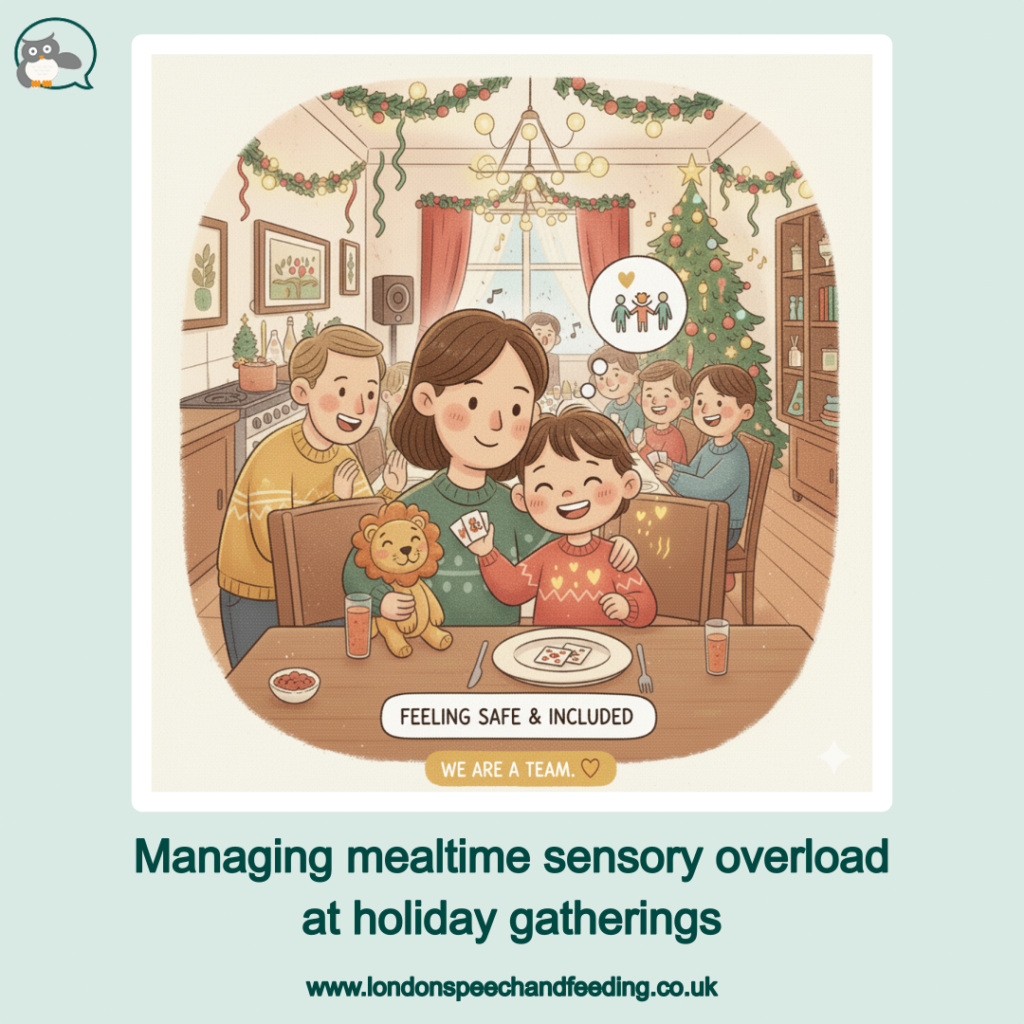
    Managing mealtime sensory overload at holiday gatherings: Supporting children with allergies and feeding differences

    Managing mealtime sensory overload at holiday gatherings: Supporting children with allergies and feeding differences

    Holiday meals are meant to be joyful and something we all look forward to. But for many children and their families, these occasions can be overwhelming and be the cause of dread and worry. The combination of new smells, unfamiliar foods, loud environments, social expectations, and allergy anxieties can quickly turn what should be a festive time into a stressful one.

    For parents of children with sensory processing differences, selective eating challenges, or food allergies, holiday gatherings often require careful planning and a big dose of tolerance and compassion. The good news is that with awareness and a few gentle strategies, you can support your child to feel safe, regulated, and included during festive meals without pressure, tears, or discomfort.

    Let’s explore how to make holiday mealtimes calmer, safer, and more connected this season.

    🎄 Why holiday meals feel so overwhelming

    Holiday gatherings usually combine several sensory triggers all at once:

    • Noisy, chaotic rooms
    • Strong smells from a mix of foods we don’t normally cook
    • Multiple conversations happening at once
    • Bright lights, Christmas décor, flickering candles
    • Unfamiliar foods with unexpected textures
    • Expectations to ‘try everything’ or ‘enjoy it’s sooo good!’
    • New environments, seating arrangements, or routines

    For children with sensory sensitivities, this can feel like a tidal wave of input. Research shows that children who are sensory-sensitive often have heightened responses to smell, taste, and texture, which may lead to avoidance or distress at mealtimes (Cermak, Curtin, & Bandini, 2010).

    Add food allergies into the picture and anxiety increases even further for both children and parents. A 2020 study by DunnGalvin et al. found that children with food allergies experience significantly higher stress in shared eating environments, especially when food preparation or contamination risk is hard to control.

    So, if your child becomes tearful, shuts down, or refuses to sit at the festive table, it isn’t ‘bad behaviour.’ It’s sensory overload, heightened vigilance, or discomfort communicating through their body.

    🌟 Preparing your child for a calmer festive meal

    Preparation is especially important for sensory-sensitive or allergy-aware children. Here’s how to set them up for success:

    1. Offer predictability through previewing

    Before the event, show your child pictures of:

    • where you’re going
    • who will be there
    • the types of foods that might be served
    • where they might sit

    A visual schedule or social story can help reduce anxiety and give your child a sense of control.

    2. Pack safe foods without apology

    If your child has allergies or selective eating, bring:

    • ‘Safe foods’ you know they will eat
    • Backup snacks
    • A separate (their own) plate, if needed
    • Emergency medication

    Announce clear, firm boundaries such as:

    ‘Ok people, these are Jamie’s safe foods — we’ll stick with these today.’ This will help relatives understand without pressure or judgement.

    3. Choose seating that supports sensory regulation

    If possible, seat your child:

    • at the end of the table
    • near a familiar adult
    • away from the kitchen (strong smells)
    • away from noise clusters
    • give them their favourite toy or fidget whilst waiting

    Let them take breaks when needed. This isn’t ‘rude,’ it’s self-regulation.

    🍽️ Supporting children during the meal

    1. Focus on connection, not consumption

    The holidays are not the time to expand your child’s food range. Keeping mealtimes low-pressure actually supports long-term progress.

    In fact, the research is clear: pressuring children to eat decreases acceptance and increases refusal (Galloway et al., 2006).

    So instead of ‘Just try it!’ try:

    • ‘You don’t have to eat it, you can look at it.’
    • ‘You’re in charge of what goes in your mouth.’
    • ‘You can keep your safe foods on your plate.’

    2. Protect your child’s allergy safety

    Holiday meals often include:

    • cross-contamination risks
    • shared utensils
    • buffets
    • homemade dishes without ingredient lists

    Use gentle but firm scripts:

    • ‘Because of Ellie’s allergies, we’ll keep her plate separate.’
    • ‘We’ll serve her food ourselves to make sure she stays safe.’

    Confidence in your boundary helps others respect it.

    3. Manage sensory load in real time

    Offer:

    • headphones
    • a small chew or fidget toy
    • a designated ‘calm corner’
    • time outside for fresh air
    • a predictable signal for breaks (e.g., a hand squeeze or card)

    Remember, sensory regulation is healthcare, not ‘giving in.’

    4. Model calm eating

    Children learn most from watching.

    Slow, happy bites and relaxed facial expressions tell the nervous system: ‘This environment is safe’.

    💛 What to say to well-meaning relatives

    Families often have big feelings about food. You can prepare nice phrases like:

    • ‘We’re focusing on helping him feel safe around food today.’
    • ‘She has allergies, so we’re sticking to our plan.’
    • ‘We’re avoiding pressure because it helps him eat better long term.’
    • ‘We’re celebrating together, eating is not the goal today.’

    Setting expectations ahead of time can reduce awkward moments later.

    🎁 The bigger picture: It’s about safety, not ‘picky eating’

    Children with allergies, sensory differences, or feeding challenges aren’t trying to be difficult. They are trying to stay safe, regulated, and comfortable.

    Your calm presence, gentle boundaries, and preparation create the conditions for a holiday that feels peaceful, not pressured.

    Sonja McGeachie

    Highly Specialist Speech and Language Therapist

    Owner of The London Speech and Feeding Practice.


    Health Professions Council registered
    Royal College of Speech & Language Therapists Member
    Member of ASLTIP

    Find a speech and language therapist for your child in London. Are you concerned about your child’s speech, feeding or communication skills and don’t know where to turn? Please contact me and we can discuss how I can help you or visit my services page.

    📚Research References

    Cermak, S. A., Curtin, C., & Bandini, L. G. (2010). Food selectivity and sensory sensitivity in children with autism spectrum disorders. Journal of the American Dietetic Association, 110(2), 238–246.

    DunnGalvin, A. et al. (2020). APPEAL-2: A pan-European qualitative study to explore the burden of peanut-allergic children, teenagers and their caregivers. Clinical & Experimental Allergy, 50(11), 1238–1248.

    Galloway, A. T., Fiorito, L. M., Francis, L. A., & Birch, L. L. (2006). ‘Finish your soup!’ Counterproductive effects of pressuring children to eat on intake and affect. Appetite, 46(3), 318–323.

    2
  • · ·

    Halloween without the tears: Supporting children through the Spooky Season

    For many families, Halloween is an exciting time filled with costumes, decorations, and sweets. But for children who are sensory sensitive, whether they’re autistic, have sensory processing differences, or simply find new experiences overwhelming, Halloween can feel like a night of chaos rather than fun.

    The bright lights, unexpected noises, strange textures, and social pressure to ‘join in’ can quickly become too much. The good news? With some thoughtful planning and gentle support, you can make Halloween a positive and manageable experience for your child.

    Understanding sensory overload

    Sensory overload happens when a child’s brain receives more sensory input than it can process. This might mean:

    • Costumes that itch, squeeze, or feel strange on the skin.
    • Loud sounds like doorbells, fireworks, or shrieking decorations.
    • Crowds and unpredictability during trick-or-treating.
    • Strong smells or tastes from face paint or unfamiliar sweets.

    When overloaded, children may cry, cover their ears, hide, run away, or ‘shut down.’ These reactions aren’t ‘bad behaviour’, they’re signs of distress. The goal isn’t to eliminate Halloween fun, but to adjust it to your child’s comfort level.

    Step 1: Choose costumes wisely

    Costumes are often the biggest trigger. Scratchy fabrics, tight seams, or masks that restrict breathing can be unbearable for some children.

    Try these tips:

    • Go sensory-friendly: Use soft, breathable fabrics and remove tags. Many retailers now sell sensory-safe costumes.
    • Test it early: Let your child wear the outfit around the house before Halloween. If it’s too much, simplify — maybe themed pyjamas or a favourite T-shirt with Halloween accessories.
    • Skip the mask: Face paint can be equally challenging, always test on a small patch of skin first. A comfortable headband or hat might be enough to feel ‘in costume.’

    Remember, participation doesn’t require perfection. Your child can still ‘be’ their favourite character without a full costume.

    Step 2: Plan your Halloween environment

    Before the big day, think about what parts of Halloween your child enjoys — and what might overwhelm them.

    At home:

    • Keep decorations minimal and predictable. Avoid motion-activated sounds or flashing lights.
    • Practise knocking at your own front door or saying ‘trick or treat’ with a trusted adult.
    • Have a ‘quiet space’ ready, a cosy corner or room where your child can retreat if things get too intense.

    If you’re going out:

    • Choose earlier, quieter times for trick-or-treating.
    • Visit a few familiar houses instead of the whole street.
    • Bring ear defenders or noise-cancelling headphones.
    • Have a clear exit plan if your child needs a break.

    Sometimes, watching from the window and handing out sweets can be just as enjoyable! it still offers social participation without sensory overload.

    Step 3: Prepare socially and emotionally

    Halloween involves a lot of unexpected social interaction: strangers at the door, unfamiliar greetings, and different rules.

    Help your child by:

    • Using visuals or stories: Read picture books about Halloween or make a short social story about what will happen.
    • Role-playing: Practise saying ‘Trick or treat!’ or handing out sweets in a fun, low-pressure way.
    • Labelling feelings: Explain that it’s okay to feel nervous or to take a break if something feels ‘too loud’ or ‘too much.’

    Children feel safer when they know what to expect. Predictability reduces anxiety and makes participation more enjoyable.

    Step 4: Rethink the treats

    Not every child enjoys sweets; some dislike sticky textures or strong flavours. Offer non-food alternatives like stickers, glow sticks, or small toys.

    If your child has feeding difficulties or oral sensitivities, it’s okay to opt out of the traditional treats entirely. They can still join in by giving treats or decorating treat bags instead.

    It’s also helpful to prepare your child that others might offer sweets they don’t want. Practising polite ‘no thank you’ responses can make these moments easier. (check out my symbol download for children who struggle to speak)

    Step 5: Celebrate your way

    Halloween doesn’t have to look like anyone else’s version. Maybe your family watches a ‘not-too-scary’ film, carves pumpkins, or does a flashlight treasure hunt indoors. The goal is joyful connection, not conformity.

    A calm, happy experience, even if it looks simple from the outside builds positive associations your child will carry into future celebrations.

    In summary

    Halloween can be full of sensory surprises, but with empathy, planning, and flexibility, it doesn’t have to end in tears.

    The more you adapt to your child’s sensory needs, the more they learn that they are safe, understood, and included not just at Halloween, but in every celebration.

    As with all things in speech and feeding development, progress starts with connection. When children feel regulated and supported, communication and confidence follow.

    Sonja McGeachie

    Highly Specialist Speech and Language Therapist

    Owner of The London Speech and Feeding Practice.


    Health Professions Council registered
    Royal College of Speech & Language Therapists Member
    Member of ASLTIP

    Find a speech and language therapist for your child in London. Are you concerned about your child’s speech, feeding or communication skills and don’t know where to turn? Please contact me and we can discuss how I can help you or visit my services page.

    2
  • · ·

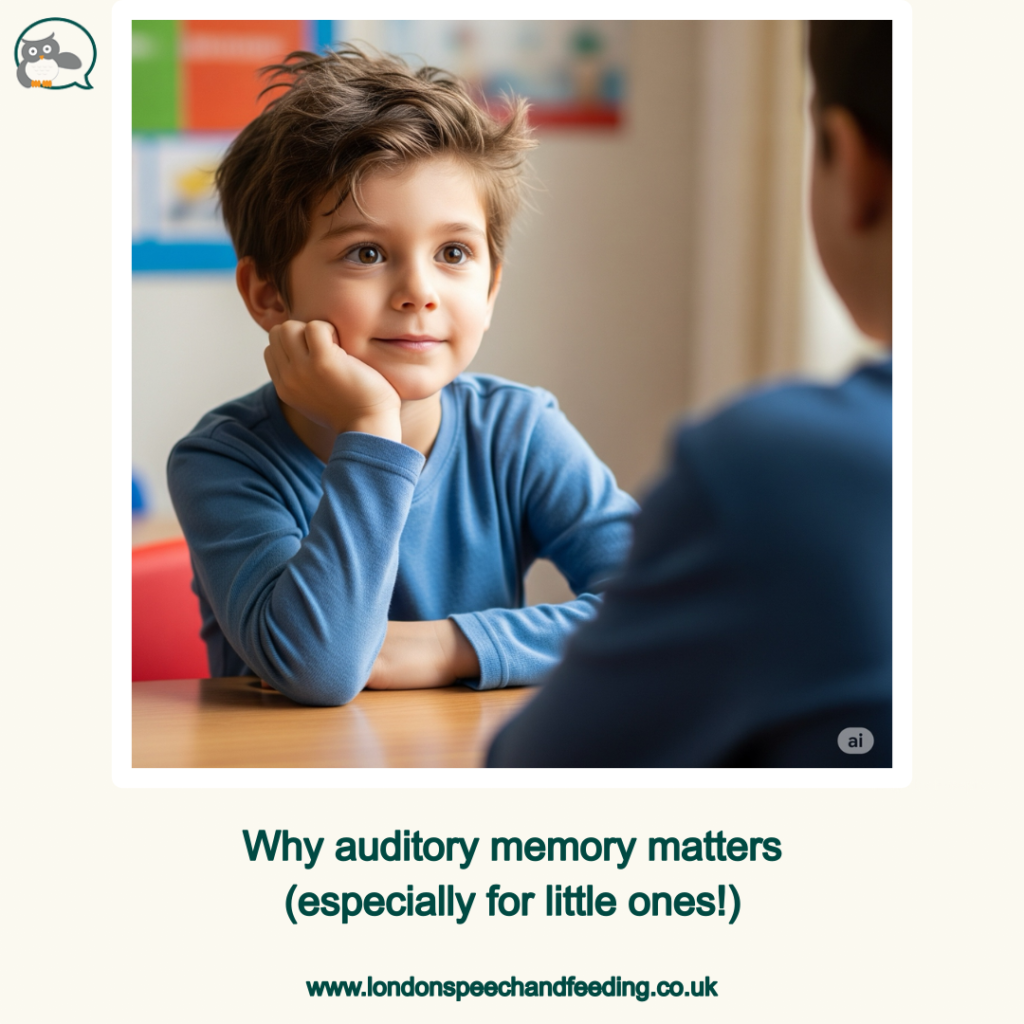
    Why auditory memory matters (especially for little ones!)

    Why auditory memory matters (especially for little ones!)

    Have you ever stopped to think about how we learn to speak, understand, and communicate effectively? It’s a complex dance of various cognitive skills, and one often overlooked but absolutely crucial player in this orchestra is auditory memory. It’s not just about remembering sounds. It’s about remembering sequences of sounds, which is fundamental to language development.

    What exactly is auditory memory?

    At its core, auditory memory is our ability to take in, process, store, and recall information that we hear. Think of it as your brain’s internal recording studio. When someone speaks to you, your auditory memory is busy at work, capturing the individual sounds, the order in which they appear, and the rhythm and intonation of the words. This isn’t just for long-term recall; it’s also vital for working auditory memory, which allows us to hold onto a small amount of auditory information for a short period, just long enough to make sense of it.

    For speech and language, auditory memory is essential for:

    • Understanding spoken language: To comprehend a sentence, we need to remember the beginning of the sentence by the time we hear the end.
    • Following instructions: Remembering a sequence of commands relies heavily on auditory memory.
    • Learning new words: We hear a word, remember its sound, and connect it to its meaning.
    • Developing phonological awareness: This is the ability to recognise and manipulate the sounds in spoken language, a critical precursor to reading. Auditory memory helps children distinguish between similar-sounding words (e.g., ‘cat’ vs. ‘bat’) and segment words into individual sounds.
    • Producing clear speech: To articulate words correctly, we need to recall the precise sequence of sounds that make up that word.
    • Developing conversational skills: Remembering what was just said helps us formulate appropriate responses.

    When auditory memory falls short: The impact on speech

    When auditory memory is poor, particularly in young children, the ripple effects on speech and language development can be significant. Children might struggle with:

    • Following multi-step directions: ‘Put on your shoes, get your coat, and meet me at the door’ can become an overwhelming jumble of sounds.
    • Learning new vocabulary: They might hear a new word repeatedly but struggle to retain its sound pattern, making it difficult to recognise or use later.
    • Understanding stories or conversations: Missing key details or losing the thread of a narrative because they can’t hold enough information in their working memory.
    • Developing phonological skills: Difficulty with rhyming, identifying initial sounds in words, or blending sounds together to form words, which can impact early literacy.
    • Speech production: They might mispronounce words, omit sounds, or struggle with the correct sequencing of sounds within words.
    • Social communication: Difficulty participating in group discussions, remembering names, or recalling what their peers have said.
    • Academic performance: Auditory memory challenges can impact a child’s ability to learn in a classroom setting, where much of the instruction is delivered verbally.

    It’s important to note that poor auditory memory isn’t a sign of low intelligence, but rather a specific processing challenge that can be addressed with targeted support.

    Nurturing auditory memory in under 5s: Preparing for schooling

    The good news is that auditory memory is a skill that can be strengthened and developed, especially during the crucial early years. For children under five, laying a strong foundation in auditory memory is an invaluable gift as they prepare for the demands of formal schooling. Here’s what we can do to help:

    1. Read aloud regularly: This is perhaps one of the most powerful tools. As you read, encourage your child to listen for specific words, predict what happens next, and retell parts of the story. Vary your voice, use different intonations, and pause to emphasise key words.
    2. Play auditory memory games:
      • ‘Simon says’: This classic game is fantastic for following multi-step instructions. Start with one command and gradually increase the number.
      • ‘I Spy’ with sounds: Instead of colours, describe sounds. ‘I spy with my little ear something that goes “moo”.’
      • Rhyming games: Sing rhyming songs, read rhyming books, and encourage your child to come up with words that rhyme.
      • Sound matching: Use everyday objects to make sounds (e.g., shaking keys, tapping a spoon) and have your child identify or match them.
      • ‘Memory chain’: Start a sentence and have your child add to it, remembering everything that came before: ‘I went to the market and bought an apple.’ ‘I went to the market and bought an apple and a banana.’
    3. Sing songs and nursery rhymes: Repetitive songs and nursery rhymes are excellent for developing auditory memory, rhythm, and phonological awareness. The predictable patterns help children anticipate and remember sequences of sounds and words.
    4. Give multi-step instructions (and praise!): Start with two-step instructions and gradually increase the complexity as your child’s skills improve. Always give positive reinforcement when they succeed. ‘Please pick up the red block and put it in the box.’
    5. Engage in active listening: Model good listening skills yourself. When your child is speaking, give them your full attention. Ask clarifying questions to encourage them to elaborate and organise their thoughts.
    6. Reduce background noise: A quiet environment makes it easier for young children to focus on auditory information. Minimise distractions like TV or loud music during activities that require listening.
    7. Use visual cues: While we’re focusing on auditory memory, sometimes pairing auditory information with visual cues can be helpful, especially initially. For example, when giving instructions, demonstrate the action as you say it.
    8. Be patient and consistent: Developing auditory memory takes time and consistent practice. Celebrate small victories and create a playful, supportive environment for learning.

    By actively engaging in these strategies, we can empower our youngest learners to build robust auditory memory skills, setting them up for success not only in speech and language development but also in their overall academic journey. It’s an investment that truly pays dividends in their future communication and learning abilities.

    Any comments or if you need help and support with your child’s speech please do not hesitate to get in touch with me: simply fill out the contact form here on the website. I endeavour to reply within 48 hours.

    Sonja McGeachie

    Highly Specialist Speech and Language Therapist

    Owner of The London Speech and Feeding Practice.


    Health Professions Council registered
    Royal College of Speech & Language Therapists Member
    Member of ASLTIP

    Find a speech and language therapist for your child in London. Are you concerned about your child’s speech, feeding or communication skills and don’t know where to turn? Please contact me and we can discuss how I can help you or visit my services page.

    1
  • · ·

    The power of imitation in supporting children with autism

    Image by Freepik

    Imitation, the act of mirroring someone else’s actions, gestures, sounds, or words, is a fundamental skill that plays a crucial role in human development. It’s how babies learn to wave ‘bye-bye’, how toddlers pick up new words, and how children acquire social skills. But for children with autism imitation can be a significant challenge and understanding why it’s important and how to foster it becomes a key focus for parents, educators, and speech and language therapists.

    Why is imitation important?

    Imitation is a building block for a wide range of developmental skills:

    • Social interaction: Imitation is the foundation of social reciprocity. When a child imitates, he or she is engaging in a shared experience, connecting with another person, and learning to take turns in social exchanges.
    • Communication development: Imitation is closely linked to language acquisition. Children often imitate sounds and words before they can produce them independently. Imitation also helps them understand the meaning of gestures and facial expressions, which are vital for nonverbal communication.
    • Cognitive development: Imitation plays a role in problem-solving, learning new skills, and understanding cause and effect. By imitating actions, children explore their environment and learn how things work.
    • Emotional development: Imitation helps children understand and share emotions. When a child imitates a smile, he or she may begin to understand the feeling of happiness.

    Imitation challenges in autism

    Many children with autism face challenges with imitation, which can affect their development in these key areas. These challenges can manifest in different ways:

    • Difficulty imitating motor actions: Children with autism may struggle to imitate simple motor movements, such as clapping hands, waving, or playing ‘peek-a-boo’.
    • Limited vocal imitation: Imitating sounds, words, and phrases can be difficult for some children with autism, which can impact their speech development.
    • Challenges with social imitation: Imitating social cues, such as facial expressions, gestures, and body language, can be particularly challenging for children with autism, affecting their ability to engage in social interactions.

    Why do children with autism struggle with imitation?

    The exact reasons for imitation difficulties in autism are complex and not fully understood. However, several factors may contribute:

    • Neurological differences: Research suggests that differences in brain structure and function, particularly in areas involved in social perception and motor control, may play a role.
    • Sensory processing differences: Some children with autism may have sensory differences that make it difficult to attend to and process the movements or sounds they are expected to imitate.
    • Attention and motivation: Challenges with attention, focus, and social motivation can also affect a child’s ability to engage in imitation.

    How to foster imitation in children with autism

    Fortunately, imitation skills can be developed and improved through targeted interventions and strategies. Here are some approaches that I use in my practice as a speech and language therapist working with autistic children and their families:

    • Create a playful and engaging environment: Children are more likely to imitate when they are having fun and feel motivated. I use toys, games, and activities that the child enjoys.
    • Start with simple imitation: Begin by imitating simple motor movements that the child is already capable of and gradually introduce more complex actions.
    • Imitate the child first: As the Hanen Program emphasises, imitating the child’s actions, sounds, and words can encourage him or her to interact and communicate more.
    • Use visual supports: Visual aids, such as pictures, photos or videos, can help children with autism understand what is expected of them and make imitation easier.
    • Break down complex actions: Divide complex actions into smaller, more manageable steps. For example, to teach a child to brush their teeth, break it down into steps like ‘pick up toothbrush’, ‘put toothpaste on brush’, and ‘move brush on teeth’.
    • Reinforce imitation attempts: Provide positive reinforcement, such as praise, smiles, or preferred activities, when the child attempts to imitate, even if the imitation is not perfect.
    • Integrate imitation into daily routines: Incorporate imitation into everyday activities, such as imitating sounds during playtime, imitating gestures during songs, or imitating actions during self-care routines.

    The role of speech therapy

    Speech-language therapists play a crucial role in helping children with autism develop imitation skills, particularly in the areas of vocal and verbal imitation. As part of my therapeutic role, I offer the following:

    • Assessing a child’s imitation abilities.
    • Developing individualised therapy plans to target specific imitation goals.
    • Using a variety of techniques to encourage vocal imitation.
    • Working with parents and caregivers to provide strategies and support for promoting imitation at home.

    Summary

    Imitation is a fundamental skill that is essential for social, communication, cognitive, and emotional development. While children with autism may face challenges with imitation, it is a skill that can be developed and improved with targeted interventions and support. By understanding the importance of imitation and using effective strategies to foster it, parents, educators, and therapists can make a significant difference in the lives of children with autism, helping them to connect with others, learn new skills, and reach their full potential.

    Do get in touch via my contact form if you have any question or need help with supporting your little one.

    Sonja McGeachie

    Highly Specialist Speech and Language Therapist

    Owner of The London Speech and Feeding Practice.


    Health Professions Council registered
    Royal College of Speech & Language Therapists Member
    Member of ASLTIP

    Find a speech and language therapist for your child in London. Are you concerned about your child’s speech, feeding or communication skills and don’t know where to turn? Please contact me and we can discuss how I can help you or visit my services page.

    1
  • · ·

    The picky eater’s plate: Introducing solids to toddlers with ARFID

    Designed by Freepik

    Mealtimes can be a battleground for parents of picky eaters, especially toddlers with Avoidant/Restrictive Food Intake Disorder (ARFID). I see a great number of toddlers with Autism traits and many of my clients are picky eaters from mild to severe. Take a look at my blog for an outline of what the issues are and how to try and help.

    ARFID goes beyond typical ‘picky eating’ and can significantly impact a child’s growth, nutrition, and social-emotional well-being. If your toddler is resistant to trying new foods or has a very limited diet, here are some strategies to navigate the introduction of solids:

    1. Understand ARFID:

    ARFID is a diagnosable eating disorder characterised by:

    • Limited food variety: Eating only a small range of foods, often with specific textures or colours.
    • Fear of new foods: Intense anxiety or aversion to trying unfamiliar foods.
    • Sensory sensitivities: Heightened sensitivity to taste, smell, texture, or appearance of food.
    • Lack of interest in eating: May show little interest in food or mealtimes.

    2. Seek professional guidance:

    • Paediatrician and/or gastroenterologist: Rule out any underlying medical conditions.
    • Registered dietitian: Assess nutritional needs and create a balanced meal plan.
    • Speech and language therapist (SLT): If oral-motor skills or sensory sensitivities are contributing to feeding difficulties.
    • Occupational therapist (OT): If sensory processing challenges are affecting mealtime behaviours.
    • Child psychologist: If anxiety or emotional factors are contributing to ARFID.

    3. Strategies for introducing solids:

    • Start small: Introduce one new food at a time, in small amounts, alongside familiar favourites.
    • Patience is key: It can take multiple exposures (up to 10–15 times!) for a child to accept a new food. Don’t give up!
    • Positive reinforcement: Praise and encouragement for any interaction with the new food, even just touching or smelling it.
    • No pressure: Avoid forcing or pressuring the child to eat. This can create negative associations with food.
    • Make it fun: Present food in playful ways, use cookie cutters for fun shapes, or involve the child in food preparation.
    • Sensory exploration: Encourage exploration of food through touch, smell, and sight before tasting.
    • Role modelling: Show the child that you enjoy eating a variety of foods.
    • Use fun utensils: your child might like characters from ‘Frozen’ or ‘Dinosaurs’ or ‘Diggers’ there are a host of character-based cutlery and cups/plates to be had. Also, I really rate these two items very highly they are so good so I want to share these with you. Both are available online. But warning: the cup is outrageously expensive as it comes from the United States and is sold by a small scale company. But I feel this is cup very worth trying, I have had good results with this.
    • Gradual desensitisation: Start with foods that are similar in texture or taste to accepted foods, then gradually introduce more challenging options.
    • Food chaining: Introduce new foods that are similar in taste, texture, or appearance to accepted foods.

    4. Mealtime Environment:

    • Positive and relaxed: Create a calm and enjoyable mealtime atmosphere.
    • No distractions: Minimise distractions like TV or toys.
    • Consistent schedule: Offer meals and snacks at regular times.
    • Child-sized portions: Offer small, manageable portions to avoid overwhelming the child.
    • Involve the child: Let the child choose their utensils, plate, or cup.

    5. Remember:

    • Every child is different: What works for one child may not work for another.
    • Progress takes time: Be patient and celebrate small victories.
    • Focus on the positive: Praise any positive interaction with food.
    • Seek support: Connect with other parents or support groups.

    Introducing solids to toddlers with ARFID can be challenging, but with patience, persistence, and professional guidance, you can help your child develop a healthier relationship with food.

    Get in touch with me via my contact form if you need support

    Sonja McGeachie

    Early Intervention Speech and Language Therapist

    Feeding and Dysphagia (Swallowing) Specialist The London Speech and Feeding Practice

    The London Speech and Feeding Practice


    Find a speech and language therapist for your child in London. Are you concerned about your child’s speech, feeding or communication skills and don’t know where to turn? Please contact me and we can discuss how I can help you or visit my services page.

    1
  • · · ·

    The joy of container play: Exploring play development and understanding of how things work

    Have you heard the term ‘Container play’? I use this very often with children in my sessions as it is so versatile and an enjoyable activity that can be done in parallel with a child or together. Container play is a powerful tool for fostering development in young children, especially those with developmental delays. This seemingly mundane activity provides a rich environment for sensory exploration, motor skill development, and cognitive growth.

    What is container play?

    Container play involves children interacting with various containers—boxes, buckets, bowls, cups, various bags, etc.—and filling, emptying, and transferring objects within and between them. Objects can include literally anything: small beads, bead chains, table tennis balls, wooden pegs, dinosaurs or any other little person toy, blocks of varying sizes, sand, water, or any other safe material. Larger containers obviously take larger items: socks, stuffed animals, bigger balls, bigger blocks etc really the choices are endless.

    Benefits for children with developmental delays:

    Sensory exploration:

    • Touch: Children explore different textures and temperatures of containers and objects.
    • Sight: They observe how objects look inside and outside the containers, how light reflects off them, and how colours change.
    • Sound: They listen to the sounds of objects clinking, rattling, and splashing.
    • Proprioception: Filling and emptying containers helps develop body awareness and spatial awareness.

    For neurodivergent children who might have sensory regulation difficulties, consider the following adaptions to accommodate your child’s sensory needs:

    • Over-stimulation: For children who are easily overstimulated, start with simple setups using a limited number of containers and objects. Gradually increase the complexity as they tolerate it.
    • Under-stimulation: For children who seek sensory input, provide a variety of textures and materials, such as sand, water, slime, or beans.
    • Temperature: Offer a variety of temperature options. Some children may enjoy warm water or cool sand.
    • Lighting: Adjust the lighting to create a calming or stimulating environment.
    • Focus on one sense at a time: Initially, focus on one sensory aspect, such as the feel of sand or the sound of water.
    • Weighted containers: Use heavy containers filled with rice or beans to provide deep pressure input.
    • Fidget toys: Incorporate fidget toys into the activity to provide sensory input and help with self-regulation.
    • Tactile exploration: Encourage exploration of different textures using objects with varying surfaces.

    Fine motor skill development:

    • Hand-eye coordination: Scooping, pouring, and transferring objects require precise hand-eye coordination.
    • Pincer grasp: Picking up small objects helps develop fine motor skills like the pincer grasp.
    • Strength and dexterity: Manipulating containers and objects strengthens hand muscles and improves dexterity. Opening and closing containers can be a huge area of interest; how does the top screw back on, or off?

    Cognitive development:

    • Cause and effect: Children learn that their actions (e.g., pouring water or sand) have consequences (e.g., the water spills).
    • Spatial awareness: They develop an understanding of concepts like inside, outside, full, empty, and over/under; also how big is the vessel and how much goes in before it’s full or spills over. How small is the vessel opening and what do I need to do to get the beads into the container.
    • Problem-solving: Children learn to solve problems, such as how to get an object out of a narrow container or how to transfer water without spilling.

    Social and emotional development:

    • Communication: Container play can encourage communication as children interact with others, sharing toys and commenting on their actions. Asking for help to open and close a container is often a great opportunity to practise ‘help me’ or ‘open it’
    • Turn-taking: Sharing containers and materials helps children learn to take turns and cooperate.
    • Sensory regulation: For children with sensory sensitivities, container play can be a calming and self-regulating activity.

    Tips for engaging children in container play:

    • Create a safe and inviting environment. A shower curtain on the floor makes things easier for tidy up afterwards. And it allows for spillages.
    • Provide a variety of containers: Use different sizes, shapes, and materials. Use containers that are visually interesting and pleasing, perhaps a festive biscuit tin, or a tin that looks like train engine. Use see-through containers at first which make the filling and emptying more obvious. This is important for children who have no previous experience with this type of play and need to ‘warm up’ to it. Once a child loves and is used to container play you can go wild with all types of containers.
    • Offer a variety of objects: Include balls, blocks, sand, water, and other age-appropriate materials.
    • Join in the fun! Start off the process, show your child what the joy of the activity is for yourself, how fun it is to fill and empty containers, provide enough containers for your child to start playing alongside you, and comment on their actions.
    • Follow your child’s lead: Allow them to explore and experiment at their own pace.
    • Adapt activities: Adjust the level of challenge based on your child’s abilities and interests.

    Container play is a simple yet powerful tool that can support the overall development of young children, especially those with developmental delays. By providing a rich and engaging sensory experience, container play can help children build essential skills in motor, cognitive, social, and emotional domains.

    If you have any questions or would like to have more in-depths demonstration of this or other play styles for your child please contact me.

    I look forward to hearing from you.

    Sonja McGeachie

    Early Intervention Speech and Language Therapist

    Feeding and Dysphagia (Swallowing) Specialist The London Speech and Feeding Practice

    The London Speech and Feeding Practice


    Find a speech and language therapist for your child in London. Are you concerned about your child’s speech, feeding or communication skills and don’t know where to turn? Please contact me and we can discuss how I can help you or visit my services page.

    1
  • · ·

    Feeding therapy: A guide for parents and caregivers

    Feeding therapy is a specialised form of therapy and support that helps children develop healthy eating habits and overcome challenges related to food. It’s often used for children with picky eating, feeding disorders, or sensory processing issues.

    What is feeding therapy?

    Feeding therapy involves a series of techniques designed to improve a child’s eating skills and attitudes towards food. In the UK it’s typically provided by speech and language therapists and dietitians. These professionals work closely with parents and caregivers to create a personalised treatment plan tailored to each child’s unique needs.

    How does feeding therapy work?

    Feeding therapy sessions are typically 30–60 minutes long and involve a variety of techniques, including:

    • Family counselling: Providing support and guidance to parents and caregivers. This can help address any practical, behavioural and emotional issues that may be impacting the child’s eating.
    • Play-based activities: Engaging children in fun activities while introducing new foods or textures. This can help alleviate anxiety and make mealtimes more enjoyable.
    • Sensory exploration: Helping children become more comfortable with different tastes, smells, and textures. This can be achieved through activities like touching, smelling, and tasting various foods.
    • Oral motor exercises: Improving chewing, swallowing, and lip coordination. These exercises can help children develop the necessary skills for eating independently.
    • Behavioural techniques: Using positive reinforcement to encourage healthy eating habits. This can involve rewarding children for trying new foods or eating a variety of meals.

    When is feeding therapy needed?

    Feeding therapy may be beneficial for children who:

    • Are picky eaters: Refuse to eat a variety of foods or have strong preferences.
    • Have feeding disorders: Experience difficulties with eating, such as swallowing or chewing.
    • Have sensory processing issues: Are sensitive to certain textures, smells, or tastes.
    • Have medical conditions: Such as autism, cerebral palsy, or gastrointestinal disorders.

    Feeding therapy strategies you can try at home

    While professional feeding therapy can be invaluable, there are several techniques you can try at home to support your child’s eating development:

    • Create a positive mealtime environment: Make mealtimes enjoyable and stress-free by avoiding distractions, limiting screen time, and creating a calm atmosphere.
    • Create regular mealtimes and mealtime routines: Introduce set ways of announcing meal times, including songs or short nursery rhymes, try and involve your child with table setting, even just carrying their spoon to the table and putting the beaker next to the plate and ensure that meal time finishes after about 30 minutes, again with a set routine so that the child always knows: this is how we do it in our home, now I am finished and meal time is over.
    • Introduce new foods gradually: Start with small amounts and gradually increase exposure. This can help reduce anxiety and make new foods less overwhelming.
    • Model healthy eating: Show your child how to enjoy a variety of foods by eating a balanced diet yourself.
    • Avoid forcing food: Allow your child to choose and explore foods at their own pace. Forcing them to eat can create negative associations with food.

    Seek professional help

    If you’re concerned about your child’s eating habits, consult with a feeding therapist. We can provide guidance and support.

    Remember, feeding therapy is a collaborative process between parents, caregivers, and professionals. With patience, understanding, and the right strategies, you can help your child develop healthy eating habits and enjoy meals.

    Would you like to know more about specific techniques or have any other questions about feeding therapy?

    Please feel free to contact me.

    Sonja McGeachie

    Early Intervention Speech and Language Therapist

    Feeding and Dysphagia (Swallowing) Specialist The London Speech and Feeding Practice

    The London Speech and Feeding Practice


    Find a speech and language therapist for your child in London. Are you concerned about your child’s speech, feeding or communication skills and don’t know where to turn? Please contact me and we can discuss how I can help you or visit my services page.

    1
  • · ·

    The power of containment: A therapeutic approach for autistic children

    Photo by lemonlenz

    The practice of wrapping or swaddling children, often referred to as ‘containment,’ has been used for centuries to soothe and comfort infants. I use this therapeutic approach with autistic children at the London Speech and Feeding Practice. While it might seem counterintuitive, the act of being tightly wrapped can provide significant benefits for children who struggle with sensory processing, emotional regulation, and communication.

    Understanding sensory processing and autism

    Autistic persons often experience challenges with sensory processing, which is their brain’s ability to interpret and respond to sensory information. This can lead to sensory overload or under-responsivity. Containment can be a valuable tool in helping children regulate their sensory input.

    Photo by lemonlenz

    To summarise, here are some of the benefits of containment:

    • Sensory Regulation:
      • Provides deep pressure input: The tight, enveloping sensation of being wrapped can provide deep pressure input, which is calming and organising for many children.
      • Reduces sensory overload: By creating a controlled sensory environment, containment can help to reduce overstimulation and promote a sense of safety.
    • Emotional Regulation:
      • Containment creates a sense of security: Being wrapped tightly can mimic the feeling of being in the womb, providing a sense of security and comfort.
      • Facilitates calming: The deep pressure input can help to calm the nervous system and reduce anxiety.
    • Improved Body Awareness:
      • Enhances proprioception: Containment can improve the child’s awareness of their body in space, which is essential for motor development and sensory integration. I often provide extra pressure on a child’s arms and legs sticking out of the yoga mat; this helps my child understand where their limbs are in space: I can feel my legs and I can feel my arms and I can feel where they are right now, i.e. they are under Sonja’s hand, I can feel them.
    • Facilitates Communication – and this is obviously where I come in as a Speech and Language Therapist:
      • Swaddling creates a safe space: When a child feels calm and secure, they are more likely to engage in communication.
      • Enhances joint attention: The shared experience of being wrapped can foster joint attention, which is essential for language development. You can see this one in my highlights where I swaddle my student in the yoga mat (picture above). She absolutely loves it, and what is more she is calm and steady when usually this child likes to be on the move constantly. Here we have a wonderful moment of joint engagement. She looks at me, she can listen to what I say or sing, and she can tell me in her own way to carry on rolling her or to carry on singing or providing calming pressure to her legs and arms or to stop.

    A few pointers for when you try this at home: How to practise containment safely and effectively

    • Create a safe environment: Ensure the wrapping material is soft, breathable, and free from any hazards.
    • Observe your child’s cues: Pay attention to your child’s body language and verbal cues to determine their comfort level.
    • Respect your child’s boundaries: If your child shows signs of distress, stop the containment immediately – this might seem obvious but sometimes we adults get so carried away with some ‘great idea’ that we have seen work elsewhere. And so we can be a little too ‘determined’ sometimes to ‘make it happen’… perhaps this rings a bell with some of my readers.
    • MAKE IT FUN: Start carefully and take it step by step. See if the student is having a nice time. It is all about trust and therefore it might not work the very first time you do it.

    It’s important to remember that containment is not a one-size-fits-all approach. Some children may respond better to other sensory-based interventions. However, for many autistic children containment can be a valuable tool in their journey towards improved communication and emotional regulation.

    For more information follow me on Instagram, Facebook or LinkedIn.

    Sonja McGeachie

    Early Intervention Speech and Language Therapist

    Feeding and Dysphagia (Swallowing) Specialist The London Speech and Feeding Practice

    The London Speech and Feeding Practice


    Find a speech and language therapist for your child in London. Are you concerned about your child’s speech, feeding or communication skills and don’t know where to turn? Please contact me and we can discuss how I can help you or visit my services page.

    1
  • · ·

    Creating your calm: containment strategies for Sensory Processing Difficulties

    The world can be a beautiful and stimulating place, but for individuals with Sensory Processing difficulties (SPD), it can also be overwhelming and even painful. Everyday sights, sounds, smells, touches, and tastes can be amplified to uncomfortable or even unbearable levels. This can lead to anxiety, meltdowns, and a constant feeling of being on edge.

    One important coping mechanism for SPD is containment. Containment strategies are techniques that help individuals manage their sensory experiences and create a sense of calm and safety.

    Understanding containment needs:

    Containment needs vary greatly from person to person. Some individuals might find comfort in deep pressure, while others might crave quiet and solitude.

    Common containment strategies:

    Here are some examples of containment strategies that can be helpful for individuals with SPD:

    • Deep pressure: This can involve activities like wearing weighted vests, using weighted blankets, getting firm hugs, or applying deep pressure massage.
    • Movement: Engaging in rhythmic movements like rocking, swinging, or jumping can be calming for some individuals.
    • Proprioceptive input: Activities that involve proprioception, the sense of body awareness, can be grounding. Examples include yoga, stretching, and proprioceptive toys like chewy necklaces or fidget spinners.
    • Visual calming: Utilising calming visuals like nature scenes, dimmed lights, or fidget toys with visual patterns can provide a sense of peace.
    • Auditory modifications: Noise-blocking headphones, earplugs, or white noise machines can help block out distracting or overwhelming sounds.
    • Oral motor activities: Chewing gum, crunchy snacks, or chewy toys can provide sensory input and help regulate emotions.
    • Sensory bottles: Watching calming visuals move within a liquid-filled bottle can be visually stimulating and promote focus.
    • Creating a safe space: Having a designated quiet area at home or school where individuals can retreat to self-regulate can be invaluable. This space should be free from clutter and overwhelming stimuli and can include calming sensory items.

    Additional tips:

    • Be patient and understanding: It takes time and practice to find what works best for each individual. Be patient with yourself or your child as you explore different strategies.
    • Consistency is key: Once you find effective strategies, use them consistently in different settings to create a sense of predictability and comfort.
    • Communicate openly: Talk to teachers, caregivers, and others about individual needs and how they can support containment strategies.
    • Celebrate progress: No matter how small, acknowledge and celebrate successes in managing sensory experiences.

    Remember:

    Containment is not about suppressing sensory experiences altogether. It’s about creating a sense of control and reducing overwhelming sensations to a manageable level. By exploring different strategies and working with a qualified professional, individuals with SPD can develop the tools they need to navigate the world and experience life to the fullest.

    Do get in touch if you would like some in-person or on-line 1:1 support with this. It can be overwhelming to figure it all out alone.


    Find a speech and language therapist for your child in London. Are you concerned about your child’s speech, feeding or communication skills and don’t know where to turn? Please contact me and we can discuss how I can help you or visit my services page.

    1
  • ·

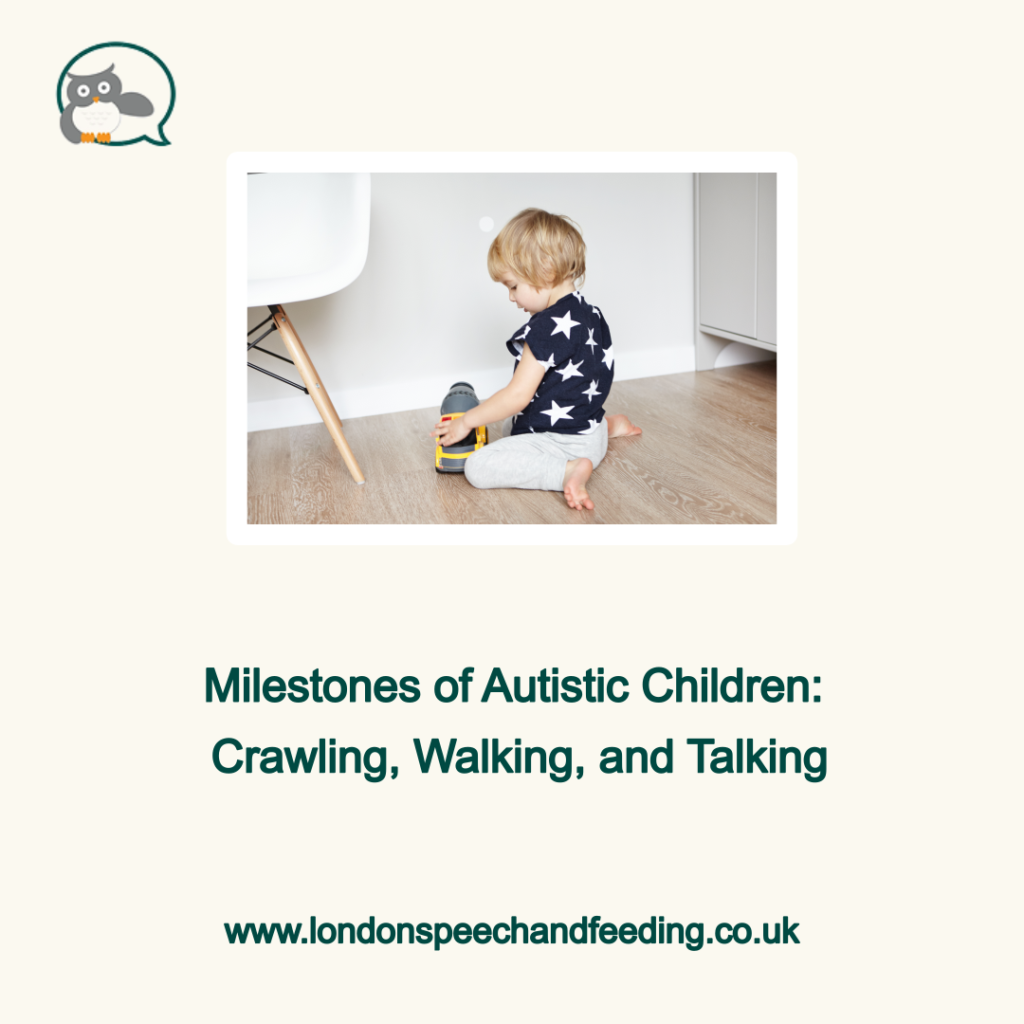
    Milestones of Autistic Children: Crawling, Walking, and Talking

    For all children every milestone achieved is a testament to the unique and intricate process unfolding within each young mind. For autistic children, this journey may present a distinct pattern, with some reaching developmental milestones like crawling, walking, and talking later than their neurotypical peers. Let’s have a look into the fascinating realm of Autism and explore why some autistic children might crawl, walk, and talk later, shedding light on the underlying factors contributing to this unique way of developing.

    1. Individual Pacing:

    Child development is not a one-size-fits-all journey. Each child, whether neurotypical or autistic, has a unique timeline for achieving milestones. Autistic children, like any other children, follow their own pacing. This individual rhythm might lead them to focus on one set of skills before they progress to others. Like some neurotypical children might focus on talking earlier than walking, autistic children might prioritise other areas before crawling or talking.

    2. Neurodevelopmental Complexity:

    The human brain is a remarkable entity, with a bewildering array of interconnected processes that lead to us achieving our developmental milestones. Autistic children often have variations in “neural wiring”, which can impact the balance between gross motor skills (crawling, walking) and fine motor skills. Speech and language acquisition falls under fine motor skills and may be momentarily disrupted due to the divergent neurological pathways at play in autism.

    2. Sensory Processing Differences:

    One of the hallmarks of autism is altered sensory processing. Autistic children often experience sensory stimuli differently than their neurotypical peers. This heightened or diminished sensitivity can influence a child’s desire or ability to engage in activities like crawling and walking. The sensation of movement while crawling or walking, for instance, might be overwhelming for some autistic children, causing them to either avoid or delay these activities.

    3. Visual-Spatial Abilities:

    Autistic children and adults frequently display excellent visual-spatial abilities. This strength might lead some children to focus more on activities that engage these skills, potentially delaying their engagement with activities like walking or talking. As they navigate their environment and process information visually, they might naturally invest more time in activities that stimulate this particular cognitive ability and strength.

    4. Communication Challenges:

    For many autistic children, speaking can be a really complex and difficult endeavour. Communication delays are a common feature of autism. This can affect both receptive and expressive language development. While some children might be physically capable of crawling or walking, they may not yet have the tools to communicate their desires and intentions. This leads to a temporary focus on non-speaking forms of expression. This does not mean that they do not communicate at all. But autistic individuals often start out using jargoning or echolalia as a form of communication as well as behaviours and physical forms of communication.

    5. Executive Functioning and Motor Skills:

    Executive functioning, or abilities for planning, organising, and carrying out tasks, can vary in autistic children. These skills are crucial for activities like crawling, walking, and talking, which need coordination and planning. About 40% of autistic persons have a motor planning difficulty.

    6. Intense Interests and Routines:

    Autistic children often develop intense interests in specific subjects, sometimes to the exclusion of other activities. These interests might become their primary mode of engagement. They might side-line milestones like crawling, walking, or talking. The mostly rigid adherence to routines and preferences might cause them to allocate more time to their preferred activities. This delays their engagement with other developmental tasks.

    How can Speech and Language Therapy help:

    Support and Intervention:

    Early intervention and regular Speech and Language Therapy play a pivotal role in the developmental journey of autistic children. Therapies tailored to individual needs can aid in bridging the gaps between milestones. Occupational therapy, for example, can help address sensory sensitivities and motor skill challenges that might impact crawling and walking. Speech therapy can help communication development, gradually bridging the gap between non-verbal expressions and spoken language.

    For example, we now know that echolalia or jargoning of longer phrases with intonation, repeating scripts from favourite tv shows or songs have many meanings and communicative functions. For example, a child who utters long strings of echolalic utterances, often difficult to understand, might want to do any one of the following:

    • Comment
    • greet
    • ask a question
    • make a request
    • express surprise
    • negate something.

    We now understand that the way to support a child with echolalia is to acknowledge all utterances and try and find out what the meaning is behind these scripts. This is very supportive. Over time it will lead a child to move on to understanding and saying more clear and self-generated language. For more information about this Natural Language Acquisition here are some other great websites for you to look at:

    Conclusion

    In conclusion, the journey of an autistic child’s development is a testament to the uniqueness and complexity of the human mind. The delays or differences in achieving milestones like crawling, walking, and talking can be attributed to a range of factors, including

    • neurodevelopmental intricacies,
    • sensory processing variations,
    • and communication challenges.

    It’s crucial to recognise that these delays are not indicative of a lack of potential, but rather a manifestation of the intricate interplay between an autistic child’s strengths and challenges. By embracing these differences and providing tailored support, we can help each autistic child unfold their potential at their own pace.

    Do get in touch if you would like to book an appointment where we can explore how to help your child develop and thrive

    Do get in touch if you would like to book an appointment where we can explore how to help your child develop and thrive


    Find a speech and language therapist for your child in London. Are you concerned about your child’s speech, feeding or communication skills and don’t know where to turn? Please contact me and we can discuss how I can help you or visit my services page.

    0