SLT

  • · ·

    My child is hard to understand at school age. Should I be concerned?

    Many parents notice speech errors when their children are toddlers. At that stage it often feels quite normal. Young children are still learning the sounds of their language, and those early mispronunciations can be very endearing.

    But as children grow older, parents sometimes begin to wonder:

    ‘Should my child still be speaking like this?’

    A common concern I hear from families is that their child is still difficult to understand even after starting school. Sometimes it is a parent who notices it first. Other times it is a teacher who gently mentions that classmates occasionally struggle to understand what a child is saying.

    When this happens, parents naturally wonder whether it is something their child will grow out of, or whether some extra support might help.

    When should children’s speech be clear?

    Children learn speech sounds gradually over several years. Some sounds develop earlier, while others take longer to master.

    By the time children reach five to six years of age, most of their speech should be clear enough for unfamiliar adults to understand. There may still be a few tricky sounds developing (such as /R/ or /TH/), but overall speech should be fairly easy to follow.

    If a child is frequently difficult to understand at school age, it can sometimes indicate that a speech sound difficulty has persisted beyond the stage when it would normally resolve on its own.

    Why some children remain hard to understand

    There are several reasons why speech clarity may still be developing in older children.

    Phonological patterns

    Some children continue to use speech patterns that are typical of younger children. For example:

    • saying ‘tat’ instead of ‘cat’
    • saying ‘doe’ instead of ‘go’
    • leaving sounds out of words

    These patterns are called phonological processes. They are a normal part of early speech development, but when they persist into the school years they can make speech difficult for others to understand.

    Difficulty producing specific sounds

    Other children may have difficulty producing certain individual sounds clearly. This might include sounds such as:

    • /S/
    • /SH/
    • /R/
    • /TH/

    These difficulties are called articulation difficulties.

    A child might understand exactly what they want to say but find it hard to produce the sound accurately with their tongue, lips or airflow.

    Motor speech planning challenges

    For some children, the difficulty lies in the planning and coordination of the movements needed for speech.

    Speech requires very precise timing between the tongue, lips, jaw and breath. If the brain finds it difficult to organise these movements consistently, speech can sound unclear or inconsistent.

    In some cases this may relate to Childhood Apraxia of Speech, although only a full assessment can determine this.

    Why clarity matters for school-age children

    Speech clarity becomes particularly important once children start school.

    At this stage, children are:

    • Answering questions in class
    • Talking with friends
    • Reading aloud
    • Developing confidence in communication

    When speech is difficult to understand, children sometimes become more hesitant to speak, particularly in group situations.

    This can affect confidence and participation, even when the child has lots of ideas they would like to share.

    The good news: speech can improve

    The encouraging news is that speech sound difficulties can often improve significantly with the right support.

    Speech therapy focuses on helping children:

    • Learn how sounds are produced
    • Practise accurate speech movements
    • Understand how sounds change meaning in words
    • Build consistency through structured practice

    Different children benefit from different therapy approaches. Some need support with phonological patterns, while others benefit from more motor-based practice that strengthens speech coordination.

    Often therapy combines several strategies to support the child’s individual speech profile.

    When to seek advice

    If your child is already at school and you find that people outside the family often struggle to understand them, it can be helpful to seek advice from a speech and language therapist.

    A detailed assessment can help identify:

    • Which sounds are causing difficulty
    • Whether patterns such as fronting or sound substitutions are present
    • Whether motor planning challenges may be contributing
    • Which therapy approach is likely to be most effective

    Early support can help children develop clearer speech and greater confidence in communication.

    Every child’s speech journey is different

    Speech development is not the same for every child. Some children master speech sounds quickly, while others need a little more guidance along the way.

    The important thing is that support is available when children need it.

    With the right strategies and practice, many children make excellent progress and develop speech that is clearer, more confident and easier for others to understand. If you are concerned about your child’s speech clarity or ongoing speech sound errors, a speech and language assessment can help identify the underlying difficulty and guide the most appropriate support.

    Feel free to contact me on my contact page.

    Sonja McGeachie

    Highly Specialist Speech and Language Therapist

    Owner of The London Speech and Feeding Practice.


    Health Professions Council registered
    Royal College of Speech & Language Therapists Member
    Member of ASLTIP

    Find a speech and language therapist for your child in London. Are you concerned about your child’s speech, feeding or communication skills and don’t know where to turn? Please contact me and we can discuss how I can help you or visit my services page.

    3
  • · ·

    When speech difficulties overlap: Helping children with phonological delay and childhood apraxia of speech

    One of the questions parents often ask is:

    ‘What kind of speech difficulty does my child have?’

    It’s a very understandable question. We often hear different terms such as phonological delay, articulation difficulties, or Childhood Apraxia of Speech (CAS), and it can be confusing.

    The reality is that many children don’t fit neatly into one single category.

    In fact, quite often I see children whose speech profile includes a mixture of difficulties. They might have some phonological patterns (where they substitute one sound for another) alongside challenges with motor speech planning, where coordinating the movements needed for speech is harder.

    When this happens, therapy needs to be flexible, responsive, and tailored to the child sitting in front of us.

    Example

    Recently I filmed a short clip from one of my therapy sessions which shows exactly how this works in practice.

    The child I was working with has difficulties with several speech sounds. Part of the challenge relates to a phonological pattern called fronting.

    Fronting is when sounds that should be made further back in the mouth (like /K/ or /G/) are produced further forward instead.

    At the same time, this child also shows signs of motor speech planning difficulty, which means the brain has to work harder to organise and sequence the movements of the tongue, lips and jaw for speech.

    This type of profile can sometimes overlap with characteristics seen in Childhood Apraxia of Speech (CAS).

    When difficulties overlap like this, therapy cannot rely on a single approach. Instead, it needs to draw on multiple evidence-based strategies.

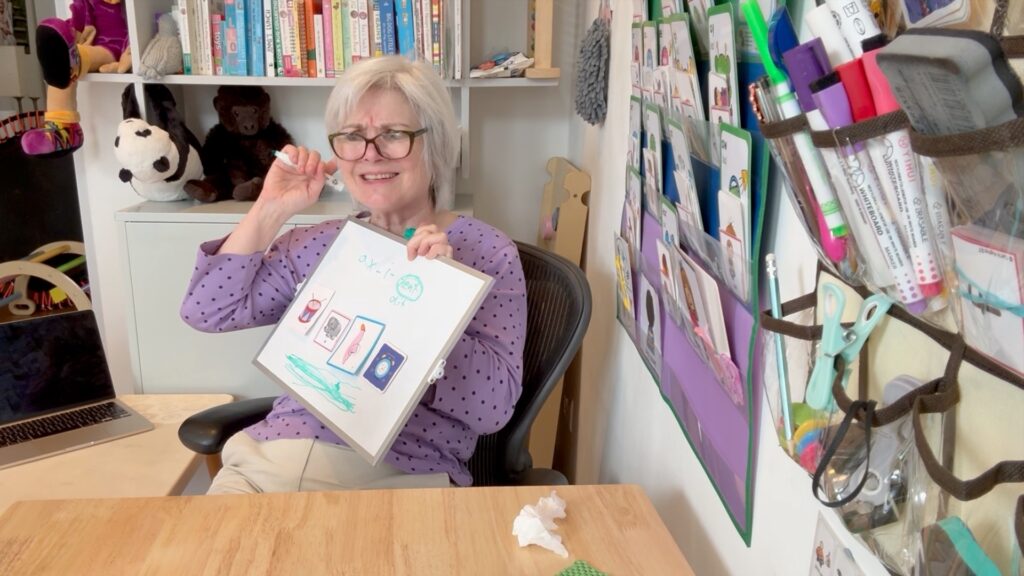
    That is exactly what you see happening in the clip. We started out generalising the /K/ sound which until recently had been replaced by a /T/ sound. Whilst looking at a sound loaded picture of /K/ sounds we somehow got talking about a ‘dent’ (I don’t recall how we got there!) but the ‘dent’ was a ‘det’ and I decided to tackle this there and then because there are other great words that end in ‘nt’ like : ‘count’ ‘giant’ ‘point’ or ‘paint’.

    Using visual cues to support motor planning

    Speech is incredibly complex. For children with motor speech difficulties, the challenge is not only knowing what sound they want to say, but also how to move their mouth to produce it.

    This is where visual cues can be incredibly helpful.

    In the clip, you can see me using a whiteboard with pictures and simple visual prompts. These help to:

    • Focus attention on the target sound
    • Understand where the sound occurs in the word
    • Remember the sequence of sounds needed

    Visual supports can act almost like a map for the mouth, guiding children as they practise new speech movements.

    For children with motor planning difficulties, this type of cueing can make a huge difference.

    Why repetition of a single word (massed practice) is so important

    Another key feature you will notice in the clip is lots of repetition.

    This is very deliberate.

    When we are supporting children with motor speech challenges, the brain needs repeated opportunities to practise the correct movement patterns. Just like learning a musical instrument or a new sport, repetition helps the brain build stronger and more efficient pathways.

    In therapy we call this massed practice.

    Rather than saying a word only once or twice, we practise it many times in a structured way, helping the child stabilise the new speech pattern.

    But repetition alone is not enough. The child also needs to understand why the sound matters.

    Showing children that sounds change meaning

    This is where another powerful therapy approach comes in: minimal pairs.

    Minimal pairs are word pairs that differ by only one sound. For example:

    • debt
    • dent

    In the clip, I use these two words to help the child realise that the /N/ sound makes a meaningful difference.

    Without the /N/, the word becomes something else entirely.

    This approach helps children recognise that speech sounds are not random: they carry meaning. If a sound is missing or substituted, the message may change.

    Helping children notice these differences can be a very motivating moment in therapy. Suddenly the sound is no longer just an abstract exercise; it becomes part of real communication.

    Blending approaches for the best outcomes

    In this short therapy moment, I am combining:

    • Visual cueing

    • Motor speech practice

    • High repetition (massed practice)

    • Minimal pair contrasts

    • Listening and awareness of sound differences

    Each element supports a different part of the speech system.

    Some strategies help with motor planning, others support phonological awareness, and others build accuracy and consistency.

    Together they create a therapy session that is both structured and responsive.

    Every child’s speech journey is unique

    One of the most important things I want to convey is that speech development is not always straightforward.

    Two children may both struggle with speech sounds, yet the underlying reasons may be very different.

    This is why careful assessment is essential, and why therapy needs to stay flexible as we learn more about how a child’s speech system works.

    Sometimes a child needs more motor-based work.

    Sometimes the focus shifts towards phonological contrasts.

    Often, as in this example, the most effective therapy uses both.

    Small steps lead to big progress

    Every session helps us understand a little more about how a child’s speech system works and what support will help them move forward.

    And when the pieces start to come together, when a child realises that one tiny sound can change a whole word, that is when the real progress begins.

    If you are concerned about your child’s speech sounds, clarity of speech, or possible motor speech difficulties, early support can make a significant difference. A detailed assessment can help identify the nature of the difficulty and guide a therapy approach tailored to your child’s individual needs.

    Feel free to contact me on www.londonspeechandfeeding.co.uk

    Sonja McGeachie

    Highly Specialist Speech and Language Therapist

    Owner of The London Speech and Feeding Practice.

    Health Professions Council registered
    Royal College of Speech & Language Therapists Member
    Member of ASLTIP

    Find a speech and language therapist for your child in London. Are you concerned about your child’s speech, feeding or communication skills and don’t know where to turn? Please contact me and we can discuss how I can help you or visit my services page.

    Reference

    McNeill, B. C., Gillon, G. T., & Dodd, B. (2009). Effectiveness of an integrated phonological awareness approach for children with childhood apraxia of speech (CAS). Child Language Teaching and Therapy, 25(3), 341-366.

    3
  • Can AI help my child’s speech delay? What it can do and what it can’t

    If you’re worried about your child’s speech, you are absolutely not alone. Many parents I work with tell me the same thing:

    ‘I’ve been Googling…’
    ‘I asked ChatGPT what activities to try…’
    ‘TikTok said we should practise this sound every day…’

    It makes complete sense. When waiting lists are long, evenings are quiet, and your child is struggling to communicate, it’s natural to look for help wherever you can find it.

    AI tools can actually be helpful in some ways. But they also have clear limits especially for children with significant speech delays or speech sound disorders.

    Here’s an honest, balanced guide to what AI can do, and what it simply can’t.

    ✔️ What AI can help with

    1. Explaining things in simple language

    AI can be very helpful for explaining speech and language terms in a way that’s easy for parents to understand for example, what a phonological delay is, or what Childhood Apraxia of Speech means. It can also suggest possible reasons for a child’s speech delay based on the information you provide.

    The difficulty is that parents (or teachers) can only ask questions based on what they notice or perceive to be the problem. In practice, this doesn’t always tell the full story. For example, parents often report that their child ‘can say certain words’, but during an assessment we may find those words are actually produced with consistent error patterns. These patterns give important clues about the underlying nature of the difficulty, whether it’s a delay or a disorder and they guide the speech therapist in choosing the most effective targets to improve intelligibility.

    2. Suggesting games and activities

    AI is very good at suggesting ideas for games and practice, such as word lists, simple play activities, sound practice games, book suggestions, and ways to encourage talking within everyday routines. These can be especially helpful when you feel stuck or want some fresh inspiration for supporting your child at home. It can help to think of AI as a big ideas bank, somewhere to dip into when you need new, playful ways to keep practice engaging.

    3. Helping you prepare questions for a therapist

    Some parents use AI to list questions before an assessment, understand reports and organise concerns.

    This can make therapy feel less overwhelming and more collaborative.

    Used this way, AI can actually support the therapy process.

    ❌ Where and why AI cannot replace real life speech therapy

    There is substantial research supporting the effectiveness of real-life speech therapy compared to generic online resources or AI-generated suggestions. Here are some key points highlighting why in-person therapy is often more beneficial:

    • Personalisation: Speech therapists assess each child’s unique needs, strengths, and challenges through direct observation and interaction. This personalised approach allows for tailored interventions that address specific issues, which generic resources cannot provide.
    • Nuanced understanding: Therapists are trained to recognise subtle cues in speech production, including the nuances of sound articulation, language comprehension, and social communication. This expertise enables us to identify underlying issues that may not be apparent through generic assessments.
    • Motivational support: A speech therapist can provide encouragement, motivation, and emotional support, which can significantly enhance a child’s willingness to participate and engage in therapy. This relational aspect is crucial for building confidence and reducing anxiety around communication.
    • Evidence-based practices: As a highly trained and specialised speech therapist I utilise evidence-based practices that are grounded in research, ensuring that the techniques used are effective and up to date. This contrasts with generic online information, which may not always be reliable or validated.
    • Progress monitoring: In-person therapy allows for ongoing assessment and adjustments to the treatment plan. We track progress over time and modify strategies as needed, ensuring that the therapy remains effective and relevant.

    Research studies consistently show that individualised, face-to-face interventions lead to better outcomes in speech therapy than generalised approaches. For parents and caregivers, seeking professional help tends to provide a more effective path toward improving their child’s communication skills.

    The healthiest way to think about AI

    AI works best as a starting point, not a substitute. You might use it to understand your child’s report and learn how speech develops,

    But if your child has significant delay or difficulty being understood, what makes the real difference is:

    • A tailored assessment
    • A clear therapy plan
    • Expert target selection
    • Ongoing adjustment
    • Support for both child and you the parent!

    Dear parents,

    If you’ve been turning to AI for help, it doesn’t mean you’re doing anything wrong. It means you care!

    But please know the best outcomes usually come from combining your daily support at home with guidance and support from your speech therapist who knows you and your child.

    Many of my past and present clients tell me that they really value my ‘handholding’ and me guiding them in between the sessions. A quick check in is often all that is needed but it makes a huge difference!

    If you’d like support or advice, please contact me and I can help guide the next steps.

    Sonja McGeachie

    Highly Specialist Speech and Language Therapist

    Owner of The London Speech and Feeding Practice.


    Health Professions Council registered
    Royal College of Speech & Language Therapists Member
    Member of ASLTIP

    Find a speech and language therapist for your child in London. Are you concerned about your child’s speech, feeding or communication skills and don’t know where to turn? Please contact me and we can discuss how I can help you or visit my services page.

    3
  • ·

    How can I incorporate AAC into my speech therapy sessions?

    Many parents are surprised when I bring AAC into a session, especially if they’ve come to see me primarily for speech sound work.

    They might wonder: ‘If we’re working on pronunciation, why are we using a communication device?’

    The simple answer is this: speech therapy is about communication first, and speech sounds second. Supporting a child’s ability to express themselves clearly and confidently is always the priority, and AAC can be a powerful tool alongside spoken speech.

    What do we mean by AAC?

    AAC stands for Augmentative and Alternative Communication.

    This can include:

    • A speech-generating device (such as LAMP Words for Life or GRID as I used in the photo below)
    • A communication app on a tablet
    • A symbol board or communication book
    • Gestures, signs, or visual supports

    AAC does not replace speech. Instead, it supports language development, reduces frustration, and builds communication success while speech skills are developing.

    Pretend Play using Speech and AAC in my clinic room

    But I mainly work on speech sounds… So how does AAC fit?

    Most of the children I see are working on:

    • Articulation difficulties
    • Phonological delay
    • Motor planning challenges (including apraxia/dyspraxia)
    • Unclear speech affecting confidence

    For these children, AAC isn’t a separate therapy. It’s simply woven naturally into what we are already doing.

    If a child brings their device to sessions, I actively include it. If they don’t yet use AAC but could benefit from visual or symbolic support, I may introduce simple options within activities.

    Using AAC to support speech practice

    Let’s say we are working on early speech targets like: ‘GO’.

    We might practise:

    • Saying the word verbally
    • Listening for the target sound
    • Using play (TOY TRAIN GOING ROUND A TRACK)

    Now we can extend this using AAC.

    On the device or communication board, we might model: ‘LET’S GO’ or ‘IT’s GOING up the hill’.

    This allows the child to:

    • Practise their speech sound target
    • Build a simple sentence
    • Experience successful communication even if speech is not fully clear yet

    All responses are valid and supported.

    AAC helps children communicate more than they can say

    Many children can understand and think in longer phrases than they can physically say.

    For example:

    • A child who verbally says single words may build longer phrases on AAC.
    • A child who struggles to plan speech movements may use AAC to communicate smoothly while still practising verbal attempts.
    • A child who becomes frustrated when misunderstood gains a reliable backup system.

    Rather than slowing speech progress, AAC often:

    • Reduces communication pressure
    • Increases participation in therapy
    • Encourages more attempts at speech
    • Supports language growth

    When children feel understood, they usually become more motivated to try speaking.

    There are no ‘prerequisites’ for AAC

    One of the biggest myths I hear is: ‘My child isn’t ready for AAC yet.’

    In reality, children do not need to:

    • Reach a certain speech level
    • Use pictures first
    • Prove they understand everything
    • Show immediate interest

    Instead, we presume competence and introduce AAC in meaningful, playful ways.

    That means:

    • Modelling words while blowing bubbles
    • Commenting during playdough activities
    • Choosing words during games
    • Building simple phrases in shared reading

    AAC should never feel like extra ‘work’. It’s simply another way to join in communication.

    My goal is always the same: to help each child communicate as clearly, confidently, and successfully as possible, using every helpful tool available.

    If your child uses AAC (or might benefit from it)

     Please feel free to:

    • Bring the device to sessions
    • Show me how your child currently uses it
    • Share advice from school or other therapists

    I am very happy to incorporate AAC into our work together so that speech practice, language development, and real communication all move forward hand-in-hand. Because ultimately, therapy isn’t just about producing perfect sounds. It’s about helping your child be heard and understood.

    If you’d like support or advice, please contact me and I can help guide the next steps.

    Sonja McGeachie

    Highly Specialist Speech and Language Therapist

    Owner of The London Speech and Feeding Practice.


      Health Professions Council registered
      Royal College of Speech & Language Therapists Member
      Member of ASLTIP

      Find a speech and language therapist for your child in London. Are you concerned about your child’s speech, feeding or communication skills and don’t know where to turn? Please contact me and we can discuss how I can help you or visit my services page.

      3
    • · ·

      Understanding phonological processes in 3–7-year-olds: What’s typical and when to seek help

      As a speech and language therapist, one of the most common questions I hear from parents is:

      ‘They can talk, but their speech still sounds immature. Is this normal?’

      Many children between the ages of three and seven use speech patterns that make their words sound different from adult speech. These patterns are known as phonological processes, and for younger children, they are a normal part of speech development.

      However, when these processes persist beyond the expected age, they can start to affect clarity, confidence and learning, especially once children enter school.

      This blog will help you understand:

      • what phonological processes are
      • which patterns are typical at different ages
      • and when it might be time to seek speech therapy support

      What are phonological processes?

      Phonological processes are patterns of sound simplification that children use while their speech system is developing.

      Instead of learning each sound one by one, children initially organise sounds into patterns that make speech easier to produce. This is a normal and efficient strategy for a developing brain.

      For example:

      • saying ‘tar’ instead of ‘car’
      • saying ‘poon’ instead of ‘spoon’
      • saying ‘bud’ instead of ‘bus’

      These are not ‘bad habits’. They are part of how speech develops.

      The key question is how long these patterns last.

      Common phonological processes (and when they usually disappear)

      Below are some of the most common processes parents notice in 3–7-year-olds.

      1. Final consonant deletion

      Leaving off the last sound in a word

      • ‘ca’ for cat, ‘da’ for dog
      • Typically resolved by 3–3½ years

      2. Fronting

      Replacing back sounds (k, g) with front sounds (t, d)

      • ‘tar’ for car, ‘do’ for go
      • Typically resolved by 3½–4 years

      3. Cluster reduction

      Omitting one sound in a consonant cluster

      • ‘poon’ for spoon, ‘top’ for stop
      • Typically resolves by 4–5 years (some clusters slightly later)

      4. Gliding

      Replacing /R/ or /L/ with /W/ or /Y/

      • ‘wabbit’ for rabbit, ‘yion’ for lion
      • Can be typical up to 5–6 years

      5. Weak syllable deletion

      Leaving out unstressed syllables

      • ‘nana’ for banana
      • Usually resolved by 4 years

      If these patterns continue past the expected age, speech can remain difficult to understand particularly for unfamiliar listeners such as teachers, peers, and also Auntie Karen or grandparents who visit once in a while.

      Why phonological processes matter in school-age children

      By the time children reach reception and Year 1, speech clarity becomes increasingly important.

      Persistent phonological difficulties can affect:

      • being understood by teachers and peers
      • phonics and early reading
      • spelling
      • confidence in speaking
      • willingness to participate in class

      Some children become aware that they ‘sound different’ and may speak less, avoid longer words, or become frustrated when misunderstood.

      What’s the difference between a delay and a disorder?

      This is an important distinction.

      • A phonological delay means a child is following the normal pattern of development, just more slowly.
      • A phonological disorder means the child is using atypical patterns, or continuing age-expected patterns well beyond when they should have resolved.

      A speech and language assessment helps identify:

      • which processes are present
      • how many are affecting speech
      • how consistent the errors are
      • and whether intervention is needed

      Signs it may be time to seek speech therapy

      You may want to seek professional advice if your child:

      • is 3½ years or older and still hard to understand
      • is understood well by family but not by others
      • becomes frustrated or avoids talking
      • has difficulty with phonics or spelling
      • uses several phonological processes at once
      • has not made progress despite time and encouragement

      Early support does not mean something is ‘wrong’. It simply helps speech development move forward more efficiently.Research consistently shows that unresolved phonological processes beyond the expected age can impact intelligibility, literacy and confidence (Dodd, 2014; Bowen, 2015).

      How speech therapy helps phonological development

      Phonological therapy is not about drilling individual sounds endlessly.

      Instead, therapy focuses on:

      • helping children recognise sound patterns
      • building awareness of contrasts (e.g. ‘tar’ vs ‘car’)
      • practising speech in meaningful, playful ways
      • supporting generalisation so progress carries into everyday speech

      For school-aged children, therapy is usually structured, motivating and highly targeted and progress can be very encouraging.

      A final reassurance

      Many children with phonological difficulties go on to develop clear, confident speech with the right support.

      If you’re unsure whether your child’s speech is ‘just a phase’ or something that needs attention, a professional assessment can give clarity and peace of mind.

      If you’d like support or advice, please contact me and I can help guide the next steps.

      Sonja McGeachie

      Highly Specialist Speech and Language Therapist

      Owner of The London Speech and Feeding Practice.

      Research references


      Health Professions Council registered
      Royal College of Speech & Language Therapists Member
      Member of ASLTIP

      Find a speech and language therapist for your child in London. Are you concerned about your child’s speech, feeding or communication skills and don’t know where to turn? Please contact me and we can discuss how I can help you or visit my services page.

      3
    • · ·

      Childhood Apraxia of Speech: Signs and first steps (2–5 years)

      If you’ve found yourself wondering ‘Why can my child say a word one day, but not at all the next?’ it might be that your child has a motor speech difficulty. This means the challenge isn’t that your child doesn’t know what they want to say; it’s that their brain finds it harder to plan and coordinate the movements needed for clear speech. This speech difficulty is called Childhood Apraxia of Speech (CAS)

      Sonja showing power words on a board

      In this post, I’ll explain what CAS can look like in 2–5 year olds, what an assessment usually involves, and what you can start doing at home to support your child without turning life into ‘speech homework all day long’.

      What is childhood apraxia of speech (CAS)?

      Children with CAS often have lots to communicate about (and strong ideas!) but their speech may come out as:

      • Unclear
      • inconsistent
      • hard to ‘copy’ on demand
      • frustrating for them and for you

      CAS is not caused by laziness and it is not a parenting issue. It is also not something children simply ‘grow out of’ without support. But with the right therapy approach, children can absolutely build clearer speech over time.

      If you’d like to read more about verbal dyspraxia, you may also find this helpful: Supporting children and families living with verbal dyspraxia.

      Why is CAS such a big topic right now?

      Many families come to me after months (or years) of being told:

      • ‘She’ll talk when she is ready’
      • ‘He’s just shy’
      • ‘It’s probably a speech delay’
      • ‘It’s normal for toddlers’

      And sometimes it is a general delay. But sometimes it’s something more specific, like CAS.

      There’s also been a huge rise in parents seeking information online, and CAS is often mentioned alongside speech sound difficulties such as:

      • phonological delay (pattern-based speech errors)
      • articulation difficulties (one sound that won’t come out clearly)
      • inconsistent speech disorder

      These can look similar at first glance, which is why a specialist assessment matters.

      Signs of childhood apraxia of speech in 2–5 year olds

      Children develop speech at different rates, and not every unclear speaker has CAS. But here are some common features that may raise a flag, especially when you notice several together.

      1) Inconsistent speech errors

      Your child might say the same word in different ways:

      • ‘banana’ → nana / baba / mana
      • ‘daddy’ → gaga / daddy / dadi

      This inconsistency is one of the biggest clues.

      2) Difficulty copying words on request

      Some children speak more easily in natural play, but when asked ‘Say ___’, they freeze or the word becomes much harder.

      3) Limited sound repertoire

      They may use only a small set of consonants (like /M/, /N/, /B/, /D/) and avoid others.

      4) Vowel distortions

      Many children with typical delays mainly struggle with consonants. But in CAS, vowels can also sound ‘off’ or change between attempts.

      5) Speech that sounds effortful

      You might notice your child:

      • pauses between sounds
      • tries multiple times
      • looks like they’re ‘searching’ for the right mouth movement

      6) Longer words are much harder

      ‘Car’ might be easier than ‘carry’, and ‘carry’ easier than ‘caterpillar’.

      7) Prosody differences (rhythm and stress)

      Some children with CAS sound a little unusual in their speech rhythm, stress, or intonation.

      8) Frustration or reduced confidence

      When a child is frequently misunderstood, they may:

      • talk less
      • use gestures more
      • become upset when asked to repeat themselves

      Important note: none of these signs alone prove CAS but they are a strong reason to seek a speech assessment rather than waiting.

      CAS vs phonological delay vs articulation difficulty (quick guide)

      These are some of the most common questions I hear.

      If it’s mainly an articulation difficulty…

      A child may consistently say one sound incorrectly (for example, ‘thun’ for ‘sun’- lisp- but everything else is developing well.

      If it’s mainly a phonological delay…

      You might notice clear patterns, like:

      • leaving off the ends of words (‘ca’ for ‘cat’)
      • swapping back sounds for front sounds (‘tar’ for ‘car’)

      Patterns are often consistent and respond well to phonology-based therapy.

      If it might be CAS…

      Speech often feels less predictable, harder to imitate, and more impacted by word length and complexity.

      If you’re unsure, that’s completely normal, and exactly why assessment matters.

      What happens in a CAS assessment?

      A high-quality speech assessment for possible CAS usually includes:

      1) Parent discussion and developmental history

      We talk about:

      • pregnancy and birth history (where relevant)
      • feeding history
      • early sounds and babbling
      • first words and how speech has progressed
      • family history of speech/language needs

      2) A speech sound assessment

      Your child might be shown pictures or play-based prompts so we can hear:

      • what sounds they can say
      • what they simplify
      • whether errors are consistent or inconsistent

      3) An oral-motor and movement check

      This isn’t about ‘strength’. It’s about coordination and planning. We look at how your child manages speech movements and transitions.

      4) Stimulability testing

      This means: how easily can your child learn a new sound or word with support?

      For CAS, we often explore how they respond to:

      • slowed-down speech
      • visual cues
      • rhythm/tapping
      • short, simple syllable shapes

      5) Functional communication and confidence

      We look at how speech impacts daily life:

      • being understood at nursery
      • joining in with peers
      • asking for help
      • managing emotions when misunderstood

      At the end, you should leave with:

      • a clear explanation of what we think is going on
      • a therapy plan
      • practical home strategies
      • realistic next steps

      What parents can do at home

      Here are CAS-friendly strategies you can start right away.

      1) Choose ‘power words’

      Pick 1–2 words that matter most in your child’s daily life, such as:

      • more
      • help
      • mummy
      • again
      • stop
      • open

      These words are motivating and functional.

      2) Keep it short and successful

      For many children with CAS, the goal is quality over quantity.

      Try five minutes a day rather than 30 minutes of struggle.

      3) Support speech with rhythm

      Some children benefit from:

      • tapping a beat on the table
      • clapping syllables
      • using a gentle ‘marching’ rhythm

      This can help the brain organise the sequence of movements.

      4) Celebrate approximations

      If your child says ‘moh’ for ‘more’, that’s communication!

      We want them to feel:

      • safe
      • understood
      • proud to try again

      Confidence is a key part of progress.

      A short parent story (anonymised)

      One mum said to me:

      ‘We kept being told to wait. But I could see my child understood everything; they just couldn’t get the words out. Once we had an assessment and a plan, it felt like we finally knew what to do. The biggest change was his confidence. He started trying more.’

      When should you seek support?

      You don’t need to wait until school.

      It’s worth getting an assessment if your child is:

      • hard to understand compared with peers
      • becoming frustrated or withdrawing from talking
      • inconsistent with words they used to say
      • struggling to imitate speech sounds
      • showing signs that match CAS

      Early support can reduce stress for the whole family and help your child feel successful in communication.

      Here’s how I can help:

      ✅ A detailed speech assessment (including whether CAS is likely)

      ✅ A clear therapy plan with realistic goals

      ✅ Practical home strategies you can use immediately

      ✅ Support for nurseries and schools (where needed)

      ✅ In-person sessions in North-West London and online options

      Book your consultation here.

      Final gentle reminder

      You are not overreacting. Trust your instincts.

      Your child is communicating the best way they can, and with the right support, speech can become easier, clearer, and more confident.

      Sonja McGeachie

      Highly Specialist Speech and Language Therapist

      Owner of The London Speech and Feeding Practice.


      Health Professions Council registered
      Royal College of Speech & Language Therapists Member
      Member of ASLTIP

      Find a speech and language therapist for your child in London. Are you concerned about your child’s speech, feeding or communication skills and don’t know where to turn? Please contact me and we can discuss how I can help you or visit my services page.

      3
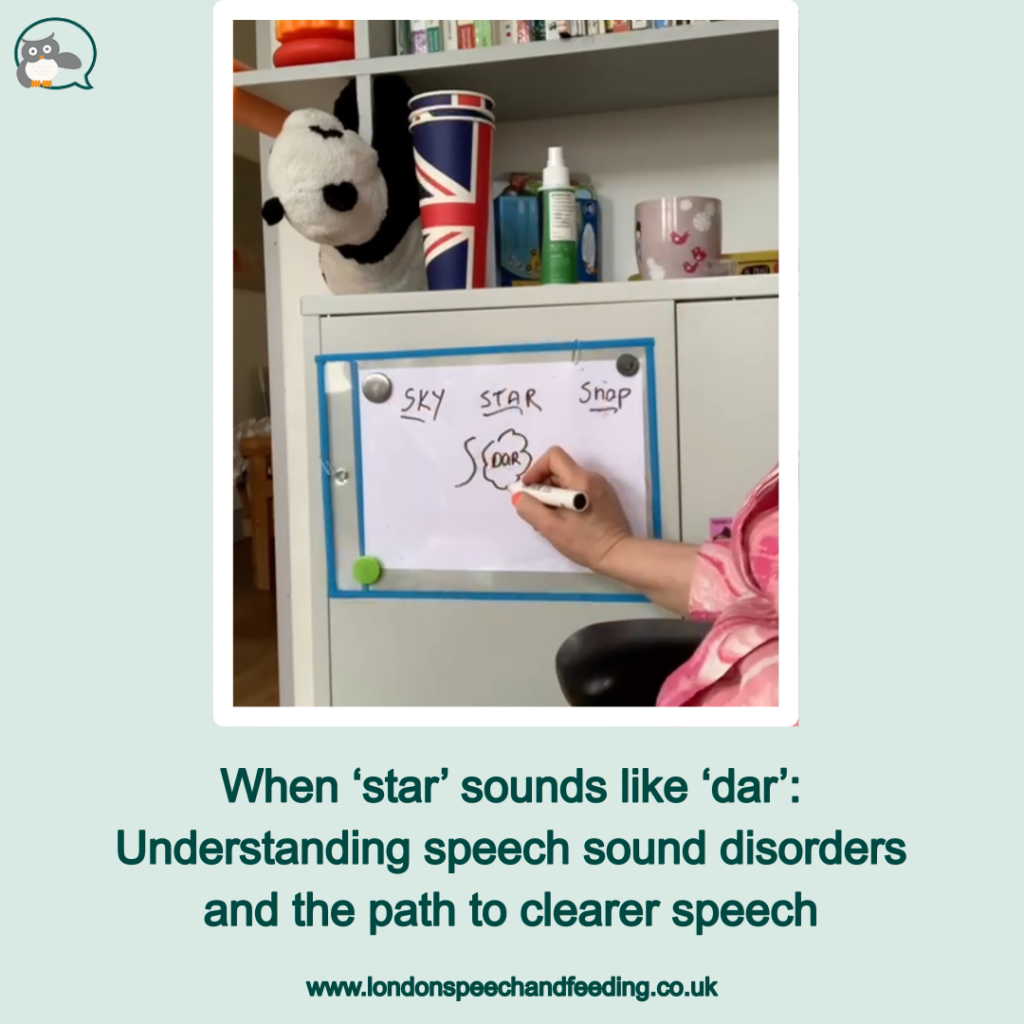
    • When ‘star’ sounds like ‘dar’: Understanding speech sound disorders and the path to clearer speech

      If your child says ‘dar’ instead of ‘star’, you might be wondering if they will simply outgrow it or if they require specialised support. While ‘cluster reduction’—dropping one of the sounds in a blend—is a normal part of learning to talk, we typically expect these sounds to lock into place by age four years. If these errors persist as a child approaches school age, it often signals a speech sound delay that may now no longer pass without help. As a Speech and Language Therapist, I specialise in helping children bridge this gap using evidence-based techniques like backward chaining.

      This isn’t about constant correction; it’s about providing the right clinical scaffolding to move a child from ‘frustrated’ to ‘fluent’ before they hit those critical early school years.

      Dropping sounds from words is a common feature of speech sound difficulties, and while it can look small on the surface, it can have a big impact on how clearly a child is understood. In this short video clip, I’m working with a child on an /ST/ sound cluster, demonstrating how I use an evidence-based speech therapy technique called backward chaining to help children build clearer speech with confidence.

      What’s actually happening when a child drops the ‘S’?

      Clusters like /ST/, /SP/, and /SK/ are tricky. They require:

      • precise timing
      • careful airflow
      • and the ability to blend sounds smoothly

      For many children, especially those with speech sound difficulties, this is a big ask.

      So instead of hearing:

      ‘star’

      we might hear:

      ‘tar’ or ‘dar’

      This isn’t laziness or refusal. It’s the child simplifying the word to make it manageable.

      Why I don’t start by saying ‘say star’

      Telling a child to ‘just add the S’ rarely works.

      Instead, I meet them where they are already successful.

      In this clip, the child can already say ‘dar’ clearly. That’s our starting point.

      Backward chaining: building speech from success

      Backward chaining means we:

      1. Start with the part of the word the child can already say
      2. Gradually add the missing sound
      3. Keep the child feeling successful at every step

      So rather than jumping straight to ‘star’, we:

      • secure the ending
      • gently introduce the /S/
      • and blend it in a way that feels achievable

      This approach reduces frustration, builds confidence, and helps the sound stick not just in the therapy room, but out in the real world.

      Why this matters beyond one word

      This isn’t just about saying ‘star’.

      It’s about:

      • teaching the mouth a new movement pattern
      • giving the brain time to organise the sound sequence
      • and helping the child feel capable, not corrected

      When therapy feels safe and successful, children are far more likely to generalise their new sounds into everyday speech.

      Speech therapy works best when children feel supported not tested.

      If your child struggles with speech clarity

      If your child:

      • drops sounds from words
      • avoids longer or trickier words
      • or becomes frustrated when they’re not understood

      This is the kind of work I do every day building speech step by step, in a way that respects each child’s pace and strengths.

      Support can be gentle, effective, and empowering.

      If you’d like to learn more about how speech therapy can support your child, you’re always welcome to get in touch.

      Sonja McGeachie

      Highly Specialist Speech and Language Therapist

      Owner of The London Speech and Feeding Practice.


      Health Professions Council registered
      Royal College of Speech & Language Therapists Member
      Member of ASLTIP

      Find a speech and language therapist for your child in London. Are you concerned about your child’s speech, feeding or communication skills and don’t know where to turn? Please contact me and we can discuss how I can help you or visit my services page.

      3
    • Tele-Speechtherapy: Online, connected, and highly effective

      A different kind of therapy. Online, connected, and highly effective

      When parents first enquire about speech and language therapy, many assume it will happen face-to-face, in a clinic room, with a therapist sitting across from their child.

      So when therapy is offered online, it’s natural for questions to arise:

      Can this really work? Will my child engage? Will progress be slower?

      This short video offers a glimpse into what online therapy can look like: calm, interactive, relationship-based, and surprisingly effective.

      Online therapy is not ‘less than’ in the right circumstances

      Teletherapy is not suitable for every child in every situation. However, for many school-aged children, particularly those who enjoy conversation, technology, and shared activities, online therapy can be an excellent fit.

      The child you see in this video is around eight years old and was supported for a persistent lisp. Sessions were primarily online, with the occasional in-person appointment when helpful.

      What made the difference was not the screen. It was the combination of engagement, support, and consistency.

      Parent involvement changes everything

      One of the greatest strengths of online therapy is the way it naturally invites parents in.

      In this case, parents regularly joined the video sessions:

      • Listening in
      • Taking part when appropriate
      • Learning how to support practice gently between sessions

      This meant that therapy didn’t stay ‘on the screen’. Strategies carried over into everyday conversation, making progress faster and more meaningful.

      Speech sound therapy, including support for lisps, relies heavily on awareness, feedback, and confidence, all of which can be supported very effectively at home with the right guidance.

      Therapy through a screen can still be deeply relational

      A common concern is whether connection can truly be built online.

      In reality, many children feel more relaxed in their own home environment. They are often more willing to talk, experiment with sounds, and reflect on their speech when they feel comfortable and supported.

      Online sessions allow:

      • Shared focus and conversation
      • Clear visual feedback
      • Real-life practice in a familiar setting
      • Immediate parent support

      For some children, this actually enhances engagement rather than limits it.

      Real progress, real outcomes

      Over the course of approximately 12 online sessions, alongside a small number of in-person appointments, this child achieved resolution of their lisp.

      Progress was steady, positive, and confidence-building. Importantly, the child remained motivated and proud of their achievements throughout the process.

      While every child’s journey is different, this example highlights what is possible when:

      • The child is ready
      • Parents are involved
      • Therapy is tailored and collaborative

      If you’re considering online therapy

      If you’re unsure whether teletherapy could work for your child, it’s worth remembering that effective speech and language therapy is less about the room you’re in, and more about:

      • Relationship
      • Understanding
      • Consistency
      • Carryover into daily life

      For many families, online therapy offers flexibility, accessibility, and excellent outcomes especially when parents are active partners in the process.

      If you’re at the start of your child’s speech journey and wondering whether online therapy could be the right fit, I’m always happy to talk it through. Sometimes clarity begins with simply understanding what therapy can look like

      Teletherapy: Frequently Asked Questions

      Is online speech and language therapy really effective?

      Yes. For many children, particularly school-aged children, online therapy can be highly effective. Progress depends far more on engagement, consistency, and support than on physical location.

      What age does online therapy work best for?

      Teletherapy often works well for children from around six years and up, especially those who can attend to a screen, enjoy conversation, and follow simple instructions. That said, suitability is always considered individually and often a supportive adult is needed to help guide the child through the activities.

      Can speech sound work (such as a lisp) really be done online?

      Absolutely. Speech sound therapy relies on clear visual feedback, listening skills, and practice all of which can be supported very effectively online. Many children respond particularly well when practising in their own home environment.

      Do parents need to be involved in sessions?

      Parental involvement is strongly encouraged. Parents may sit in, join parts of the session, or support practice between appointments. This involvement often leads to quicker progress and better carryover into everyday speech.

      Will my child still build a relationship with the therapist?

      Yes. Strong therapeutic relationships can and do develop online. Many children feel more relaxed and confident communicating from home, which can actually enhance connection and learning.

      Is online therapy suitable for every child?

      Not in my experience. Some children benefit more from in-person support, or a combination of online and face-to-face sessions. A discussion and initial assessment help determine the best approach for each child.

      Sonja McGeachie

      Highly Specialist Speech and Language Therapist

      Owner of The London Speech and Feeding Practice.


      Health Professions Council registered
      Royal College of Speech & Language Therapists Member
      Member of ASLTIP

      Find a speech and language therapist for your child in London. Are you concerned about your child’s speech, feeding or communication skills and don’t know where to turn? Please contact me and we can discuss how I can help you or visit my services page.

      3
    • · ·

      Your child’s communication journey

      Understanding our neurodiversity-affirming, child-led approach

      Welcome to a different kind of therapy!

      Your child’s communication journey

      The start of a new year often brings fresh hope, and sometimes fresh worries, for parents supporting their child’s communication. I am always genuinely excited to begin a new journey with children and their families, and I know that, for many parents, this kind of therapy may look very different from what they were expecting.

      Parents (and children!) are often surprised to discover that our sessions are playful, joyful, and intentionally low-pressure. You won’t see demands for eye contact, sitting still, or being told to ‘do it this way’ or ‘put the red square there’. Instead, you’ll see your child being met exactly where they are.

      For families who have previously experienced more adult-led or behaviour-based approaches including Applied Behaviour Therapy, this difference can feel unfamiliar at first. Because of that, I want to take a moment to prepare you for what child-led, neurodiversity-affirming therapy looks like, so you can feel confident, comfortable, and reassured from day one.

      Why doesn’t child-led therapy look like ‘traditional’ therapy?

      Many people picture speech and language therapy as sitting at a table, using flashcards, or practising words through repetition. While those approaches can work well for some children, they are often not effective or appropriate for many neurodivergent children—including children with autistic profiles, ADHD, or demand-sensitive nervous systems.

      Our approach is grounded in a simple and powerful truth:

      Children learn best when they feel safe, motivated, and emotionally connected.

      When a child’s nervous system feels calm and secure, learning becomes possible. When a child feels pressured or controlled, communication often shuts down, even if they can speak.

      🎯 Our purpose: Communication through connection

      Our goal is not simply to help your child say more words. Our goals go deeper and are built on strong foundations:

      • Trust and regulation: We focus on building a trusting relationship where your child feels safe, understood, and emotionally regulated. A calm nervous system is the starting point for all communication.
      • Motivation: We follow your child’s intrinsic motivation, the things they naturally enjoy to make communication meaningful, joyful, and purposeful.
      • Spontaneous communication: We create opportunities for your child to communicate because they want to, not because they are asked or instructed to.

      🧸 What to expect in a session

      Our sessions are intentionally child-led and often look very much like play.

      FeatureWhat it looks likeWhy we do this
      Minimal toysWe usually offer just 3–4 carefully chosen activities (such as bubbles, blocks, or sensory play).Less is more. Fewer choices reduce overwhelm and help children focus on what genuinely interests them.
      Child choosesYour child decides what to play with and how to engage.This immediately establishes us as a safe, non-demanding partner and increases motivation.
      The therapist’s roleWe join your child’s play, observing closely and responding naturally.We model language, share attention, and reflect your child’s experiences in a way that feels natural and supportive.
      No pressure or demandsThere are no ‘must-do’ tasks. If your child wants to spin, crash, line up toys, or repeat an activity, we follow.Reducing demands lowers anxiety and supports communication, particularly for children with demand-sensitive profiles.

      Is this really effective?

      It’s completely natural to wonder, ‘Are they just playing?’ The answer is yes, and very intentionally so.

      Our sessions are guided by nearly 30 years of speech and language therapy experience, alongside clear, achievable goals tailored to each individual child. Play is a child’s natural language and their most powerful learning tool.

      Within play, we are constantly creating opportunities to:

      • Build joint attention (sharing focus and interest)
      • Model language at the right level
      • Encourage back-and-forth communication
      • Develop a deep, authentic connection

      If your child has struggled to engage or communicate in more structured or demand-heavy settings, this child-led approach is often the key to unlocking their potential.

      💛 What this might look like at home

      You may notice that when pressure is reduced:

      • Your child begins communicating more during everyday routines
      • Language emerges through play, movement, or shared enjoyment
      • Communication feels more natural and less forced

      Small moments could be a shared smile, a look, a sound, a gesture. All matter. These are the building blocks of meaningful communication.

      📚 Resources for parents

      If you’d like to explore these ideas further, you may find the following helpful:

      I look forward to meeting you and your child. Please bring any questions, uncertainties, or curiosities to our first session, there is no such thing as a silly question. This is a journey we take together. Contact me via my contact form.

      Sonja McGeachie

      Highly Specialist Speech and Language Therapist

      Owner of The London Speech and Feeding Practice.


      Health Professions Council registered
      Royal College of Speech & Language Therapists Member
      Member of ASLTIP

      Find a speech and language therapist for your child in London. Are you concerned about your child’s speech, feeding or communication skills and don’t know where to turn? Please contact me and we can discuss how I can help you or visit my services page.

      3
    • · · · ·

      Holiday disruptions & New Year routines: How to support your child’s feeding, communication and regulation over the festive season

      Holiday disruptions & New Year routines

      The festive season is a wonderful time for many families, but for children with feeding challenges, sensory differences, or autism traits, December can feel overwhelming. Changes in routine, busier environments, travel, new foods, disrupted sleep, and well-meaning relatives giving ‘advice’ can all affect a child’s feeding, communication and overall regulation.

      As a speech and language therapist specialising in Early Years, I see the same pattern each year: children often make progress during the term, only to struggle in late December when everything becomes unpredictable. The good news? With a bit of preparation, children can not only cope better, but they can actually make significant developmental gains during the holidays.

      This blog will help you feel confident, supported and prepared for the transition from ‘festive mode’ to a smoother, regulated start in January.

      1. Why routines matter so much. Especially now

      Young children thrive on predictability. For neurodivergent children or those with sensory, feeding or communication needs, routine isn’t just helpful: it’s the backbone of emotional regulation.

      In December, typical patterns change:

      • Mealtimes shift or become irregular
      • Bedtime slides
      • New foods appear
      • Loud social gatherings overwhelm
      • Travel disrupts naps and comfort routines
      • Therapies pause
      • Childcare closes

      Any one of these can lead to feeding refusals, more meltdowns, increased stimming, reduced communication attempts or regression in speech sounds.

      It’s simply the nervous system responding to too much change.

      2. Protecting feeding progress during holiday mealtimes

      My last blog and insta post have a nice social story on festive meals. They are often the trickiest part of the season for families I support. Children with sensory-based feeding challenges, or ARFID traits may find holiday foods completely unfamiliar and challenging.

      What helps:

      • Offer one ‘safe food’ at every meal
      • Keep portion sizes tiny
      • Use the ‘buffet rule’
      • Rehearse tricky moments

      3. Supporting communication when routines are disrupted

      Holiday time actually offers more opportunities for communication, just in different ways.

      Strategies:

      • Slow down and follow your child’s lead
      • Use everyday routines as language opportunities
      • Keep AAC going even if casually

      4. Understanding holiday ‘regressions’ and know they’re temporary

      This is almost always due to nervous system overload. Children don’t truly ‘lose’ skills; they temporarily prioritise regulation over learning.

      5. A gentle January reset: How to start the New Year smoothly

      • Re-establish predictability early
      • Return to preferred foods
      • Book early support if needed
      • Focus on regulation first

      Sonja McGeachie

      Highly Specialist Speech and Language Therapist

      Owner of The London Speech and Feeding Practice.


      Health Professions Council registered
      Royal College of Speech & Language Therapists Member
      Member of ASLTIP

      Find a speech and language therapist for your child in London. Are you concerned about your child’s speech, feeding or communication skills and don’t know where to turn? Please contact me and we can discuss how I can help you or visit my services page.

      Reference:

      Bronson, M. (2000). Self-regulation in early childhood. Guilford Press.

      2
    • · · · ·

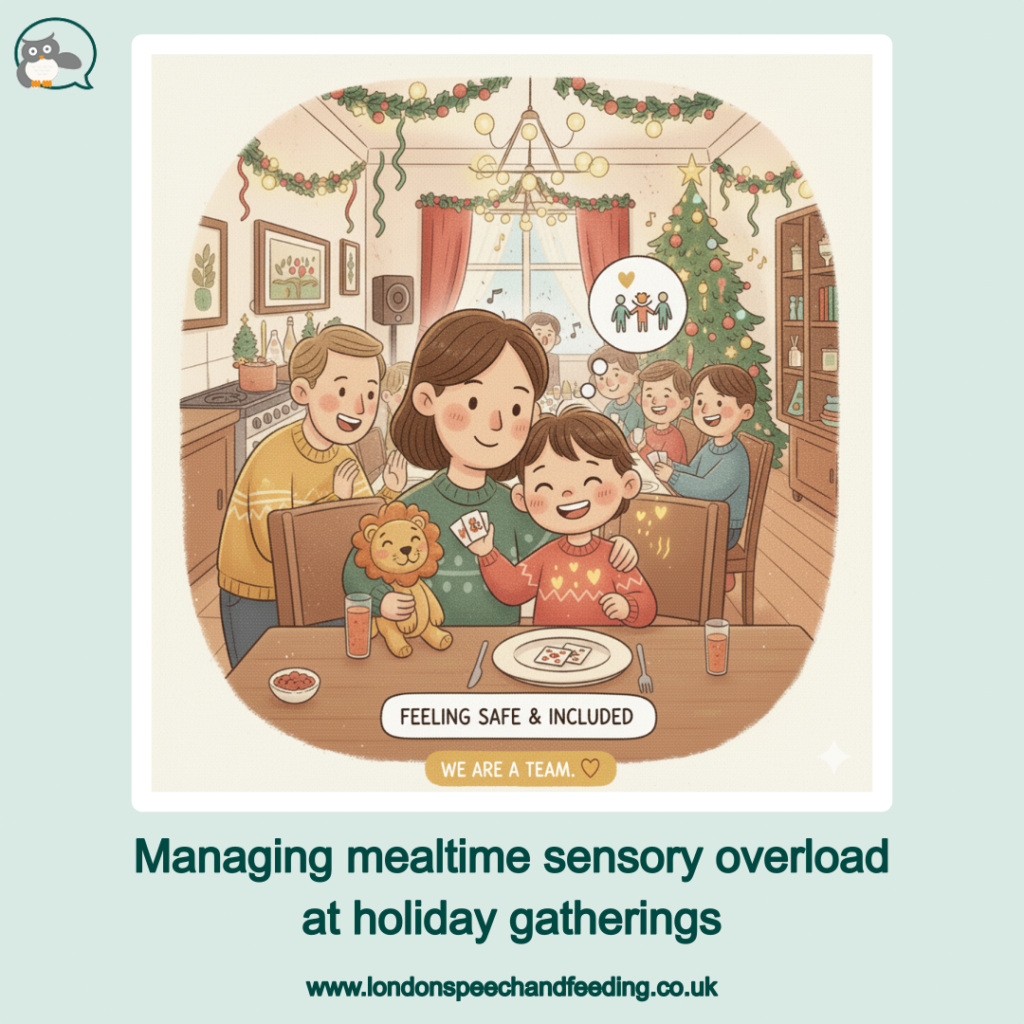
      Managing mealtime sensory overload at holiday gatherings: Supporting children with allergies and feeding differences

      Managing mealtime sensory overload at holiday gatherings: Supporting children with allergies and feeding differences

      Holiday meals are meant to be joyful and something we all look forward to. But for many children and their families, these occasions can be overwhelming and be the cause of dread and worry. The combination of new smells, unfamiliar foods, loud environments, social expectations, and allergy anxieties can quickly turn what should be a festive time into a stressful one.

      For parents of children with sensory processing differences, selective eating challenges, or food allergies, holiday gatherings often require careful planning and a big dose of tolerance and compassion. The good news is that with awareness and a few gentle strategies, you can support your child to feel safe, regulated, and included during festive meals without pressure, tears, or discomfort.

      Let’s explore how to make holiday mealtimes calmer, safer, and more connected this season.

      🎄 Why holiday meals feel so overwhelming

      Holiday gatherings usually combine several sensory triggers all at once:

      • Noisy, chaotic rooms
      • Strong smells from a mix of foods we don’t normally cook
      • Multiple conversations happening at once
      • Bright lights, Christmas décor, flickering candles
      • Unfamiliar foods with unexpected textures
      • Expectations to ‘try everything’ or ‘enjoy it’s sooo good!’
      • New environments, seating arrangements, or routines

      For children with sensory sensitivities, this can feel like a tidal wave of input. Research shows that children who are sensory-sensitive often have heightened responses to smell, taste, and texture, which may lead to avoidance or distress at mealtimes (Cermak, Curtin, & Bandini, 2010).

      Add food allergies into the picture and anxiety increases even further for both children and parents. A 2020 study by DunnGalvin et al. found that children with food allergies experience significantly higher stress in shared eating environments, especially when food preparation or contamination risk is hard to control.

      So, if your child becomes tearful, shuts down, or refuses to sit at the festive table, it isn’t ‘bad behaviour.’ It’s sensory overload, heightened vigilance, or discomfort communicating through their body.

      🌟 Preparing your child for a calmer festive meal

      Preparation is especially important for sensory-sensitive or allergy-aware children. Here’s how to set them up for success:

      1. Offer predictability through previewing

      Before the event, show your child pictures of:

      • where you’re going
      • who will be there
      • the types of foods that might be served
      • where they might sit

      A visual schedule or social story can help reduce anxiety and give your child a sense of control.

      2. Pack safe foods without apology

      If your child has allergies or selective eating, bring:

      • ‘Safe foods’ you know they will eat
      • Backup snacks
      • A separate (their own) plate, if needed
      • Emergency medication

      Announce clear, firm boundaries such as:

      ‘Ok people, these are Jamie’s safe foods — we’ll stick with these today.’ This will help relatives understand without pressure or judgement.

      3. Choose seating that supports sensory regulation

      If possible, seat your child:

      • at the end of the table
      • near a familiar adult
      • away from the kitchen (strong smells)
      • away from noise clusters
      • give them their favourite toy or fidget whilst waiting

      Let them take breaks when needed. This isn’t ‘rude,’ it’s self-regulation.

      🍽️ Supporting children during the meal

      1. Focus on connection, not consumption

      The holidays are not the time to expand your child’s food range. Keeping mealtimes low-pressure actually supports long-term progress.

      In fact, the research is clear: pressuring children to eat decreases acceptance and increases refusal (Galloway et al., 2006).

      So instead of ‘Just try it!’ try:

      • ‘You don’t have to eat it, you can look at it.’
      • ‘You’re in charge of what goes in your mouth.’
      • ‘You can keep your safe foods on your plate.’

      2. Protect your child’s allergy safety

      Holiday meals often include:

      • cross-contamination risks
      • shared utensils
      • buffets
      • homemade dishes without ingredient lists

      Use gentle but firm scripts:

      • ‘Because of Ellie’s allergies, we’ll keep her plate separate.’
      • ‘We’ll serve her food ourselves to make sure she stays safe.’

      Confidence in your boundary helps others respect it.

      3. Manage sensory load in real time

      Offer:

      • headphones
      • a small chew or fidget toy
      • a designated ‘calm corner’
      • time outside for fresh air
      • a predictable signal for breaks (e.g., a hand squeeze or card)

      Remember, sensory regulation is healthcare, not ‘giving in.’

      4. Model calm eating

      Children learn most from watching.

      Slow, happy bites and relaxed facial expressions tell the nervous system: ‘This environment is safe’.

      💛 What to say to well-meaning relatives

      Families often have big feelings about food. You can prepare nice phrases like:

      • ‘We’re focusing on helping him feel safe around food today.’
      • ‘She has allergies, so we’re sticking to our plan.’
      • ‘We’re avoiding pressure because it helps him eat better long term.’
      • ‘We’re celebrating together, eating is not the goal today.’

      Setting expectations ahead of time can reduce awkward moments later.

      🎁 The bigger picture: It’s about safety, not ‘picky eating’

      Children with allergies, sensory differences, or feeding challenges aren’t trying to be difficult. They are trying to stay safe, regulated, and comfortable.

      Your calm presence, gentle boundaries, and preparation create the conditions for a holiday that feels peaceful, not pressured.

      Sonja McGeachie

      Highly Specialist Speech and Language Therapist

      Owner of The London Speech and Feeding Practice.


      Health Professions Council registered
      Royal College of Speech & Language Therapists Member
      Member of ASLTIP

      Find a speech and language therapist for your child in London. Are you concerned about your child’s speech, feeding or communication skills and don’t know where to turn? Please contact me and we can discuss how I can help you or visit my services page.

      📚Research References

      Cermak, S. A., Curtin, C., & Bandini, L. G. (2010). Food selectivity and sensory sensitivity in children with autism spectrum disorders. Journal of the American Dietetic Association, 110(2), 238–246.

      DunnGalvin, A. et al. (2020). APPEAL-2: A pan-European qualitative study to explore the burden of peanut-allergic children, teenagers and their caregivers. Clinical & Experimental Allergy, 50(11), 1238–1248.

      Galloway, A. T., Fiorito, L. M., Francis, L. A., & Birch, L. L. (2006). ‘Finish your soup!’ Counterproductive effects of pressuring children to eat on intake and affect. Appetite, 46(3), 318–323.

      2
    • · · · ·

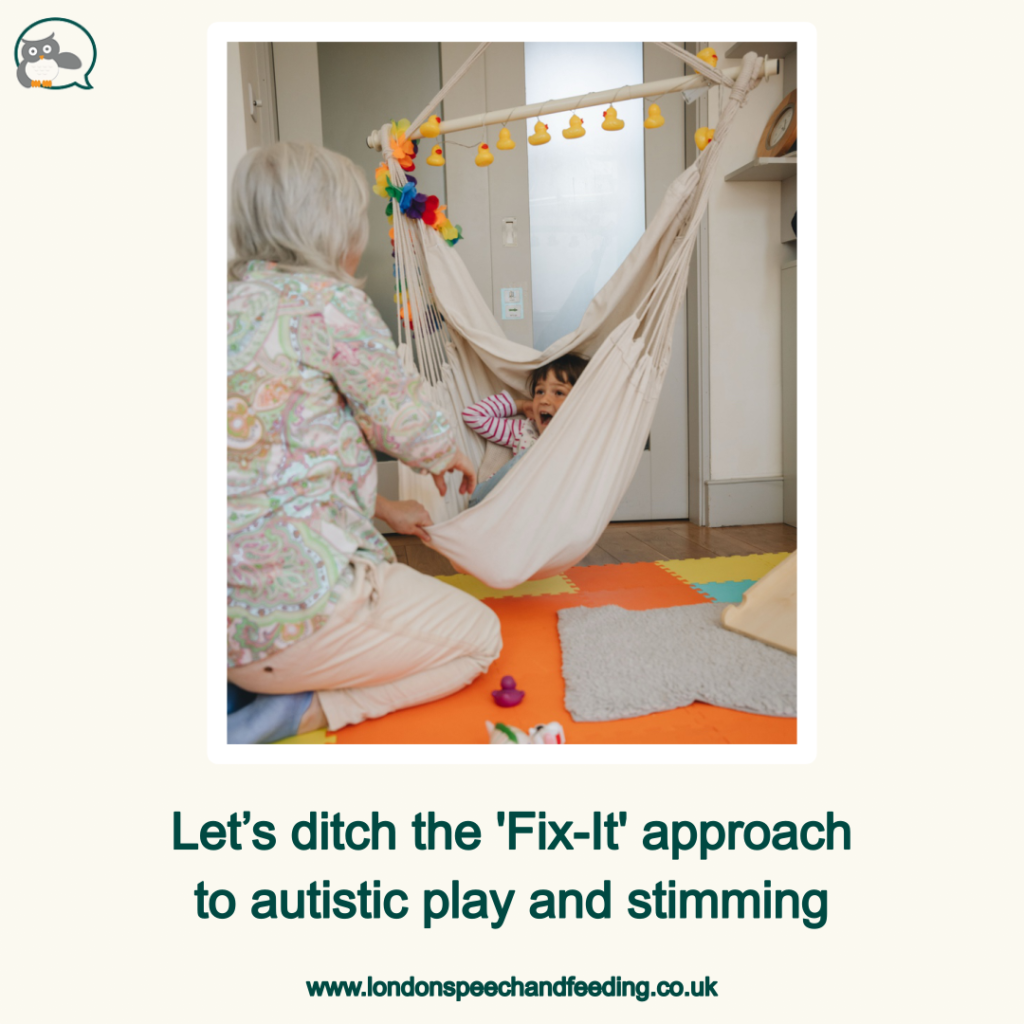
      Let’s ditch the ‘Fix-It’ approach to autistic play and stimming

      Let’s ditch the 'Fix-It' approach to autistic play and stimming

      December is often presented as a time of perfect, reciprocal play. Children are supposed to be unwrapping toys, sharing, and engaging in imaginative scenarios with family. But for parents of young autistic children, this high-pressure, socially demanding period can often feel like a battleground.

      If you’ve been told to interrupt your child’s stimming, push for eye contact, or force them to play ‘functionally’ with toys, it’s time to take a deep breath. Those traditional approaches are not only stressful—they often miss the point of your child’s communication.

      As a neurodiversity-affirming Speech and Language Therapist, I want to encourage you this December: You are allowed to follow your child’s lead, validate his or her unique interests, and trust that his or her play and movement are profoundly meaningful.

      1. Stimming: not a distraction, but a regulator 💡

      Stimming is short for self-stimulatory behaviour and includes repetitive movements or sounds like hand flapping, humming, rocking, finger flicking, or repeating phrases (called echolalia).

      For years, parents were incorrectly advised to block or eliminate these behaviours. The neurodiversity-affirming view tells us the exact opposite: Stimming is a vital and essential tool for your child’s self-regulation.

      Think of stimming as an internal volume dial:

      • Too loud/overwhelmed: Your child may stim to reduce incoming sensory input (e.g., rocking to ground himself or herself in a busy room).
      • Too quiet/under-stimulated: Your child may stim to increase sensory input and focus (e.g., running back and forth to maintain alertness).

      The shift: validate, don’t block

      Instead of saying, ‘Stop flapping your hands’, try to understand the message behind the movement.

      • Observe: When does the stimming happen? Is it before a meltdown? When your child excited? When your child is bored?
      • Validate: Name the need, not just the behaviour. You might say, ‘I see your body needs to move fast right now. That helps you calm down!’
      • Co-regulate: If the stim is unsafe (e.g., head-banging), help your child find a safer, alternative stim that meets the same sensory need (e.g., pushing hard against a wall, squeezing a stress ball).

      By validating your child’s need to regulate, you are building trust, reducing anxiety, and teaching him or her critical self-awareness.

      2. Autistic play: Meaningful, even if it’s monologue

      The traditional idea of ‘good play’ often involves turn-taking, pretending, and specific toy functions (e.g., pushing a train around a track). When an autistic child spends 30 minutes lining up cars, spinning their wheels, or scripting whole scenes from a favourite movie, it can often be dismissed as non-functional or repetitive.

      In neurodiversity-affirming practice, we recognise that autistic play is authentic play. These activities are crucial for learning, deep focus, and imaginative development.

      • Lining up toys may be an exploration of patterns, visual organisation, and order.
      • Spinning wheels may be a deep interest in cause-and-effect and visual sensory input.
      • Scripting is often a way to process language, regulate emotions, and practise complex social situations in a safe, controlled way.

      Make a change: Join your child’s world, don’t drag them to yours.

      Stop trying to force the ‘right’ way to play. Instead, try these neuro-affirming strategies:

      1. Be a co-regulator, not a director: If your child is lining up cars, sit down next to him or her. Instead of moving a car, try handing him or her another car to line up. Focus on the shared interest rather than forcing interaction.
      2. Narrate (don’t question): Avoid constantly asking, ‘What are you doing?’ or ‘What does this car say?’ This puts pressure on your child to perform. Instead, narrate your observations using his or her interest: ‘I see you made a long, straight line of red cars. Look at all the wheels spinning!’
      3. Validate the interest: Show genuine appreciation for your child’s focus. ‘Wow, you know so much about how magnets stick together! That’s incredible.’

      3. The communication revolution: Honouring gestalt language processing 

      Many young autistic children communicate in ways that don’t fit the traditional model of building language word-by-word. Many use Gestalt Language Processing (GLP).

      A gestalt language processor learns language in chunks or scripts (e.g., ‘what’s-in-there?’ or ‘ready-go!’). These chunks (or gestalts) are not random; they are often tied to an emotional memory or meaning. Over time, the child breaks down these big chunks into individual words then learns to recombine those words creatively.

      If your child repeats movie phrases or whole sentences that seem unrelated, he or she is likely a gestalt language processor!

      Affirm the script, then model something useful.

      1. Affirm the script: When your child says a script, respond to the meaning or emotion behind it, not the literal words. If he or she says, ‘We’re going to need a bigger boat’, and he or she is looking at a messy toy pile, he or she may be trying to express overwhelm or a need for help. You can affirm: ‘That pile is too big! I can help you move it.’
      2. Model new ‘mix and match’ scripts: To help your child move from whole scripts to single words, you can model shorter, slightly changed versions of the script, also called ‘mitigated gestalts’. If they say, ‘I want to go home now’, you might model, ‘Let’s go home, now’ or ‘I wanna go home’.

      By honouring your child’s communication style, you validate his or her experience and naturally support his or her path to language development—a core part of neurodiversity-affirming SLT.

      Your December gift to your little one:

      This December, stop trying to make your child fit into a neurotypical box. Instead, make your home a safe space where he or she can be his or her authentic selves.

      Prioritise regulation and connection over compliance.

      Trust that when your child is regulated, his or her communication, learning, and engagement will flourish naturally. This is the true gift of neurodiversity-affirming practice.

      Download and print my neuro-affirming quick reference guide and keep this guide handy on your fridge and/or in your child’s play area for a quick reminder to prioritise connection over conformity.

      Sonja McGeachie

      Highly Specialist Speech and Language Therapist

      Owner of The London Speech and Feeding Practice.


      Health Professions Council registered
      Royal College of Speech & Language Therapists Member
      Member of ASLTIP

      Find a speech and language therapist for your child in London. Are you concerned about your child’s speech, feeding or communication skills and don’t know where to turn? Please contact me and we can discuss how I can help you or visit my services page.
      2